
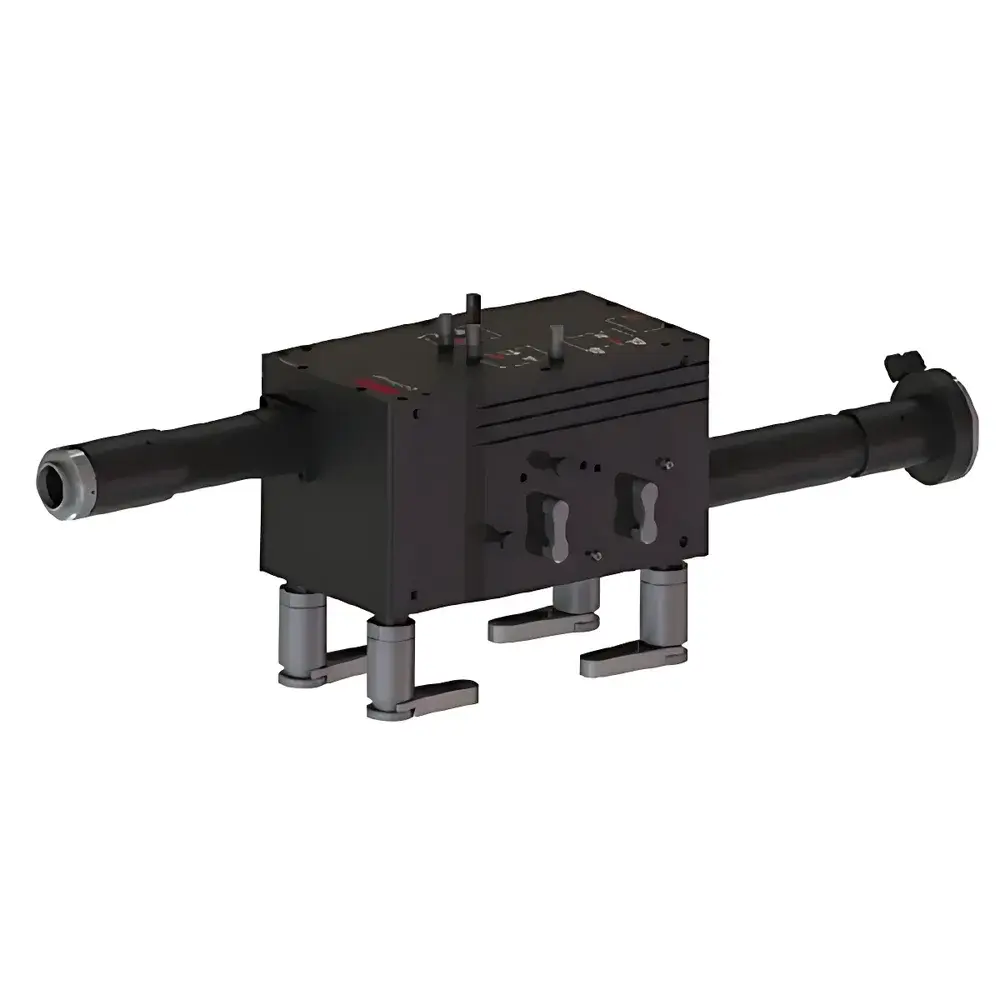
Airy QuadImage Imaging Separator
| Brand | Airy |
|---|---|
| Origin | Beijing, China |
| Manufacturer Type | Authorized Distributor |
| Origin Category | Domestic (China) |
| Model | QuadImage |
| Pricing | Available Upon Request |
Overview
The Airy QuadImage Imaging Separator is a high-precision optical beam-splitting system engineered for simultaneous multi-channel fluorescence microscopy of live cells. It operates on the principle of dichroic spectral separation—utilizing precisely aligned, hard-coated interference filters and precision-mounted mirror assemblies—to route four distinct emission wavelength bands to corresponding detection paths without active electronic modulation or moving parts. This passive architecture eliminates timing jitter, mechanical latency, and photobleaching artifacts associated with filter wheels or tunable acousto-optic devices, enabling true real-time, synchronized acquisition across up to four fluorophores. Designed specifically for confocal, spinning-disk, and widefield microscopes equipped with multi-camera or multi-port output configurations, the QuadImage ensures minimal photon loss (<8% total transmission loss per channel, typical) and sub-pixel spatial registration stability over extended time-lapse experiments (≥12 hours at 25 °C ambient).
Key Features
- Passive, all-optical design with zero electronic control requirements—no drivers, no firmware, no calibration routines
- Four-way spectral separation with user-selectable dichroic filter sets (standard options: 440/525/595/670 nm center wavelengths; custom configurations available)
- Mechanically rigid monolithic aluminum housing with kinematic mounting interface compatible with standard microscope side ports and camera adapters (C-mount, F-mount, M42)
- Sub-0.1 pixel inter-channel registration accuracy verified via NIST-traceable USAF 1951 resolution target and centroid-based cross-correlation analysis
- Optical path length matching within ±15 µm across all four channels to preserve temporal coherence in lifetime-sensitive modalities (e.g., FLIM, FRET)
- Integrated thermal stabilization platform minimizing drift-induced misalignment (<0.3 µm/h positional shift at steady state)
Sample Compatibility & Compliance
The QuadImage Imaging Separator supports standard live-cell imaging workflows using common fluorescent probes—including GFP/RFP/mCherry derivatives, SiR dyes, HaloTag ligands, and quantum dots—with excitation compatibility across UV–NIR (350–900 nm). Its optical train is sealed against dust and humidity (IP52 rating), and all internal optics meet ISO 10110 surface quality standards (scratch-dig 20–10). The system complies with IEC 61000-6-3 (EMC emission limits) and IEC 61000-6-2 (immunity for laboratory environments). While not a medical device, its mechanical and optical performance aligns with GLP-aligned documentation practices required for publication-grade cell biology studies (e.g., adhering to Nature Methods reporting guidelines for multiplexed imaging).
Software & Data Management
The QuadImage requires no proprietary software—its passive operation enables native integration with all major acquisition platforms, including Micro-Manager (v2.0+), MetaMorph (v7.12+), NIS-Elements (v5.0+), and ZEN Blue (v3.4+). Synchronized multi-camera triggering is achieved via TTL-compatible hardware sync ports (BNC inputs/outputs). Metadata embedding (channel assignment, filter IDs, exposure timestamps) follows OME-TIFF v0.4 specification, ensuring compatibility with open-source analysis pipelines such as Fiji/ImageJ, Python-based napari, and MATLAB Bioinformatics Toolbox. Audit trails for hardware configuration changes are maintained externally through microscope control software; no FDA 21 CFR Part 11 compliance is claimed, as the device does not store or process regulated data.
Applications
- Long-term dual- or quad-color tracking of organelle dynamics (e.g., mitochondria–lysosome contacts, ER–Golgi trafficking)
- Quantitative co-localization analysis in primary neurons and stem-cell-derived organoids under physiological CO2/temperature control
- FRET-based conformational sensing with ratiometric donor–acceptor pairs acquired simultaneously
- High-content screening of subcellular phenotypes in response to pharmacological perturbations
- Correlative light–electron microscopy (CLEM) sample mapping where precise spatial correspondence between fluorescence channels is mandatory
FAQ
Does the QuadImage require power or computer connectivity?
No—it is entirely passive and contains no electronics, motors, or powered components.
Can I retrofit it onto an existing inverted microscope with dual-camera output?
Yes—provided your microscope has either a trinocular port with ≥40 mm clear aperture or a side port with C-mount thread and ≥32 mm field diameter.
What is the maximum NA supported at the input port?
The system maintains diffraction-limited performance up to NA 1.45 with oil-immersion objectives when used with appropriate relay optics.
Is custom filter set configuration available?
Yes—Airy offers factory-aligned custom dichroic and emission filter combinations upon request, with full spectral transmission reports provided.
How is alignment verified after installation?
A collimated HeNe laser (632.8 nm) and a CMOS alignment target are included for initial coarse alignment; final sub-pixel registration is validated using fluorescent bead stacks and cross-channel centroid analysis in acquisition software.




