
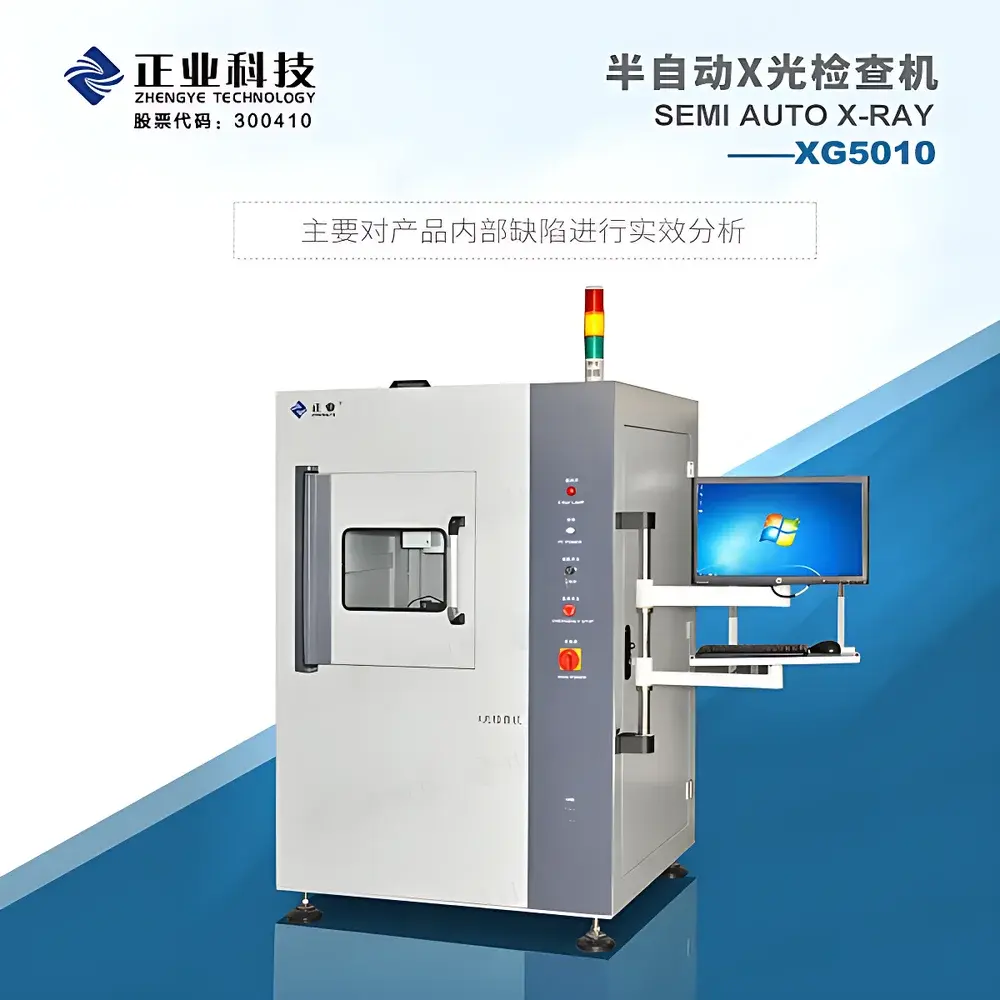
Aisida XG Series Industrial X-ray Inspection System
| Brand | Aisida |
|---|---|
| Origin | Guangdong, China |
| Manufacturer Type | Authorized Distributor |
| Origin Category | Domestic (China) |
| Model | XG |
| Pricing | Upon Request |
Overview
The Aisida XG Series Industrial X-ray Inspection System is a high-resolution, real-time radiographic imaging platform engineered for non-destructive internal defect analysis in precision manufacturing environments. Based on the fundamental principle of X-ray transmission—where differential attenuation of X-ray photons through materials of varying density and atomic composition generates contrast in the resulting projection image—the system delivers quantitative structural insight without physical contact or sample preparation. Designed specifically for high-velocity inline and offline quality assurance workflows, it is widely deployed in lithium-ion battery production lines to detect electrode misalignment, weld voids, foreign metallic particles, separator wrinkles, anode/cathode delamination, and sealing defects. The system integrates a microfocus X-ray source with a high-sensitivity flat-panel detector or image intensifier, enabling sub-50 µm spatial resolution under optimized geometric magnification conditions. Its architecture supports both manual operator-guided inspection and automated pass/fail decision-making within regulated production settings.
Key Features
- 2.5D Metrology Engine: Performs calibrated geometric measurements—including linear distance, circle diameter, concentricity of nested circles, and point-to-center offset—with pixel-level sub-pixel interpolation and edge-detection-based contour fitting.
- CNC Path Programming: Stores and recalls multi-axis motion sequences (X/Y/Z) for repeatable positioning; supports batch-mode execution of pre-defined inspection routines across small-lot production runs.
- Intuitive Navigation Interface: Features a real-time overview map with synchronized crosshair cursor; clicking any region in the navigation window triggers servo-controlled repositioning to the corresponding coordinate on the detector plane.
- Triaxial Motion System: X-ray tube and detector move independently along orthogonal X, Y, and Z axes via precision ground ball screws and synchronous belt-driven stepper motors—ensuring smooth, backlash-free translation with programmable velocity profiles.
- Fixed Sample Stage: Rigid, vibration-damped platform accommodates parts up to 300 mm × 300 mm; optional custom fixtures available for battery pouch, cylindrical, or prismatic cell mounting.
Sample Compatibility & Compliance
The XG system is validated for use with standard commercial lithium-ion battery formats (18650, 21700, pouch, and prismatic cells), as well as electronic assemblies, ceramic capacitors, and hermetically sealed relays. All mechanical and radiation safety components comply with GB/T 18871–2002 (Chinese national standard for ionizing radiation protection) and IEC 61000-6-4 (EMC emission requirements). While not certified to ISO 13485 or FDA 21 CFR Part 11 out-of-the-box, the system’s software architecture supports audit trail logging, user access levels, and electronic signature integration when deployed in GLP/GMP-aligned environments upon customer-specific configuration.
Software & Data Management
The proprietary Aisida VisionInsight™ software provides real-time image acquisition, dynamic contrast enhancement (DCE), noise suppression, and threshold-based binary segmentation. It natively supports DICOM, TIFF, PNG, and BMP export formats, with metadata embedding (exposure time, kV/mA, magnification factor, timestamp, operator ID). Measurement data is logged in CSV/Excel-compatible format with traceable calibration references. Optional modules include statistical process control (SPC) dashboards, defect clustering analytics, and API-based integration with MES or SCADA platforms via RESTful web services.
Applications
- Lithium-ion battery quality control: detection of internal short-circuit precursors, tab weld integrity, jelly-roll winding uniformity, and electrolyte fill level verification.
- PCB and semiconductor package inspection: identification of voids in solder joints, wire bond lift-off, die attach delamination, and leadframe misalignment.
- Automotive electronics: validation of encapsulation integrity in power modules, sensor housings, and connector assemblies.
- Medical device manufacturing: verification of component placement in implantable pulse generators and sterilization indicator packaging.
- Research & development labs: comparative failure mode analysis (FMA) across thermal cycling or mechanical abuse test samples.
FAQ
What is the typical spatial resolution achievable with the XG system?
Resolution depends on geometric magnification, focal spot size, and detector pixel pitch; under standard 5× magnification with a 5-µm focal spot source and 100-µm pixel detector, effective resolution is approximately 20–30 µm.
Does the system support automatic defect classification?
Yes—VisionInsight™ includes rule-based classification logic (e.g., “void area > 0.1 mm² → reject”) and supports supervised machine learning model deployment via optional AI inference module.
Is radiation shielding included in the base configuration?
Yes—the enclosure meets Class I cabinet requirements per GBZ 138–2019, incorporating ≥2 mm lead-equivalent acrylic panels and interlocked door safety circuits.
Can the XG system be integrated into an existing production line conveyor?
Yes—customized tunnel-style configurations with upstream/downstream photoelectric sensors and PLC-compatible I/O are available upon engineering review.
What calibration standards are supported?
NIST-traceable step wedges, line-pair gauges, and stainless-steel ball grids are recommended for periodic verification of contrast sensitivity, spatial resolution, and measurement accuracy.




