
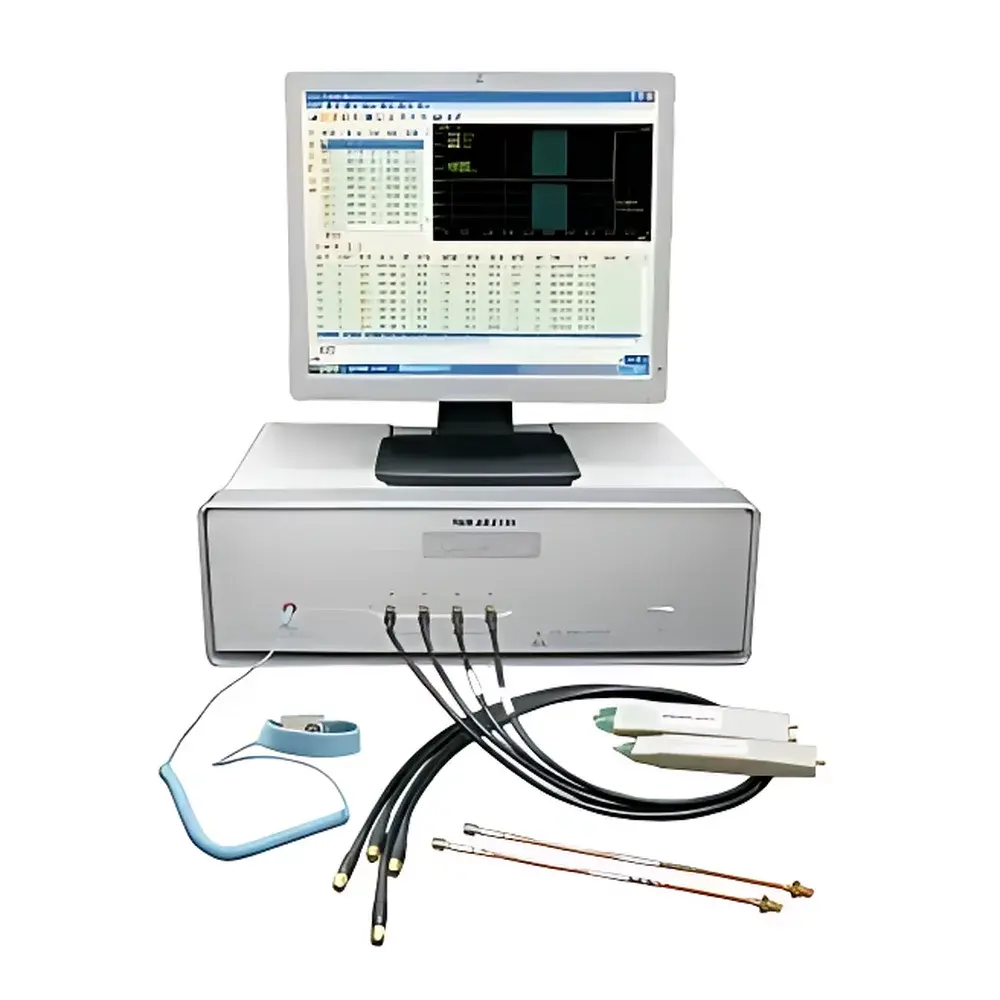
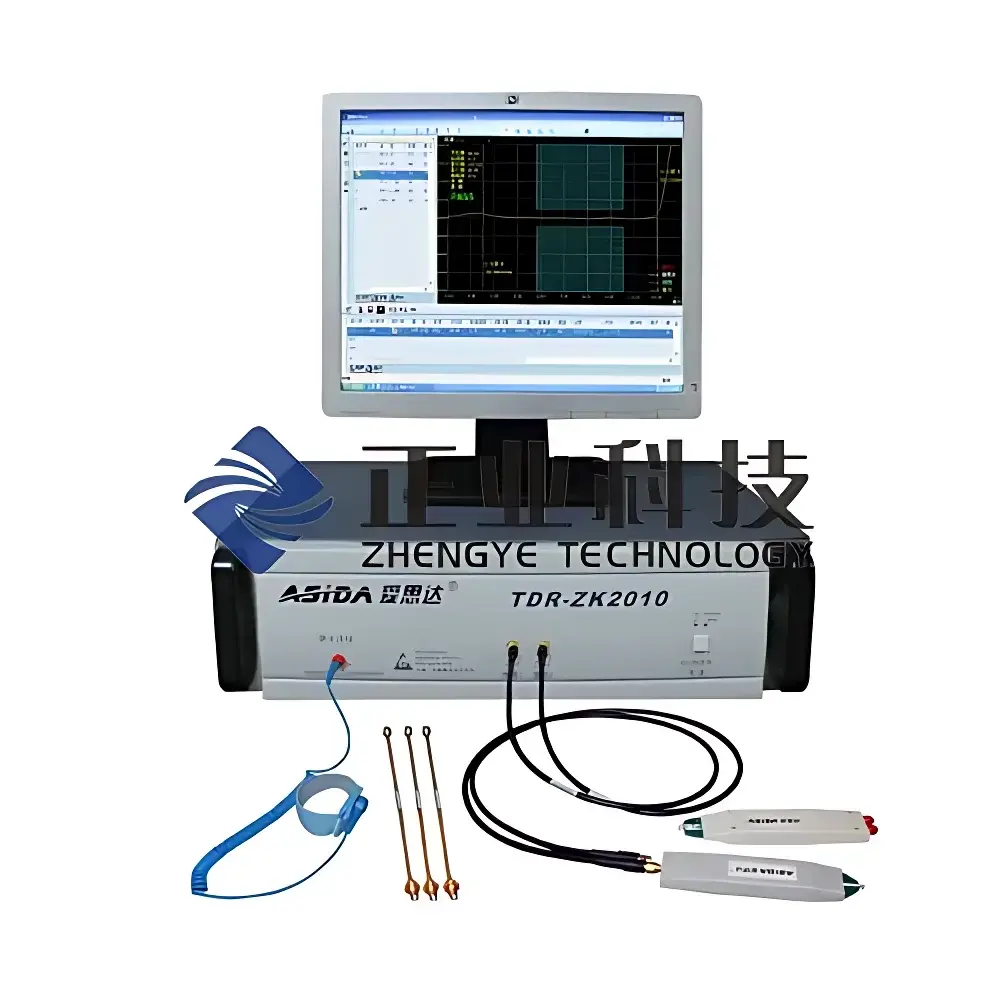
Aisida ZK2130 High-Frequency TDR Impedance Analyzer for PCB and Cable Characterization
| Brand | Aisida |
|---|---|
| Model | ZK2130 |
| Origin | Guangdong, China |
| Testing Principle | Time-Domain Reflectometry (TDR) |
| Impedance Range | 20–150 Ω |
| Measurement Accuracy | ±1% at 50 Ω |
| Maximum Test Length | 2 m |
| Horizontal Resolution | 0.2 mm |
| Vertical Resolution | 0.05 Ω |
| Bandwidth | 3 GHz |
| Supported Configurations | Single-ended & Differential Impedance |
| Channel Options | 2-channel or 4-channel |
| Compliance | IPC-TM-650, IPC-2141 |
| Data Analysis | Integrated SPC module with statistical reporting |
| Operating System | Windows-based GUI |
Overview
The Aisida ZK2130 High-Frequency TDR Impedance Analyzer is an engineered solution for precision time-domain reflectometry (TDR) measurements in printed circuit board (PCB) fabrication and high-frequency cable manufacturing environments. Leveraging a 3 GHz bandwidth analog front-end and calibrated step-pulse generation, the ZK2130 captures signal reflections along transmission lines to compute characteristic impedance profiles with sub-millimeter spatial resolution. Unlike conventional LCR meters or vector network analyzers (VNAs), the ZK2130 applies true TDR methodology—injecting a fast-rise-time step signal and analyzing reflected waveform morphology—to derive localized impedance variations, discontinuities, and fault locations without requiring RF calibration standards or complex de-embedding. Its design targets production-line deployment where repeatability, traceability, and compliance with industry-defined test methodologies are critical. The instrument operates under deterministic real-time acquisition architecture, ensuring consistent timing integrity across thousands of automated test cycles per shift.
Key Features
- Automated batch testing workflow with programmable sequence execution and pass/fail thresholding per DUT
- Windows-native graphical user interface with intuitive test setup wizard, waveform overlay comparison, and multi-cursor measurement tools
- Dual-mode impedance analysis supporting both single-ended (SE) and differential (DIFF) configurations with independent reference plane compensation
- Scalable channel architecture: configurable for 2-channel or 4-channel parallel testing to reduce throughput time in high-volume PCB panel inspection
- Embedded test file editor enabling rapid definition of impedance zones, length markers, and tolerance bands without external scripting
- Real-time waveform display synchronized with impedance profile rendering, including reflection coefficient (Γ) and effective dielectric constant (εeff) derivation
- Comprehensive data logging with timestamped CSV export, XML metadata tagging, and native support for audit-ready report generation
- Integrated Statistical Process Control (SPC) engine compliant with ANSI/ASQ B18.1 and ISO 7870-2, providing X-bar/R charts, Cp/Cpk indices, and outlier detection alerts
Sample Compatibility & Compliance
The ZK2130 accommodates rigid and flexible PCB substrates (FR-4, polyimide, Rogers laminates), microstrip/stripline traces, coaxial cables (RG-174, SMA-terminated), twisted-pair assemblies, and automotive LVDS harnesses. Fixturing supports standard edge-mount probes, spring-pin fixtures, and custom-designed load boards. All measurement procedures adhere strictly to IPC-TM-650 Section 2.5.5.7 (TDR-based impedance verification) and IPC-2141A (design guidelines for controlled impedance). Instrument firmware includes built-in validation routines traceable to NIST-traceable reference standards, and raw waveform data files retain full acquisition parameters for third-party reanalysis. For regulated industries—including medical electronics and aerospace avionics—the system supports optional 21 CFR Part 11-compliant electronic signatures and audit trail logging when deployed with validated Windows OS configurations.
Software & Data Management
The ZK2130 runs on a dedicated Windows 10 IoT Enterprise image with locked-down service configuration and signed driver enforcement. Its proprietary software suite provides version-controlled test method templates, role-based access permissions (operator, engineer, administrator), and encrypted local database storage using SQLite with WAL journaling. Export formats include PDF reports with embedded waveforms, CSV time-series data, and industry-standard .tdr binary files compatible with third-party simulation tools (e.g., HyperLynx, ADS). Data archival follows ISO/IEC 17025 requirements for retention duration, checksum validation, and media migration protocols. Optional integration with MES/ERP systems is available via RESTful API endpoints supporting JSON payloads and OAuth 2.0 authentication.
Applications
Primary use cases span PCB process control (impedance validation pre- and post-plating, solder mask effect quantification), high-speed interconnect qualification (USB 3.2 Gen2x2, PCIe 5.0 channel modeling), cable assembly certification (5G fronthaul, automotive radar harnesses), and failure analysis (open/short location, impedance mismatch mapping, connector transition loss assessment). In R&D labs, the ZK2130 serves as a correlation tool between electromagnetic simulation outputs and physical prototypes, particularly for validating field solver accuracy in complex stack-ups. Its ability to resolve impedance deviations within 0.05 Ω over 0.2 mm intervals enables root-cause analysis of etch variation, copper thickness non-uniformity, and prepreg resin flow anomalies.
FAQ
What is the minimum measurable impedance discontinuity length the ZK2130 can resolve?
The system achieves 0.2 mm horizontal resolution at full 3 GHz bandwidth, corresponding to ~20 mm electrical length in FR-4 at 1 GHz; actual resolvability depends on rise time of the incident step and dielectric properties.
Does the ZK2130 support calibration against traceable standards?
Yes—factory calibration includes verification against NIST-traceable TDR reference standards (e.g., Tektronix 067-1686-00), with certificate of conformance supplied with each unit.
Can test methods be exported and shared across multiple ZK2130 units?
Test configuration files (.zkp) are portable across identical firmware versions and include all parameter definitions, zone markers, and pass/fail logic.
Is GLP/GMP-compliant operation supported out-of-the-box?
Basic audit trail functionality is included; full 21 CFR Part 11 compliance requires optional software license and validated Windows environment configuration per customer SOPs.
How does the ZK2130 handle impedance measurement in differential pairs with asymmetric routing?
The differential mode algorithm computes odd-mode impedance while compensating for intra-pair skew and common-mode coupling effects through adaptive cross-talk correction during waveform decomposition.



