
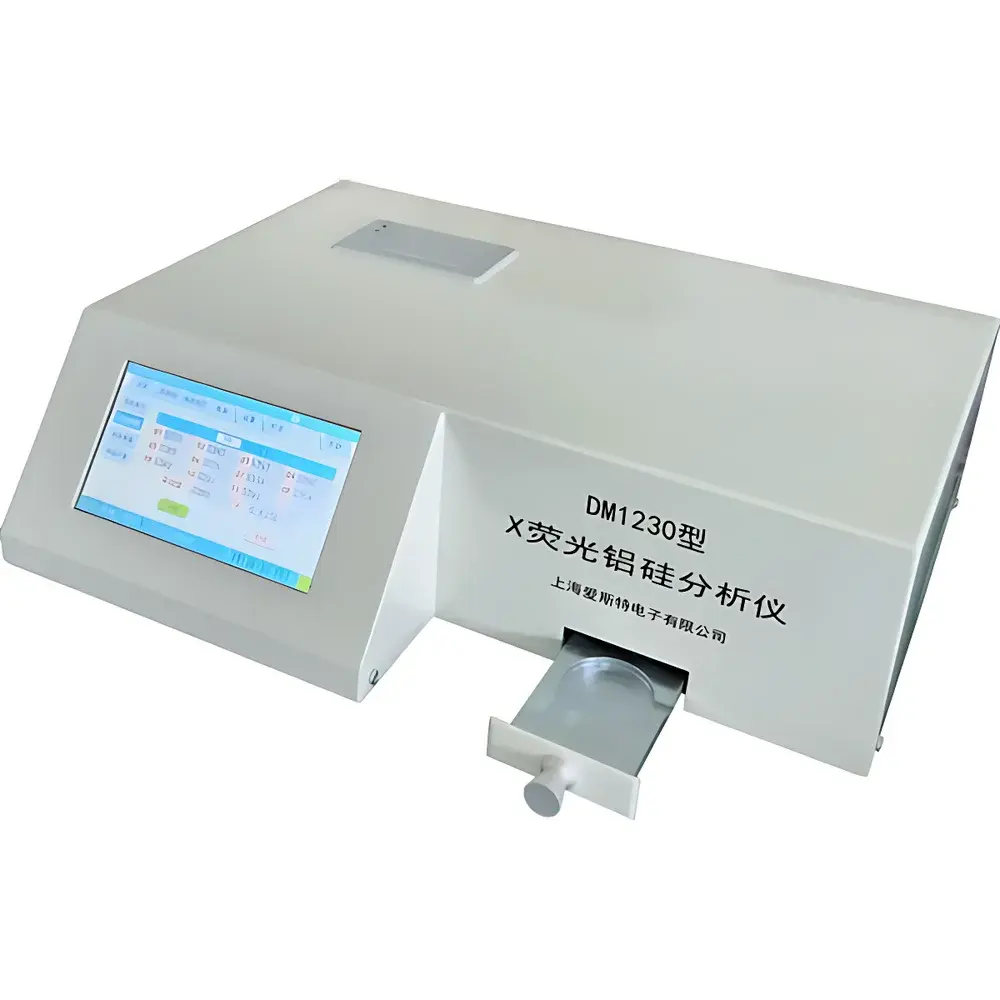
Aist DM1230 Energy Dispersive X-Ray Fluorescence (EDXRF) Analyzer for Al₂O₃ and SiO₂ in Cement Raw Materials
| Brand | Aist / ST |
|---|---|
| Origin | Shanghai, China |
| Manufacturer Type | Authorized Distributor |
| Product Origin | Domestic (China) |
| Model | DM1230 |
| Configuration | Benchtop |
| Industry Application | Cement, Energy & Chemicals |
| Elemental Analysis Range | Al₂O₃, SiO₂ |
| Concentration Range | 0.01%–100% (w/w) |
| Energy Resolution | ≤18% at Mn Kα (5.9 keV) |
| Repeatability | σ(Al₂O₃) ≤ 0.07%, σ(SiO₂) ≤ 0.07% (n=11, cement raw meal) |
| Detector | Thin-Be-window gas-flow proportional counter |
| X-ray Source | Low-power microfocus tube (≤10 kV, ≤0.5 mA, ≤5 W) |
| Measurement Time | 100–300 s (user-selectable |
| default | 300 s) |
| Compliance | GB/T 176–2017, JC/T 1085–2008, JB/T 11145–2011 |
Overview
The Aist DM1230 is a purpose-built benchtop energy dispersive X-ray fluorescence (EDXRF) spectrometer engineered for rapid, non-destructive quantitative analysis of aluminum oxide (Al₂O₃) and silicon dioxide (SiO₂) in cement raw materials, clinker, and finished cement. Unlike general-purpose multi-element EDXRF systems, the DM1230 employs a dedicated optical architecture optimized for high-fidelity resolution of adjacent light elements—specifically Al (Kα = 1.486 keV) and Si (Kα = 1.739 keV)—within complex silicate matrices. Its measurement principle relies on primary X-ray excitation of sample atoms, followed by detection of characteristic fluorescent photons using a low-background, thin-beryllium-window gas-flow proportional counter. Signal discrimination is enhanced by proprietary spectral deconvolution algorithms, secondary filter selection, and a downward-beam geometry that isolates the detector from particulate contamination—a critical design feature for routine analysis of abrasive, fine-powder cement feedstocks. The instrument meets the metrological requirements of GB/T 176–2017 (“Chemical Analysis Methods for Cement”), ensuring traceability to national reference standards used across China’s cement industry.
Key Features
- Optimized light-element performance: Engineered optical path and thin-Be detector window maximize peak-to-background ratio for Al and Si, enabling accurate quantification even at sub-1% concentrations in heterogeneous raw meals.
- Downward irradiation geometry: Eliminates risk of powder deposition on detector window or collimator, significantly reducing maintenance intervals and improving long-term signal stability.
- High-reliability electronics: 2021-generation hardware features FPGA/CPLD-based multi-channel pulse height analyzer with digital variable-gain amplification, replacing legacy single-channel analog circuitry to minimize drift and thermal instability.
- Intuitive human-machine interface: 7-inch color capacitive touchscreen replaces mechanical keys and monochrome displays, supporting guided sample loading, real-time spectrum preview, and one-touch analysis initiation.
- Robust calibration framework: Implements quadratic intensity-to-concentration regression (C = D + E·IC + F·IC²), validated against 11 certified cement raw meal reference materials; correlation coefficients exceed γ = 0.991 for Al₂O₃ and γ = 0.998 for SiO₂.
- Low operational overhead: No vacuum pumps, helium purge, or chemical reagents required; power consumption <50 W; radiation shielding complies with national exemption-level safety regulations (GBZ 188–2014).
Sample Compatibility & Compliance
The DM1230 accepts pressed pellets (typically 32 mm diameter, ≥10 t pressure) prepared from dried, homogenized powders—including cement raw meal, limestone, clay, fly ash, slag, and kiln feed. Liquid and slurry samples may be analyzed after evaporation and pelletization. It is explicitly designed for compliance with Chinese national and industrial standards governing cement quality control: GB/T 176–2017 (repeatability limits: ±0.20% for both Al₂O₃ and SiO₂), JC/T 1085–2008 (performance criteria for XRF analyzers in cement plants), and JB/T 11145–2011 (general specifications for XRF instrumentation). While not pre-certified to ISO/IEC 17025 or ASTM C114, its documented repeatability (3σ ≤ 0.07%), linearity, and inter-laboratory consistency support internal method validation under GLP-aligned QA/QC protocols.
Software & Data Management
Embedded firmware provides full spectral acquisition, background subtraction, peak integration, and concentration calculation without external PC dependency. All measurement data—including raw spectra, net intensities, calibration coefficients, and statistical summaries—are stored internally with timestamping and user ID tagging. Storage capacity exceeds 10,000 analyses; data retention persists through power loss. Export is supported via USB 2.0 to CSV or proprietary binary format for traceability auditing. Optional RS-232 or Ethernet interfaces enable integration into plant-wide automation systems (e.g., “Analyzer → PLC → Belt Scale” closed-loop raw mix control), delivering real-time Al₂O₃/SiO₂ values to DCS platforms. Audit trails record operator actions, calibration events, and system diagnostics—supporting basic 21 CFR Part 11 readiness when deployed with controlled access and electronic signature workflows.
Applications
Primary deployment is in cement manufacturing for online rate control (Lime Saturation Factor, Silica Modulus, Alumina Modulus) by delivering Al₂O₃ and SiO₂ results within 5 minutes per sample—complementing existing CaO/Fe₂O₃ measurements from Aist calcium-iron analyzers using the same pellet. Secondary applications include coal ash analysis in thermal power plants, alumina content verification in bauxite processing, silica monitoring in refractory brick production, and elemental screening of geological core samples. Its ruggedized design and low power demand also suit mobile labs and field-deployed QA units in mining and metallurgical operations where laboratory-grade precision is required outside centralized facilities.
FAQ
Does the DM1230 require vacuum or helium purging for light-element analysis?
No. The thin-Be detector window and optimized air-path geometry enable stable Al/Si detection without vacuum or inert gas environments.
Can it analyze liquid or slurry samples directly?
Not directly. Liquids must be evaporated to dryness and homogenized prior to pelletization; slurry solids content must exceed 85% w/w for reproducible pressing.
What reference materials are recommended for initial calibration?
Certified cement raw meal standards compliant with GB/T 176–2017, such as those issued by CNAS-accredited providers (e.g., NIM CRM 8101 series), are strongly advised.
Is remote diagnostics or firmware update supported?
Firmware updates are performed via USB drive; remote diagnostic access is not enabled by default but can be configured under secured network policies upon request.
How often must the instrument be recalibrated?
Initial calibration remains valid for ≥6 months under stable environmental conditions (±2°C, <60% RH); quarterly verification using control samples is recommended per GB/T 176–2017 Annex B.




