
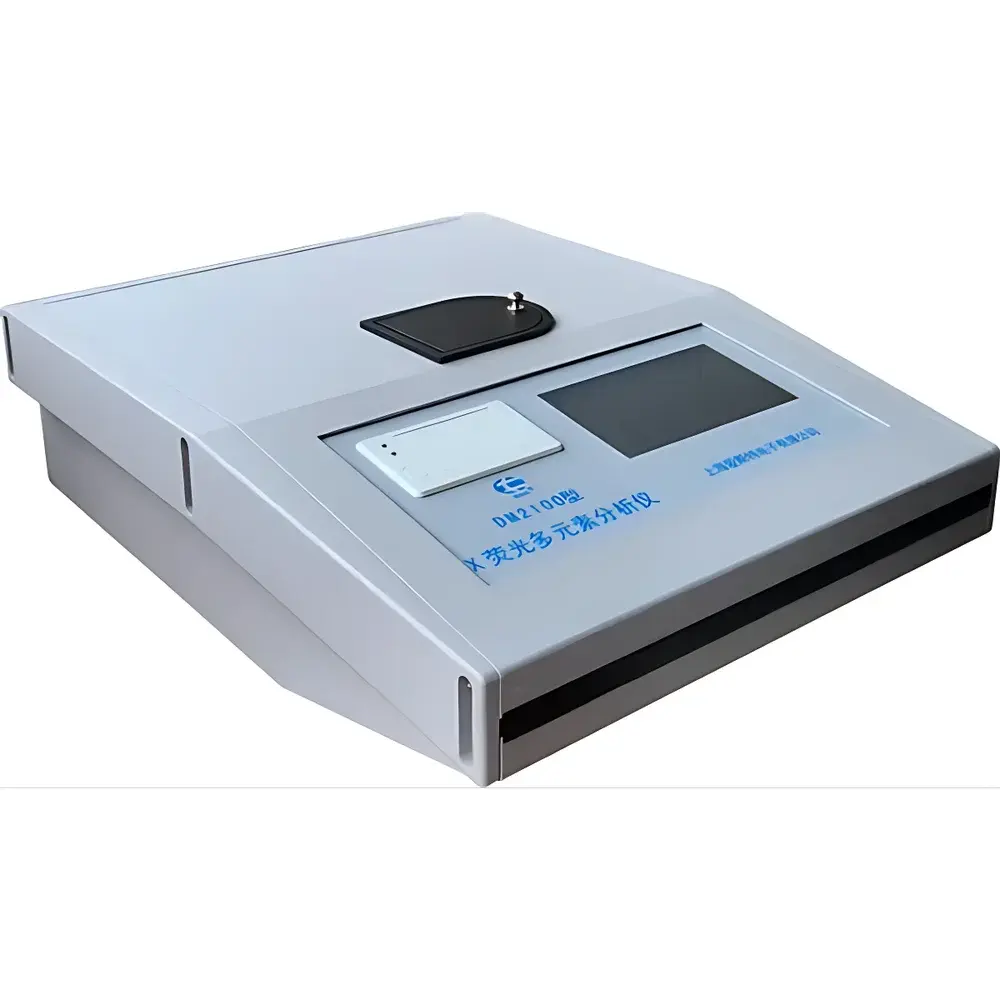
Aist DM2100 Energy Dispersive X-Ray Fluorescence Spectrometer
| Brand | Aist / ST |
|---|---|
| Origin | Shanghai, China |
| Model | DM2100 |
| Form Factor | Benchtop |
| Industry Application | Cement & Energy Chemicals |
| Elemental Range | Si, Al, S, Ca, Fe |
| Concentration Range | 0.01% – 99.99% |
| Energy Resolution | 16% (at Mn Kα) |
| Repeatability (RSD) | ≤0.20% |
| Detector | Thin-Be-window Proportional Counter |
| X-ray Tube | ≤10 kV, ≤0.5 mA, ≤5 W |
| Measurement Time | 1–999 s (default 310 s) |
| Compliance | GB/T 176–2017, JC/T 1085–2008, JB/T 11145–2011 |
| Radiation Status | Exempted per National Radiation Safety Authority (First EDXRF instrument in China granted exemption) |
Overview
The Aist DM2100 Energy Dispersive X-Ray Fluorescence (EDXRF) Spectrometer is a benchtop elemental analyzer engineered for high-precision, non-destructive quantitative analysis of major oxides—Al2O3, SiO2, SO3, CaO, and Fe2O3—in cement raw meal, clinker, finished cement, and related industrial materials. It operates on the fundamental principle of EDXRF: primary X-rays from a low-power (<5 W) micro-focus tube excite characteristic secondary (fluorescent) X-rays from sample atoms; emitted photons are energy-resolved by a thin-beryllium-window proportional counter and processed via digital pulse-height analysis. Unlike wavelength-dispersive systems, the DM2100 achieves rapid multi-element quantification without vacuum or helium purge, leveraging proprietary spectral deconvolution algorithms to resolve overlapping peaks of adjacent light elements—particularly critical for distinguishing Al Kα (1.486 keV) from Si Kα (1.739 keV) in cement matrices. Its design conforms rigorously to GB/T 176–2017 (Cement Chemical Analysis Methods), JC/T 1085–2008 (XRF Analyzers for Cement), and JB/T 11145–2011 (General Specifications for XRF Spectrometers), and it holds formal radiation exemption certification from China’s national regulatory authority—validating its inherently safe, low-dose operational profile.
Key Features
- Light-element resolution capability: Proprietary spectral deconvolution technology enables accurate separation and quantification of Al and Si—elements with closely spaced Kα lines—without requiring cryogenic detectors or vacuum environments.
- Robust hardware architecture: 2021-generation platform features an ARM-based embedded CPU, surface-mount PCB design, FPGA/CPLD-based multi-channel pulse height analyzer, and variable-gain digital amplification—eliminating legacy instability issues such as system lockups and drift.
- Intuitive human-machine interface: 7-inch full-color capacitive touchscreen replaces mechanical keypad and monochrome display, supporting gesture navigation, real-time spectrum visualization, and context-sensitive operation prompts.
- Non-invasive, reagent-free analysis: Solid, powder, or pressed-pellet samples require no digestion, combustion, or chemical treatment; measurement is contactless, preserving sample integrity and eliminating hazardous waste streams.
- Long-term stability assurance: Integrated gain stabilization, ratio correction, and background drift compensation ensure calibration retention over extended periods—critical for unattended operation in continuous quality control environments.
- Regulatory-compliant safety: Certified radiation-exempt under national safety regulations; no shielding enclosure or operator licensing required—reducing facility integration complexity and operational overhead.
Sample Compatibility & Compliance
The DM2100 accommodates powdered, pelletized, or solid bulk samples up to 40 mm in diameter and 15 mm thick. Sample preparation follows standardized protocols defined in GB/T 176–2017: grinding to ≤75 µm particle size, homogenization, and hydraulic pressing at ≥20 MPa into 32-mm-diameter pellets. The instrument meets all performance criteria specified in JC/T 1085–2008 for cement-specific XRF analyzers—including repeatability limits (e.g., RSD ≤0.20% for Al2O3), linearity (r ≥0.99 for all five oxides), and measurement uncertainty budgets traceable to certified reference materials (CRMs). Its analytical output supports GLP-aligned documentation workflows, with audit-trail-capable data logging (time-stamped results, calibration history, operator ID) compatible with FDA 21 CFR Part 11–ready laboratory information management systems (LIMS) when integrated via RS-232 or USB.
Software & Data Management
Firmware v4.2 includes embedded analysis software with preconfigured calibration models for cement raw meal, clinker, and blended cement. Quantitative analysis employs fundamental parameter (FP)-assisted empirical calibration using quadratic regression (C = D + E·IC + F·IC2), where IC is corrected intensity derived from raw pulse counts via background subtraction and matrix normalization. Calibration coefficients are stored per element and validated against NIST-traceable CRMs (e.g., GBW 03121–GBW 03131 series). Data storage capacity exceeds 10,000 measurements with automatic timestamping, power-failure resilience, and export to CSV/Excel via USB flash drive. Optional PC software enables remote monitoring, statistical process control (SPC) charting (X̄-R, CUSUM), rate-value calculation (KH, SM, IM), and automated pass/fail reporting aligned with internal QC specifications.
Applications
Primary deployment is in cement manufacturing process control: real-time monitoring of raw meal composition to adjust limestone/clay/pyrite feed ratios; clinker quality assessment via CaO/Fe2O3 ratio tracking; and final cement certification through SO3 content verification per ISO 9001 and ASTM C150. Secondary applications include coal ash analysis in thermal power plants (SiO2/Al2O3/Fe2O3), metallurgical slag characterization (CaO/SiO2/MgO), and geological exploration core scanning (Al/Si/Ca/Fe ratios in silicate rocks). The instrument supports closed-loop integration with industrial automation systems—outputting analog 4–20 mA signals or Modbus TCP packets to feed mill controllers or DCS platforms for automated raw mix adjustment.
FAQ
Does the DM2100 require vacuum or helium purging for light-element analysis?
No. Its thin-Be-window proportional detector and optimized air-path geometry enable reliable detection of Si and Al without vacuum or gas flush—reducing maintenance and operational cost.
Can the instrument be calibrated using customer-specific standards?
Yes. The calibration module accepts user-defined CRM sets; quadratic regression coefficients are auto-generated and validated against correlation thresholds (r ≥0.990 required for acceptance).
What is the typical measurement time for routine cement analysis?
310 seconds is recommended per GB/T 176–2017 for optimal precision; shorter durations (60–120 s) are configurable for screening, with documented trade-offs in RSD.
Is firmware update supported in-field?
Yes. Updates are delivered via USB stick; version history and rollback capability are retained in non-volatile memory.
How is data integrity ensured during power interruption?
All measurement records and calibration parameters are written to protected EEPROM with atomic write protocols—zero data loss observed in >10,000 simulated brownout events.
Does the system support 21 CFR Part 11 compliance?
The embedded software provides electronic signature fields, audit trail export, and role-based access control; full Part 11 validation requires site-specific IQ/OQ/PQ documentation performed by qualified personnel.




