
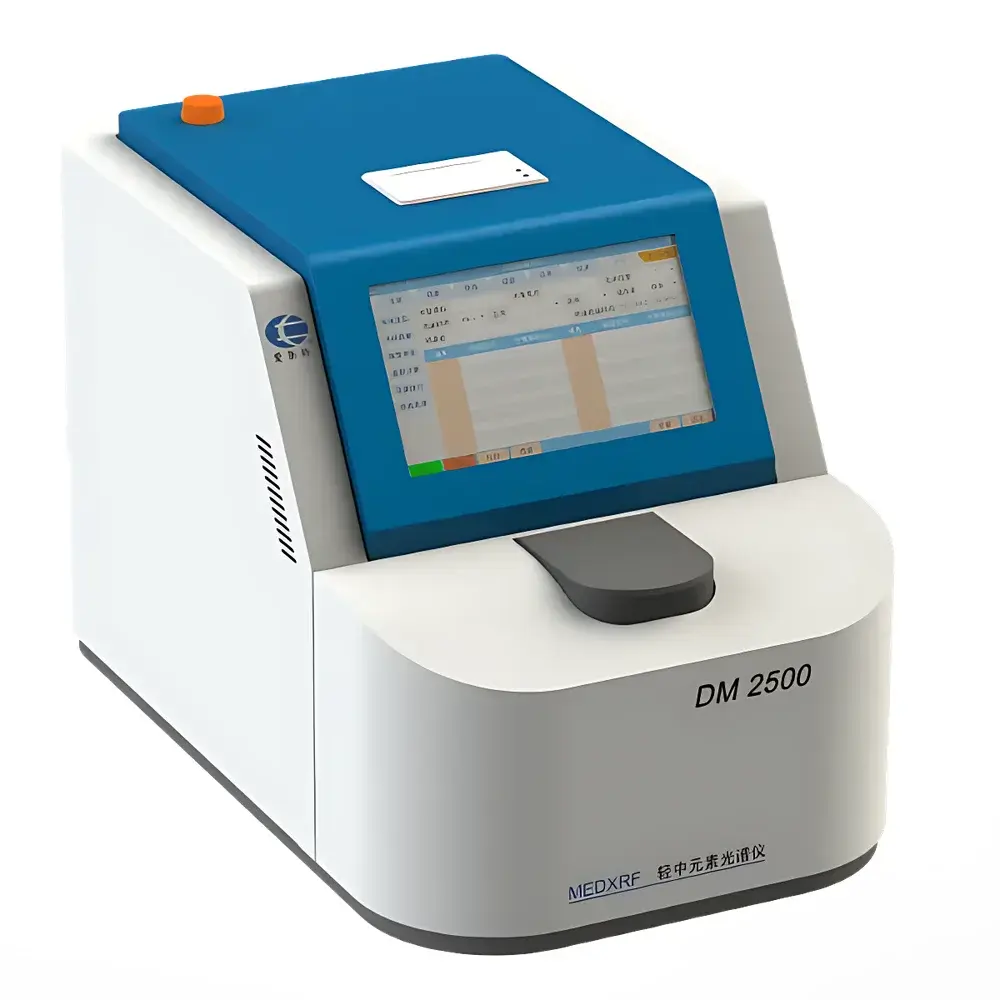
Aist DM2500 MMEDXRF Light-to-Mid-Element Spectrometer
| Brand | Aist (ST) |
|---|---|
| Model | DM2500 |
| Element Range | B (Z=5) to Zn (Z=30) |
| Detection Limit | 1 ppm |
| Quantification Range | 1 ppm – 99.99% |
| Energy Resolution | <129 eV (Mn Kα) |
| Repeatability | ≤0.3 ppm (S, typical) |
| Detector | Silicon Drift Detector (SDD), 20 mm² active area, AP3.3 polymer window |
| X-ray Source | 50 W microfocus Ag-target tube with thin Be window, optimized kV/mA/target combination |
| Excitation Method | Multiple Monochromatic Excitation (MMEDXRF) using Logarithmic Spiral Doubly Curved Crystal (LSDCC) and Ge secondary target |
| Sample Geometry | Downward-beam configuration with sample rotation |
| Compliance | GB/T 176–2017, JC/T 1085–2008, JB/T 11145–2011 |
| Form Factor | Benchtop |
| Regulatory Status | Radiation-exempt design per national safety standards |
Overview
The Aist DM2500 MMEDXRF Light-to-Mid-Element Spectrometer is a benchtop energy dispersive X-ray fluorescence (EDXRF) instrument engineered for high-fidelity quantitative analysis of elements from boron (B, Z=5) through zinc (Zn, Z=30). Unlike conventional EDXRF systems, the DM2500 implements Multiple Monochromatic Excitation Energy Dispersive XRF (MMEDXRF)—a proprietary analytical architecture that combines two physically distinct monochromatic excitation pathways within a single optical train. For light elements (B–Cl), excitation is achieved via a log-spiral doubly curved crystal (LSDCC) made of germanium, which delivers point-to-point focusing and high-efficiency Bragg diffraction of Ag Kα radiation. For mid-Z elements (K–Zn), the same Ge crystal serves as a secondary target, generating characteristic Ge K-lines with optimal energy match for efficient ionization. This dual-path monochromatization reduces continuum background by up to one order of magnitude compared to polychromatic excitation, thereby enhancing peak-to-background ratios—particularly critical for low-fluorescence-yield light elements. The system employs a downward-beam geometry with motorized sample rotation and optional vacuum or He-purge atmosphere control, ensuring robust performance on pressed powder pellets, fused beads, and solid blocks without sample contact or destruction.
Key Features
- Multiple monochromatic excitation architecture: Simultaneous, independently optimized excitation for light (B–Cl) and mid-Z (K–Zn) elements using a single Ge-based LSDCC optic
- High-performance SDD detector: KETEK VITUS H20LE silicon drift detector with ≤129 eV resolution at Mn Kα, 20 mm² active area, 2 Mcps maximum count rate, and AP3.3 polymer entrance window enabling B Kα (185 eV) detection
- Optimized microfocus X-ray source: 50 W Ag-anode tube with thin beryllium window, variable kV (up to 50 kV) and mA (up to 2 mA), and large emission angle for maximal photon flux onto the LSDCC
- Downward-beam optics with sample rotation: Eliminates contamination risk to detector window; mitigates heterogeneity artifacts in heterogeneous powders (e.g., cement raw meals containing hard agglomerates)
- Radiation-safe enclosure: Fully shielded cabinet meeting national exemption criteria—no external shielding or regulatory licensing required
- Digital pulse processing: Variable-gain digital multichannel analyzer with automatic PHA adjustment, real-time drift correction, and long-term intensity stabilization
- Intuitive operation: Industrial-grade touchscreen interface with one-touch measurement initiation and context-aware parameter guidance
Sample Compatibility & Compliance
The DM2500 is validated for pressed powder pellets (e.g., cement raw meal, clinker, limestone, slag) and supports optional He-flush or vacuum environments to enhance light-element sensitivity (B, C, N, O, F, Na, Mg, Al, Si, P, S, Cl). Its optical and electronic architecture complies with multiple national standards governing cement analysis and XRF instrumentation: GB/T 176–2017 “Chemical Analysis Methods for Cement”, JC/T 1085–2008 “XRF Analyzers for Cement”, and JB/T 11145–2011 “XRF Spectrometers”. All mechanical, electrical, and radiation safety designs conform to IEC 61000-6-3 (EMC) and GB 4793.1 (safety of laboratory equipment). While optimized for cement applications, the instrument’s flexible excitation/detection configuration enables adaptation to geological, metallurgical, environmental, and recycling sectors where B–Zn quantification is required—without hardware modification in most cases.
Software & Data Management
The embedded firmware and PC-based analysis suite support full GLP-compliant data handling. Calibration models are built using least-squares regression on certified reference materials (CRMs); polynomial-type calibration functions (e.g., C = D + E·IC + F·IC2) are automatically generated and stored with metadata (date, operator, CRM lot, measurement conditions). Each spectrum includes audit-trail logging: acquisition time, tube parameters, atmosphere status, detector temperature, and live count rate. Software enforces user-level access control, electronic signatures, and 21 CFR Part 11–compatible audit logs for regulated environments. Quantitative reports export to CSV, PDF, and LIMS-compatible XML formats. Optional modules include spectral deconvolution for overlapping peaks (e.g., S Kα/Pb Mα), matrix correction algorithms (fundamental parameters + empirical coefficients), and trend monitoring dashboards for QC/QA workflows.
Applications
Primary deployment targets include quality control laboratories in cement manufacturing (raw mix homogeneity, kiln feed optimization, clinker phase balance), but the DM2500 extends to diverse domains requiring precise light-to-mid-Z elemental profiling:
- Geology: Bulk rock analysis (SiO₂, Al₂O₃, Fe₂O₃, CaO, MgO, TiO₂, SO₃, Cl⁻) in exploration and mine planning
- Metallurgy: Slag composition monitoring, alloy grade verification (e.g., Al–Si–Mg–Fe in cast aluminum), and inclusion analysis
- Environmental: Soil screening for heavy metals (Cr, Mn, Fe, Ni, Cu, Zn) and anions (Cl⁻, SO₄²⁻) in contaminated land assessment
- Recycling: Rapid sorting of scrap metals and electronic waste (WEEE) based on elemental fingerprints
- Construction materials: Gypsum, fly ash, pozzolans, and supplementary cementitious materials (SCMs)
FAQ
Does the DM2500 require liquid nitrogen or Peltier cooling for the detector?
No—the KETEK VITUS H20LE SDD operates at ambient temperature with integrated thermoelectric stabilization; no cryogens or external chillers are needed.
Can the instrument measure carbon or oxygen?
While the AP3.3 window enables B Kα detection, routine quantification of C (277 eV) and O (525 eV) is not supported due to absorption in air and detector window limitations; He-purge or vacuum is mandatory, and accuracy remains application-dependent.
Is method transfer possible between DM2500 units?
Yes—calibration models, spectral libraries, and instrument parameters are exportable/importable via encrypted USB drive; inter-unit reproducibility is maintained within ±0.3% RSD for major oxides under identical measurement conditions.
What maintenance is required beyond routine cleaning?
Annual verification of X-ray tube output stability and detector resolution (Mn Kα) is recommended; no consumables (e.g., gas cylinders, filaments) are used—operational cost is limited to electricity and periodic CRM purchases.
How does MMEDXRF compare to WDXRF for cement analysis?
In validation studies against certified WDXRF systems, the DM2500 achieves comparable precision (RSD <0.1% for CaO, SiO₂) and accuracy (bias <0.05% absolute vs. GB/T 176 CRMs), with significantly lower footprint, power demand (<200 W), and total cost of ownership.



