
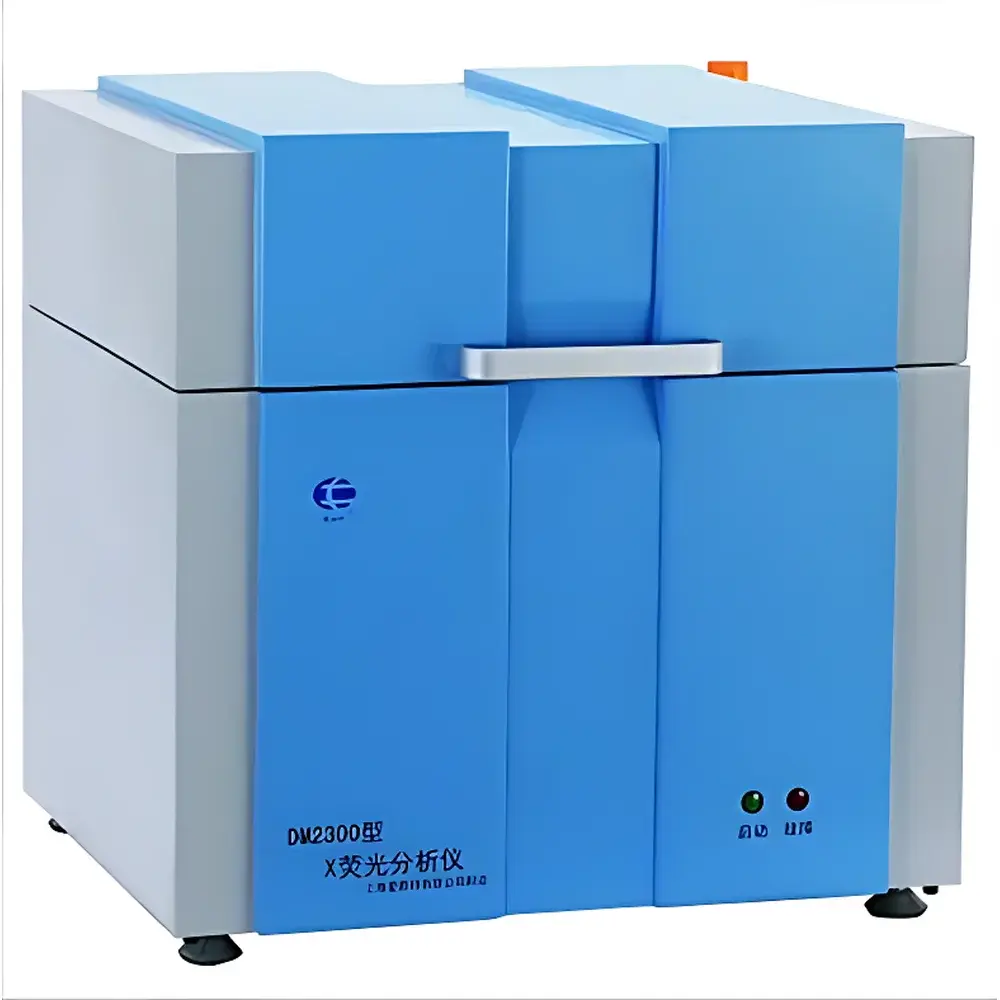
Aist EDXRF DM2300 Energy Dispersive X-Ray Fluorescence Spectrometer
| Brand | Aist / ST |
|---|---|
| Origin | Shanghai, China |
| Model | DM2300 |
| Configuration | Benchtop / Floor-standing |
| Analytical Range | Cl (Z=17) to U (Z=92) |
| Detection Limit | ≤2 ppm (for Pb, Cd, Hg, Cr, Br, Cl) |
| Measurement Time | 300 s (typical) |
| X-ray Tube | 0–50 kV, 0–1 mA (continuously adjustable) |
| Collimators | Ø1 mm, Ø3 mm, Ø5 mm, Ø7 mm (motorized auto-switching) |
| Filters | 4-position motorized filter wheel |
| Detector | High-resolution silicon PIN diode |
| Energy Resolution | ≤155 eV at Mn Kα (5.9 keV) |
| Sample Chamber | 480 × 350 × 125 mm (L×W×H) |
| Operating Environment | 5–30 °C, RH ≤80% @ 25 °C, 220 ±20 V, 50 Hz |
| Power Consumption | ≤150 W |
| Dimensions | 503 × 412 × 478 mm |
| Weight | 45 kg |
Overview
The Aist EDXRF DM2300 is a benchtop/floor-standing energy dispersive X-ray fluorescence (EDXRF) spectrometer engineered for regulatory screening and quantitative analysis of restricted substances in compliance-critical industries. It operates on the fundamental principle of EDXRF: primary X-rays from a high-stability microfocus X-ray tube excite atoms in the sample, inducing characteristic secondary (fluorescent) X-ray emission. These emitted photons are collected and resolved by a silicon PIN diode detector, with spectral deconvolution performed via proprietary peak-fitting algorithms. The instrument is specifically optimized for rapid, non-destructive, and reagent-free determination of RoHS/ELV-restricted elements—including Cl, Cr, As, Se, Br, Cd, Sb, Ba, Hg, and Pb—in electronic components, automotive parts, children’s toys, packaging materials, and precious metal alloys. Its design targets regulatory screening workflows where speed, safety, and operational simplicity are prioritized over ultra-trace laboratory-grade quantification—making it ideal for incoming inspection, production line QA, and pre-certification triage.
Key Features
- High-efficiency excitation system featuring a continuously adjustable X-ray tube (0–50 kV, 0–1 mA) with motorized 4-position collimator and filter wheels to optimize signal-to-background ratio for each element group.
- Silicon PIN semiconductor detector with ≤155 eV energy resolution at Mn Kα (5.9 keV), enabling reliable separation of overlapping peaks (e.g., Cr Kα/Kβ, As Kα/Pb Lα, Br Kα/Pb Lβ).
- Large sample chamber (480 × 350 × 125 mm) accommodating irregular or oversized objects—such as printed circuit boards, plastic housings, or jewelry pieces—without sectioning or destructive preparation.
- Integrated CCD camera and motorized XYZ sample stage for precise positioning and repeatable measurement targeting, critical for heterogeneous or multi-layered samples.
- Proprietary spectral deconvolution and internal standardization algorithms that support semi-quantitative analysis even in the absence of matrix-matched certified reference materials (CRMs), reducing calibration dependency.
- Robust radiation shielding compliant with IEC 61000-6-3 and national Class II X-ray device safety standards; zero chemical waste, no consumables, and <150 W power draw ensure low total cost of ownership.
- Stability performance validated per ISO 18551: after 1-hour warm-up, 8-hour drift in peak position and integrated intensity remains <0.1% RSD under ambient lab conditions (25 °C, ≤80% RH).
Sample Compatibility & Compliance
The DM2300 accepts solid, powdered, and thin-film samples without digestion, acid treatment, or pelletizing—enabling direct analysis of polymers, metals, ceramics, coated substrates, and composite assemblies. It supports regulatory screening protocols aligned with ASTM F2617–22 (Standard Test Method for Determining Lead, Cadmium, Chromium, Mercury, and Bromine in Plastics by EDXRF), IEC 62321–3-2:2023 (Determination of certain substances in electrotechnical products – Part 3-2: Screening – Sulphur, chlorine and bromine using EDXRF), and China’s SN/T 2003.1–2005 (Determination of Pb, Hg, Cd, Cr, and Br in EEE products — Part 1: Qualitative screening by XRF). While not intended for GLP-compliant final certification, its documented detection limits (≤2 ppm for key analytes), repeatability (<5% RSD for homogeneous plastics), and inter-laboratory reproducibility meet the performance criteria for Tier 1 screening as defined in EU Commission Decision 2005/618/EC and IPC J-STD-609B Annex B.
Software & Data Management
The instrument is controlled via Windows-based Aist-Spectra software, providing intuitive workflow-driven operation—from method setup and automated calibration to report generation and audit trail logging. All measurement parameters (tube voltage/current, collimator/filter selection, acquisition time, region-of-interest definitions) are stored with each spectrum. Software enforces user-level access control, records operator ID, timestamp, and instrument configuration changes, and maintains full spectral raw data archives. Export formats include CSV, PDF, and XML, compatible with LIMS integration. Optional 21 CFR Part 11 compliance package adds electronic signature capability, immutable audit logs, and secure user authentication—supporting regulated environments requiring traceability per ISO/IEC 17025 and GMP Annex 11 requirements.
Applications
- RoHS/ELV compliance screening of PCBs, connectors, cables, and enclosures in electronics manufacturing.
- Halogen-free verification (Cl, Br) in flame-retardant polymers per IEC 61249-2-21 and JEDEC J-STD-709.
- Heavy metal screening in children’s toys (ASTM F963, EN71-3) and food contact packaging (EU 10/2011).
- Elemental composition verification of precious metal alloys (e.g., Au, Ag, Pt, Pd) and plating thickness estimation (Ni, Cu, Sn, Cr layers).
- Raw material QC for recycled plastics, scrap metals, and mineral concentrates prior to processing.
- Environmental monitoring of soil and sediment extracts for regulated metals (EPA Method 6200).
FAQ
Is the DM2300 suitable for final compliance certification, or only for screening?
The DM2300 is validated for qualitative and semi-quantitative screening per international regulatory guidelines. For definitive pass/fail decisions in formal certification, confirmatory testing using ICP-MS or ICP-OES is recommended when results approach regulatory thresholds.
Does the instrument require annual recalibration or third-party certification?
No mandatory annual recalibration is required. Daily verification using a check standard (e.g., NIST SRM 2582) is sufficient to maintain confidence in performance. Full system validation per ISO/IEC 17025 may be performed internally or by an accredited service provider.
Can it analyze liquids or powders directly?
Yes—powders may be measured in standard cups with Mylar film; liquids require containment in XRF-compatible vials with polymer windows. Homogeneity and surface flatness remain critical for precision.
What maintenance is required beyond routine cleaning?
The X-ray tube has a typical lifetime exceeding 15,000 hours. Detector Peltier cooling and vacuum pump (if equipped) require periodic inspection. No optical alignment or gas refills are needed.
Is remote diagnostics or firmware update supported?
Yes—via secure HTTPS interface, authorized service engineers can perform remote health checks, log analysis, and over-the-air firmware updates while preserving local data integrity.





