
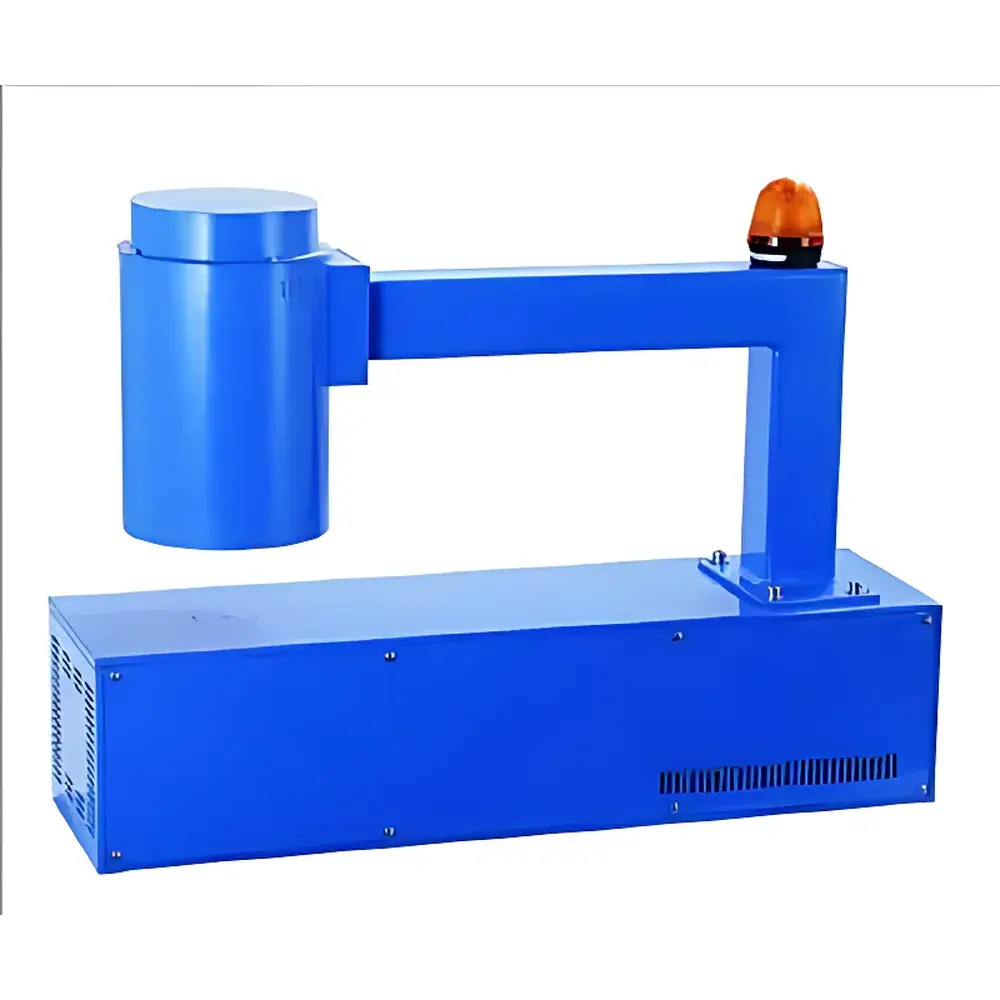
Aist ST DM6100 X-ray Thickness Gauge
| Brand | Aist ST |
|---|---|
| Origin | Shanghai, China |
| Model | DM6100 |
| Measurement Principle | X-ray transmission attenuation (dual-energy correction capable) |
| Measuring Range | 0.1–4.0 mm (steel), 0.01–10.0 mm (aluminum) |
| Accuracy | ±0.2% |
| Resolution | 0.001 mm |
| Response Time | 100 ms (63% to 5% thickness step) |
| Sampling Interval | 200/400/600/800 ms selectable |
| Repeatability | 0.2% |
| Long-term Drift | <±0.24% per 8 h |
| Preheat Time | 1 h |
| Auto-calibration Time | ≤20 min |
| Operating Temp. | 0–40 °C |
| Humidity | ≤95% RH at 30 °C |
| Power Supply | 220 V ±20 V, 50 Hz |
| Power Consumption | ≤250 W |
| Dimensions (Operator Console) | 470 × 365 × 160 mm, 15 kg |
| C-frame Dimensions | 673 × 579 × 189 mm, 35 kg |
| Radiation Safety | Fully shielded |
| Regulatory Certification | CMC (Shanghai) No. 沪制02280027 |
Overview
The Aist ST DM6100 X-ray Thickness Gauge is an industrial-grade, non-contact online thickness measurement system engineered for continuous, real-time monitoring of metallic and non-metallic strip materials during high-speed rolling processes. It operates on the principle of X-ray transmission attenuation—measuring the intensity reduction of a collimated X-ray beam as it passes through the material—and correlates this attenuation to thickness using calibrated mass absorption coefficients. Unlike isotope-based systems, the DM6100 employs a compact, air-cooled microfocus X-ray tube (operating up to 90 kV / 1.0 mA in standard configuration), enabling precise energy and intensity modulation across the full dynamic range. This design eliminates regulatory burdens associated with radioactive isotopes (e.g., 241Am or 109Cd), including licensing, transport restrictions, source disposal, and long-term radiation safety management. The instrument delivers metrological traceability to national standards and supports closed-loop integration with Automatic Gauge Control (AGC) systems via analog (4–20 mA) and digital (RS485/Modbus RTU) outputs.
Key Features
- Isotope-free X-ray source: Eliminates radiological licensing, source replacement costs, and end-of-life disposal liabilities.
- Energy-tunable X-ray tube: Enables optimized photon energy selection per material type and thickness—maximizing signal-to-noise ratio and minimizing beam hardening artifacts.
- High-speed real-time measurement: 100 ms response time (63% to 5% step change) and configurable sampling intervals (200–800 ms) support line speeds up to 27 m/s.
- Integrated self-diagnostic suite: Real-time fault detection, operator error alerts, automatic zero/ span calibration, and drift compensation algorithms ensure sustained metrological integrity.
- Radiation-hardened mechanical architecture: Fully shielded C-frame housing meets GBZ 138–2002 requirements for occupational exposure limits (<1 µSv/h at 5 cm from surface).
- Robust environmental tolerance: Operational within 0–40 °C ambient temperature and ≤95% RH (non-condensing); EMI/EMC compliant per IEC 61000-6-4.
- Intuitive human-machine interface: Backlit monochrome LCD with Chinese-language menu navigation; parameter configuration, trend logging, and alarm history accessible without external software.
Sample Compatibility & Compliance
The DM6100 is validated for continuous measurement of homogeneous, flat-sheet materials including cold-rolled steel, electrolytic copper, wrought aluminum alloys, polymer films, rubber sheets, paperboard, and laminated composites. Material-specific compensation is supported via user-defined alloy curves or fixed percentage density offset (0–15%). Calibration is performed using certified reference standards traceable to NIM (National Institute of Metrology, China). The system complies with ISO 2178 (non-magnetic coatings), ASTM E1001 (X-ray gauging of metals), and relevant sections of GB/T 12604.2–2021 (Non-destructive testing—Terminology—Radiographic testing). For regulated manufacturing environments, audit trails, electronic signatures, and data integrity controls align with GLP/GMP expectations—though native 21 CFR Part 11 compliance requires optional firmware upgrade and external validation protocol.
Software & Data Management
Local operation is fully self-contained: no PC dependency for routine measurement, calibration, or diagnostics. All critical parameters—including thickness trends, alarm logs, calibration records, and diagnostic codes—are stored in non-volatile memory with timestamping. Optional RS485/Modbus RTU interface enables integration into SCADA or MES platforms for centralized data aggregation. Raw analog output (4–20 mA) is linearly scaled to full-scale thickness range and isolated to prevent ground-loop interference. Firmware updates are performed via USB port using signed binary packages; version history and checksum verification are retained in device EEPROM. Data export (CSV format) is available via USB flash drive—supporting post-process statistical analysis (Cp/Cpk, SPC charts) without proprietary software dependencies.
Applications
- Hot/cold rolling mills: Real-time thickness profiling of steel strip, aluminum foil, and copper foil during tandem mill operation.
- Continuous annealing lines: In-line verification of gauge consistency before and after heat treatment.
- Coating and lamination lines: Thickness verification of metallic or polymer coatings on metal substrates (e.g., tinplate, aluminized steel).
- Quality assurance labs: Reference-grade verification of offline samples where destructive testing is impractical.
- Recycling facilities: Rapid sorting and grading of mixed scrap based on inferred density and thickness profiles.
FAQ
Does the DM6100 require radioactive source licensing?
No. It uses a sealed X-ray tube—not a radioactive isotope—and therefore does not fall under national nuclear regulatory frameworks governing sealed sources.
Can the DM6100 measure multi-layer or coated materials?
It measures total areal density; for layered structures, accuracy depends on known composition ratios and prior calibration with representative samples. Dual-energy mode (optional) improves discrimination between base metal and coating.
What maintenance is required beyond scheduled calibration?
Annual X-ray tube performance verification and optical path cleaning are recommended. No consumables or periodic source replacement are needed.
Is remote diagnostics supported?
Yes—via Modbus TCP gateway (external) or optional embedded Ethernet module; allows parameter readout, alarm status polling, and limited firmware update capability.
How is radiation safety verified during installation?
Aist ST provides pre-installation shielding assessment and post-installation survey report (per GBZ 138–2002) using calibrated ionization chamber detectors; certification documentation is supplied with shipment.



