
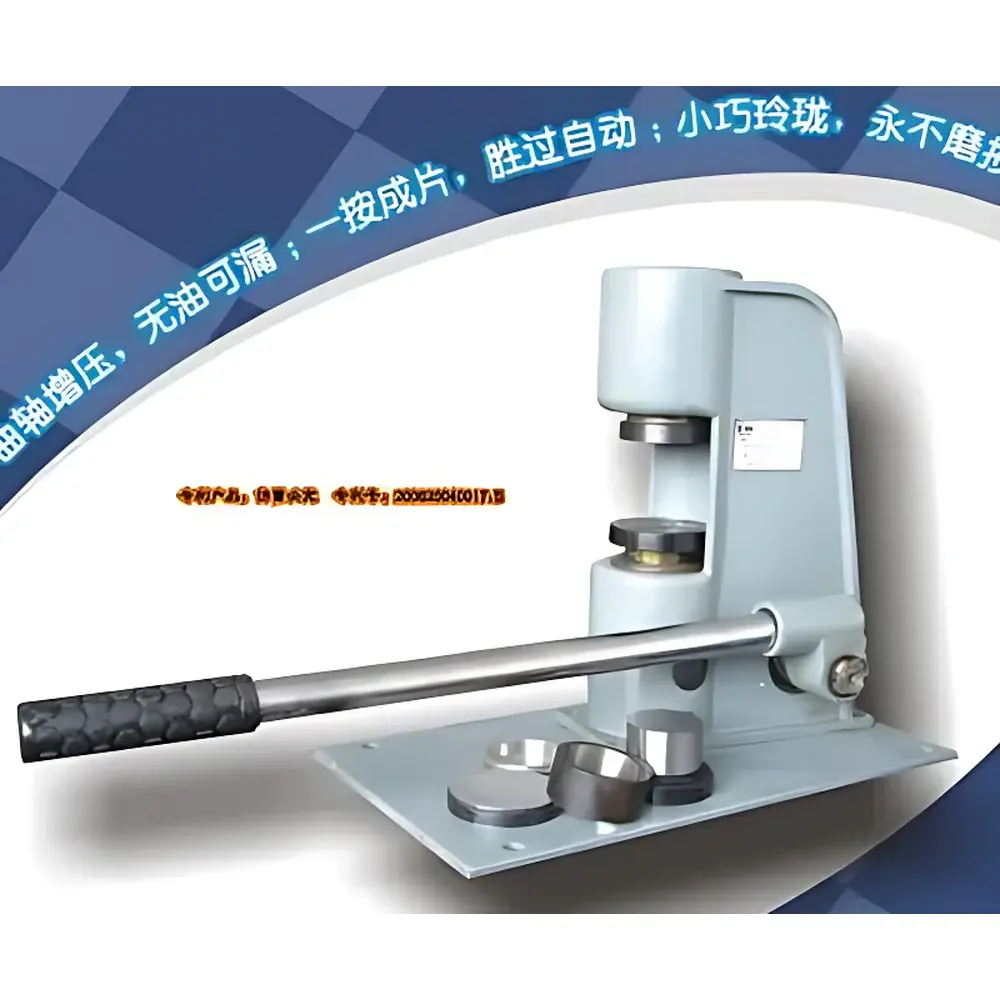
Aist ST SH-3 Mechanical Pellet Press
| Brand | Aist ST |
|---|---|
| Origin | Shanghai, China |
| Manufacturer Type | Authorized Distributor |
| Country of Origin | China |
| Model | SH-3 |
| Pricing | Available Upon Request |
| Rated Force | 50 kN |
| Platen Closure Height | 50 mm |
| Platen Stroke | 6.5 mm |
| Maximum Hand Lever Effort | 210 N |
| Net Weight | 14 kg |
| Dimensions (L×W×H) | 180 × 330 × 280 mm |
Overview
The Aist ST SH-3 Mechanical Pellet Press is a precision-engineered manual hydraulic-free compaction device designed specifically for standardized sample preparation in X-ray fluorescence (XRF) spectroscopy laboratories. Unlike conventional hydraulic or gear-driven pellet presses, the SH-3 employs a patented crank-and-connecting-rod force-multiplication mechanism—eliminating reliance on fluid-based pressure transmission and avoiding inherent failure modes such as oil leakage, seal degradation, or gear slippage. This mechanical architecture delivers highly reproducible, stable compressive loads up to 50 kN with minimal operator input, enabling consistent pellet density and homogeneity critical for quantitative XRF analysis. Its compact footprint (180 × 330 × 280 mm) and lightweight construction (14 kg net weight) make it ideal for benchtop deployment in QC labs, academic research facilities, and field-deployable analytical setups where space, reliability, and maintenance simplicity are prioritized.
Key Features
- Patented crank-and-connecting-rod force amplification system—certified under Chinese Utility Model Patents ZL03230487.0 and ZL200620040917.5—ensures deterministic mechanical advantage without hydraulic components.
- Single-stroke operation: Full compaction achieved with one ergonomic lever actuation (≤210 N hand force), significantly reducing operator fatigue and inter-operator variability compared to multi-cycle manual presses.
- Oil-free design: Eliminates risk of contamination, maintenance downtime, and calibration drift associated with hydraulic fluid degradation or seal failure.
- High structural rigidity: Cast iron frame and hardened steel platens provide long-term dimensional stability and resistance to deformation under repeated 50 kN loading cycles.
- Optimized stroke geometry: 6.5 mm platen travel and 50 mm closed-height configuration accommodate standard 32 mm and 40 mm die sets used in ISO 9516-1, ASTM E1361, and GB/T 176–2017 cement and mineral analysis protocols.
Sample Compatibility & Compliance
The SH-3 is compatible with standard stainless steel, tungsten carbide, and borosilicate glass die sets (32 mm, 40 mm diameter) for preparing homogeneous pellets from powdered geological, metallurgical, cementitious, ceramic, and environmental samples. It supports binder-free compaction as well as low-binder formulations (e.g., cellulose, boric acid, wax) per ISO/IEC 17025-compliant sample prep workflows. The absence of hydraulic fluid ensures zero risk of sample cross-contamination—a critical requirement for trace-element XRF analysis. Device design aligns with general safety principles outlined in IEC 61010-1 for laboratory equipment, and its deterministic mechanical operation facilitates full traceability in GLP and GMP environments where audit-ready documentation of compaction parameters (force, stroke, dwell time) is required.
Software & Data Management
As a fully mechanical, non-electronic press, the SH-3 requires no embedded firmware, software drivers, or connectivity interfaces. This architecture inherently satisfies FDA 21 CFR Part 11 requirements for systems where electronic records are not generated—eliminating validation overhead for computerized system compliance. Users maintain complete control over process documentation via lab notebooks or LIMS-integrated SOPs specifying lever actuation protocol, dwell duration (typically 10–30 s post-compaction), and die identification. Optional digital force gauges or load-cell adapters (third-party) may be mounted externally for calibrated verification; raw analog output from such devices can be logged into validated data acquisition systems compliant with ALCOA+ data integrity principles.
Applications
- Routine preparation of pressed pellets for wavelength-dispersive (WDXRF) and energy-dispersive (EDXRF) elemental analysis of ores, slag, fly ash, soils, and industrial powders.
- Method development and validation in ISO/IEC 17025-accredited testing laboratories performing cement composition (GB/T 176), clinker phase analysis, and refractory material certification.
- Teaching laboratories requiring robust, low-maintenance instrumentation for undergraduate materials science and analytical chemistry courses.
- Mobile or remote analytical units where power availability, environmental temperature fluctuations, and service accessibility constrain use of electromechanical or hydraulic alternatives.
FAQ
Does the SH-3 require calibration or periodic maintenance?
No scheduled calibration is mandated, as force transmission is governed solely by mechanical geometry and material elasticity. Routine visual inspection of lever pivot pins and platen surfaces is recommended; no lubrication or fluid replacement is necessary.
Can the SH-3 be integrated into automated sample preparation lines?
It is not designed for direct automation integration due to its manual actuation interface. However, it serves as a reliable, low-downtime backup or primary press in hybrid workflows where automation handles feeding/die handling while final compaction remains operator-controlled.
What die sizes are supported out-of-the-box?
The standard configuration accommodates 32 mm and 40 mm diameter dies with standard height (12–15 mm) and removable bottom punches per ASTM D7580 and ISO 9516-1 specifications.
Is technical support available outside mainland China?
Yes—Aist ST provides international distributor-level engineering support, including spare parts logistics, application guidance, and compatibility documentation for global XRF OEMs and end-users.



