
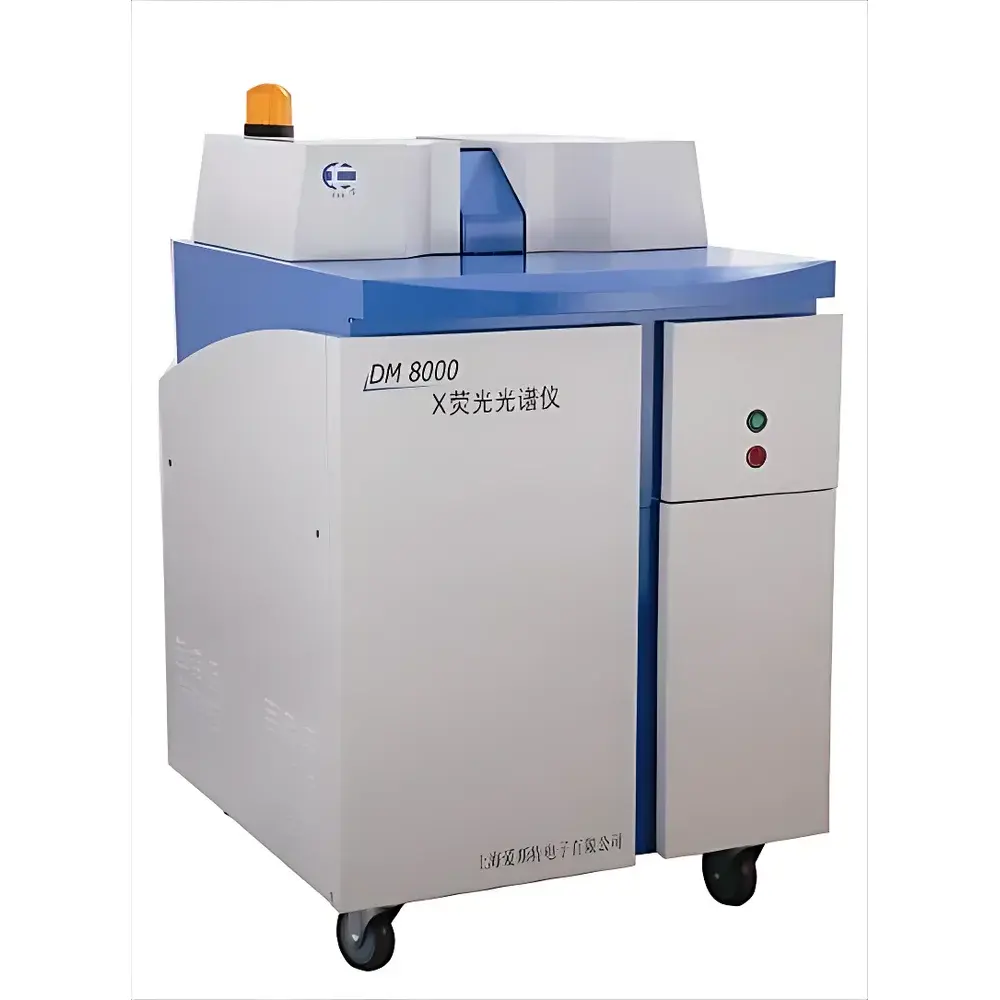
Aist WDXRF Multi-Element Analyzer DM8000 — Wavelength Dispersive X-Ray Fluorescence Spectrometer
| Brand | Aist (ST) |
|---|---|
| Model | DM8000 |
| Instrument Type | Floor-standing |
| X-ray Tube Power | 400 W |
| X-ray Tube | Varian EG-60 thin Be-window, Rh anode |
| Detectable Elements | Any 10 elements from Na (11) to U (92) |
| Detector Window | Moxtek ProLINE 0.6 µm polyimide |
| Detector Linear Range | 500 kcps |
| Be Window Thickness | 75 µm |
| Compliance | GB/T 176–2017, JC/T 1085–2008, JB/T 11145–2011 |
Overview
The Aist DM8000 is a high-performance, simultaneous-type wavelength dispersive X-ray fluorescence (WDXRF) spectrometer engineered for routine quantitative elemental analysis in industrial quality control laboratories. Unlike energy-dispersive systems (EDXRF), the DM8000 employs Bragg diffraction of characteristic X-rays using precisely aligned analyzing crystals—each dedicated to a specific element—to achieve superior spectral resolution (>10× higher than EDXRF). This enables unambiguous separation and quantification of adjacent light elements (e.g., Na Kα and Mg Kα), critical for accurate oxide analysis in cement, metallurgical slags, and geological matrices. The instrument operates on a fixed multi-channel architecture: ten independent optical channels—each comprising a crystal spectrometer, collimator, and gas-flow proportional counter—are permanently aligned to pre-selected elements (e.g., Na₂O, MgO, Al₂O₃, SiO₂, SO₃, K₂O, CaO, TiO₂, Fe₂O₃), eliminating mechanical scanning and ensuring sub-minute measurement cycles with exceptional long-term stability. Its vertical X-ray tube geometry minimizes source-to-sample distance, maximizing excitation efficiency while enabling compact, radiation-shielded floor-standing integration compliant with national exemption-level safety requirements.
Key Features
- Simultaneous multi-element detection: Ten pre-configured analytical channels acquire data concurrently—no sequential scanning required—yielding full quantitative results in ≤180 s per sample.
- High-resolution WDXRF optics: Utilizes calibrated flat or bent analyzing crystals (e.g., LiF, PET, TAP) selected per channel to resolve overlapping peaks; resolution independent of detector performance, governed solely by crystal lattice parameters and angular alignment.
- Optimized light-element sensitivity: Features Varian EG-60 Rh-anode X-ray tube with 75 µm Be window and Moxtek ProLINE 0.6 µm ultra-thin polyimide detector windows—enabling reliable detection of Na (Kα, 1.04 keV) and Mg (Kα, 1.25 keV) with minimal absorption loss.
- Thermal & pneumatic stabilization: Precision thermostatic chamber maintains 36 °C ± 0.1 °C across spectrometer, detectors, and electronics; high-stability gas-flow system regulates proportional counter fill-gas pressure to <3 Pa deviation, ensuring count-rate linearity over extended operation.
- Sample homogeneity mitigation: Integrated sample spinner compensates for particle-size heterogeneity in pressed-powder pellets—critical for reproducible analysis of SiO₂-rich or coarse-grained materials like cement raw meals.
- Radiation safety compliance: Fully shielded cabinet design meets national regulatory exemption criteria—no external shielding or licensing required during routine operation.
Sample Compatibility & Compliance
The DM8000 accepts solid samples prepared as fused beads or pressed pellets (diameter: 32–40 mm), accommodating powders, granules, and homogeneous solids typical of cement, mining, metallurgy, and petrochemical QA/QC workflows. Liquid samples require specialized containment cells compatible with the instrument’s sample chamber geometry. All hardware and software implementations conform to Chinese national standards governing XRF instrumentation: GB/T 176–2017 (Cement Chemical Analysis Methods), JC/T 1085–2008 (XRF Analyzers for Cement Industry), and JB/T 11145–2011 (General Technical Requirements for XRF Spectrometers). While not certified to ISO/IEC 17025 or ASTM E1361, its documented repeatability (3σ ≤ 0.015% for Fe₂O₃; ≤0.006% for SO₃) and linearity (r² ≥ 0.9945 for major oxides) align with GLP-aligned validation practices for in-house method verification. Regulatory traceability is supported via audit-ready calibration logs, drift correction records, and user-accessible raw intensity files.
Software & Data Management
The embedded Windows-based analysis suite provides comprehensive quantitative workflows: fundamental parameter (FP) and empirical calibration modes, matrix-effect correction (e.g., Lachance–Traill), ratio-based standardization, and real-time statistical process monitoring (SPC). Calibration models are built using certified reference materials (CRMs)—including 11 national cement raw meal standards—with coefficients stored in editable polynomial equations (e.g., C = D + E·IC + F·IC²). Software features include automated pass/fail flagging against specification limits, rate-value calculation (e.g., LSF, SM, AM), batch reporting (PDF/CSV), and export of raw pulse-height spectra. All data entries—including operator ID, sample ID, measurement time, and environmental conditions—are timestamped and stored with immutable audit trails. Firmware and application updates are delivered remotely; custom algorithm development (e.g., alternate normalization schemes) is supported under NDA-based collaboration agreements.
Applications
Primary deployment targets include cement manufacturing (raw meal, clinker, finished cement), where the DM8000 replaces wet-chemical methods for daily control of key oxides (Na₂O–Fe₂O₃) per GB/T 176–2017. It is equally applicable to coal ash analysis (SiO₂, Al₂O₃, Fe₂O₃, CaO), ferrous/non-ferrous slag composition, bauxite grading (Al₂O₃/SiO₂ ratio), phosphate rock P₂O₅ quantification, and catalyst metal loading (Ni, Co, Mo). In integrated production environments, analog/digital outputs interface directly with PLCs or DCS systems—enabling closed-loop raw mix proportioning (“analyzer → controller → belt scale”) without intermediate PC mediation. Secondary applications span geological survey labs (multi-element soil/sediment screening), power plant fly ash characterization, and refractory material certification.
FAQ
What sample preparation methods are supported?
Pressed powder pellets (using borate or cellulose binders) and fused glass beads (Li₂B₄O₇ flux) are validated; bead fusion is recommended for heterogeneous or high-iron matrices.
Does the system support regulatory-compliant data integrity?
Yes—software enforces electronic signatures, auto-archives calibration history, and prevents post-acquisition intensity modification; full audit trail export complies with internal GLP documentation protocols.
Can additional elements be added post-purchase?
No—the ten-channel configuration is hardware-fixed at manufacture; adding new elements requires replacement of crystal/detector assemblies and recalibration.
What maintenance intervals are recommended?
Annual verification of X-ray tube output, crystal alignment, and gas-flow stability; quarterly cleaning of sample chamber and collimators; no routine detector replacement required under normal operating conditions.
Is remote diagnostics available?
Yes—secure VNC-enabled remote access allows Aist engineers to monitor system health, review error logs, and validate calibration performance without on-site visits.
Related Products




