
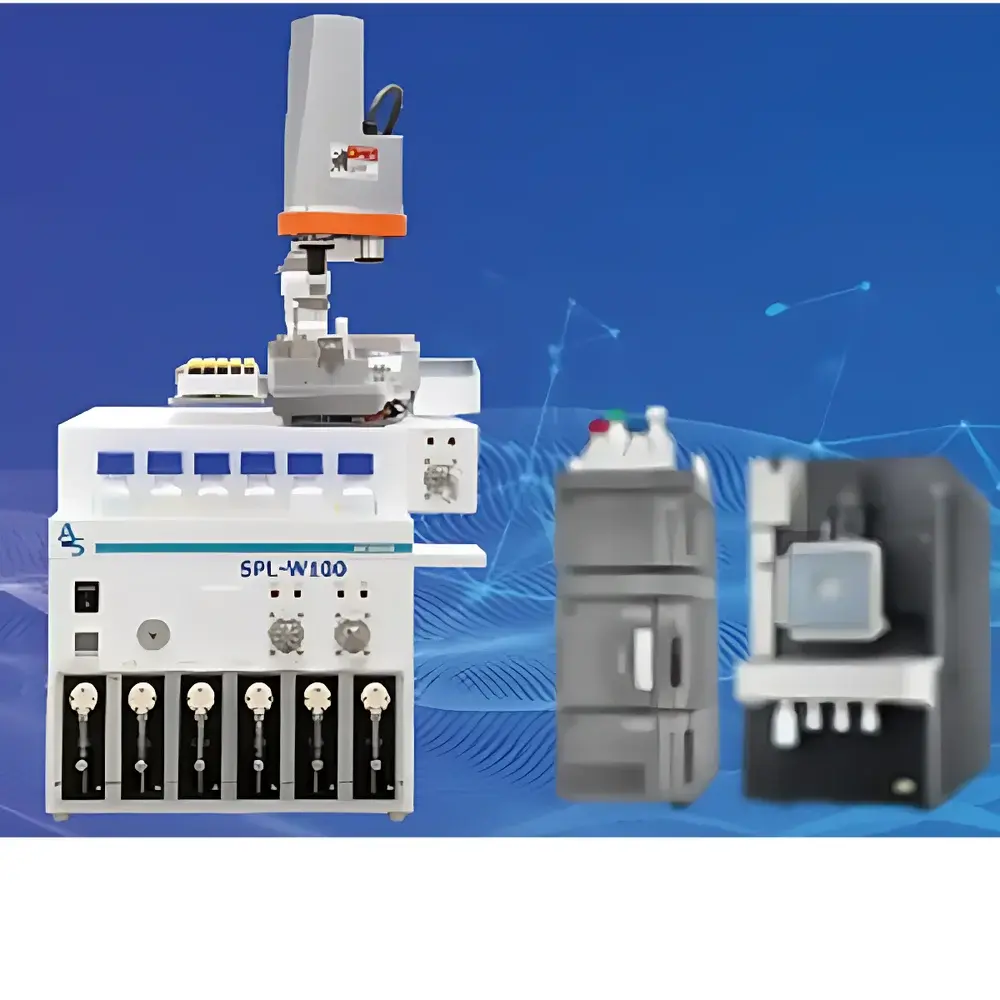
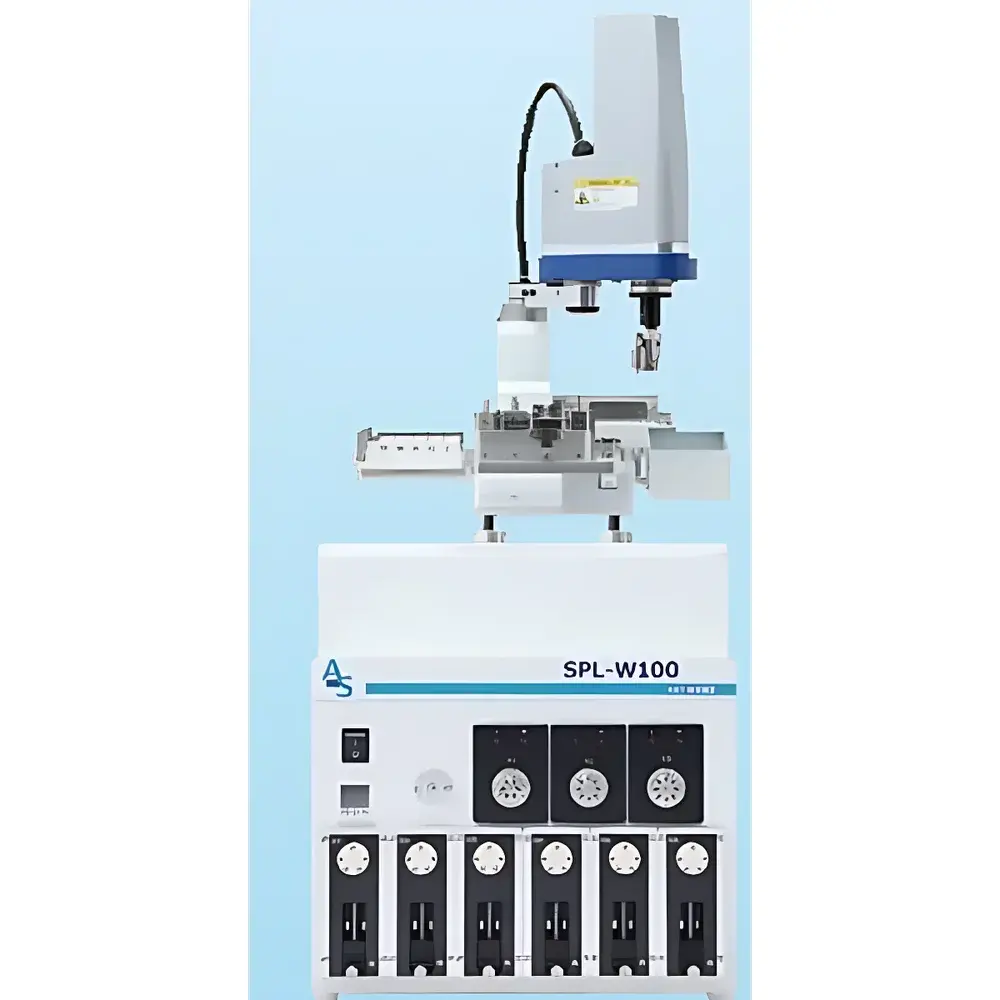
AISTI SPL-W100 Fully Automated Online Solid Phase Extraction System
| Brand | AISTI |
|---|---|
| Origin | Japan |
| Device Type | Fully Automated Online SPE-LC Coupled System |
| Model | SPL-W100 |
| Automation Level | Fully Automatic |
| Channel Configuration | Multi-Channel |
| Extraction Format | Cartridge-Based SPE |
| Flow Rate Control Range | 0.1–30 mL/min |
| Solvent Selection Capacity | 5 Independent Solvent Lines |
| Sample Capacity | 50 Positions |
| Sample Loading Volume | 1.5 mL per Vial |
| Wetted Materials | Borosilicate Glass, PTFE, and Chemically Inert Elastomers |
Overview
The AISTI SPL-W100 is a fully automated, online solid phase extraction (SPE) system engineered for seamless integration with high-performance liquid chromatography (HPLC) or ultra-high-performance liquid chromatography–tandem mass spectrometry (UHPLC–MS/MS) platforms. It implements a cartridge-based, flow-through SPE architecture grounded in classical adsorption/desorption thermodynamics and kinetic mass transfer principles. Unlike offline batch SPE workflows—where manual column conditioning, sample loading, washing, and elution introduce variability—the SPL-W100 executes all steps—including column activation, sample loading, solvent gradient washing, targeted elution, post-elution mixing, and direct LC injection—within a closed, programmable fluidic path. This eliminates manual intervention, minimizes analyte loss or degradation, and ensures high reproducibility across large sample batches. Designed specifically for trace-level quantitative analysis in regulated environments, the system supports method development aligned with ISO 17025, EPA Method 537.1 (for PFAS), and FDA Guidance for Bioanalytical Method Validation.
Key Features
- Fully automated end-to-end SPE–LC coupling: Conditioning, loading, washing, elution, dilution, and injection are sequentially executed without operator involvement.
- Multi-channel architecture supporting parallel processing of up to 50 samples per run, with independent flow control per channel (0.1–30 mL/min).
- MiVS (Mixed Injection Valve System): A proprietary dual-syringe valve manifold enabling precise post-elution mixing of eluate with diluent or reconstitution solvent prior to LC injection—improving peak shape, reducing matrix effects, and enhancing detection sensitivity.
- Glass-wetted fluidic path: All solvent-contacting components—including sample loops, elution lines, and SPE cartridge holders—are constructed from borosilicate glass, PTFE, and fluoropolymer-coated elastomers to ensure chemical inertness and minimize analyte adsorption or leaching.
- Modular hardware design: Pre-treatment unit (robotic arm for vial handling), transport unit (dual syringe pumps + high-pressure switching valves), and Flash-SPE microcartridges (1–10 mg sorbent bed, optimized for <1.5 mL aqueous samples) operate as interoperable subsystems.
- Method scalability: Supports both standard cartridge formats (e.g., 1 mL, 3 mL) and custom-packed Flash-SPE columns for method transfer and optimization.
Sample Compatibility & Compliance
The SPL-W100 accommodates aqueous matrices including surface water, wastewater, drinking water, plasma, urine, and food extracts. It is validated for PFAS analysis (PFOS, PFOA, PFHxS, PFNA, GenX), glyphosate and its metabolite AMPA via on-cartridge derivatization, pesticide residues (organophosphates, neonicotinoids), pharmaceutical impurities, and food additives. All operational parameters—including dwell time, flow rate ramping, valve timing, and solvent switching—are logged with timestamped audit trails compliant with 21 CFR Part 11 requirements when used with validated LIMS or CDS software. The system meets GLP/GMP documentation standards for QC/QA laboratories performing environmental monitoring under ISO/IEC 17025 accreditation.
Software & Data Management
Control and method programming are performed via AISTI’s dedicated SPL Control Suite—a Windows-based application supporting I/O mapping, sequence scheduling, real-time pressure monitoring, and error logging. The software exports raw method files (.spl), event logs (.csv), and instrument status reports compatible with third-party chromatography data systems (CDS) such as Thermo Chromeleon, Waters Empower, and Agilent OpenLab. All method changes, user logins, and critical events (e.g., column blockage alerts, solvent depletion warnings) are recorded with digital signatures and immutable timestamps. Optional integration with enterprise LIMS enables automatic sample ID propagation and result auto-reporting.
Applications
- Regulatory environmental analysis: EPA 533, 537.1, and ISO 21675-compliant PFAS quantification in drinking and surface waters.
- Clinical and forensic toxicology: High-throughput cleanup of biological fluids prior to UHPLC–MS/MS analysis of drugs of abuse, biomarkers, or metabolites.
- Food safety testing: Multi-residue pesticide screening in fruits, vegetables, and infant formula with minimized solvent consumption (<2 mL per sample).
- Pharmaceutical quality control: Residual solvent removal and active pharmaceutical ingredient (API) enrichment from synthesis intermediates.
- Method development support: Rapid evaluation of SPE sorbents (C18, HLB, SAX, SCX, mixed-mode) and solvent gradients without manual column packing or fraction collection.
FAQ
Can the SPL-W100 be integrated with existing HPLC or UHPLC systems from major vendors?
Yes—it features standardized 1/16″ PEEK tubing connections, TTL/RS-232 trigger interfaces, and configurable injection pulse signals compatible with Thermo, Waters, Agilent, Shimadzu, and SCIEX platforms.
Does the system support method validation per ICH Q2(R2) guidelines?
Yes—its deterministic fluidic control, full audit trail capability, and reproducible retention time alignment enable robustness testing, intermediate precision assessment, and system suitability verification.
What maintenance is required for long-term reliability?
Routine tasks include quarterly calibration of syringe pump displacement volume, biannual replacement of PTFE valve rotor seals, and periodic cleaning of glass manifolds with high-purity acetonitrile. No consumable cartridges beyond standard SPE sorbents are required.
Is remote monitoring supported?
Yes—via optional Ethernet-enabled controller module, users can monitor run status, receive email/SMS alerts on completion or fault conditions, and access historical logs through secure HTTPS portal.
How does the MiVS improve analytical performance compared to conventional post-column mixing?
MiVS achieves sub-microliter mixing precision before the injector, minimizing band broadening and ensuring consistent eluate:diluent ratios—critical for maintaining linearity and LOD/LOQ in multi-analyte MS/MS assays.



