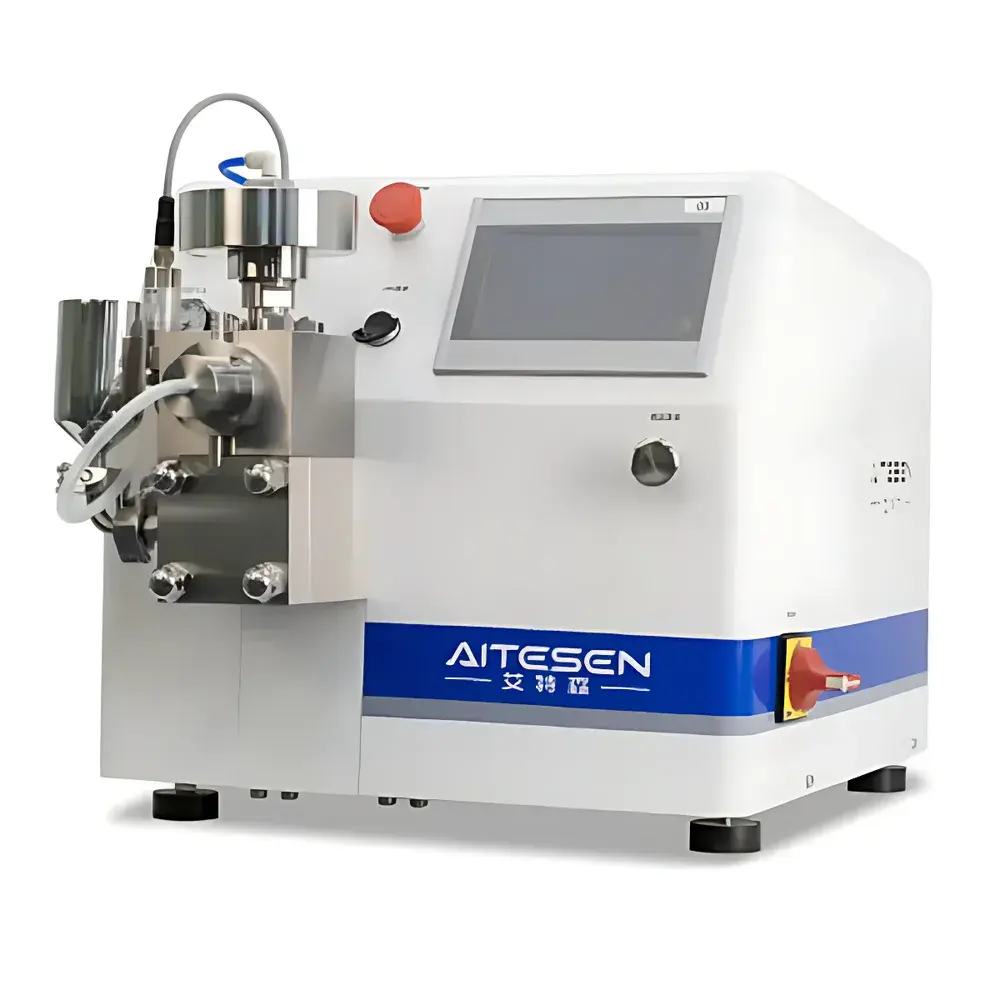
Aitesen HPH-L2 High-Pressure Homogenizer for Cell Disruption and Nanoscale Emulsification
| Brand | Aitesen |
|---|---|
| Origin | Jiangsu, China |
| Manufacturer Type | Authorized Distributor |
| Product Origin | Domestic (China) |
| Model | HPH-L2 |
| Max. Pressure | 2000 bar |
| Max. Inlet Particle Size | 500 µm |
| Flow Rate | 5–15 L/h |
| Minimum Sample Volume | 15 mL |
| Noise Level | 65 dB(A) |
| Power | 1.5 kW |
| Dimensions (W×D×H) | 545 × 755 × 494 mm |
| Weight | 140 kg |
| Material | SAF2507 super duplex stainless steel |
| Compliance | EU Machinery Directive 98/37/EC (MD) |
| Cleaning & Sterilization | CIP-compatible, autoclavable components |
Overview
The Aitesen HPH-L2 is a benchtop high-pressure homogenizer engineered for reproducible cell disruption, nanoemulsion formation, and submicron particle size reduction in life science and pharmaceutical R&D environments. It operates on the principle of controlled fluid shear, cavitation, and impact forces generated when pressurized sample suspension passes through a precisely engineered homogenizing valve at pressures up to 2000 bar. This mechanical lysis method ensures high-efficiency disruption of robust microbial cells—including Escherichia coli, Saccharomyces cerevisiae, and filamentous fungi—without thermal degradation or chemical contamination. Unlike sonication or enzymatic lysis, the HPH-L2 delivers scalable, continuous-flow processing with deterministic process parameters, making it suitable for both early-stage discovery and preclinical formulation development. Its modular architecture supports integration into GMP-aligned workflows, particularly for lipid nanoparticle (LNP), liposome, and fat emulsion manufacturing where batch-to-batch consistency and scalability are critical.
Key Features
- Robust homogenization head constructed from SAF2507 super duplex stainless steel—resistant to chloride-induced stress corrosion cracking and compatible with aggressive biological buffers and organic solvents.
- Integrated pressure regulation system with dual-mode control: manual fine-tuning via precision handwheel and optional pneumatic actuation for repeatable setpoint accuracy ±5 bar.
- Touchscreen HMI interface with real-time pressure monitoring, logging interval configuration (1–60 s), and USB export of time-stamped CSV data files for audit-ready recordkeeping.
- Dedicated safety architecture including hardware-based pressure cut-off at 105% of setpoint, redundant pressure transducers, and emergency stop circuit compliant with EN ISO 13850.
- Modular expansion capability: supports factory-integrated options such as variable-frequency drive (VFD) for flow modulation, PLC-based automation (IEC 61131-3), jacketed temperature-controlled inlet manifold (±0.5 °C), and multi-stage homogenization modules for sequential pressure staging.
Sample Compatibility & Compliance
The HPH-L2 accommodates aqueous suspensions, organic-aqueous mixtures, and viscous biopolymer solutions with viscosities up to 500 mPa·s. Minimum sample volume is 15 mL—enabling efficient processing of precious recombinant protein or mRNA-LNP formulations. All wetted surfaces meet USP Class VI and FDA 21 CFR Part 11 requirements for electronic records when paired with optional audit-trail-enabled software. The system conforms to EU Machinery Directive 98/37/EC (MD) and carries CE marking. For regulated applications, validation documentation packages—including IQ/OQ protocols, material certificates (EN 10204 3.1), and surface roughness reports (Ra ≤ 0.4 µm)—are available upon request. Sterilization compatibility includes steam-in-place (SIP) at 121 °C for 30 min and validated ethylene oxide (EtO) cycles.
Software & Data Management
The embedded firmware supports configurable data acquisition, with timestamped pressure, flow, and runtime metrics stored locally and exportable without proprietary software dependencies. Optional Aitesen Homogenization Suite (v3.2+) provides advanced features: comparative batch analysis, deviation alerts against SOP-defined pressure profiles, and PDF report generation compliant with ALCOA+ principles. When integrated with laboratory information management systems (LIMS), the HPH-L2 can transmit metadata via OPC UA or Modbus TCP, supporting traceability in GLP and GMP environments. Electronic signatures, user role-based access control, and immutable audit trails satisfy FDA 21 CFR Part 11 Annex 11 requirements for computerized systems.
Applications
- Biopharmaceutical Processing: Lysis of bacterial and yeast expression hosts; preparation of inclusion bodies; generation of uniform liposomes and LNPs for mRNA vaccine delivery.
- Parenteral Formulations: Production of sterile fat emulsions (e.g., lipid injectables per USP ), nanosuspensions for poorly soluble APIs, and microcrystalline dispersions.
- Nanomaterial Synthesis: Exfoliation of graphene and carbon nanotubes; dispersion of cellulose nanocrystals; stabilization of metal-organic frameworks (MOFs) in colloidal suspension.
- Cosmeceutical Development: Formation of sub-100 nm emulsions for enhanced dermal penetration; homogenization of active-loaded liposomes and solid lipid nanoparticles (SLNs).
- Food Science Research: Stabilization of cold-pressed fruit juices; nanoencapsulation of probiotics and polyphenols; viscosity control in plant-based dairy alternatives.
FAQ
What is the maximum allowable particle size in the feed stream?
The HPH-L2 accepts particles up to 500 µm in diameter. Pre-filtration through a 100 µm stainless steel mesh is recommended for particulate-laden lysates or crude extracts.
Can the system be validated for GMP manufacturing?
Yes—the HPH-L2 supports full qualification (IQ/OQ/PQ) with vendor-supplied protocols and calibration certificates traceable to NIST standards. Optional 21 CFR Part 11-compliant software enables electronic record integrity.
Is temperature control available during homogenization?
Standard operation generates adiabatic heating (~2–3 °C per 500 bar pressure drop). An optional recirculating chiller interface or jacketed inlet module maintains sample temperature within ±0.5 °C across the full pressure range.
How does the HPH-L2 compare to ultrasonic or bead-beating methods for cell lysis?
HPH offers superior scalability, lower thermal load per unit mass, and higher batch-to-batch reproducibility—critical for regulatory filings. It avoids cross-contamination risks associated with reusable beads and eliminates probe erosion artifacts seen in sonication.
What maintenance intervals are recommended for the homogenizing valve?
Valve service life exceeds 500 operating hours under typical bacterial lysis conditions (1500–1800 bar). A predictive maintenance log tracks cumulative pressure-hours and triggers service alerts based on usage thresholds.