
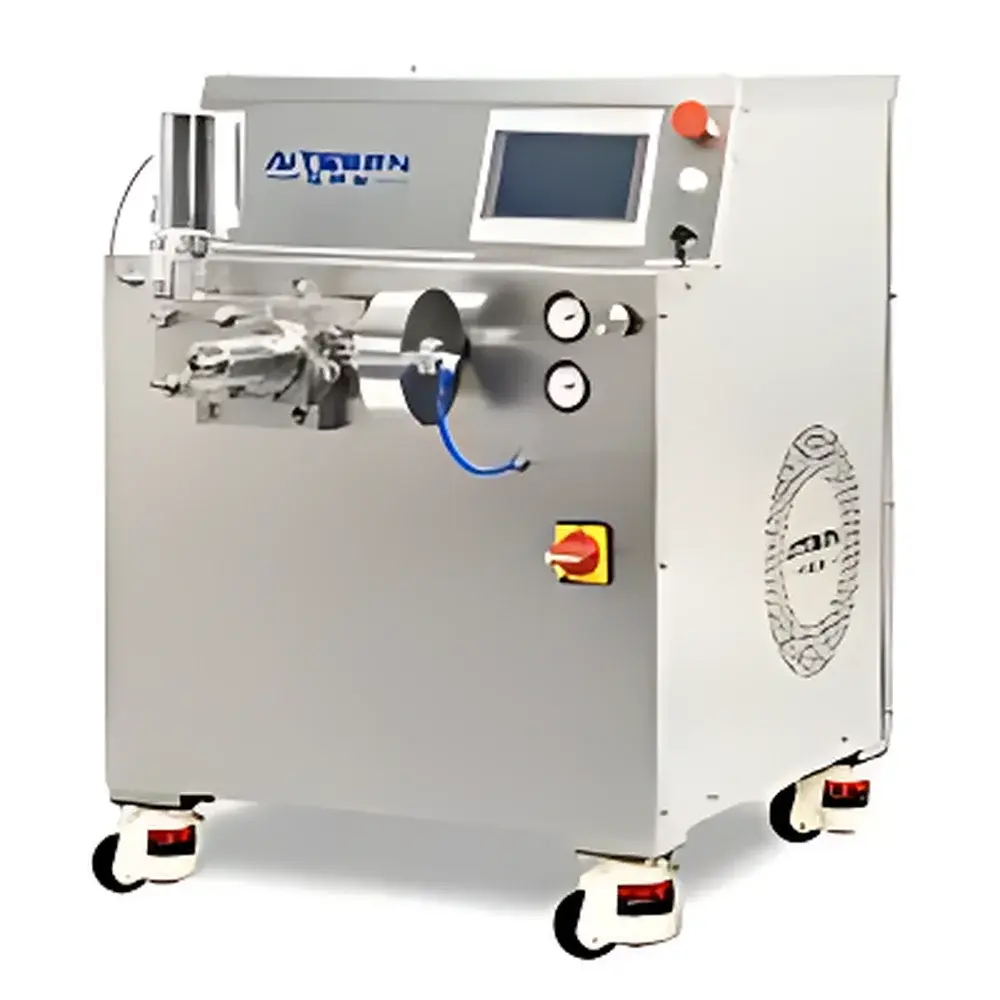
Aitesen HPH-L3 High-Pressure Homogenizer for Cell Disruption and Nanoscale Emulsification
| Brand | Aitesen |
|---|---|
| Origin | Jiangsu, China |
| Manufacturer Type | Authorized Distributor |
| Product Category | Domestic |
| Model | HPH-L3 |
| Max. Inlet Particle Size | 500 µm |
| Flow Rate | 10–40 L/h |
| Max. Operating Pressure | 1800 bar |
| Minimum Sample Volume | 30 mL |
| Noise Level | 65 dB(A) |
| Power Rating | 5.5 kW |
| Dimensions (L×W×H) | 658 × 868 × 920 mm |
| Weight | 280 kg |
| Construction Material | SAF2507 Super Duplex Stainless Steel |
| Compliance | EU Machinery Directive 98/37/EC (MD) |
Overview
The Aitesen HPH-L3 is a bench-to-pilot scale high-pressure homogenizer engineered for reproducible cell disruption, nanoemulsion formation, and advanced colloidal processing in regulated life science and pharmaceutical environments. It operates on the principle of controlled hydrodynamic cavitation, shear, and impact forces generated when pressurized fluid is forced through a precisely engineered homogenizing valve—enabling efficient lysis of robust microbial cells (e.g., E. coli, yeast), uniform lipid nanoparticle (LNP) formation for mRNA delivery, and sub-100 nm particle size reduction in liposomal, fat emulsion, and nanocrystal suspensions. Designed to meet the mechanical integrity and traceability requirements of early-phase bioprocess development, the HPH-L3 delivers stable pressure output across its full operational range (up to 1800 bar), with real-time pressure monitoring and programmable safety interlocks integrated into its control architecture.
Key Features
- Robust pump head assembly with modular, service-friendly split-body design for rapid maintenance and validation-compatible cleaning.
- SAF2507 super duplex stainless steel wetted parts—resistant to chloride-induced stress corrosion cracking and compatible with aggressive biological buffers, organic solvents, and alkaline CIP solutions.
- High-precision homogenizing valve system with adjustable geometry and wear-resistant tungsten carbide components—ensuring consistent particle size distribution (PSD) and minimal batch-to-batch variability.
- Touchscreen HMI interface supporting manual and pneumatic pressure actuation, real-time pressure logging (0.1 bar resolution), and export of timestamped CSV data files via USB or Ethernet.
- Configurable safety protocols including user-defined maximum pressure limits, automatic pressure decay shutdown, and dual-channel pressure transducer redundancy.
- Integrated thermal management options (optional jacketed homogenizer block or external chiller coupling) to maintain sample temperature within ±2 °C during extended operation.
Sample Compatibility & Compliance
The HPH-L3 accommodates viscous and particulate-laden feed streams up to 500 µm in nominal particle size, making it suitable for crude lysates, fermentation broths, and pre-filtered lipid dispersions. Its flow path design supports sterile processing when coupled with validated aseptic connectors and autoclavable tubing sets. The system complies with EU Machinery Directive 98/37/EC (MD) and conforms to fundamental safety principles outlined in ISO 12100. When configured with audit-trail-enabled PLC control (optional), it supports alignment with FDA 21 CFR Part 11 requirements for electronic records and signatures in GMP-compliant environments. Routine operation aligns with ASTM E2918 (Standard Guide for Validation of High-Pressure Homogenization Processes) and USP <729> for subvisible particle analysis of injectables.
Software & Data Management
The embedded control firmware enables pressure profiling, multi-step homogenization cycles (e.g., coarse → fine passes), and event-triggered data capture—including pressure spikes, dwell time at target pressure, and total processing volume. Exported datasets include absolute timestamps, operator ID (if login-enabled), and system status flags (e.g., “valve temperature warning”, “pressure deviation >±5 bar”). Optional PLC integration provides OPC UA connectivity for MES/SCADA integration, enabling automated batch record generation compliant with Annex 11 and ALCOA+ data integrity principles. All firmware updates are digitally signed and version-logged to support change control documentation.
Applications
- Cell disruption of Gram-negative bacteria, yeasts, and filamentous fungi for intracellular protein recovery and inclusion body isolation.
- Preparation of clinical-grade LNPs for mRNA vaccine and therapeutic platforms—achieving PDI <0.15 and mean diameter 70–90 nm under optimized process parameters.
- Manufacture of parenteral fat emulsions (e.g., soybean oil-based TPN formulations) meeting USP <729> light obscuration and membrane filtration specifications.
- Top-down nanosizing of poorly water-soluble APIs into stable nanosuspensions for IV or pulmonary delivery.
- Exfoliation and dispersion of 2D nanomaterials (graphene oxide, nanocellulose) in aqueous and non-aqueous media for functional coating and composite applications.
- Integration into continuous downstream processing trains—including inline degassing, tangential flow filtration (TFF), and sterile filtration modules.
FAQ
What is the minimum viable sample volume for method development studies?
The HPH-L3 supports reproducible processing down to 30 mL with appropriate priming and recirculation configuration; smaller volumes (15–25 mL) may be feasible using dedicated low-volume adapters (not standard equipment).
Can the system be validated for GMP manufacturing use?
Yes—when equipped with optional PLC control, calibrated pressure transducers, and electronic audit trail functionality, the HPH-L3 supports IQ/OQ/PQ execution per ASTM E2500 and EU GMP Annex 15 guidelines.
Is the homogenizing valve replaceable without specialized tools?
Valve cartridge replacement requires only standard hex keys and torque calibration; full valve disassembly is designed for under-15-minute turnaround by trained personnel.
Does the system support closed-loop recirculation for multi-pass processing?
Yes—the base configuration includes inlet/outlet ports compatible with sanitary clamp connections; optional closed-loop kits with heat-exchange capability are available for temperature-sensitive formulations.
What maintenance intervals are recommended for routine operation?
Daily visual inspection of seals and pressure lines; monthly verification of transducer calibration and valve seat wear; annual full pump head service including piston seal replacement and hydraulic oil analysis.





