
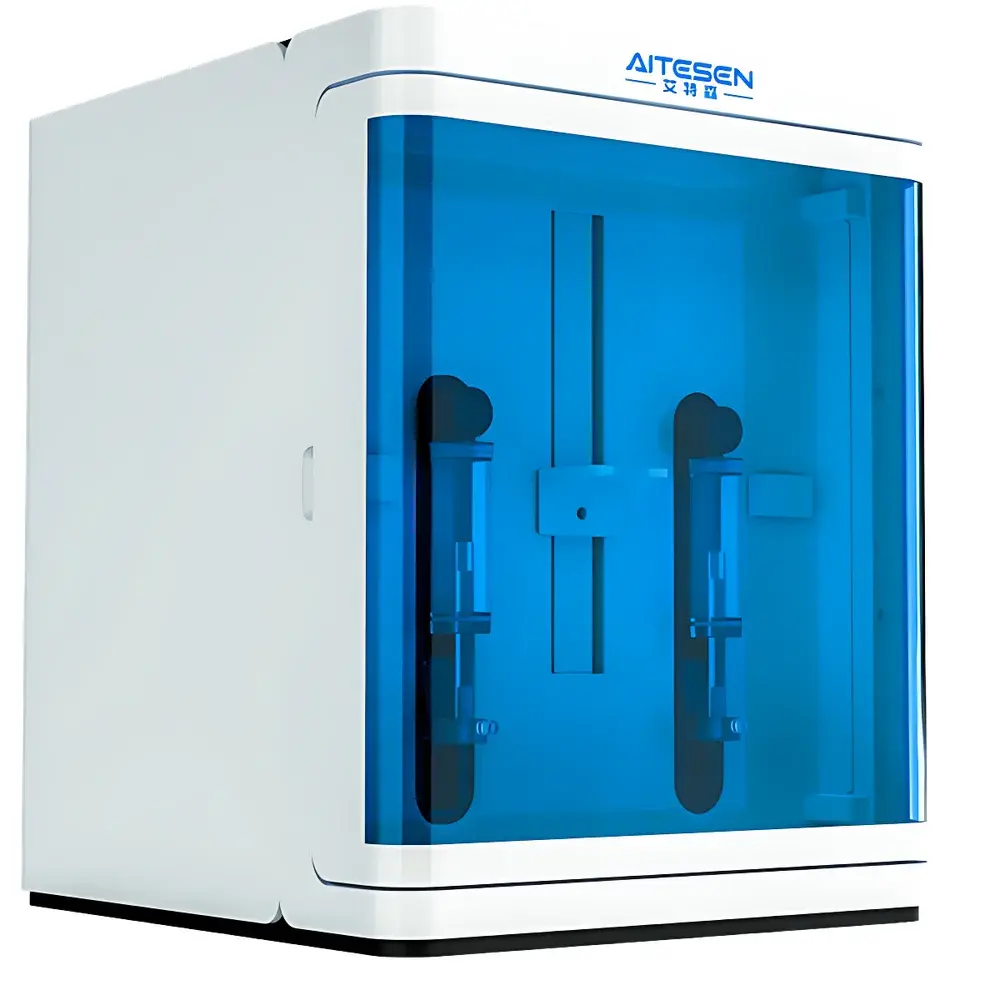
Aitesen MPE-L2 GMP-Compliant Microfluidic Lipid Nanoparticle (LNP) Manufacturing System
| Brand | Aitesen |
|---|---|
| Origin | Jiangsu, China |
| Manufacturer Type | Authorized Distributor |
| Product Category | Domestic |
| Model | MPE-L2 |
| Pricing | Available Upon Request |
| Payload Carrier Type | Lipid Nanoparticle (LNP) |
Overview
The Aitesen MPE-L2 is a benchtop-scale, GMP-aligned microfluidic platform engineered for the reproducible, continuous preparation of lipid nanoparticles (LNPs) used in nucleic acid delivery—particularly mRNA, siRNA, and DNA therapeutics. It operates on the principle of hydrodynamic flow focusing and controlled turbulent mixing within precision-machined microchannels, leveraging laminar-to-transitional flow regimes to achieve rapid, homogeneous nanoprecipitation. Unlike batch-based ethanol injection or thin-film hydration methods, the MPE-L2 enables real-time modulation of critical process parameters—including flow rate ratio (FRR), total flow rate (TFR), mixing time, and post-mixing residence duration—thereby directly governing nucleation kinetics, particle growth, and final colloidal stability. Its architecture supports both single-step primary emulsification and sequential two-stage processing (e.g., LNP formation followed by PEGylation or surface functionalization), making it suitable for formulation screening, process parameter mapping, and Phase I–II clinical material generation under documented development conditions.
Key Features
- GMP-ready design with stainless steel fluid-contact surfaces, electropolished tubing, and traceable component certification per ISO 13485-compliant manufacturing practices
- Dual-syringe pump system enabling independent, programmable control of aqueous (Phase A) and organic (Phase B) streams with flow rate resolution down to 0.01 mL/min
- On-the-fly multi-injection capability: allows sequential introduction of additional reagents (e.g., crosslinkers, targeting ligands, or stabilizers) without interrupting ongoing nanoparticle synthesis
- Integrated high-pressure microfluidic chip module (up to 200 MPa) for post-emulsification size homogenization via impingement and shear-driven fragmentation
- Modular chip interface supporting interchangeable microchannel geometries—including T-junction, staggered herringbone, and vortex-assisted designs—for empirical optimization of mixing efficiency and polydispersity index (PDI)
- Real-time pressure monitoring at inlet and chip outlet with automatic overpressure shutdown (threshold configurable between 50–200 MPa)
Sample Compatibility & Compliance
The MPE-L2 accommodates standard LNP formulation solvents (e.g., ethanol, isopropanol), ionizable lipids (DLin-MC3-DMA, SM-102, ALC-0315), phospholipids (DSPC, DOPC), cholesterol, and PEG-lipids (DMG-PEG2000, ALC-0159) across concentration ranges typical for preclinical development (0.5–5 mg/mL RNA payload; 1–20 mM total lipid). All wetted materials comply with USP Class VI biocompatibility standards. The system supports documentation packages aligned with ICH Q5A(R2), Q5B, and Q5D for viral vector and nucleic acid therapeutic development. While not certified as a full GMP production line, its operational logs, parameter locking, and audit trail functionality meet baseline requirements for GLP-compliant lab environments and early-phase GMP process validation per FDA Guidance for Industry: Quality Considerations for Clinical Trials (2022) and EMA’s Guideline on Quality of mRNA-Based Therapeutics (CHMP/BWP/677050/2022).
Software & Data Management
The embedded control software provides deterministic sequence programming with up to 99 step-defined protocols, each storing flow profiles, pressure curves, temperature setpoints (ambient only), and timestamped event logs. Export formats include CSV and XML for integration into LIMS or electronic lab notebooks (ELN). Audit trail features record user login/logout events, parameter changes, and emergency stop triggers—fully compliant with ALCOA+ principles. Optional 21 CFR Part 11 add-on module enables electronic signatures, role-based access control, and immutable log archiving for regulated environments. No cloud connectivity is enabled by default; all data remains resident on the local industrial PC unless explicitly exported via secure USB transfer.
Applications
- Rapid screening of LNP composition space (lipid molar ratios, PEG density, ionizable lipid pKa variants)
- Correlation of microfluidic mixing parameters (FRR, TFR, chip geometry) with downstream characteristics: encapsulation efficiency (measured by RiboGreen®), cryo-TEM morphology, serum stability (FBS incubation assay), and in vitro transfection potency (luciferase reporter assays)
- Process robustness studies under deliberate perturbations (e.g., ±5% flow deviation, ±2°C ambient fluctuation) to define proven acceptable ranges (PARs)
- Technology transfer support: identical chip configurations and protocol files can be deployed across multiple MPE-L2 units to ensure inter-site consistency during multi-center preclinical studies
- Scalability assessment: linear scale-up correlation established between MPE-L2 output (1–10 mL/min) and pilot-scale microfluidic systems (e.g., Precision NanoSystems NanoAssemblr® Ignite or Gen 3 platforms)
FAQ
Is the MPE-L2 qualified for GMP manufacturing?
No—it is designed for research use and early-stage process development under GMP-aligned conditions. Final commercial manufacturing requires qualification of a fully validated, facility-integrated system meeting Annex 1 and ISO 14644-1 Class C/D cleanroom integration standards.
Can custom microfluidic chips be fabricated and validated?
Yes. Aitesen collaborates with ISO 13485-certified microfabrication partners to deliver application-specific chips with full dimensional inspection reports, leak testing (≤1 × 10⁻⁹ mbar·L/s He), and functional test data against reference formulations.
What is the minimum sample volume required per run?
As low as 200 µL total (100 µL aqueous + 100 µL organic phase) for preliminary screening—ideal for precious mRNA or modified nucleotide constructs.
Does the system support inline particle size monitoring?
Not natively. However, the outlet stream is compatible with external inline DLS (e.g., Wyatt DynaPro NanoStar) or FFF-MALS coupling via standardized 1/16″ SS tubing and zero-dead-volume connectors.
How is cleaning and sterilization performed?
Wetted components are cleaned using graded ethanol/water flushes (70% → 30% → DI water), followed by nitrogen purging. Sterilization is achieved via autoclaving of removable chip carriers and syringe modules (121°C, 20 min); non-autoclavable pumps require vaporized hydrogen peroxide (VHP) chamber treatment.



