
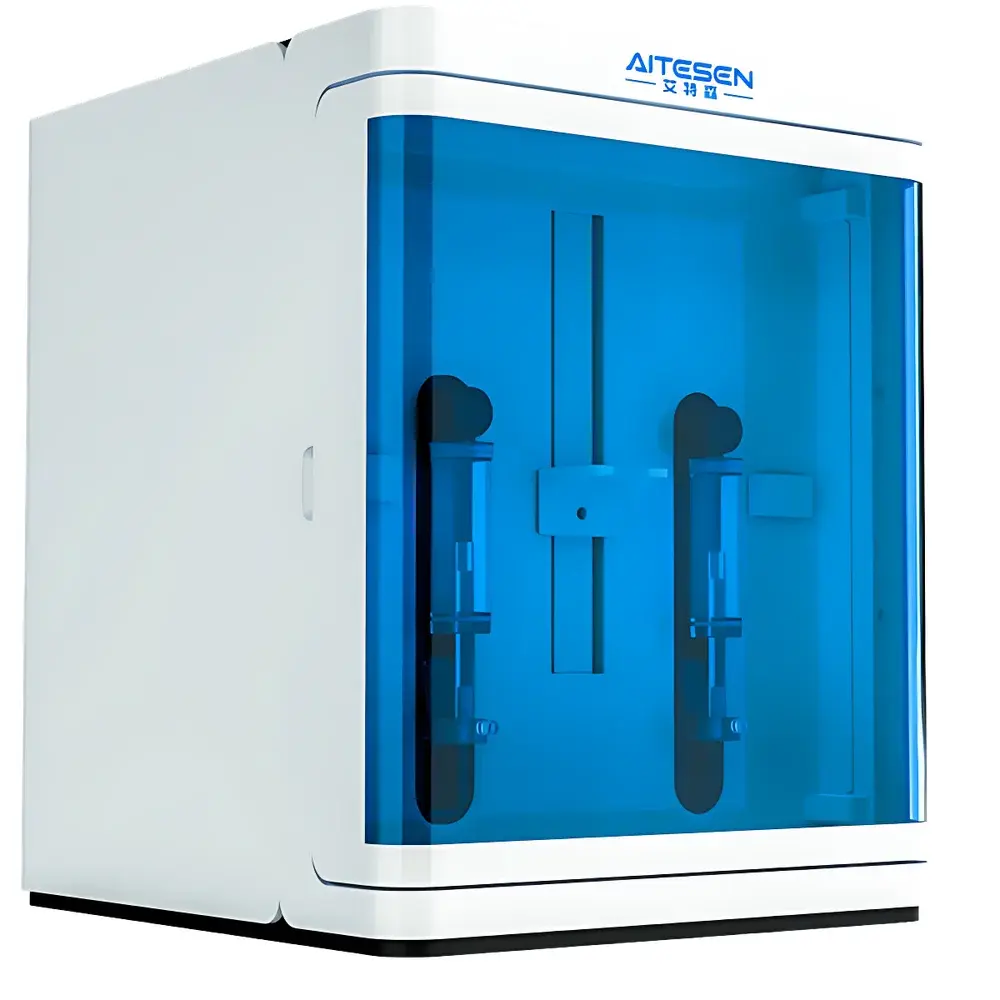
Aitesen MPE-L2 GMP-Compliant Microfluidic Nanomedicine Preparation System
| Brand | Aitesen |
|---|---|
| Origin | Jiangsu, China |
| Manufacturer Type | Authorized Distributor |
| Product Category | Domestic |
| Model | MPE-L2 |
| Carrier Type | Liposomes |
| Particle Size Range | <100 nm |
| Polydispersity Index (PDI) | <0.1 |
| Flow Control | Dual-syringe Pump Driven |
| Chip Integration | Modular High-Pressure Microfluidic Chip |
| Process Mode | Continuous On-Line Preparation (OPT) |
| Compliance Framework | Designed for GMP-aligned process development and early-stage validation |
Overview
The Aitesen MPE-L2 is a benchtop microfluidic nanomedicine preparation system engineered for reproducible, scalable formulation development of lipid-based nanocarriers—particularly liposomes—under controlled, continuous-flow conditions. It operates on the principle of hydrodynamic focusing and controlled shear-induced emulsification within precision-machined microchannels. Unlike batch-based homogenization or sonication methods, the MPE-L2 implements laminar-to-turbulent transition control in real time via adjustable flow rate ratios and pressure differentials across dual-phase inlets (Phase A: aqueous phase; Phase B: organic/lipid phase). This enables deterministic control over nucleation kinetics, interfacial stabilization, and subsequent particle growth—critical parameters governing final liposome size distribution, encapsulation efficiency, and membrane integrity. The system is explicitly designed for technology transfer from lab-scale formulation screening to pilot-scale process validation, supporting Quality-by-Design (QbD) workflows aligned with ICH Q5A, Q5C, and FDA guidance on nanotechnology-based products.
Key Features
- Dual independent syringe pump architecture enabling precise volumetric delivery of immiscible phases at flow rates from 0.01–5 mL/min with ≤1% CV repeatability
- Modular high-pressure microfluidic chip interface accommodating custom chip geometries (T-junction, staggered herringbone, hydrodynamic flow-focusing) for tailored mixing regimes
- In-process re-injection capability: allows sequential addition of stabilizers, crosslinkers, or targeting ligands without interrupting primary emulsification
- Integrated pressure monitoring (0–200 MPa range) and real-time flow feedback loop for closed-loop process stability
- GMP-ready mechanical design: stainless steel fluid paths, electropolished wetted surfaces, and traceable component labeling compliant with ISO 13485 manufacturing documentation standards
- Zero dead-volume chip coupling with standardized Luer-lock and Swagelok®-compatible fittings for rapid chip exchange and cleaning validation
Sample Compatibility & Compliance
The MPE-L2 supports formulation of lipid nanoparticles (LNPs), solid lipid nanoparticles (SLNs), polymeric micelles, and nanoemulsions using phospholipids (e.g., DPPC, DSPC), cholesterol, PEG-lipids, and ionizable lipids. It is validated for use with common organic solvents (ethanol, isopropanol) and aqueous buffers (PBS, HEPES, citrate) across pH 4.0–9.0. All wetted materials meet USP Class VI biocompatibility requirements. While not a certified GMP production unit, the MPE-L2 meets critical design attributes referenced in Annex 1 (EU GMP) for aseptic process simulation and early-phase clinical material preparation. Its operational parameters are documented per ASTM E2500-13 (Guide for Specification, Design, and Verification of Pharmaceutical and Biopharmaceutical Manufacturing Systems) and support PAT implementation per FDA’s 2019 Guidance on Process Analytical Technology.
Software & Data Management
The embedded control interface provides synchronized logging of flow rates, pressure transients, temperature (ambient sensor), and total processed volume at 100 Hz sampling frequency. Export formats include CSV and HDF5 for integration with LIMS or electronic lab notebooks (ELN). Audit trail functionality complies with 21 CFR Part 11 requirements when deployed on validated Windows OS platforms. Optional Python API enables automated parameter sweeps (e.g., flow ratio ramping, pressure stepping) and integration with in-line DLS or UV-Vis modules for real-time quality attribute monitoring. All method files store metadata including chip ID, calibration date, operator ID, and environmental conditions—ensuring full traceability during regulatory submissions.
Applications
- Rapid screening of lipid composition and molar ratios for mRNA/LNP formulation optimization
- Development of temperature-sensitive thermosensitive liposomes for triggered drug release
- Preparation of PEGylated stealth liposomes with controlled surface density and circulation half-life
- Scale-down modeling of industrial high-pressure homogenizers for DoE-based process characterization
- Generation of reference standards with narrow PDI (<0.1) for method validation of dynamic light scattering (DLS) and nanoparticle tracking analysis (NTA)
- Continuous synthesis of hybrid nanocarriers (e.g., liposome-polymer hybrids) via secondary emulsification stages
FAQ
Can the MPE-L2 be used for sterile manufacturing?
No—it is intended for non-sterile R&D and process development. Sterile filtration and aseptic filling must occur downstream using ISO 5-certified equipment.
What chip configurations are supported out-of-the-box?
Standard delivery includes a hydrodynamic flow-focusing chip (100 µm channel) and a staggered herringbone mixing chip (200 µm). Custom chips are available under NDA with lead times of 4–6 weeks.
Is training provided for method development?
Yes—Aitesen offers a 2-day on-site application workshop covering chip selection, flow ratio optimization, PDI reduction strategies, and troubleshooting of clogging or phase separation.
Does the system support GLP-compliant data archiving?
When configured with validated software and networked storage, raw data logs and audit trails satisfy GLP data integrity requirements per OECD Principles of Good Laboratory Practice.
What maintenance is required for long-term reliability?
Quarterly calibration of syringe pumps and annual pressure transducer verification are recommended. Chip cleaning protocols (isopropanol flush + nitrogen purge) are included in the operator manual.
Related Products





