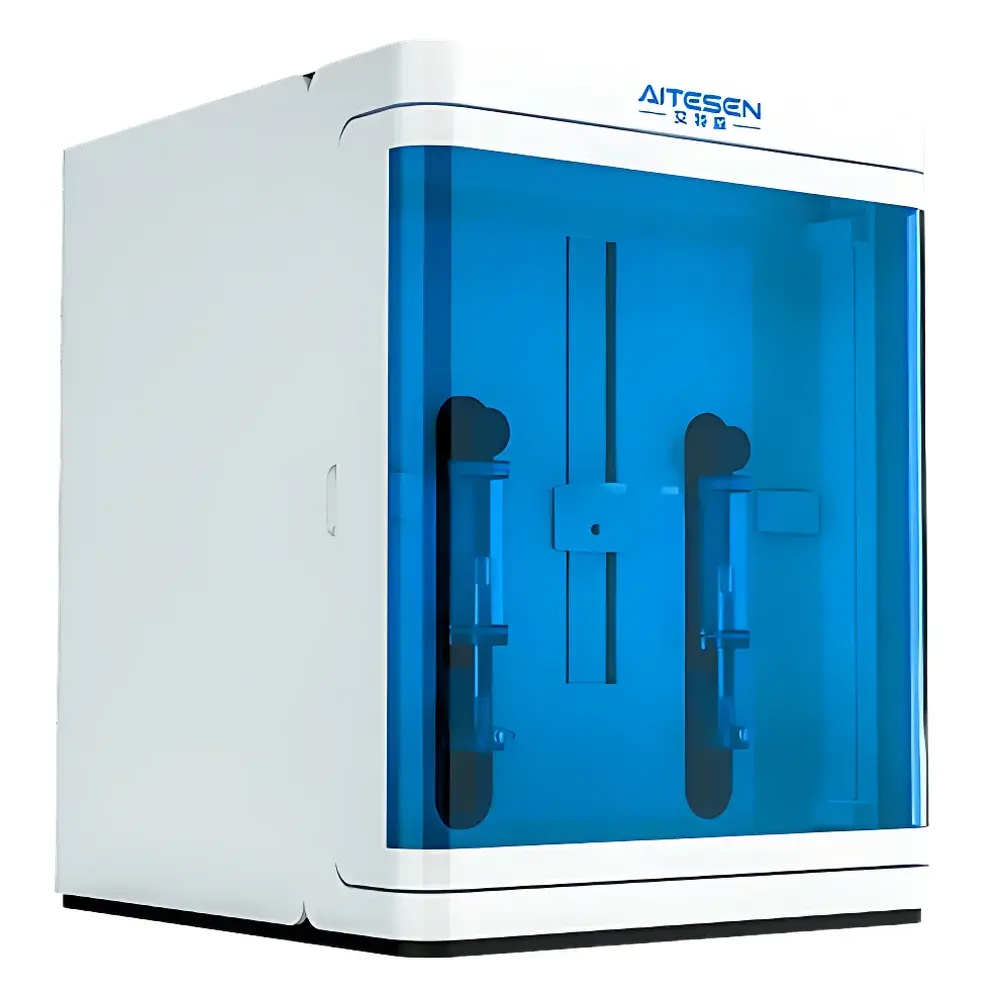
Aitesen MPE-L2 Microfluidic Nanoparticle Preparation System for Lipid Nanoparticle (LNP) Vaccine Adjuvant and Liposome Formulation
| Brand | Aitesen |
|---|---|
| Origin | Jiangsu, China |
| Manufacturer Type | Authorized Distributor |
| Product Origin | Domestic (China) |
| Model | MPE-L2 |
| Carrier Type | Lipid Nanoparticle (LNP) |
| Pricing | Available Upon Request |
| Pump-Driven Architecture | Dual-Syringe Precision Injection Pumps |
| Chip-Based Processing | Customizable Microfluidic Chip Platform |
| Minimum Sample Volume | < 100 µL per run |
| Particle Size Range | Down to < 100 nm |
| Polydispersity Index (PDI) | < 0.1 achievable under optimized conditions |
Overview
The Aitesen MPE-L2 Microfluidic Nanoparticle Preparation System is an engineered platform designed for the controlled, reproducible synthesis of lipid-based nanocarriers—specifically lipid nanoparticles (LNPs) and liposomes—used in vaccine adjuvant development, mRNA delivery research, and early-stage nanomedicine process validation. It operates on the principle of hydrodynamic flow focusing and controlled laminar/turbulent interfacial mixing within microstructured channels, enabling precise manipulation of fluid dynamics at the microliter-to-nanoliter scale. Unlike conventional bulk-phase emulsification methods (e.g., sonication or high-shear homogenization), the MPE-L2 implements continuous-flow microfluidics to achieve deterministic nanoparticle formation through defined residence time, mixing ratio, and shear history. This architecture supports first-principles-driven process understanding—critical for Quality by Design (QbD) frameworks—and facilitates seamless transition from lab-scale formulation screening to scalable, GMP-aligned manufacturing protocols.
Key Features
- Dual independent syringe pump modules with programmable flow rate control (0.001–5 mL/min, resolution ±0.001 mL/min), enabling precise volumetric ratio adjustment between aqueous (e.g., nucleic acid buffer) and organic (e.g., ethanol-dissolved lipid) phases.
- In-line, real-time sample injection capability: allows sequential or iterative introduction of reagents during an ongoing run—ideal for staged encapsulation, surface functionalization, or multi-step LNP assembly.
- Modular microfluidic chip interface compatible with custom-designed silicon/glass/PDMS chips; chip geometry (e.g., T-junction, herringbone, staggered herringbone, or chaotic mixer designs) governs mixing regime (laminar vs. transitional flow), nucleation kinetics, and final particle morphology.
- Integrated post-mixing high-pressure processing stage (optional integration with external high-pressure homogenizer or built-in microfluidic shear module) for secondary size refinement and PDI reduction.
- Compact benchtop footprint (W × D × H: 320 × 450 × 280 mm) with CE-compliant electrical safety and chemical-resistant fluid path materials (e.g., PTFE, stainless steel 316, borosilicate glass).
Sample Compatibility & Compliance
The MPE-L2 supports a broad range of biocompatible formulations including ionizable cationic lipids (e.g., DLin-MC3-DMA, SM-102), phospholipids (DSPC, DOPE), cholesterol, PEGylated lipids (DMG-PEG2000), and aqueous payloads such as plasmid DNA, siRNA, mRNA, and protein antigens. All wetted components comply with USP Class VI and ISO 10993-5 cytotoxicity standards. The system architecture permits full traceability of process parameters (flow rates, temperature, timing), supporting alignment with ICH Q5A(R2), Q5B, and FDA Guidance for Industry on “Quality Considerations for Clinical Trials of Gene Therapy Products.” While not a GMP-certified instrument per se, its design enables documentation practices consistent with GLP audit requirements and 21 CFR Part 11-compliant data handling when paired with validated third-party acquisition software.
Software & Data Management
The MPE-L2 operates via embedded firmware with USB/RS-232 connectivity and optional Ethernet interface. A dedicated Windows-based control application provides graphical workflow configuration—including multi-segment flow profiles, timed valve actuation, and synchronized logging of pump status, elapsed time, and error codes. All operational metadata (timestamped flow logs, chip ID, user-defined batch ID) are exported in CSV or XML format for integration into laboratory information management systems (LIMS) or electronic lab notebooks (ELN). Audit trail functionality meets ALCOA+ principles (Attributable, Legible, Contemporaneous, Original, Accurate, Complete, Consistent, Enduring, Available) when deployed in regulated environments.
Applications
- Rapid screening of LNP formulation matrices (lipid ratios, PEG-lipid %, N:P ratios) for mRNA encapsulation efficiency and colloidal stability.
- Development of adjuvant-loaded liposomal vaccines targeting dendritic cell activation via TLR agonists (e.g., MPLA, CpG) or STING ligands.
- Process parameter mapping (e.g., total flow rate, flow rate ratio, chip geometry) to establish design space per ICH Q8(R2).
- Preparation of reference standards and comparability batches for analytical method development (DLS, NTA, TEM, HPLC-SEC).
- Education and training in microfluidic nanoparticle engineering for academic and industrial biomanufacturing programs.
FAQ
Is the MPE-L2 suitable for GMP manufacturing?
No—the MPE-L2 is intended for R&D, process development, and preclinical batch production. It is not qualified as a GMP production unit; however, its process parameters are directly transferable to scalable microfluidic platforms (e.g., NanoAssemblr® Ignite or Precision NanoSystems systems) used in clinical manufacturing.
Can I use my own microfluidic chips with the MPE-L2?
Yes—the system features standardized 1/4″-28 UNF threaded ports and compatible fluidic connectors (e.g., NanoPort™ or equivalent), allowing integration of third-party or in-house fabricated chips, provided dimensional and pressure specifications are verified.
What is the typical particle size reproducibility across repeated runs?
Under fixed operating conditions (same chip, same solvent system, calibrated pumps), DLS-measured Z-average diameter exhibits CV ≤ 3% and PDI ≤ 0.08 across ≥5 consecutive batches—demonstrating high inter-run consistency essential for DoE studies.
Does the system support temperature-controlled operation?
The base configuration does not include active temperature regulation; however, ambient-temperature-sensitive protocols can be supported using externally jacketed chips or integration with commercial Peltier-cooled chip holders (custom mounting required).
Is technical support available for chip design consultation?
Aitesen partners with certified microfabrication service providers and offers application engineering support for initial chip layout review, fluidic simulation guidance (COMSOL/ANSYS), and empirical performance benchmarking against target specifications.