
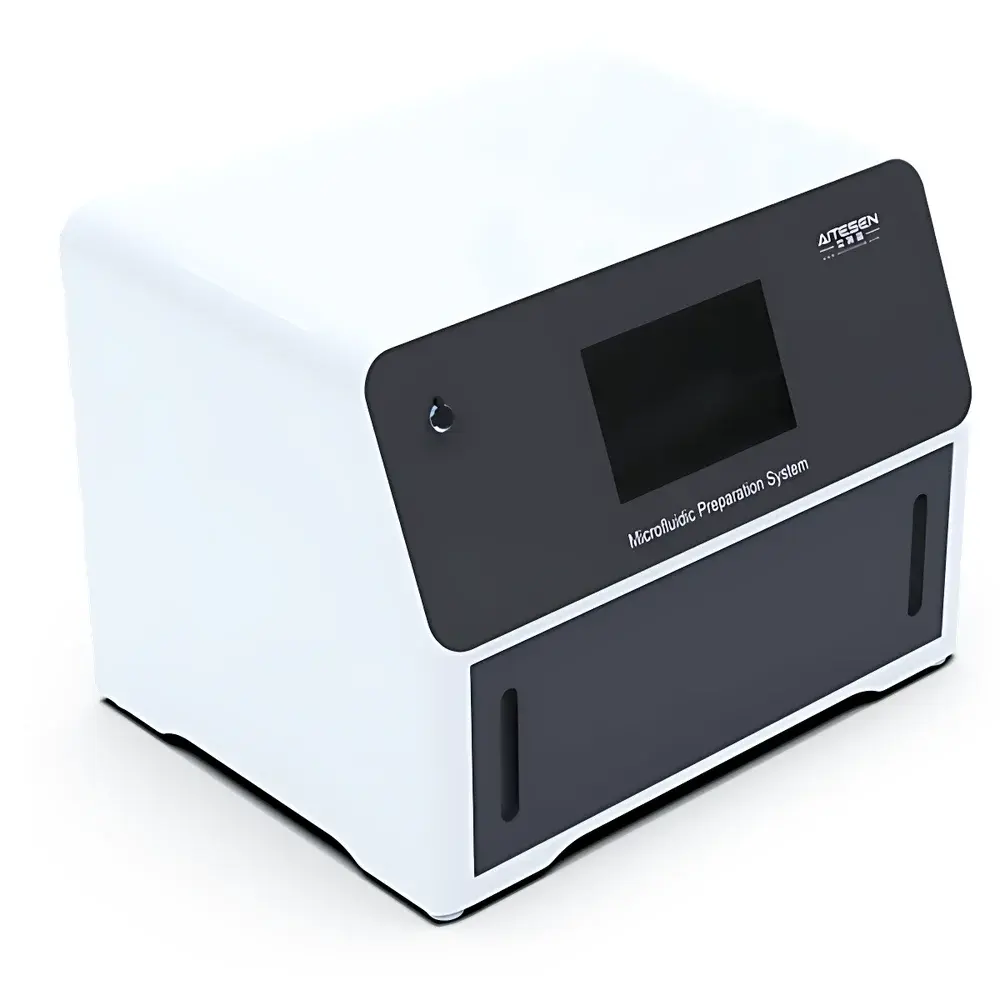
Aitesen MPE-P1 Microfluidic Nanomedicine Production System
| Brand | Aitesen |
|---|---|
| Origin | Jiangsu, China |
| Manufacturer Type | Authorized Distributor |
| Product Category | Domestic |
| Model | MPE-P1 |
| Carrier Type | Lipid Nanoparticles (LNP) |
| Pricing | Upon Request |
Overview
The Aitesen MPE-P1 Microfluidic Nanomedicine Production System is a pilot-scale, integrated microfluidic platform engineered for the reproducible, scalable preparation of advanced nanocarrier formulations. It operates on the principle of controlled hydrodynamic focusing and laminar/turbulent interfacial mixing within precision-machined microchannels—enabling deterministic nanoparticle formation via rapid solvent displacement, spontaneous self-assembly, or controlled emulsification. Unlike batch-based or bulk homogenization methods, the MPE-P1 implements continuous-flow microfluidics grounded in fundamental fluid mechanics, where residence time, flow rate ratio (FRR), total flow rate (TFR), and chip geometry collectively govern nucleation kinetics, particle growth, and final colloidal architecture. This physics-driven approach ensures thermodynamic and kinetic control over critical quality attributes (CQAs), including mean particle diameter (Z-average), polydispersity index (PDI), encapsulation efficiency (EE%), and surface charge (zeta potential)—all essential for regulatory-compliant development of nucleic acid therapeutics (e.g., mRNA-LNP, siRNA-LNP), liposomal chemotherapeutics (e.g., doxorubicin, irinotecan), and polymer-based delivery systems (e.g., PLGA, PEG-PLGA).
Key Features
- Pilot-scale continuous processing capacity: 1–50 mL/min total flow rate, supporting process transfer from lab-scale screening to clinical manufacturing readiness.
- Integrated touchscreen HMI with real-time parameter logging (flow rates, pressure, temperature), automatic batch record generation, and CSV/Excel data export compliant with ALCOA+ principles.
- Dual-syringe high-precision peristaltic pumps and high-pressure conveying pump (up to 200 bar) for stable co-injection of aqueous and organic phases under precisely defined FRRs.
- Modular microfluidic chip interface accommodating application-specific chip designs—including multi-stage chips for sequential emulsification, incubation, size homogenization, and secondary mixing.
- Robust architecture with stainless-steel wetted parts, solvent-compatible fluid paths (compatible with ethanol, isopropanol, chloroform, and aqueous buffers), and CE-marked electrical safety compliance.
- Reproducible sub-100 nm particle generation with PDI < 0.1 under optimized conditions—validated across LNP, liposome, polymeric nanoparticle, and oil-in-water emulsion formulations.
Sample Compatibility & Compliance
The MPE-P1 supports a broad spectrum of nanocarrier classes: lipid nanoparticles (LNPs) for mRNA/siRNA delivery; multilamellar and unilamellar liposomes; biodegradable polymeric nanoparticles (e.g., PLGA, PCL, chitosan); nanoemulsions and microemulsions (e.g., vaccine adjuvants, parenteral fat emulsions); and inorganic colloids (e.g., gold, iron oxide nanoparticles). All process parameters—including flow dynamics, shear history, and mixing time—are fully traceable and auditable. The system’s data management framework aligns with FDA 21 CFR Part 11 requirements for electronic records and signatures when deployed with validated software configurations. It supports GLP- and GMP-aligned workflows through configurable user access levels, electronic audit trails, and IQ/OQ documentation templates. While not certified to ISO 13485 out-of-the-box, the platform is designed to integrate into ISO 13485- or Annex 1-compliant facility environments with appropriate qualification.
Software & Data Management
The embedded control software provides intuitive graphical workflow configuration, real-time monitoring of pressure transients and flow stability, and automated calibration routines for pump priming and zero-offset correction. Batch metadata—including timestamps, operator ID, chip ID, environmental temperature, and raw sensor outputs—is embedded into each exported dataset. Export formats include timestamped .csv files for statistical process control (SPC) analysis and .xlsx reports formatted for inclusion in regulatory submissions (e.g., CMC sections of IND/IMPD dossiers). Optional API integration enables connection to LIMS or MES platforms for centralized data aggregation and trending across multiple MPE-P1 units. All software updates are version-controlled and accompanied by change logs meeting ICH Q5A(R2) traceability standards.
Applications
- Process development and optimization of LNP formulations for mRNA vaccines and gene-editing therapeutics.
- Rapid screening of liposome composition (e.g., HSPC, cholesterol, DSPE-PEG2000) and hydration parameters for small-molecule encapsulation.
- Scale-down modeling of commercial microfluidic production lines to de-risk tech transfer and support Quality-by-Design (QbD) initiatives.
- Preclinical batch manufacturing of GMP-like material for toxicology and PK/PD studies.
- Development of sterile-fill compatible nanoemulsions for adjuvant delivery or parenteral nutrition.
- Controlled synthesis of hybrid organic–inorganic nanoparticles for theranostic applications.
FAQ
What microfluidic chip configurations are supported?
The MPE-P1 accepts custom-designed chips with standard 1/4″-28 UNF inlet/outlet ports. Common configurations include Y-junction, T-junction, herringbone, and multi-layer staggered herringbone (SLH) chips—each optimized for specific mixing regimes (diffusive vs. convective) and downstream processing steps.
Is the system suitable for aseptic processing?
While the base system is not Class A/B-certified, it can be installed within ISO 5 (Class 100) isolators or RABS and qualified for aseptic operation using sterilizable chips, pre-sterilized tubing sets, and SIP-capable fluid paths upon customer specification.
Can the MPE-P1 be integrated into automated process lines?
Yes—via Modbus TCP or OPC UA protocols, the system supports synchronization with upstream buffer prep stations, downstream tangential flow filtration (TFF) modules, and fill-finish equipment for end-to-end continuous manufacturing demonstration.
What validation documentation is provided?
Standard delivery includes Factory Acceptance Test (FAT) report, User Requirement Specification (URS) cross-reference matrix, and IQ/OQ protocol templates aligned with ASTM E2500 and ISPE Baseline Guide Vol. 5.
Does Aitesen offer chip design support?
Qualified users may engage Aitesen’s Application Engineering team for computational fluid dynamics (CFD)-informed chip design consultation, including ANSYS Fluent-based simulation of mixing efficiency, shear stress distribution, and residence time distribution (RTD) profiling.
Related Products



