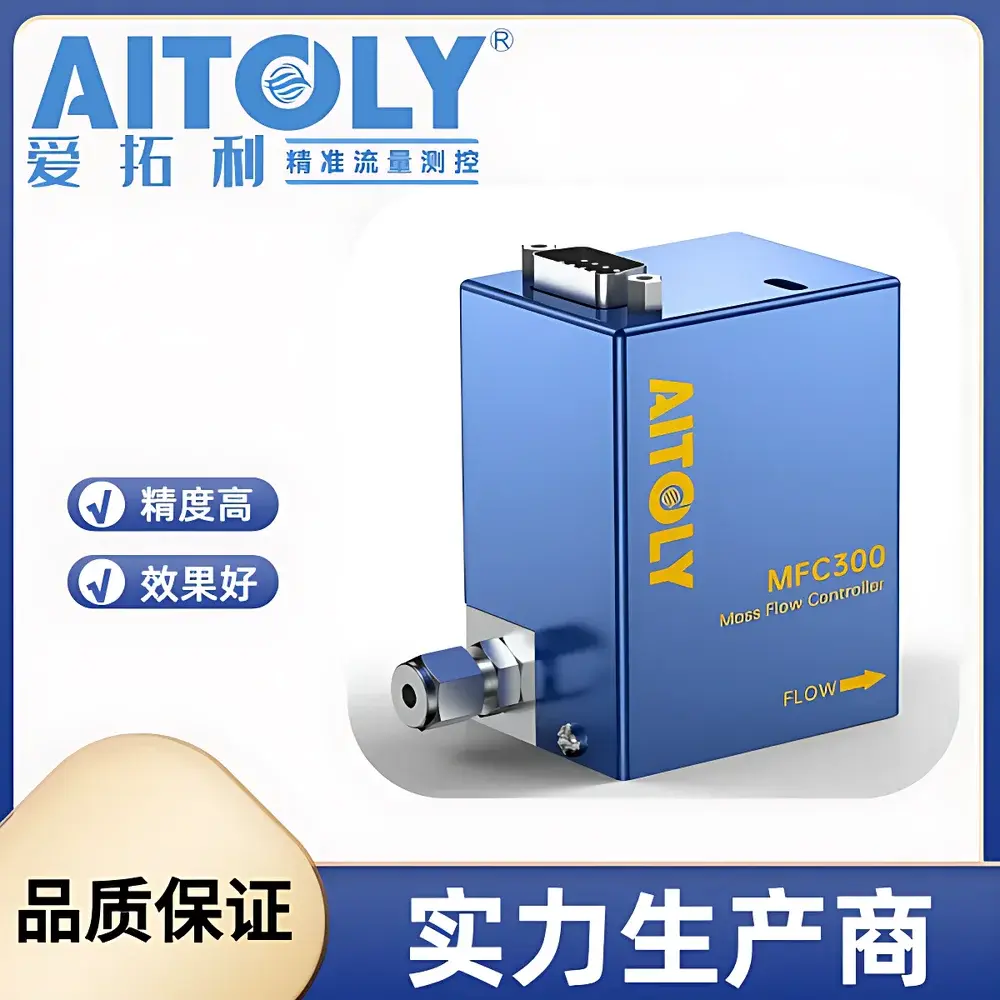
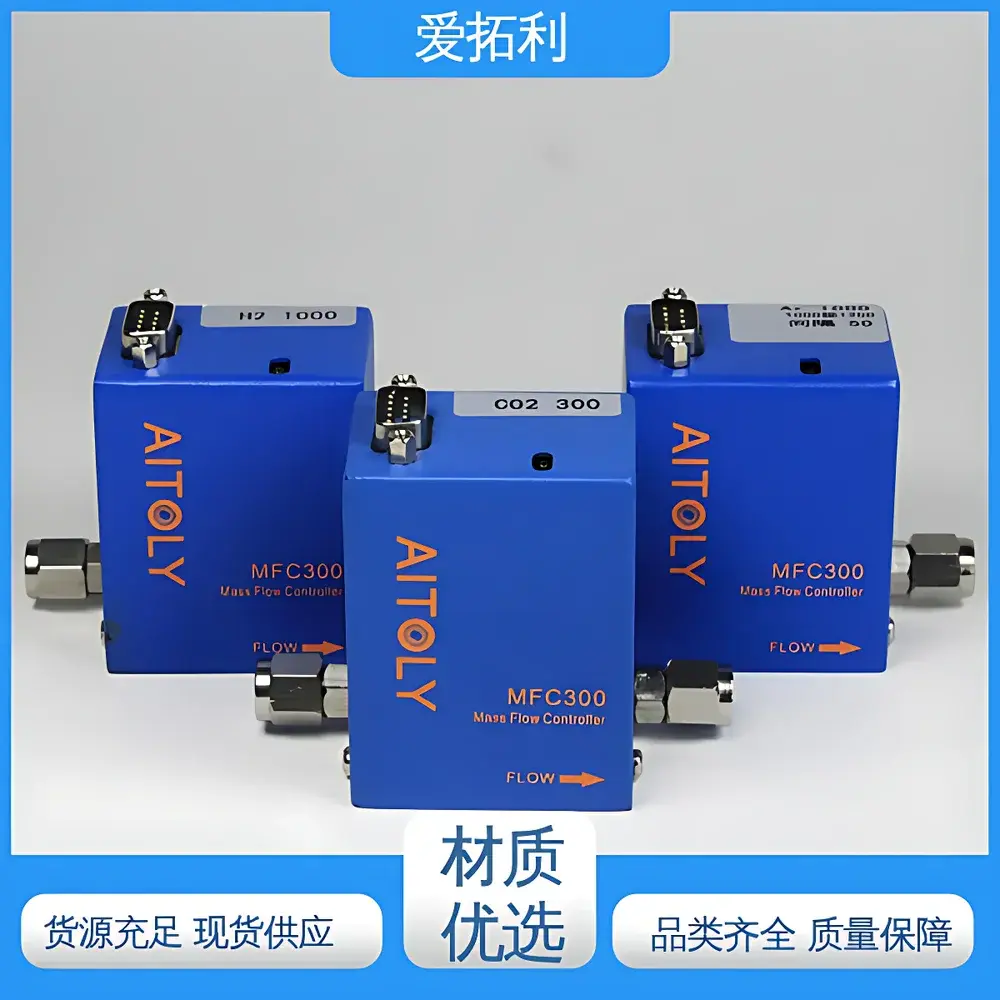
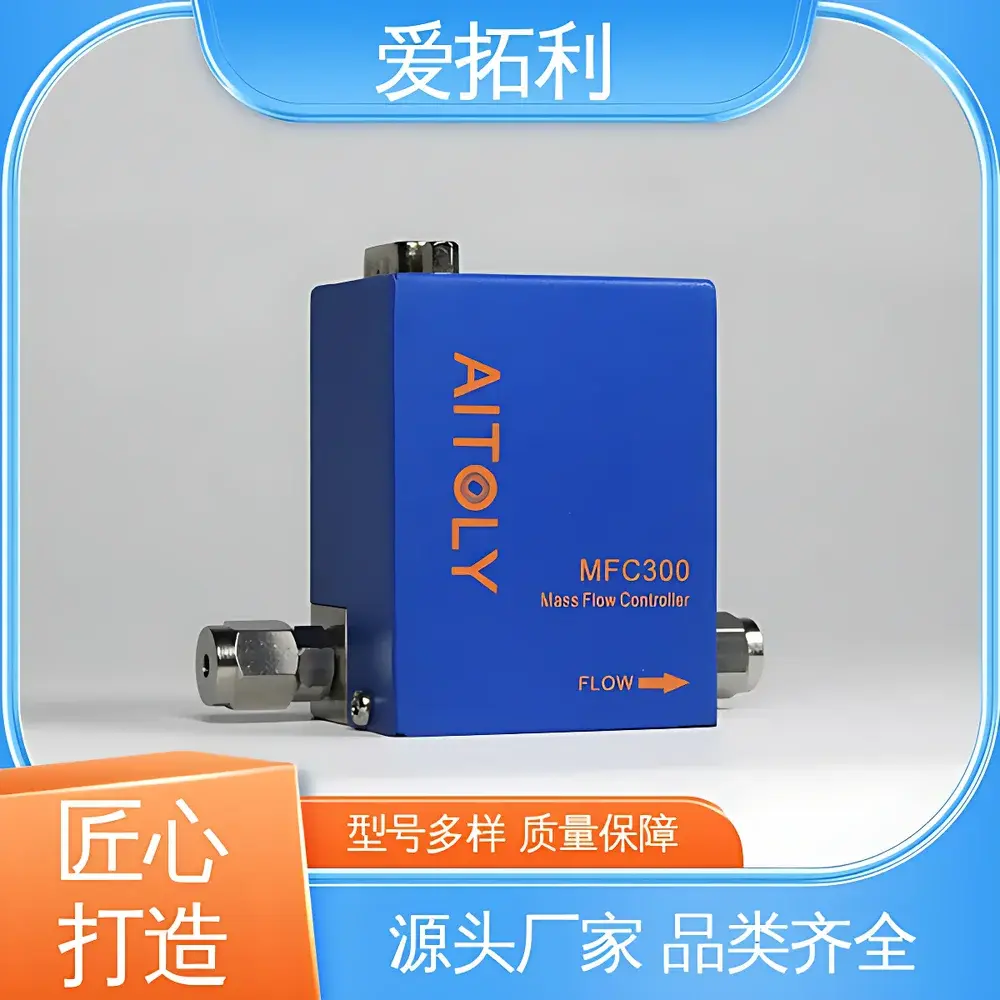
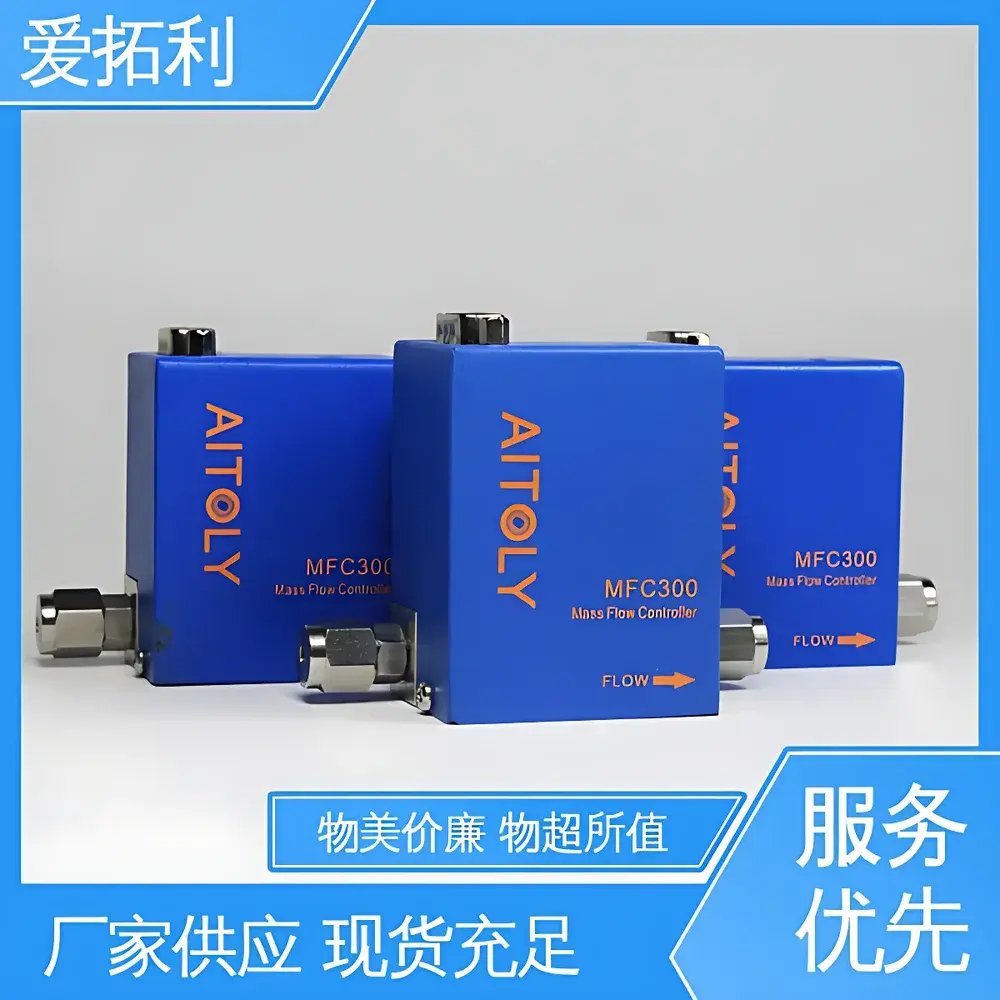
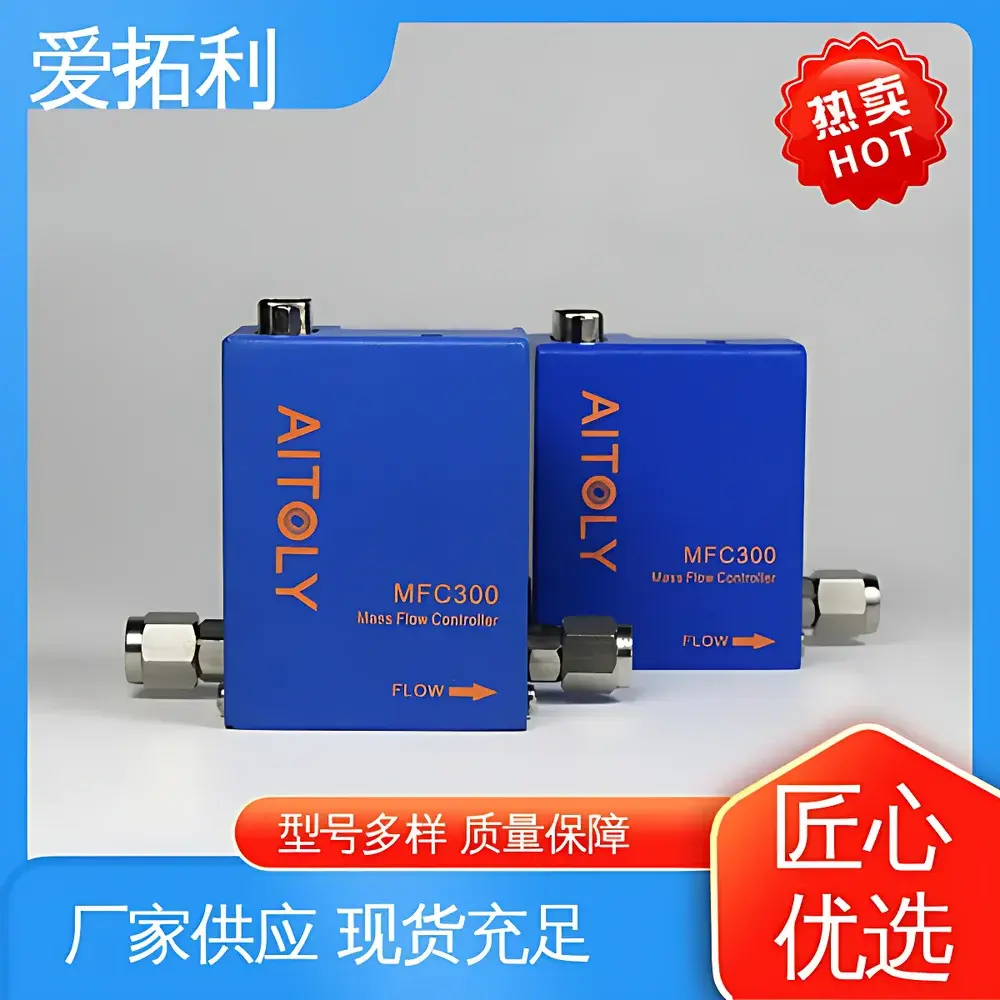
AITOLY MFC300-03A MEMS-Based Thermal Mass Flow Controller
| Brand | AITOLY |
|---|---|
| Origin | Jiangsu, China |
| Type | Thermal Mass Flow Controller |
| Sensor Technology | MEMS with Integrated Temperature & Pressure Compensation |
| Flow Range | 0.2–100% of Full Scale (1:500 turndown) |
| Accuracy | ±0.5% FS |
| Repeatability | ±0.5% FS |
| Linearity | ±0.2% FS |
| Resolution | 0.1 sccm (0–1000 sccm) |
| Sensor Response Time | 5 ms |
| Control Response Time | 300 ms |
| Warm-up Time | ≤1 s |
| Valve Type | Normally Closed |
| Max Operating Pressure | 1.1 MPa (11 bar) |
| Operating ΔP Range | 0–1 MPa |
| Ambient & Gas Temp Range | 0–65 °C |
| Humidity Range | 0–98% RH (non-condensing) |
| Wetted Materials | FKM fluoroelastomer, brass, 300-series stainless steel, silicon seals |
| Enclosure Rating | IP40 |
| Mounting | Omnidirectional |
| Weight | 0.38 kg |
| Connection Options | Push-to-connect, quick-thread, compression, VCR |
Overview
The AITOLY MFC300-03A is a high-performance thermal mass flow controller engineered for precise, real-time measurement and closed-loop control of low-flow-rate gases in laboratory, analytical, and process-critical applications. Based on micro-electromechanical systems (MEMS) technology, the device integrates a thermally sensitive flow sensor element with on-board temperature and pressure compensation circuitry—enabling accurate mass flow quantification independent of ambient or process gas condition fluctuations. Unlike volumetric flow devices, this controller delivers true mass flow output (standard cubic centimeters per minute, sccm), eliminating the need for external correction factors when gas composition, temperature, or pressure deviates from reference conditions. Its compact form factor (0.38 kg), minimal pressure drop (<1 kPa across full scale), and fast dynamic response (5 ms sensor latency, 300 ms control loop settling) make it particularly suitable for integration into gas chromatography sample introduction systems, semiconductor process tool purge lines, fuel cell test benches, and microreactor feed control architectures.
Key Features
- MEMS-based thermal sensor with integrated T&P compensation for stable, composition-aware mass flow output
- Wide turndown ratio of 1:500 (0.2–100% FS), supporting both ultra-low (down to 0.01 sccm with optional resolution) and mid-range (up to 5 slpm) flow regimes
- High metrological performance: ±0.5% FS accuracy and repeatability, ±0.2% FS linearity under calibrated conditions
- Fast warm-up time (≤1 s) and rapid sensor response (5 ms), enabling use in pulsed or transient gas delivery protocols
- Omnidirectional mounting capability and flexible interface options—including push-to-connect, compression, VCR, and quick-thread fittings—for seamless integration into diverse gas handling platforms
- Robust wetted materials package: FKM seals, 300-series stainless steel flow body, brass manifolds, and silicon gaskets ensure compatibility with common industrial and research gases (Air, N₂, O₂, Ar, CH₄, CO₂)
- IP40-rated enclosure with M4 mounting holes and low-profile mechanical footprint (≤5 mm depth clearance required)
Sample Compatibility & Compliance
The MFC300-03A is validated for use with clean, dry, non-corrosive gases only. It is not rated for aggressive media (e.g., Cl₂, NH₃, H₂S), solvent vapors, or particulate-laden streams. For compliance-critical environments—including pharmaceutical process validation, environmental emissions monitoring, or ISO/IEC 17025-accredited laboratories—the unit supports traceable calibration certificates (NIST-traceable where applicable) and may be operated within documented GLP/GMP workflows. While the device itself does not carry CE or UL certification out-of-the-box, its electrical interface (typically 0–5 V or 4–20 mA analog I/O, RS485 Modbus RTU) is compatible with safety-rated PLCs and SCADA systems compliant with IEC 61508 and IEC 61000-6-2/6-4 EMC standards. Users are advised to implement upstream filtration (0.1 µm particulate + coalescing moisture removal) and downstream pressure regulation to maintain specified operating parameters.
Software & Data Management
The MFC300-03A operates as a stand-alone analog/digital instrument but is fully interoperable with third-party control software via standard industrial protocols. Analog output (0–5 V or 4–20 mA) provides direct integration with PID controllers, data loggers, or DAQ systems. Digital communication over RS485 Modbus RTU enables remote configuration of setpoints, flow units, gas type selection (via built-in gas correction factors), and diagnostic reporting—including valve status, sensor health flag, and over-pressure warnings. Firmware updates and calibration parameter loading require proprietary AITOLY configuration utility (Windows-based), which maintains audit trails for critical settings changes—supporting basic 21 CFR Part 11 readiness when deployed with appropriate system-level access controls and electronic signature implementation.
Applications
- Gas feed control in benchtop CVD, PECVD, and ALD reactors
- Carrier and purge gas regulation in GC-FID/TCD and GC-MS systems
- Calibration gas dilution in environmental air quality analyzers (e.g., NOₓ, SO₂ monitors)
- Fuel and oxidizer metering in miniature combustion and electrochemical test cells
- Leak testing and helium sniffing systems requiring sub-sccm resolution
- Lab-scale bioreactor sparging and headspace gas exchange control
- Research-grade gas blending for atmospheric simulation chambers
FAQ
What gases are supported out-of-the-box?
The MFC300-03A includes factory-calibrated correction factors for Air, N₂, O₂, Ar, CH₄, and CO₂. Custom gas calibrations can be loaded via Modbus if the molecular weight and specific heat ratio are known.
Is zero calibration required before operation?
No routine zero calibration is needed due to active thermal drift compensation; however, a one-time zero offset verification is recommended after installation and before first use under actual operating conditions.
Can multiple MFC300 units be daisy-chained on a single RS485 bus?
Yes—up to 32 units may share one RS485 network using unique Modbus slave IDs; termination resistors and proper cable shielding are mandatory for reliable communication beyond 10 m.
Does the device support fail-safe shutdown on signal loss?
The normally closed (NC) solenoid valve defaults to closed position upon power loss or command interruption, ensuring gas isolation without auxiliary safety relays.
What is the maximum allowable differential pressure during operation?
The unit is rated for continuous operation at up to 1 MPa differential pressure across the flow path; exceeding this may compromise sensor stability and long-term repeatability.