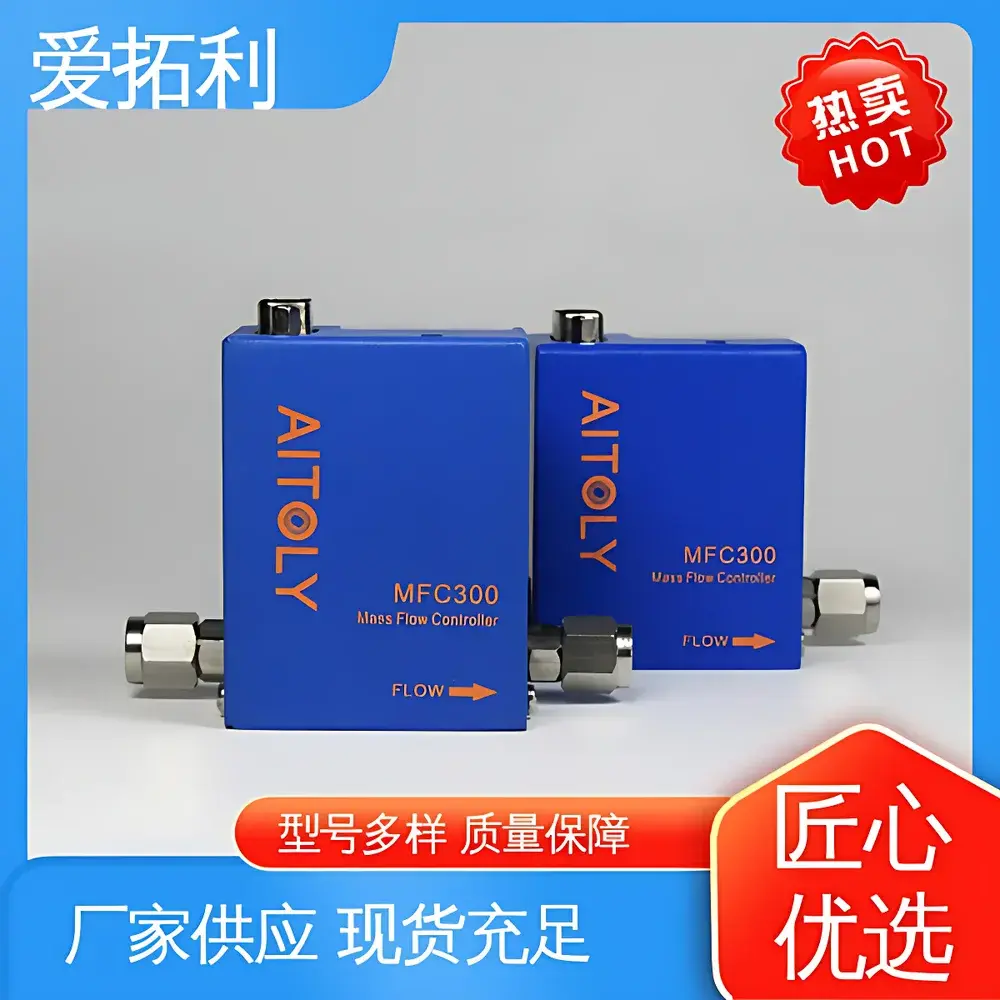
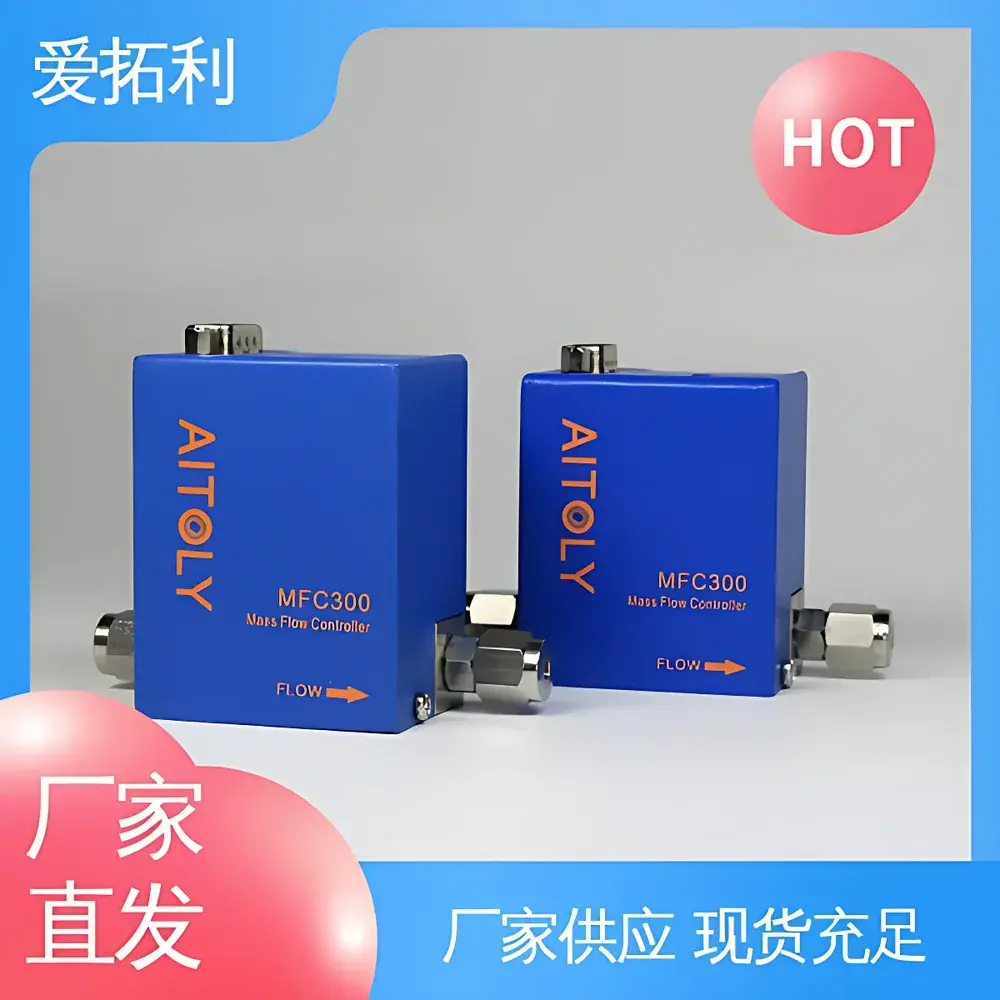
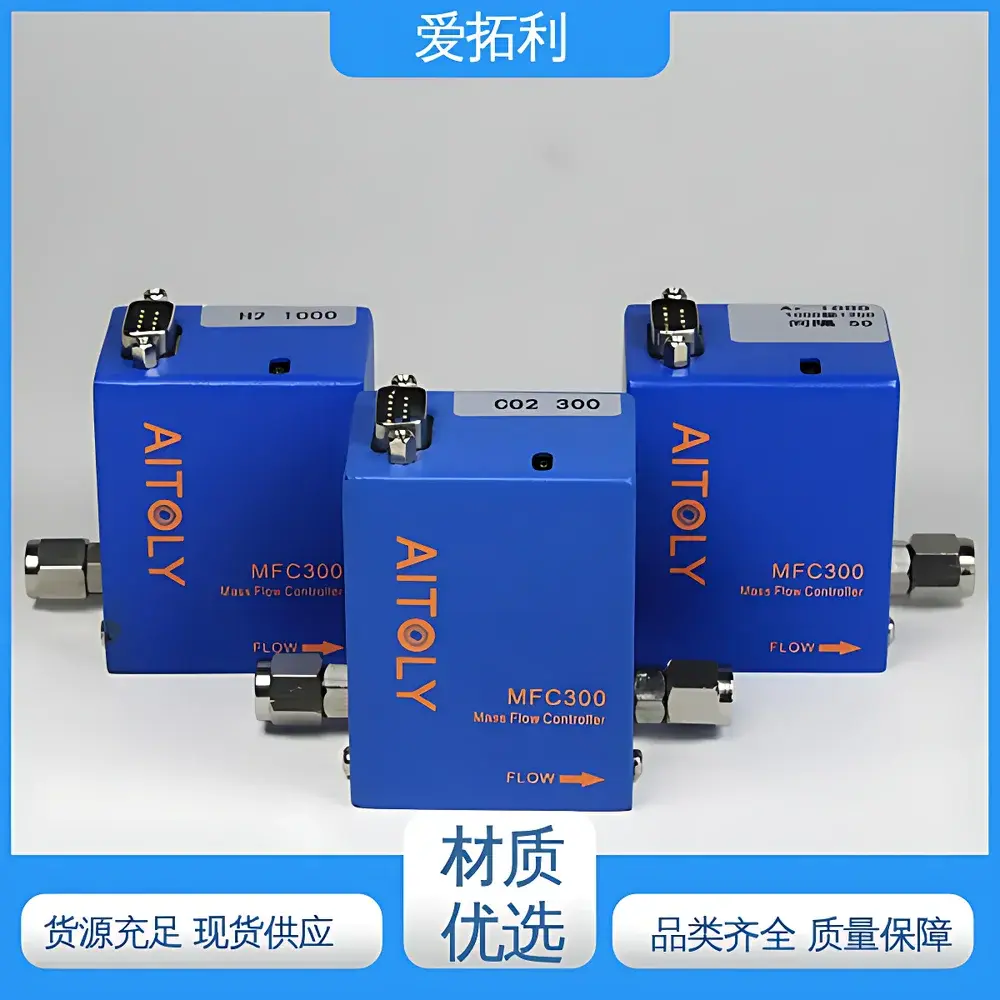
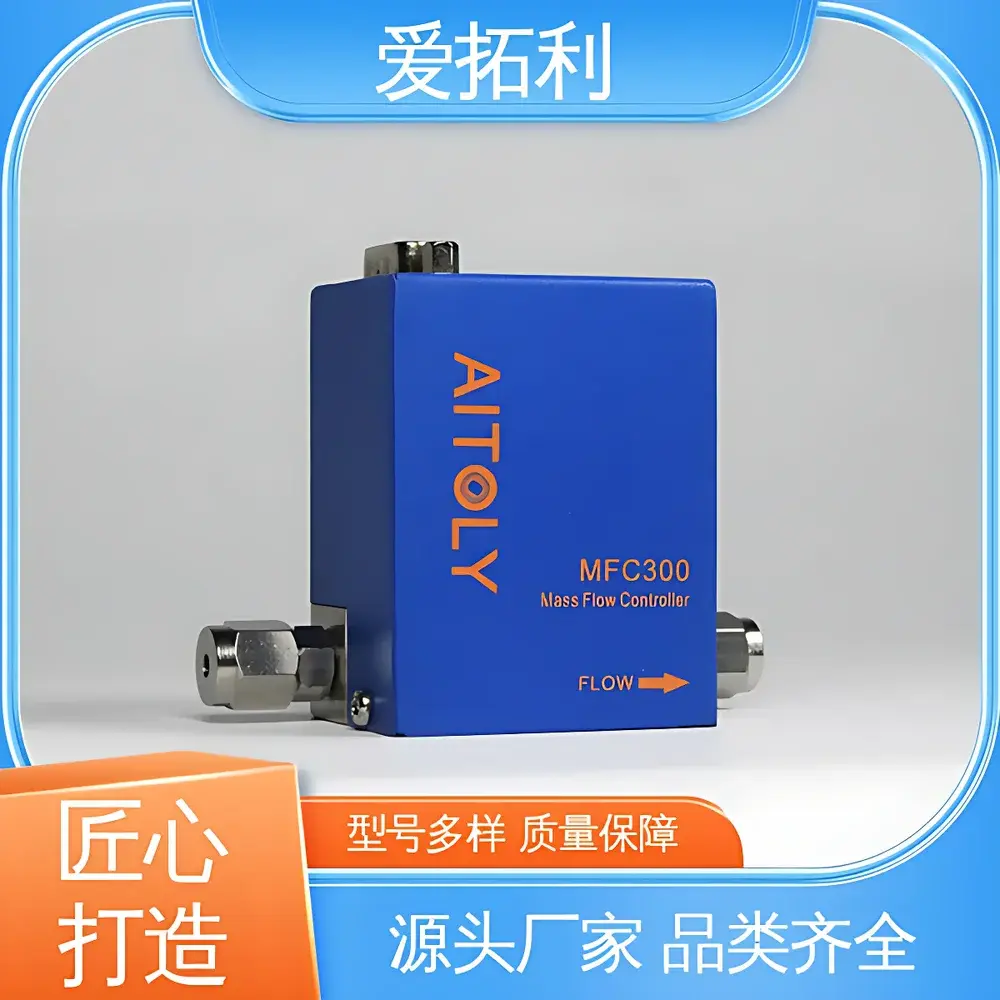
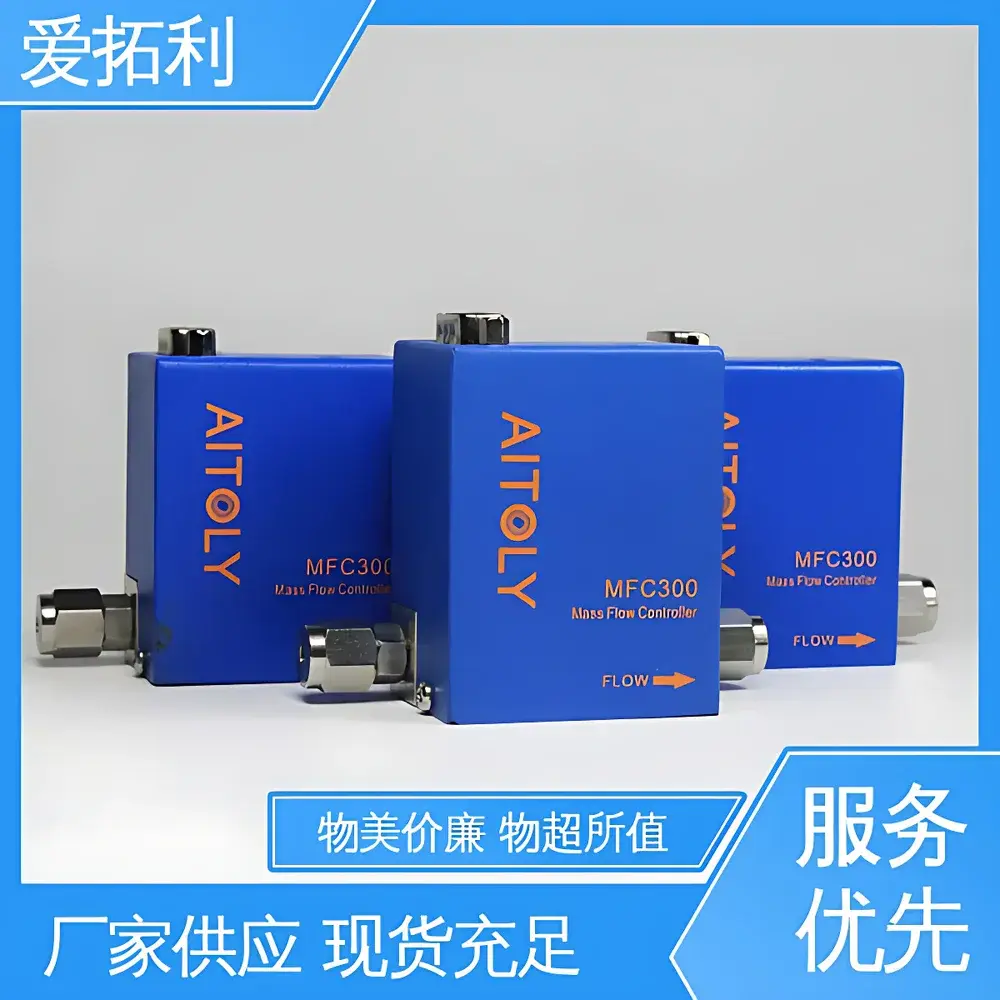
AITOLY MFC300 MEMS-Based Thermal Mass Flow Controller
| Brand | AITOLY |
|---|---|
| Model | MFC300 |
| Type | Thermal Mass Flow Controller |
| Sensor Technology | MEMS Thermal Anemometry |
| Flow Range | 0.2–100% of Full Scale (1:500 turndown) |
| Accuracy | ±0.5% FS |
| Repeatability | ±0.5% FS |
| Linearity | ±0.2% FS |
| Resolution | 0.1 sccm (0–1000 sccm), 1 sccm (1–5 slpm) |
| Sensor Response Time | 5 ms |
| Control Response Time | 300 ms |
| Warm-up Time | ≤1 s |
| Valve Type | Normally Closed |
| Gas Compatibility | Clean, dry, non-corrosive gases (Air, N₂, O₂, Ar, CH₄, CO₂) |
| Pressure & Temperature Compensation | Integrated |
| Pressure Drop | Low |
| Mounting | Flexible (panel, inline, or manifold-compatible) |
Overview
The AITOLY MFC300 is a high-precision, MEMS-based thermal mass flow controller engineered for stable, repeatable gas flow measurement and closed-loop control in laboratory, analytical, and industrial process environments. Unlike volumetric flow devices, the MFC300 employs constant-temperature anemometry (CTA) principles—where a heated MEMS sensor element is maintained at a fixed temperature differential above ambient—and quantifies mass flow via convective heat transfer dynamics. This method eliminates dependence on ambient pressure and temperature fluctuations, enabling true mass flow measurement (standard cubic centimeters per minute, sccm) without external compensation hardware. Its integrated digital signal processing unit performs real-time temperature and pressure compensation using on-board sensors, ensuring compliance with ISO 14644-3 cleanroom airflow validation requirements and supporting traceable calibration protocols aligned with ASTM F2781 and ISO/IEC 17025–accredited practices.
Key Features
- MEMS thermal sensor architecture delivering 5 ms measurement response and 300 ms closed-loop control response, suitable for dynamic process modulation and pulsed gas delivery systems.
- Ultra-wide turndown ratio of 1:500 (0.2–100% FS), enabling accurate low-flow operation down to 0.1 sccm while maintaining linearity across full scale.
- Integrated thermal and barometric compensation ensures stability under variable environmental conditions—critical for applications in gloveboxes, vacuum interface modules, and multi-gas blending systems.
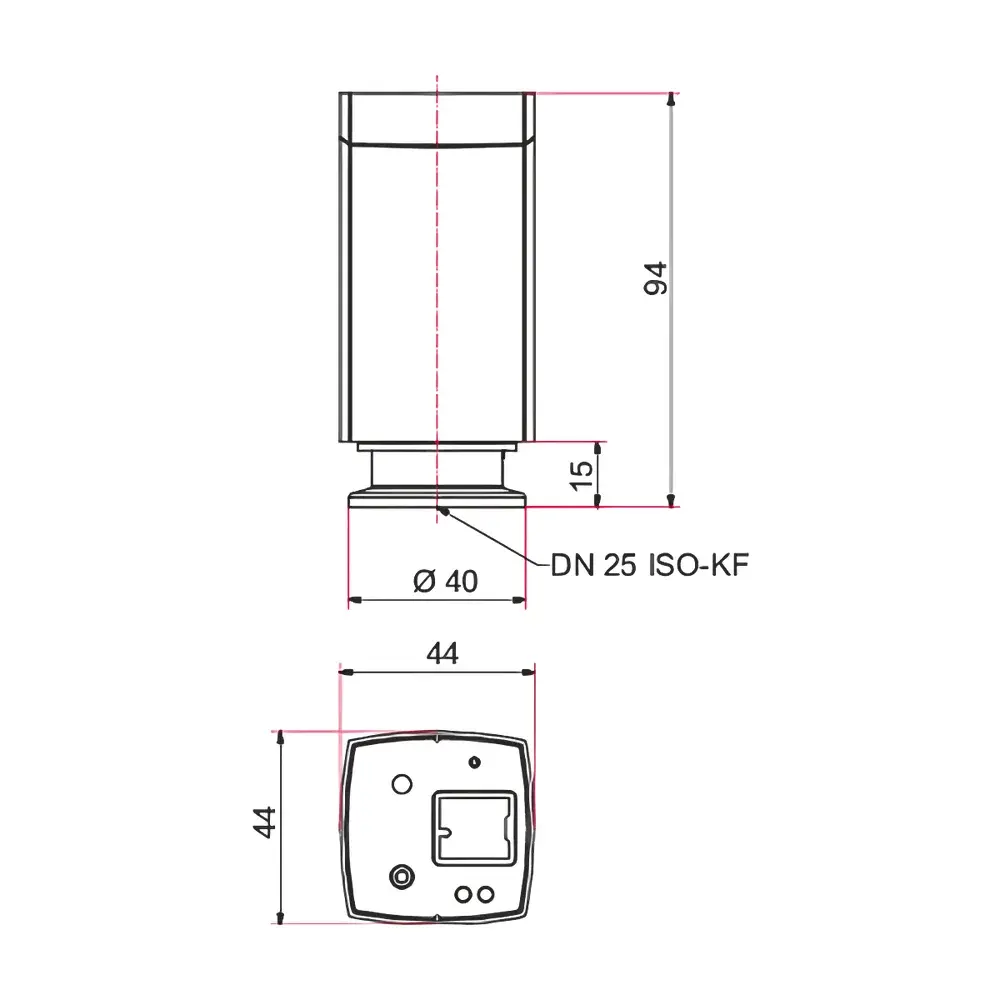
- Compact form factor (≤90 mm × 55 mm × 30 mm) with multiple mounting options: direct inline installation, panel-mount flange, or manifold-integrated configurations—reducing system footprint and minimizing dead volume.
- No preheat requirement (≤1 s warm-up time) enables immediate operational readiness after power-on, supporting high-throughput automated workflows compliant with GLP/GMP instrument qualification (IQ/OQ/PQ).
- Normally-closed piezoelectric or solenoid actuation valve with sub-second settling time, optimized for inert and reactive gas service including nitrogen, oxygen, argon, methane, and carbon dioxide.
Sample Compatibility & Compliance
The MFC300 is validated for use with clean, dry, non-corrosive gases only. It is not rated for humid, particulate-laden, or chemically aggressive media (e.g., HCl, Cl₂, NH₃, or silane). Gas compatibility includes Air, N₂, O₂, Ar, CH₄, and CO₂—with factory calibration traceable to NIST-traceable standards. The device meets CE marking requirements under the EU Electromagnetic Compatibility Directive 2014/30/EU and Low Voltage Directive 2014/35/EU. While not intrinsically safe certified, its low-power design (<2 W typical) and absence of spark-prone components allow deployment in Class 1, Division 2 environments when installed per NEC Article 500 guidelines. For regulated pharmaceutical or medical device manufacturing, the MFC300 supports 21 CFR Part 11-compliant audit trails when interfaced with validated SCADA or LIMS platforms via its RS-485 Modbus RTU or analog 0–5 V / 4–20 mA I/O.
Software & Data Management
The MFC300 operates natively with AITOLY’s FlowConfig™ desktop utility (Windows/macOS), enabling parameter configuration, multi-point calibration verification, and firmware updates. All setpoints, measured values, and valve status are timestamped and logged with microsecond-resolution internal clock synchronization. Optional Ethernet/IP or EtherCAT interfaces support deterministic real-time integration into PLC-controlled gas distribution networks. Data export formats include CSV and HDF5, facilitating post-acquisition analysis in MATLAB, Python (Pandas/NumPy), or LabVIEW. Audit trail records—including user login, parameter changes, and calibration events—are stored onboard with write-protection and SHA-256 hashing, satisfying ALCOA+ data integrity criteria for regulated laboratories.
Applications
- Gas dosing in semiconductor CVD and ALD reactors requiring precise stoichiometric control of precursor flows.
- Calibration transfer standards for secondary flow meters in metrology labs accredited to ISO/IEC 17025.
- Inert gas purging and blanketing in battery electrolyte filling stations and lithium-metal anode coating lines.
- Multi-gas mixing for respiratory simulation systems, environmental chamber conditioning, and combustion research test benches.
- Flow feedback in laser-assisted chemical vapor deposition (LCVD), plasma-enhanced thin-film synthesis, and microfluidic reactor arrays.
FAQ
What gases can the MFC300 measure and control?
Air, nitrogen, oxygen, argon, methane, and carbon dioxide—provided they are clean, dry, and non-corrosive. Custom calibrations for other gases are available upon request with supporting thermophysical property data.
Is the MFC300 compatible with vacuum or pressurized systems?
It is designed for operation at ambient to 300 kPa absolute inlet pressure; downstream vacuum operation is permissible if inlet pressure remains ≥100 kPa abs and differential pressure across the device does not exceed 100 kPa.
Does the device support field recalibration?
Yes—using AITOLY’s certified calibration kit (NIST-traceable reference standard + FlowConfig™), users may perform two-point span adjustment and zero offset correction per ISO 6358 Annex B procedures.
How is long-term stability ensured?
The MEMS sensor undergoes accelerated life testing (>10⁷ cycles) and is hermetically sealed within a stainless-steel housing with gold-plated contacts to minimize drift; typical zero stability is <±0.1% FS/year under continuous operation.
Can multiple MFC300 units be synchronized for coordinated flow control?
Yes—via Modbus TCP broadcast or hardware trigger input, enabling master-slave sequencing with sub-10 ms inter-unit timing jitter for multi-channel gas blending applications.