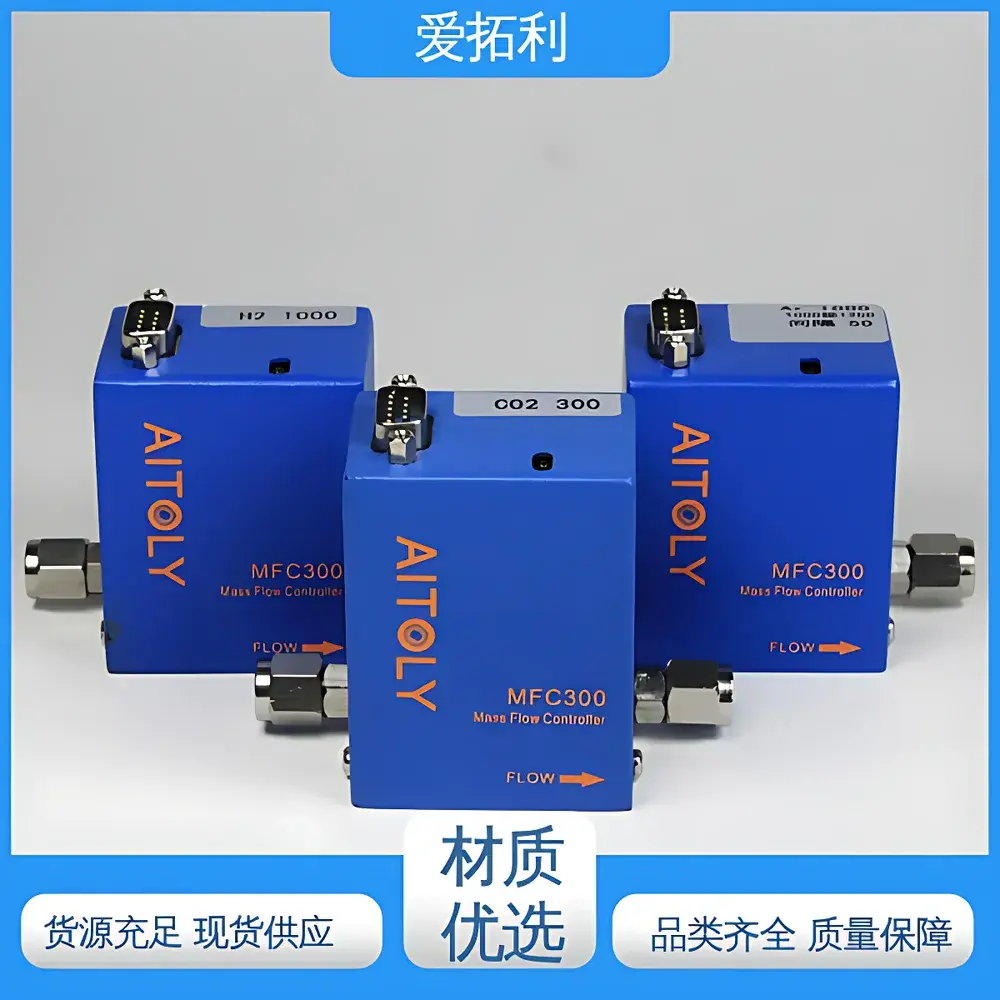
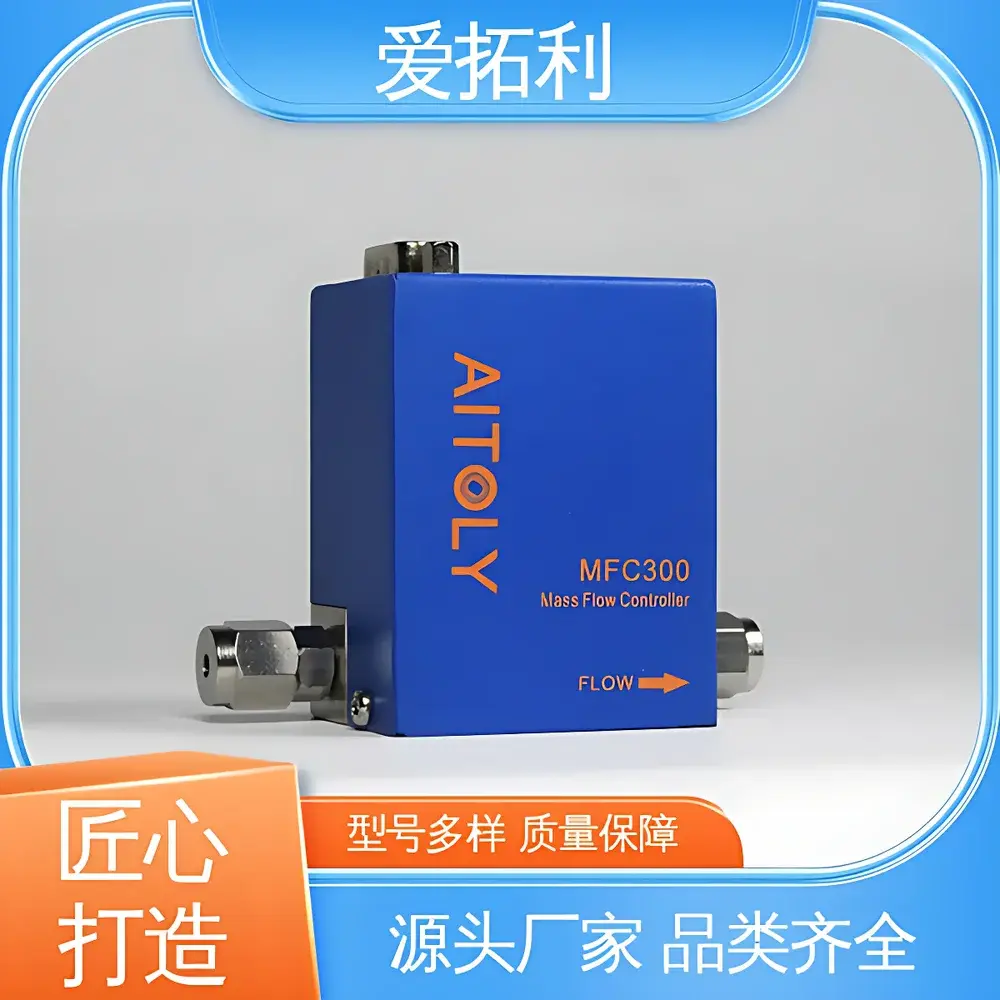
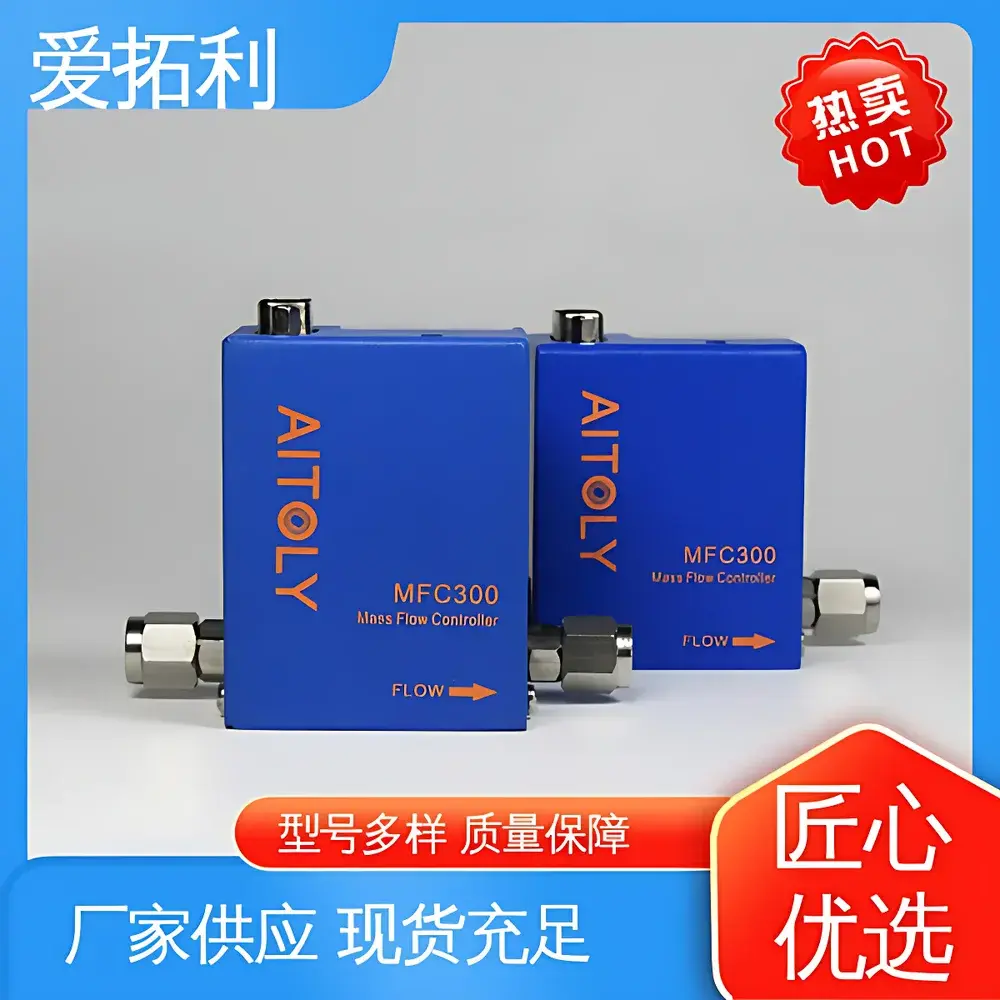
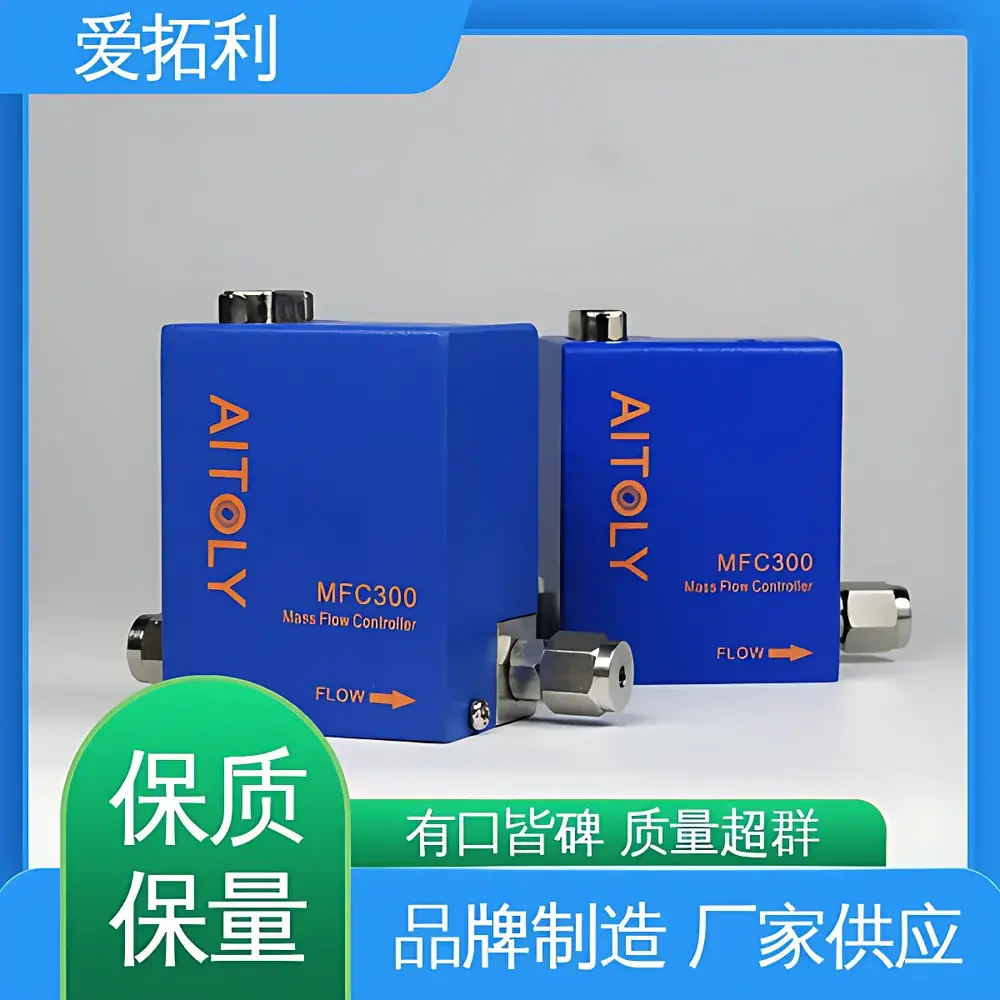
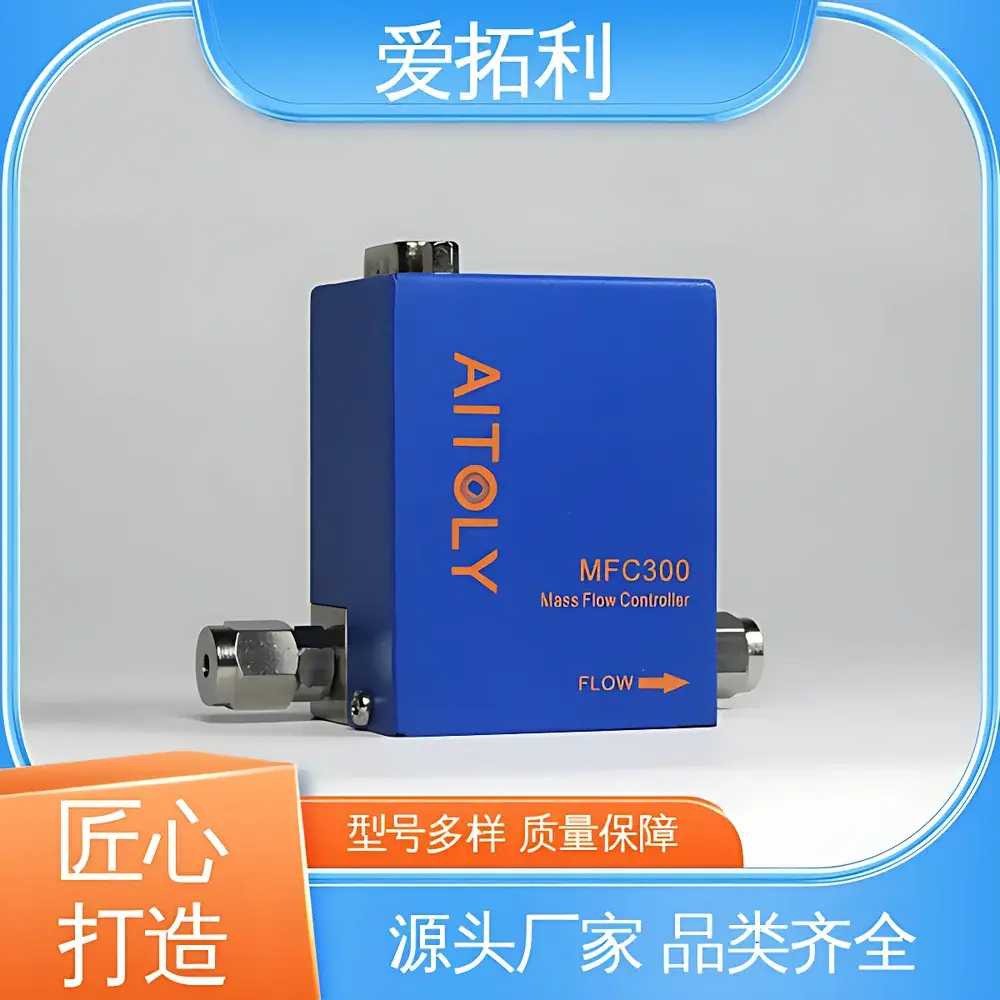
Aitoly MFC300 Series Thermal Mass Flow Controller
| Brand | Aitoly |
|---|---|
| Origin | Jiangsu, China |
| Type | Thermal Mass Flow Controller (MFC) |
| Sensor Technology | MEMS-based with integrated temperature and pressure compensation |
| Flow Range | 0.2–100% F.S. (1:500 turndown ratio) |
| Accuracy | ±0.5% F.S. |
| Repeatability | ±0.5% F.S. |
| Linearity | ±0.2% F.S. |
| Resolution | 0.1 sccm (0–1000 sccm) |
| Sensor Response Time | 5 ms |
| Control Response Time | 300 ms |
| Warm-up Time | ≤1 s |
| Valve Type | Normally Closed (NC) |
| Compatible Gases | Clean, dry, non-corrosive gases including Air, N₂, O₂, Ar, CH₄, CO₂ |
Overview
The Aitoly MFC300 Series Thermal Mass Flow Controller is an engineered solution for precise, real-time measurement and closed-loop control of gas mass flow in laboratory, pilot-scale, and industrial process environments. Based on constant-temperature anemometry (CTA) principles, the device utilizes a micro-electromechanical systems (MEMS) thermal sensor element that directly measures convective heat transfer from a heated surface to the flowing gas stream. This method inherently delivers mass flow output—unaffected by changes in temperature or pressure—eliminating the need for external compensation hardware in most applications. Integrated digital temperature and absolute pressure sensors enable dynamic compensation across varying ambient and process conditions, ensuring consistent metrological performance across its full 1:500 turndown ratio (0.2–100% F.S.). Designed for integration into automated gas delivery systems—including semiconductor tooling, analytical instrumentation, catalytic reactor feeds, and environmental simulation chambers—the MFC300 meets the functional requirements of applications demanding rapid setpoint tracking, high stability, and repeatable dosing accuracy.
Key Features
- MEMS-based thermal sensing architecture with on-chip temperature and absolute pressure compensation
- Ultra-fast sensor response time of 5 ms and closed-loop control response within 300 ms
- No preheat requirement—operational readiness achieved in ≤1 second after power-on
- Compact form factor (standard 1/4″ NPT or M5 threaded ports) supporting panel-mount, inline, or manifold-integrated installation
- Normally closed (NC) proportional solenoid valve with low hysteresis and high cycle life (>10⁷ operations)
- High-resolution digital output: 0.1 sccm (0–1000 sccm range), 1 sccm (1–5 slpm), with optional 0.01 sccm resolution for ultra-low-flow configurations
- Stable repeatability (±0.5% F.S.) and linearity (±0.2% F.S.) validated per ISO 6358 and ASTM D7504 guidelines
Sample Compatibility & Compliance
The MFC300 is calibrated and validated for use with clean, dry, non-corrosive gases including air, nitrogen (N₂), oxygen (O₂), argon (Ar), methane (CH₄), and carbon dioxide (CO₂). It is not rated for use with vapors, condensable gases, particulate-laden streams, or chemically aggressive media such as Cl₂, NH₃, H₂S, or HF. All wetted materials conform to ASTM F2022 standards for elastomer compatibility and are certified RoHS-compliant. While not intrinsically safe or explosion-proof, the unit may be deployed in Class I, Division 2 environments when installed per NEC Article 500 guidelines. Calibration certificates traceable to NIST standards are available upon request, and device firmware supports audit-ready logging for GLP/GMP-aligned workflows.
Software & Data Management
The MFC300 communicates via standard RS-485 (Modbus RTU) or optional analog 0–5 V / 4–20 mA interfaces. A Windows-compatible configuration utility enables full parameterization—including flow range selection, PID tuning, alarm thresholds, and gas-specific calibration coefficients. The software supports multi-device daisy-chaining, batch calibration import/export, and timestamped event logging (e.g., setpoint changes, fault codes, valve status). For integration into SCADA or MES platforms, Modbus register maps include real-time flow value, temperature, pressure, valve position, and diagnostic flags. Firmware updates preserve user-configured settings and support secure version rollback. Data export formats include CSV and XML, compatible with LIMS systems requiring 21 CFR Part 11–compliant audit trails when paired with validated host software.
Applications
- Precise gas dosing in plasma etch and CVD tools for semiconductor fabrication
- Carrier and reactant gas control in GC, GC-MS, and ICP-MS sample introduction systems
- Mass flow regulation in fuel cell test stations and hydrogen safety validation rigs
- Controlled atmosphere generation for accelerated corrosion testing (ASTM G85 Annex A5)
- Low-flow calibration of secondary flow sensors and leak detection standards
- Gas blending and dilution systems for emissions monitoring equipment (EPA Method 205)
FAQ
Is the MFC300 suitable for use with humidified gases?
No. The MEMS sensor is sensitive to condensation and particulate accumulation; inlet gas must be dried to a dew point ≤ –20°C and filtered to ≤0.1 µm.
Can the device be recalibrated for a different gas without hardware modification?
Yes—gas-specific correction factors can be loaded via software using built-in NIST-traceable gas property tables; no physical sensor replacement is required.
What is the maximum allowable system backpressure for stable operation?
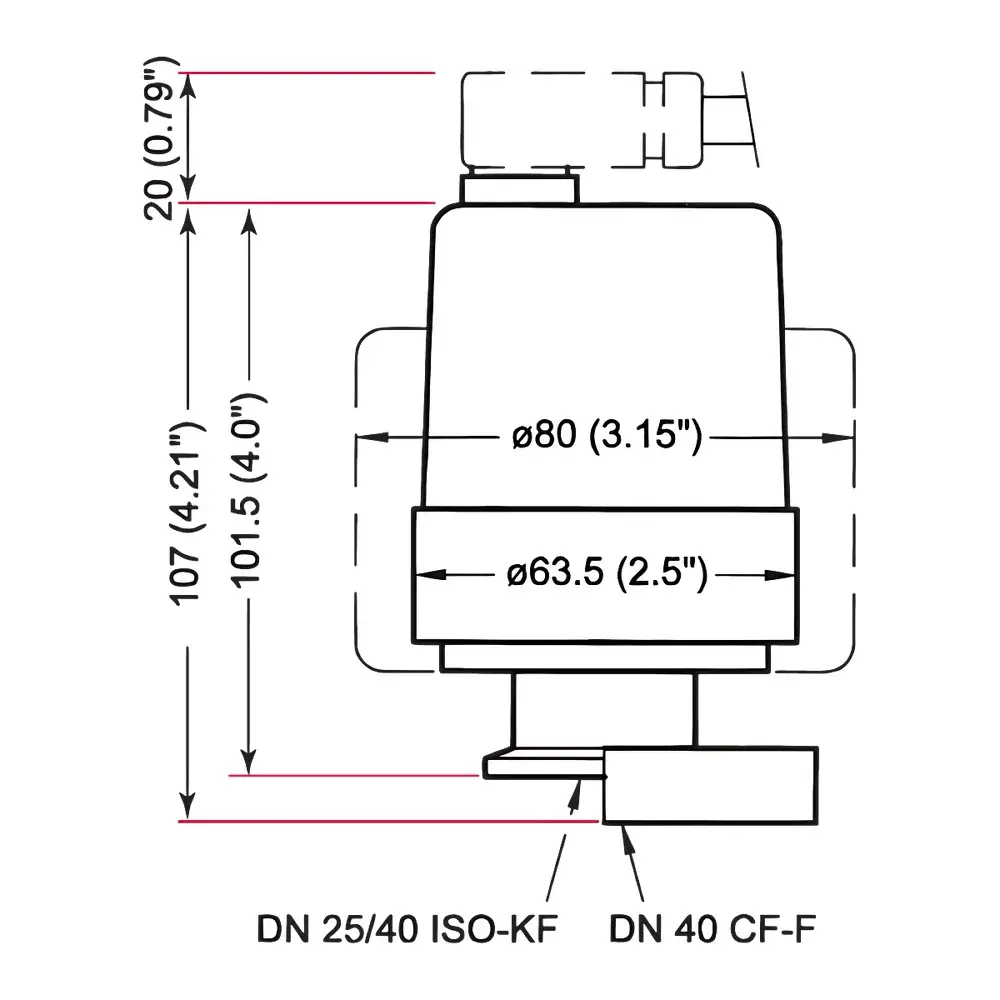
The controller maintains specification compliance up to 10 bar absolute inlet pressure and differential pressure ≤3 bar; consult the mechanical drawing for port-specific pressure ratings.
Does the MFC300 support fail-safe behavior during communication loss?
Yes—configurable fail-safe modes include hold-last-value, return-to-zero, or maintain current setpoint, activated within 100 ms of communication timeout.
How is long-term drift managed during continuous operation?
The embedded auto-zero algorithm performs periodic baseline correction during zero-flow intervals; recommended zero-check frequency is every 24 hours for critical metrology applications.