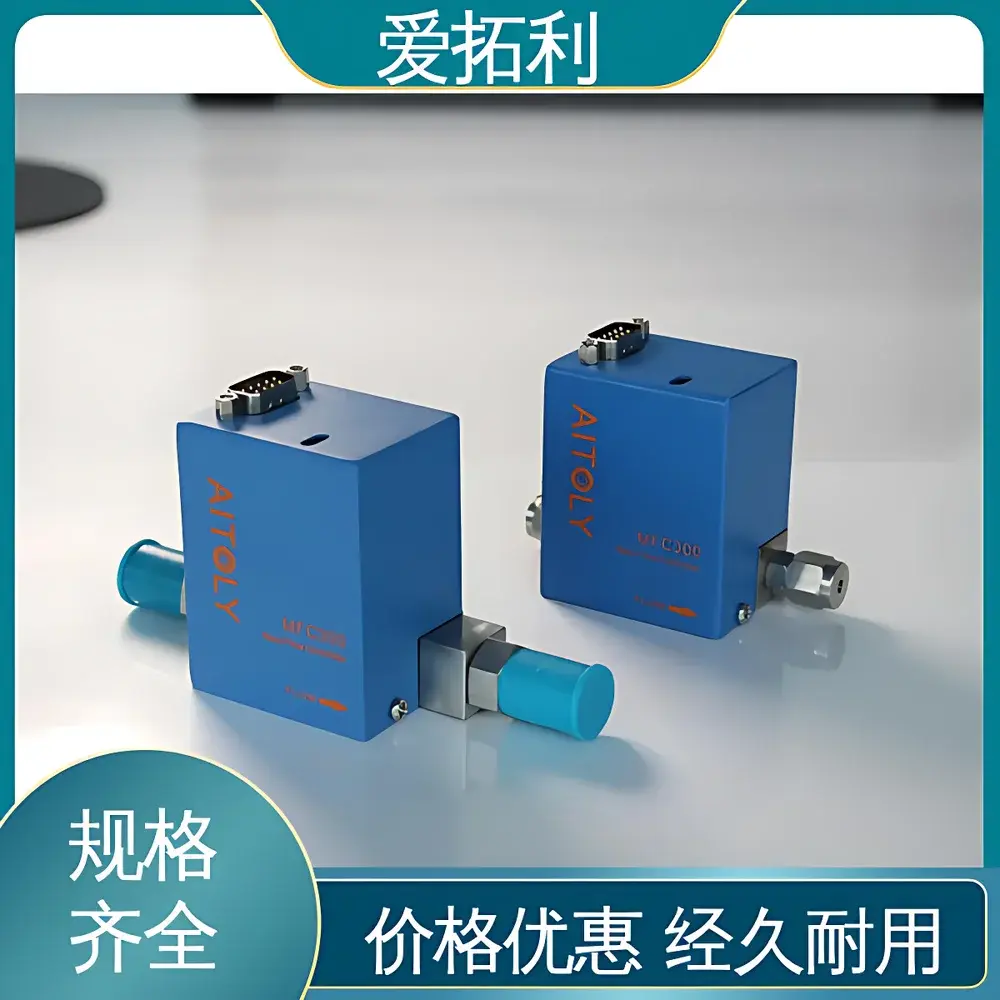
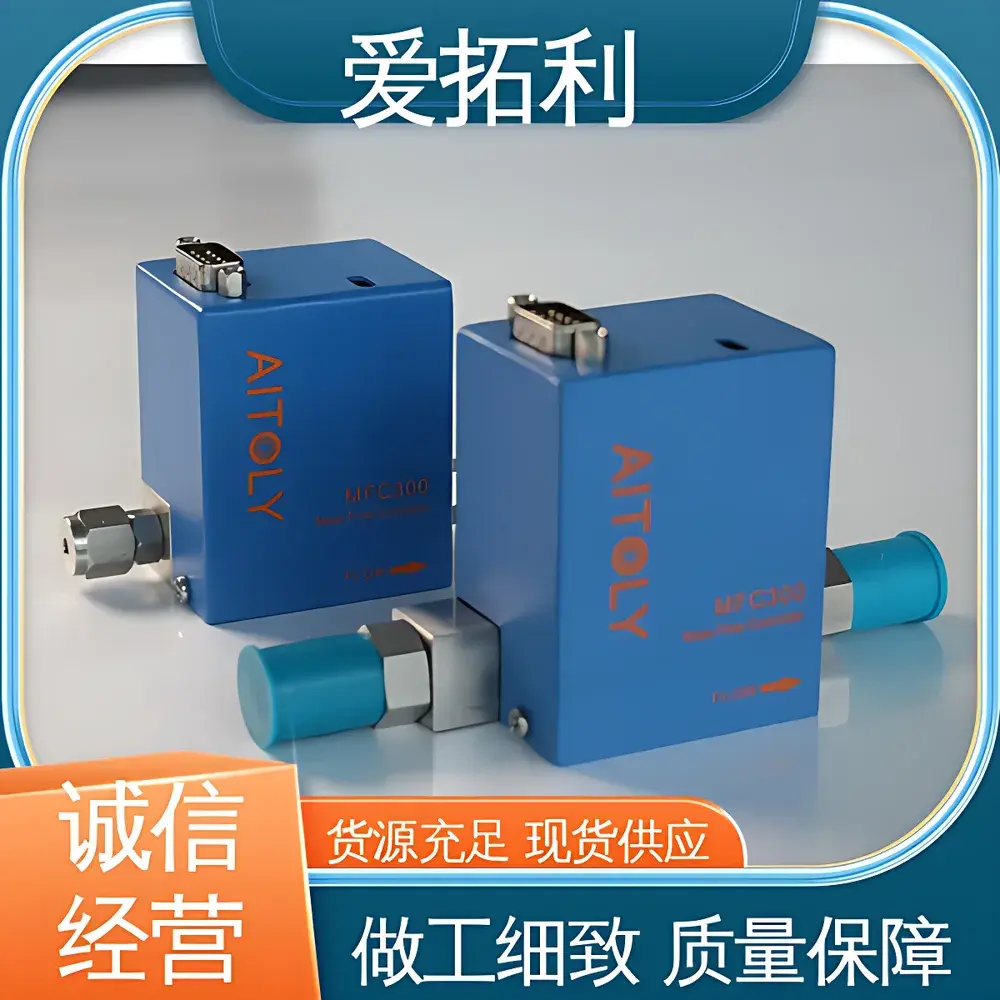
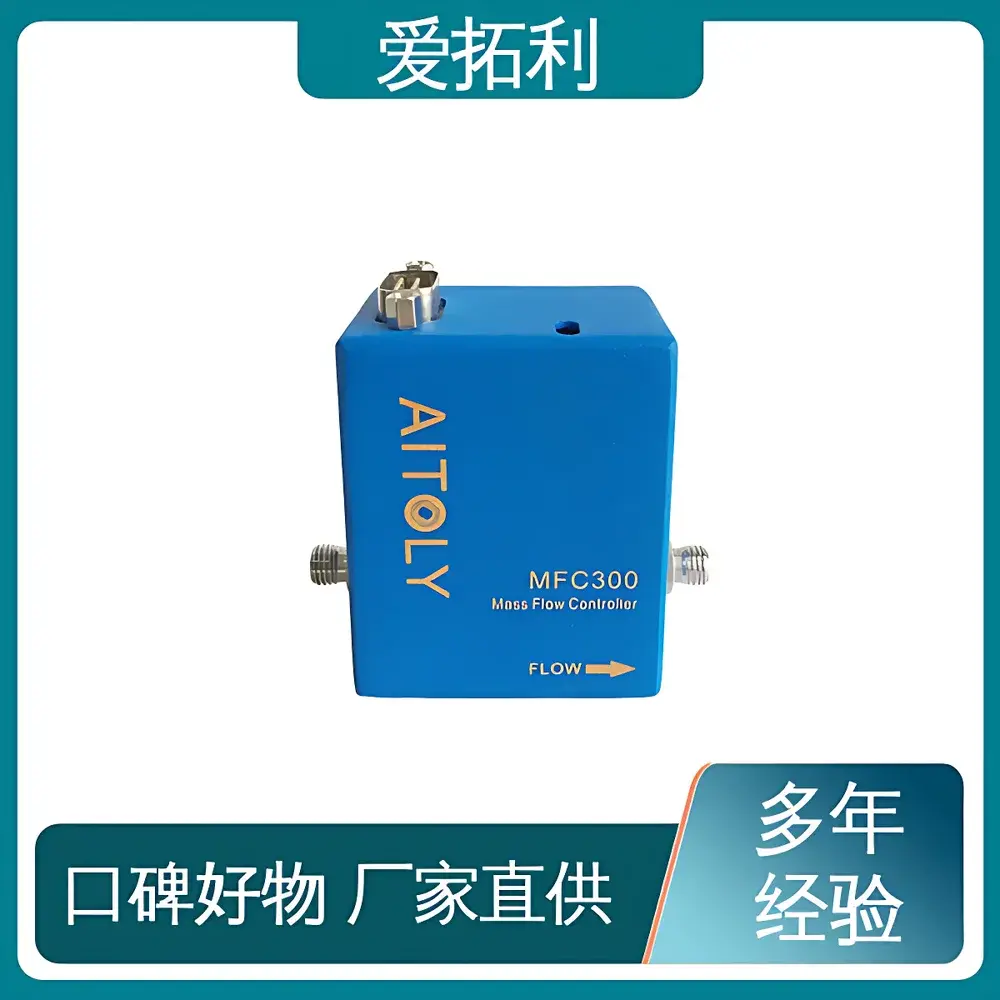
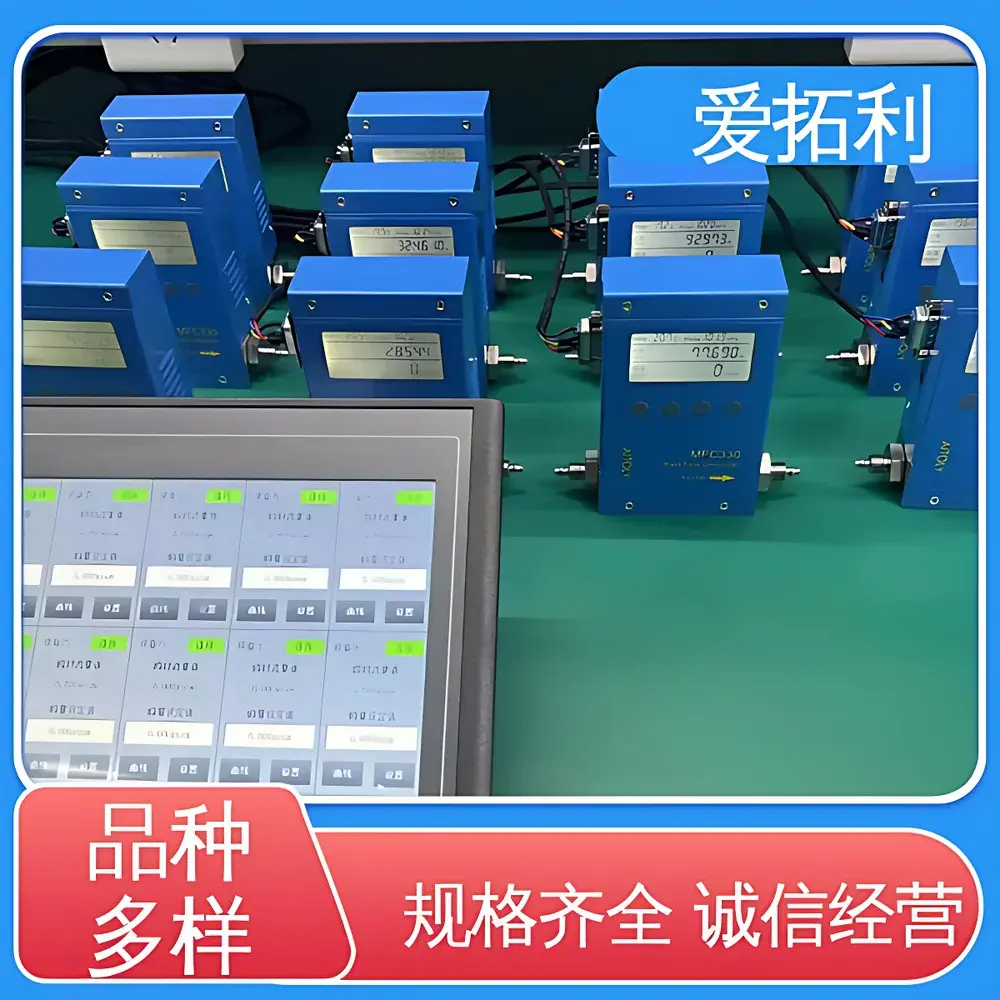
AITOLY MFC300 Thermal Mass Flow Controller
| Brand | AITOLY |
|---|---|
| Origin | Jiangsu, China |
| Type | Thermal Mass Flow Controller |
| Power Supply | 15–40 VDC |
| Communication Interfaces | CAN, RS232, RS422, RS485 (galvanically isolated) |
| Flow Ranges | 0–5 to 0–5 L/min (standard ranges: 0–5, 10, 50, 100, 200, 300, 500 sccm |
| Accuracy | ±0.5 % FS |
| Linearity | ±1 % FS |
| Repeatability | ±0.5 % FS |
| Response Time | <1 s |
| Operating Pressure Drop | 0–1 MPa |
| Maximum Working Pressure | 1.1 MPa |
| Ambient Temperature Range | 0–65 °C |
| Gas Compatibility | Air, He, Ar, N₂, O₂, H₂, NO, CO, CH₄, NH₃, N₂O, NO₂, CO₂ |
| Display Resolution | 0.1 sccm |
| Electrical Connector | DB9 |
| Fluid Connection Options | M8×1 thread, 4 mm push-to-connect, 6 mm push-to-connect |
| Tubing ID | 3–3.2 mm, 4 mm, 6 mm |
| Zero Drift | Extremely low |
| Moving Parts | None |
| Compatible Controller | AITOLY MCL300 (supports up to 16 units) |
Overview
The AITOLY MFC300 is a high-performance thermal mass flow controller engineered for precise, real-time measurement and closed-loop control of gas mass flow rates in industrial and laboratory environments. Based on constant-temperature anemometry (CTA), the device employs a micro-machined sensor element with integrated heating and temperature-sensing resistors to detect convective heat transfer induced by gas flow — a principle directly proportional to mass flow rate independent of pressure and temperature fluctuations (when compensated). Unlike volumetric flow meters, the MFC300 delivers true mass flow output in standard cubic centimeters per minute (sccm) or liters per minute (L/min), eliminating the need for external pressure/temperature correction in most process applications. Its solid-state architecture—featuring no moving parts—ensures long-term reliability, minimal maintenance, and immunity to mechanical wear or clogging, making it especially suitable for clean, corrosive, or mixed-gas processes where particle sensitivity or fluid compatibility is critical.
Key Features
- Single-supply operation from 15–40 VDC, enabling flexible integration into existing DC-powered instrumentation racks or PLC-controlled systems.
- Multi-protocol digital communication interface (CAN, RS232, RS422, RS485), all with galvanic isolation to suppress ground-loop noise and enhance EMC robustness in electrically noisy plant environments.
- Simultaneous analog output (0–5 V / 0–10 V / 4–20 mA) and digital data streaming for redundant monitoring or hybrid control architectures.
- Factory-calibrated for up to 13 common industrial gases—including H₂, He, CO₂, CH₄, NH₃, and reactive species such as NO₂ and NO—with built-in gas selection tables and user-configurable gas-specific scaling factors.
- Ultra-low zero drift (<0.02 % FS/month typical), achieved through active thermal compensation and matched sensor bridge design, ensuring stable baseline performance across ambient temperature variations (0–65 °C).
- Sub-second dynamic response (<1 s to 90 % step change), supporting fast-cycling processes such as pulsed gas delivery in semiconductor ALD/CVD tools or combustion air modulation in burner management systems.
Sample Compatibility & Compliance
The MFC300 is validated for use with non-aggressive, non-condensing gases within its specified composition and pressure limits. It complies with IEC 61000-6-2 (immunity) and IEC 61000-6-4 (emission) standards for industrial environments. While not intrinsically safe certified, its low-power design and absence of ignition sources permit deployment in Zone 2/Class I, Division 2 areas when installed per local electrical codes. The device supports traceability per ISO/IEC 17025 requirements when used with calibrated reference standards and documented calibration intervals. Its firmware architecture enables audit-ready configuration logging — essential for GLP-compliant laboratories and FDA-regulated manufacturing (e.g., pharmaceutical purge gas verification under USP or bioreactor sparging control per 21 CFR Part 11-compliant systems when paired with validated software).
Software & Data Management
The MFC300 operates autonomously but is fully programmable via ASCII-based command sets over any supported serial interface. Configuration parameters—including gas type, full-scale range, setpoint ramp rate, auto-zero enable/disable, and alarm thresholds—are stored in non-volatile memory. When integrated with the optional AITOLY MCL300 master controller, users gain centralized supervision of up to 16 MFC300 units: real-time flow visualization, cumulative volume tracking (with manual reset or auto-cycle modes), setpoint scheduling, and event-triggered data export (CSV/Excel). All digital transactions support timestamped logging with configurable sampling intervals (10 ms to 10 s), facilitating trend analysis, batch record generation, and deviation investigation in regulated workflows.
Applications
- Semiconductor fabrication: Precise dopant gas dosing (e.g., SiH₄, PH₃, B₂H₆) in CVD, PECVD, and etch tools.
- Environmental monitoring: Calibration gas blending for EPA Method TO-14/TO-15 analyzers and continuous emissions monitoring systems (CEMS).
- Energy & combustion: Stoichiometric air/fuel ratio control in industrial burners and fuel cell test stations.
- Chemical synthesis: Reactor feedstock metering for catalytic hydrogenation, nitration, or oxidation reactions requiring strict gas stoichiometry.
- Medical device manufacturing: Sterilization cycle validation using ethylene oxide (EtO) or hydrogen peroxide vapor flow profiling.
- Research labs: Multi-gas mixing for plasma physics experiments, breath analysis simulators, or catalysis screening platforms.
FAQ
Does the MFC300 require periodic recalibration?
Yes — while designed for long-term stability, annual calibration against a NIST-traceable primary standard is recommended for applications demanding metrological rigor (e.g., ISO 17025-accredited testing or regulatory submissions).
Can the MFC300 measure humidified or saturated gases?
No — condensation inside the sensor channel will impair thermal transfer accuracy and may cause irreversible damage. Use only with dried gases or install inline desiccant traps upstream.
Is firmware upgrade supported in-field?
Yes — firmware updates are delivered via ASCII command sequence over RS232 or CAN, with checksum verification and rollback capability to ensure operational continuity.
What is the maximum allowable differential pressure across the device?
The MFC300 is rated for continuous operation at pressure drops up to 1 MPa; however, sustained operation above 0.7 MPa may reduce long-term repeatability due to increased thermal stress on the sensor chip.
How does the MFC300 handle gas mixtures not listed in its factory calibration table?
Users may input custom gas properties (specific heat, thermal conductivity) via the MCL300 interface or direct serial command to generate interpolated scaling coefficients — subject to validation against reference flow measurements.