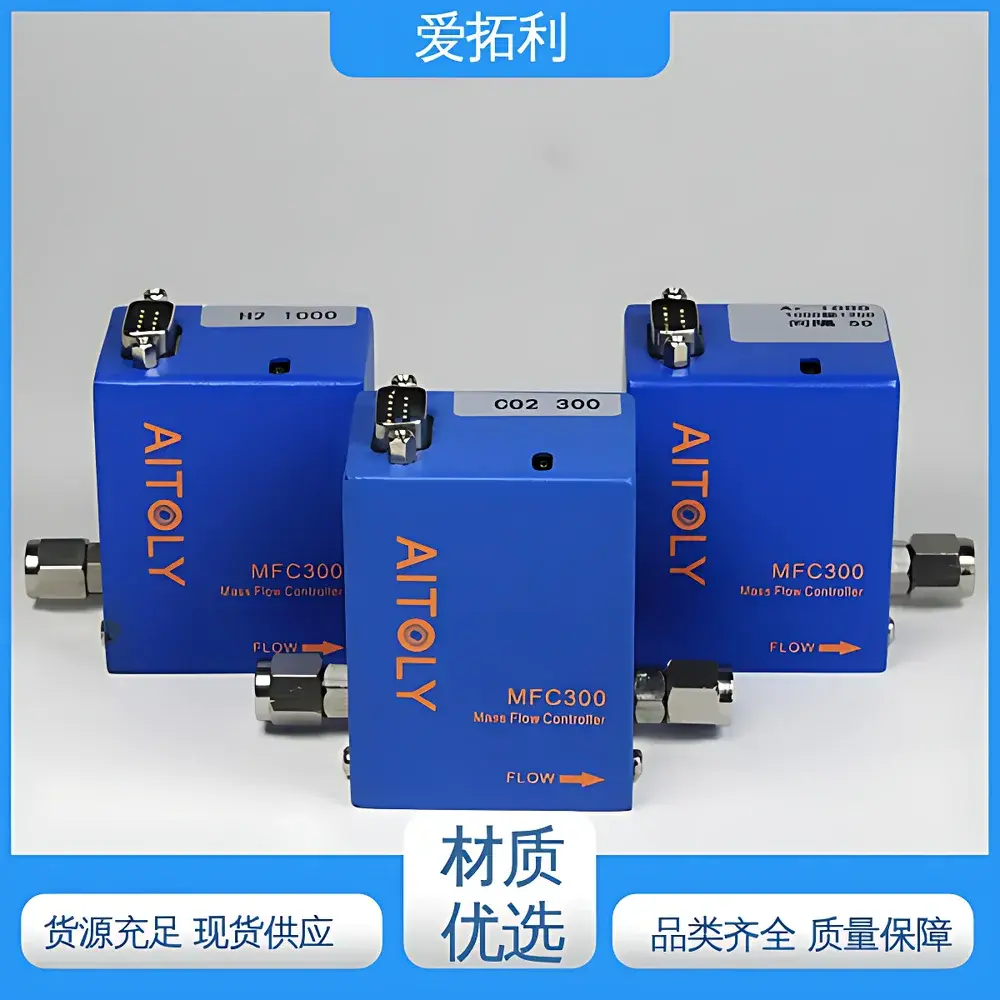
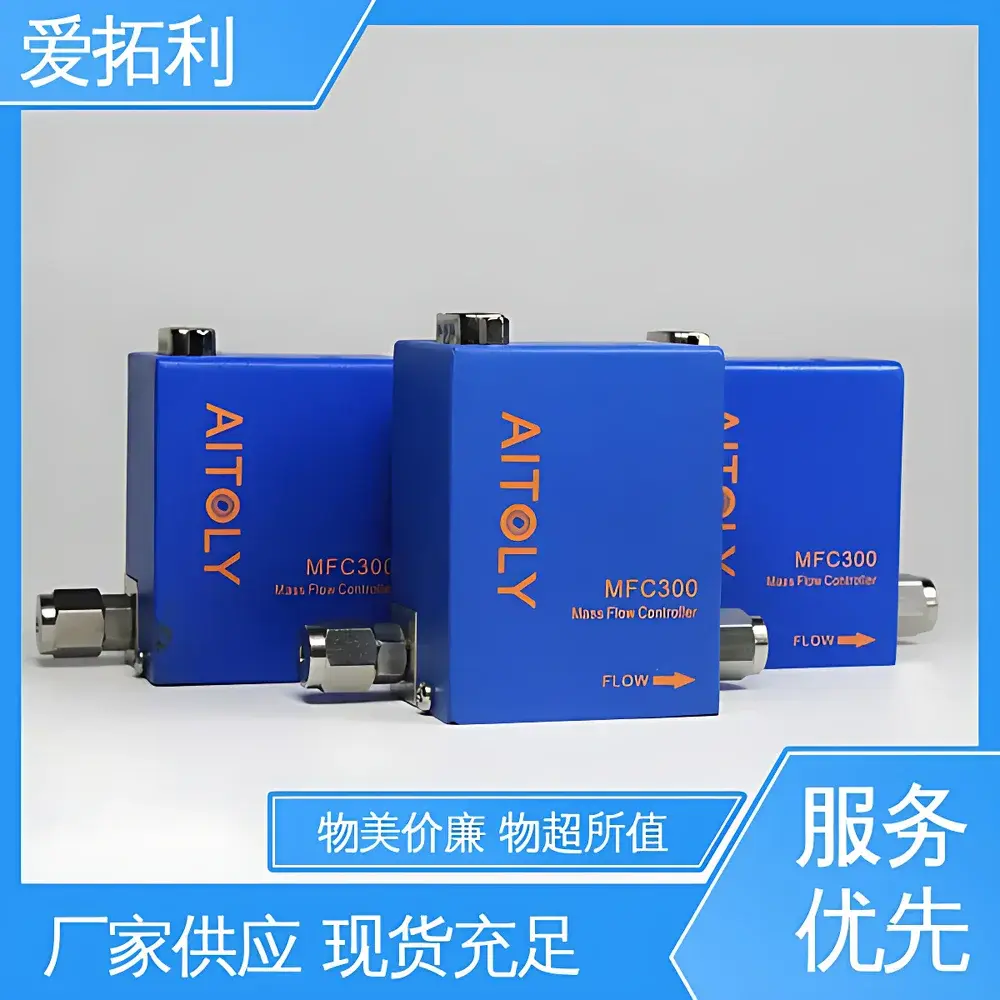
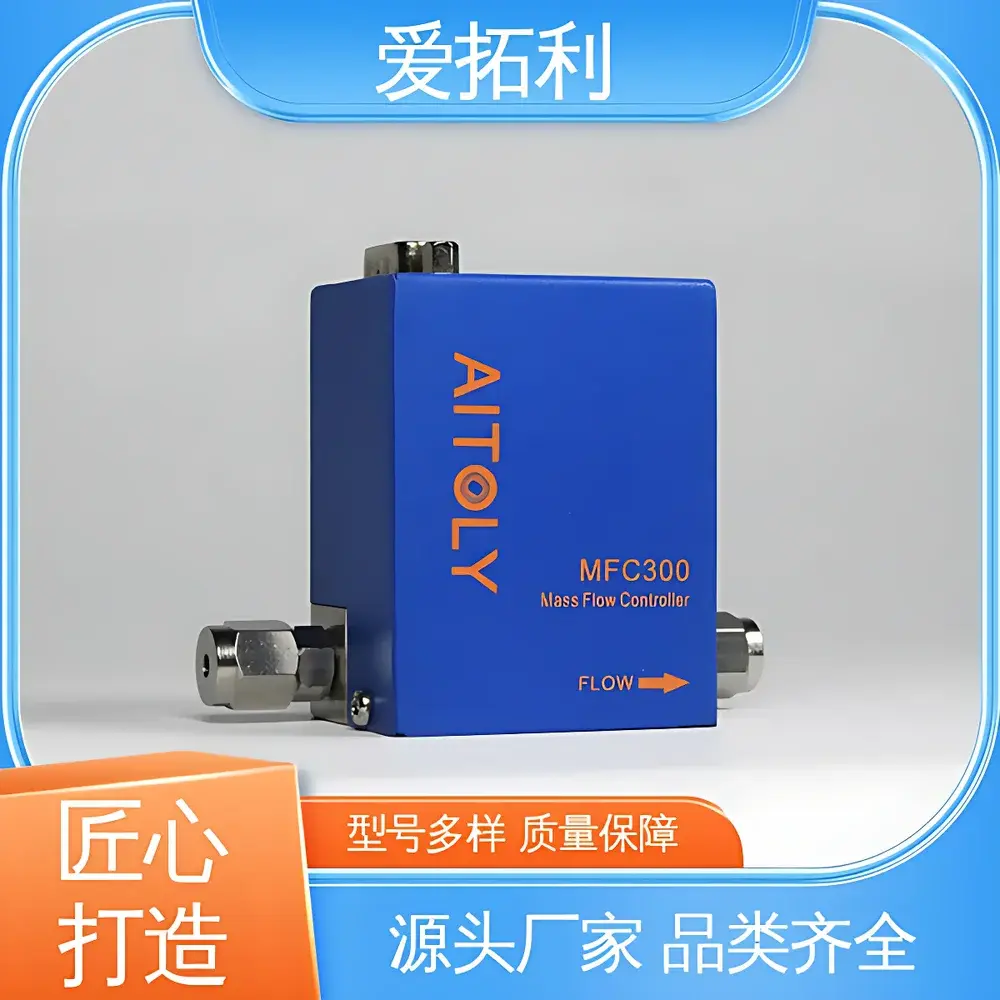
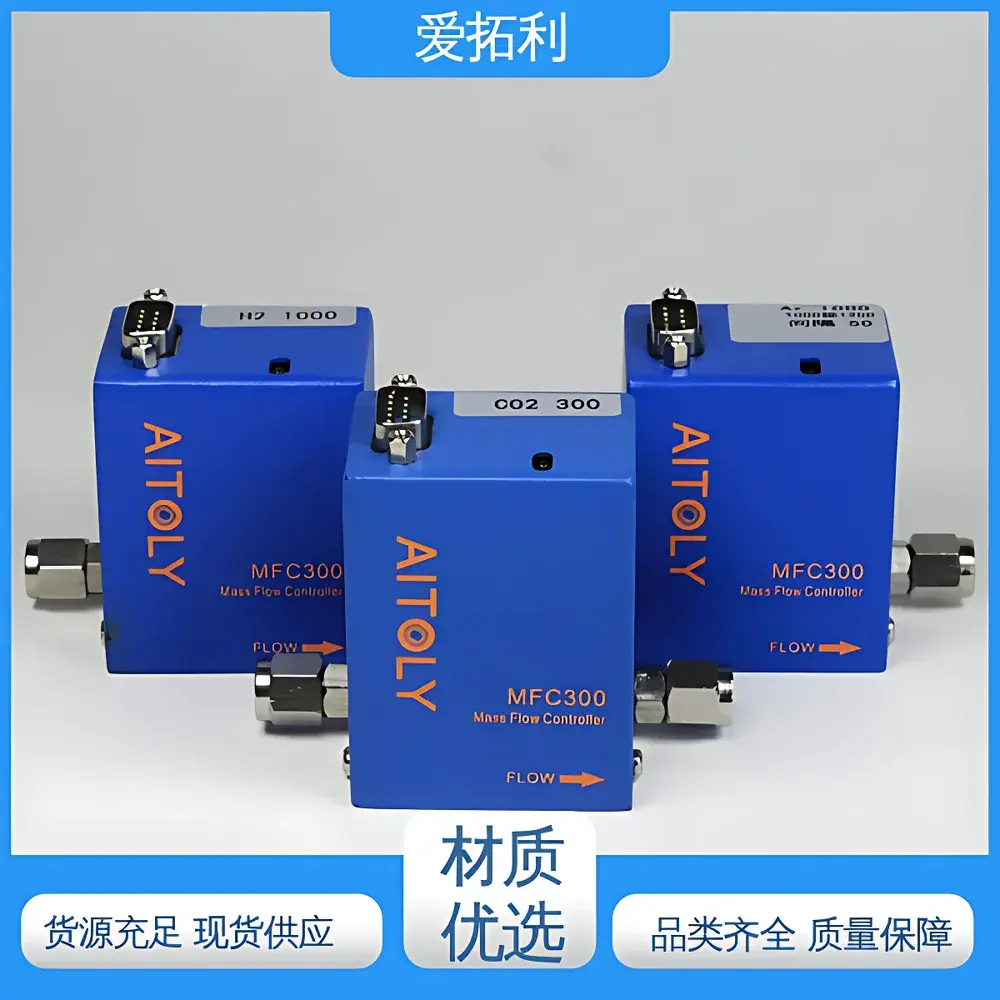
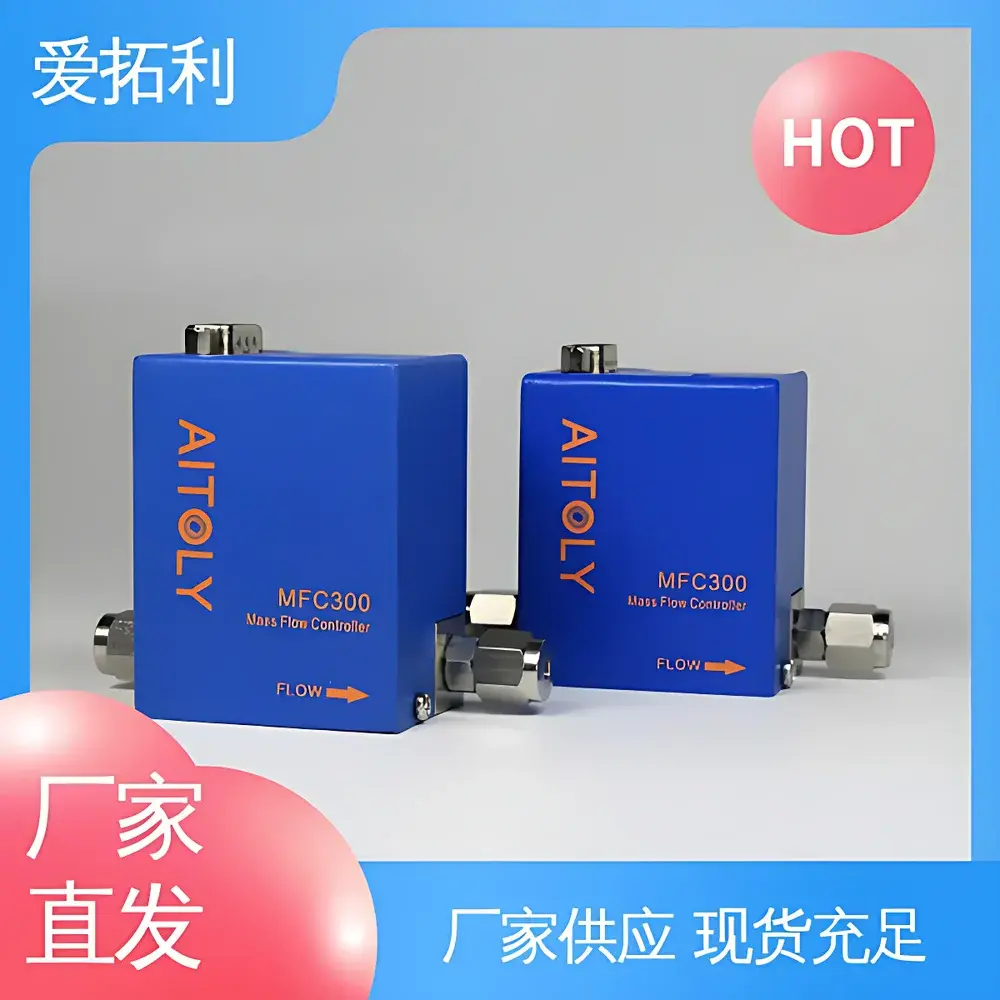
Aitoly MFC300 Thermal Mass Flow Controller
| Brand | Aitoly |
|---|---|
| Origin | Jiangsu, China |
| Model | MFC300 |
| Type | Thermal Mass Flow Controller |
| Measurement Principle | Constant-Temperature Anemometry (CTA) with MEMS Sensor |
| Gas Compatibility | Clean, dry, non-corrosive gases (Air, N₂, O₂, Ar, CH₄, CO₂) |
| Flow Range | 0.2–100% of Full Scale (1:500 turndown ratio) |
| Accuracy | ±0.5% FS |
| Repeatability | ±0.5% FS |
| Linearity | ±0.2% FS |
| Resolution | 0.1 sccm (0–1000 sccm) |
| Sensor Response Time | ≤5 ms |
| Control Response Time | ≤300 ms |
| Warm-up Time | ≤1 s |
| Valve Type | Normally Closed (NC) |
| Pressure Drop | <1 kPa at full scale |
| Operating Temperature | 0–50 °C |
| Compensations | Integrated temperature and pressure compensation |
| Electrical Interface | Analog (0–5 V / 0–10 V / 4–20 mA) and digital (RS-485 Modbus RTU) |
| Power Supply | 24 VDC ±10% |
Overview
The Aitoly MFC300 is a high-performance thermal mass flow controller engineered for precise, real-time measurement and closed-loop control of gas mass flow in low-to-medium flow applications. Based on constant-temperature anemometry (CTA), the device employs a micro-electro-mechanical systems (MEMS) thermal sensor chip that directly measures mass flow rate independent of gas composition—provided calibration is performed for the target gas. Unlike volumetric flowmeters, the MFC300 delivers true mass flow output (standard cubic centimeters per minute, sccm, or standard liters per minute, slpm), eliminating dependency on ambient temperature and pressure fluctuations. Its integrated temperature and pressure compensation ensures stable performance across variable environmental conditions commonly encountered in laboratory, process, and manufacturing environments. Designed for integration into automated gas delivery subsystems, the MFC300 supports both analog and digital communication protocols, enabling seamless interoperability with PLCs, DAQ systems, and custom control software.
Key Features
- MEMS-based thermal sensor with <5 ms response time—enabling dynamic flow regulation in fast-cycling processes such as ALD and PECVD
- Wide turndown ratio of 1:500 (0.2–100% FS), supporting operation from trace-level flows (e.g., 0.1 sccm) up to 5 slpm without range switching
- Low-pressure drop (<1 kPa at full scale), minimizing system backpressure and preserving vacuum integrity in sensitive applications
- Compact, modular housing (standard 1/4″ NPT or Swagelok®-compatible ports) optimized for space-constrained instrument integration
- Normally closed (NC) proportional solenoid valve with ≤300 ms control loop response—suitable for safety-critical shut-off and rapid setpoint tracking
- Onboard temperature and absolute pressure sensing for real-time density correction; eliminates need for external transducers
- Factory-calibrated for six common industrial gases (Air, N₂, O₂, Ar, CH₄, CO₂); user-selectable gas mode via digital interface
Sample Compatibility & Compliance
The MFC300 is validated for use with clean, dry, non-corrosive gases only. Particulate filtration (≤0.1 µm) and dew point control (<−20 °C) are strongly recommended upstream to prevent sensor contamination or drift. While not rated for hazardous area use (e.g., ATEX or IECEx), the unit complies with CE marking requirements under EMC Directive 2014/30/EU and Low Voltage Directive 2014/35/EU. Its analog outputs meet IEC 61000-4 immunity standards for industrial environments. For regulated industries, the device supports audit-ready operation when paired with compliant host software: digital communications include timestamped data logging, configurable alarm thresholds, and read-only access to calibration history—facilitating alignment with GLP and GMP documentation practices per FDA 21 CFR Part 11 (when implemented at system level).
Software & Data Management
The MFC300 operates in standalone mode using analog setpoints, but its RS-485 Modbus RTU interface enables full bidirectional configuration and monitoring. Supported parameters include flow setpoint, measured flow, valve position, internal temperature/pressure, and diagnostic status flags (e.g., over-range, sensor fault, communication timeout). A Windows-compatible configuration utility (provided separately) allows users to adjust zero/span offsets, select gas type, configure analog output scaling, and export calibration certificates. All configuration changes are non-volatile and survive power cycling. When integrated into larger SCADA or MES platforms, the MFC300 supports periodic polling at up to 10 Hz, with timestamp resolution aligned to host system clocks—critical for synchronized multi-channel gas delivery in semiconductor tool clusters.
Applications
- Semiconductor fabrication: Precise dopant and precursor delivery in CVD, ALD, and etch tools
- Vacuum coating systems: Reactive gas control (O₂, N₂, Ar) during sputtering and evaporation processes
- Gas chromatography and mass spectrometry: Carrier and make-up gas regulation with sub-sccm stability
- Fuel cell R&D: Stoichiometric air and hydrogen flow management in test benches
- Environmental simulation chambers: Controlled gas blending for accelerated aging and corrosion testing
- Medical device manufacturing: Sterilant (e.g., EtO) flow metering in validation-grade packaging lines
FAQ
Is the MFC300 suitable for corrosive or humid gas streams?
No. The MEMS sensor and internal wetted surfaces are incompatible with moisture, condensables, or chemically aggressive gases (e.g., Cl₂, NH₃, HCl). Always install appropriate inline filters and dryers upstream.
Can I recalibrate the unit in-house?
Field recalibration requires traceable NIST-traceable flow standards and controlled environmental conditions. Aitoly recommends annual factory recalibration to maintain ±0.5% FS accuracy specification.
Does it support multiple gas calibrations simultaneously?
The MFC300 stores six preloaded gas coefficients internally. Switching between them is done digitally; no hardware change is required—but each calibration is gas-specific and must match actual process gas composition.
What is the minimum operating pressure required for accurate measurement?
The device functions reliably down to 50 kPa (absolute) inlet pressure. Below this, density compensation becomes less effective, and accuracy degrades beyond specification limits.
Is firmware upgrade capability available?
Yes—firmware updates are delivered via the RS-485 interface using the official Aitoly configuration tool. Version history and release notes are provided with each update package.