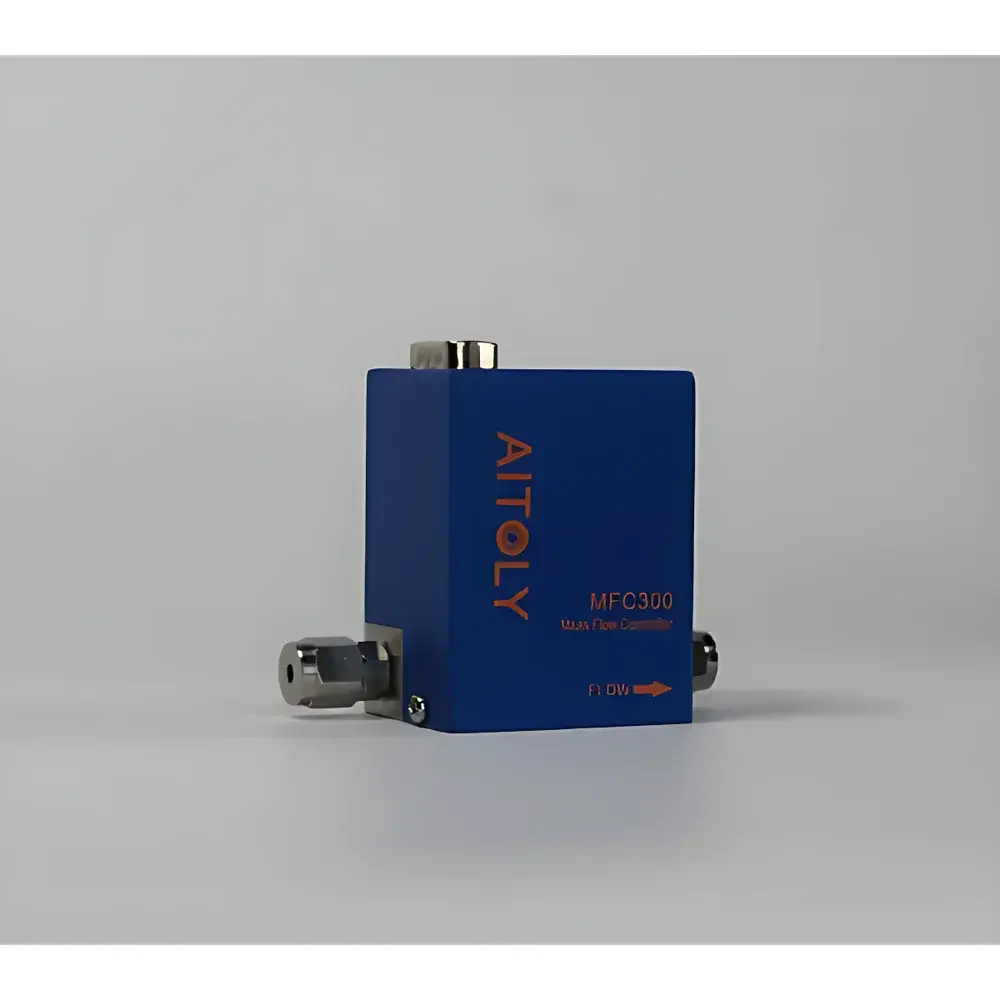
Aitoly MFC300_CAN Thermal Mass Flow Controller
| Brand | Aitoly |
|---|---|
| Origin | Jiangsu, China |
| Type | Thermal Mass Flow Controller |
| Flow Range Options | 0–5 sccm to 0–5 L/min |
| Accuracy | ±0.5% FS |
| Linearity | ±1% FS |
| Repeatability | ±0.5% FS |
| Response Time | <1 s |
| Operating Pressure Differential | 0–1 MPa |
| Max Burst Pressure | 1.1 MPa |
| Ambient Temperature | 0–65 °C |
| Power Supply | 15–40 VDC |
| Electrical Interface | DB9 connector |
| Output Signals | 0–5 V / 0–10 V / 4–20 mA analog + isolated digital protocols (CAN, RS232, RS422, RS485) |
| Gas Compatibility | Air, He, Ar, N₂, O₂, H₂, NO, CO, CH₄, NH₃, N₂O, NO₂, CO₂ |
| Gas Path Fittings | M8×1, 4 mm push-to-connect, 6 mm push-to-connect |
| Tubing ID | 3–3.2 mm, 4 mm, 6 mm |
| Zero Drift | Extremely low |
| Moving Parts | None |
| Compliance | Designed for industrial process control environments |
Overview
The Aitoly MFC300_CAN is a high-stability thermal mass flow controller engineered for precise, real-time measurement and closed-loop regulation of gas mass flow rates in demanding industrial and laboratory applications. Based on constant-temperature anemometry (CTA), the device employs a thermally sensitive sensor element immersed in the gas stream—typically a platinum RTD or micro-machined hot-film sensor—to detect convective heat transfer proportional to mass flow rate. Unlike volumetric flowmeters, thermal mass flow controllers inherently compensate for temperature and pressure variations without requiring external sensors or complex compensation algorithms, delivering true mass-based readings in standard cubic centimeters per minute (sccm) or liters per minute (L/min). Its monolithic sensor architecture contains no moving parts, eliminating mechanical wear and ensuring long-term calibration stability. The MFC300_CAN operates across a wide dynamic range—from ultra-low flows (0–5 sccm) up to 5 L/min—with sub-second response time (<1 s), making it suitable for both steady-state process monitoring and rapid transient gas delivery control.
Key Features
- No moving parts: Eliminates mechanical hysteresis, drift due to bearing wear, and maintenance downtime.
- Multi-gas capability: Factory-calibrated for 13 common gases (Air, He, Ar, N₂, O₂, H₂, NO, CO, CH₄, NH₃, N₂O, NO₂, CO₂); gas selection configurable via digital interface.
- Dual-mode operation: Simultaneous analog output (0–5 V, 0–10 V, or 4–20 mA) and electrically isolated digital communication (CAN bus, RS232, RS422, RS485) enable integration into PLC-based automation systems as well as direct PC-based lab control.
- Low zero drift design: Optimized thermal management and signal conditioning reduce baseline drift to negligible levels over extended operating periods—critical for unattended batch processes and long-duration experiments.
- Wide supply voltage range: Operates reliably from 15–40 VDC, supporting integration into diverse power architectures including 24 VDC industrial rails and custom DC distribution systems.
- Robust mechanical construction: Stainless steel or anodized aluminum housing with IP65-rated sealing; gas path wetted materials compliant with ISO 8573-1 Class 3 for particulate, water, and oil content.
Sample Compatibility & Compliance
The MFC300_CAN is designed for clean, dry, non-corrosive, and non-particulate gas streams. It is not rated for use with aggressive halogenated compounds, highly reactive silanes, or vapors containing condensable hydrocarbons. Gas compatibility extends across inert, oxidizing, reducing, and mildly corrosive species—including ammonia and nitrogen dioxide—provided moisture content remains below dew point and particulate load complies with ISO 8573-1 Class 3 specifications. While not certified to IEC 61508 or SIL standards out-of-the-box, its deterministic response behavior, diagnostic flagging (e.g., over-pressure, sensor fault, communication timeout), and traceable calibration history support integration into safety-instrumented systems when deployed under appropriate system-level validation. The device’s digital communication stack includes CRC error checking and configurable watchdog timers—features aligned with functional safety requirements for Category B equipment per IEC 61511.
Software & Data Management
The MFC300_CAN supports bidirectional parameter configuration and real-time data acquisition via ASCII command protocol over all supported serial interfaces. Users can adjust setpoints, select active gas type, configure analog scaling, enable/disable auto-zero routines, and read instantaneous flow, accumulated volume, temperature, and internal diagnostics—all without interrupting flow control. When paired with the optional MCL300 master controller, up to 16 units can be daisy-chained via CAN bus, enabling synchronized multi-channel gas blending, totalizing, and alarm coordination. The MCL300 provides local display, manual/automatic mode switching, batch-triggered accumulation reset, and USB-host connectivity for CSV export. All configuration changes and operational events (e.g., setpoint updates, gas switch, fault recovery) are timestamped and stored in non-volatile memory—supporting audit trail generation required under GLP and GMP frameworks (21 CFR Part 11 compliance achievable via host-system implementation).
Applications
- Gas mixing and ratio control in semiconductor CVD and PECVD tooling.
- Precise fuel-air ratio management in combustion test benches and emissions analyzers.
- Calibration gas generation and standard gas dilution systems.
- Controlled atmosphere furnaces and heat treatment process monitoring.
- Bioreactor sparging and fermentation gas dosing (O₂, CO₂, air).
- Environmental chamber conditioning and indoor air quality simulation.
- Research-scale plasma generation, laser gas handling, and vacuum process feed control.
FAQ
Does the MFC300_CAN require upstream/downstream straight pipe runs?
No—thermal mass flow controllers are insensitive to flow profile disturbances; installation requires only minimal straight-run sections (≥2× pipe diameter upstream) and avoids sharp elbows or valves immediately adjacent to the inlet.
Can the device measure mass flow of humidified gases?
Humidity alters gas-specific heat capacity and density; for accurate readings, either dry the gas stream prior to measurement or apply manufacturer-provided humidity correction factors during post-processing.
Is firmware upgrade supported in-field?
Yes—firmware updates are delivered via ASCII command sequence over any digital interface; full update logs and version verification are available through diagnostic commands.
What is the recommended recalibration interval?
Annual recalibration is advised for critical applications; however, built-in zero-check functionality and stable thermal design typically extend calibration intervals to 18–24 months under controlled environmental conditions.
How is gas-specific calibration validated?
Each unit undergoes multi-point gravimetric or primary-standard reference calibration using NIST-traceable gas standards; calibration certificates include uncertainty budgets per ISO/IEC 17025 requirements.