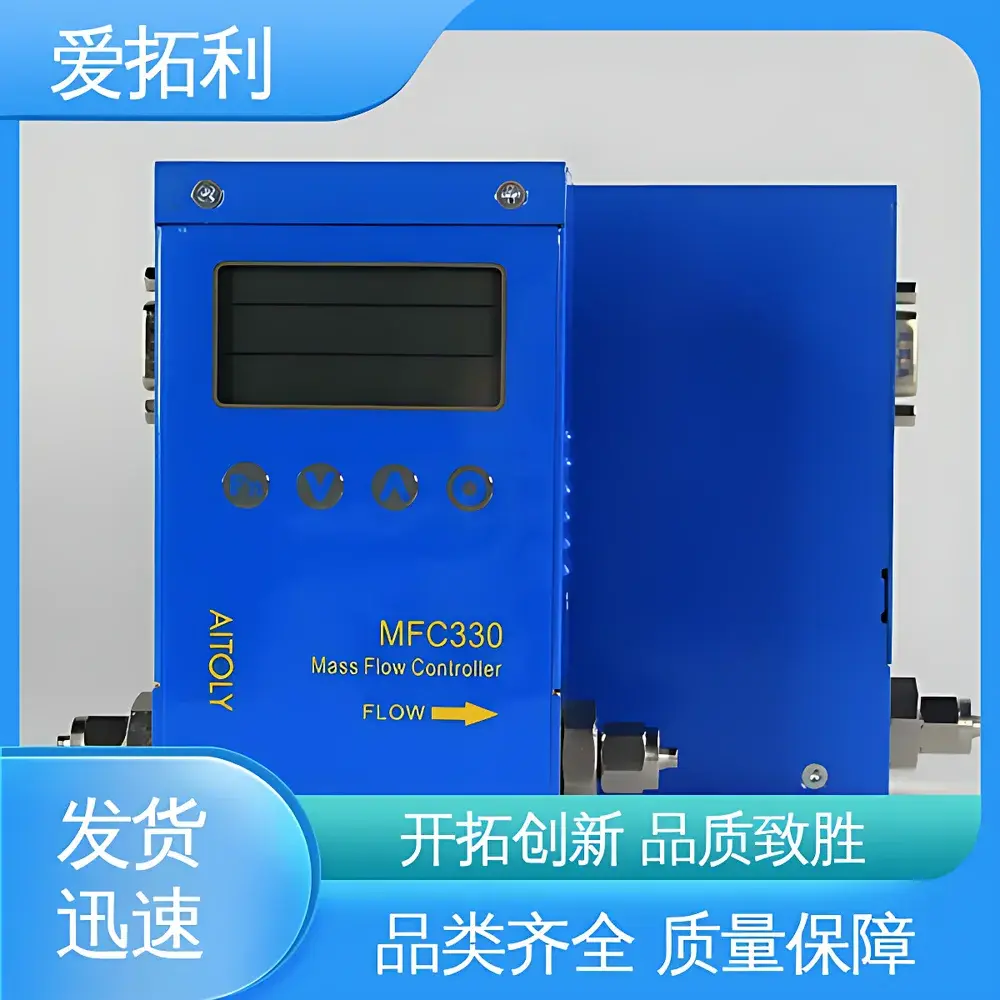
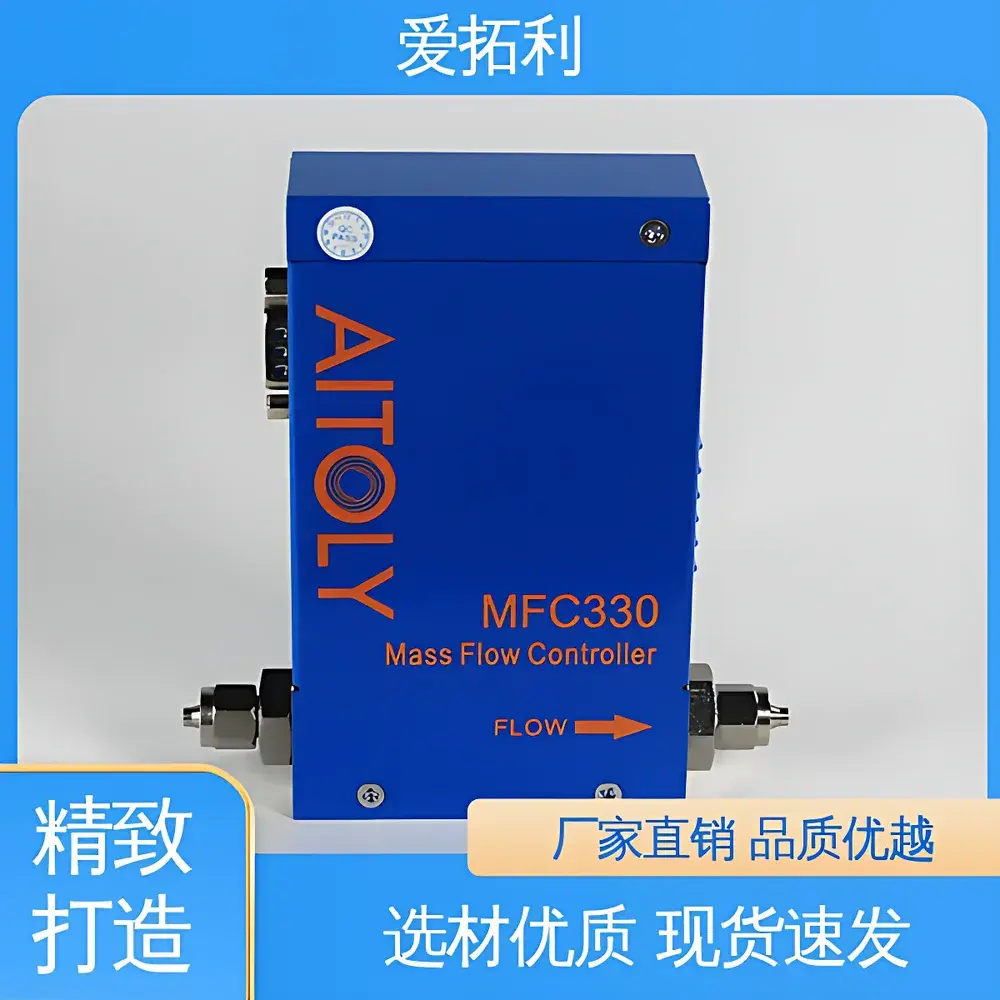
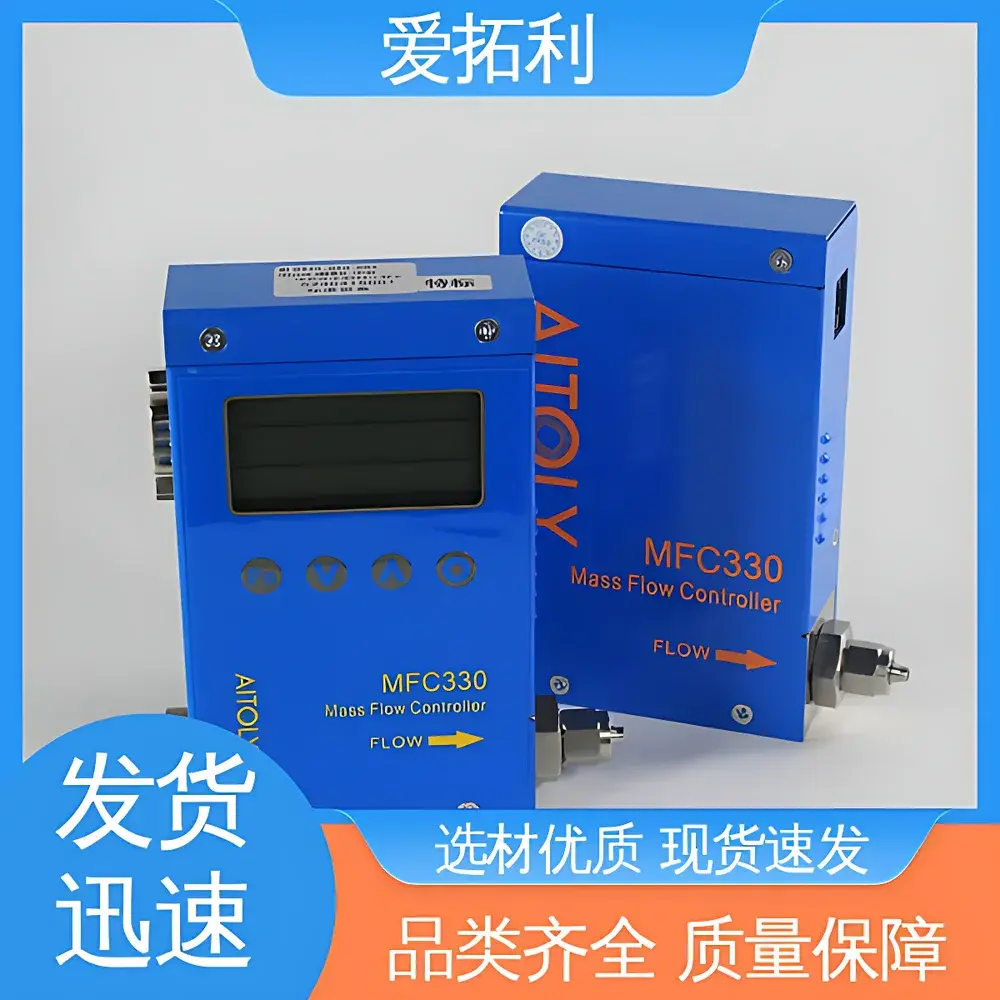
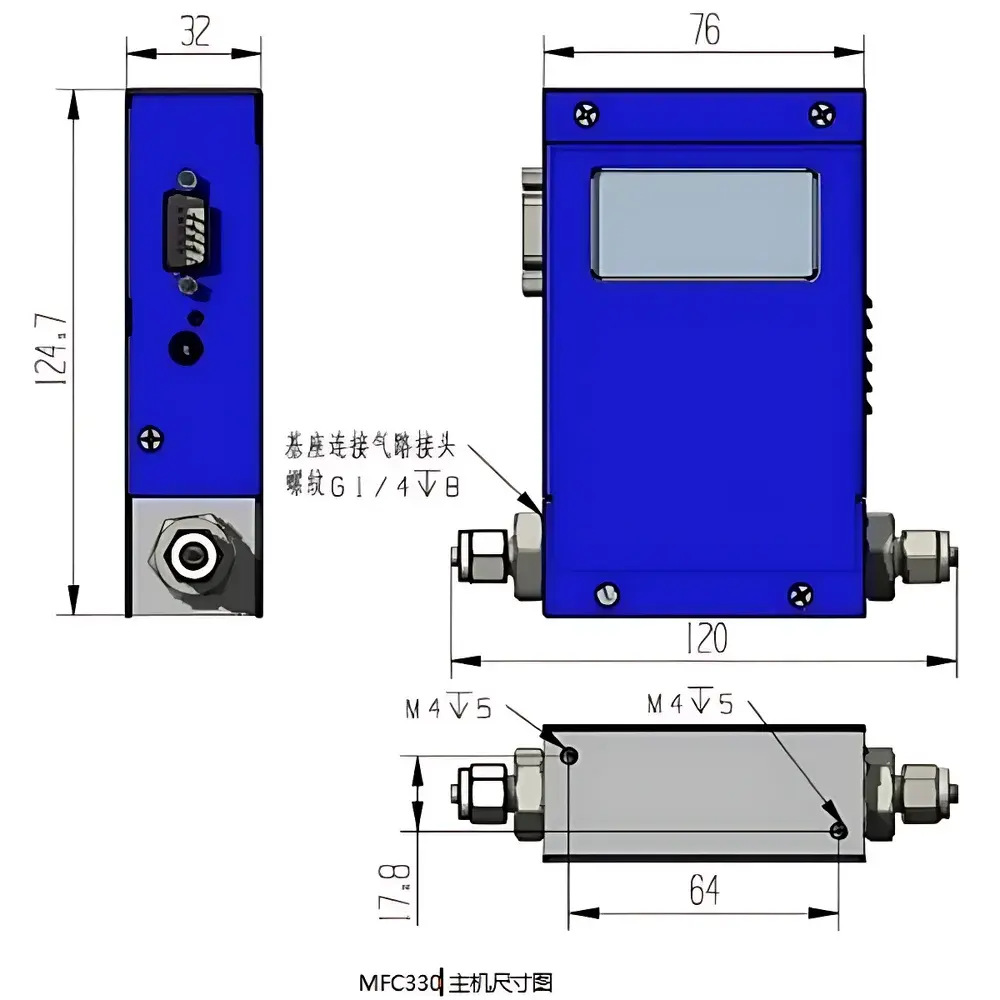
AITOLY MFC330 Series Thermal Mass Flow Controller
| Brand | AITOLY |
|---|---|
| Origin | Jiangsu, China |
| Manufacturer Type | Authorized Distributor |
| Product Type | Thermal Mass Flow Controller |
| Model | MFC330 |
| Flow Range Options | 0–2 / 10 / 20 / 50 / 100 / 300 / 500 sccm |
| Accuracy | ±0.5% FS |
| Repeatability | ±0.2% FS |
| Linearity | ±0.2% FS |
| Control Range | 1–100% FS (1:100) |
| Measurement Range | 0.5–100% FS (1:200) |
| Response Time | <3 s |
| Warm-up Time | 5 min (T95), 30 min for optimal stability |
| Valve Type | Normally Closed Proportional Solenoid Valve |
| Operating Pressure Drop | 0–1 MPa |
| Pressure Drop | Low |
| Gas Compatibility | Clean, dry gases |
| Optional Features | All-metal proportional valve, integrated digital display |
Overview
The AITOLY MFC330 Series Thermal Mass Flow Controller is an engineered solution for precise, real-time mass flow measurement and closed-loop control of clean, dry process gases in laboratory, pilot-scale, and light industrial applications. Based on the principle of thermal dispersion—where gas flow rate is determined by the differential cooling effect of the flowing gas across two temperature-sensing elements—the MFC330 delivers true mass flow output independent of ambient temperature and upstream/downstream pressure fluctuations. Its core architecture integrates a capillary-tube-based thermal sensor, a precision bypass分流 system, a high-bandwidth proportional solenoid valve, and an embedded PID control algorithm. This design ensures stable setpoint tracking under dynamic process conditions, including variable inlet pressure (up to 1 MPa differential) and ambient temperature drift—critical for reproducible gas delivery in analytical instrumentation, semiconductor tooling, chemical vapor deposition (CVD), and environmental simulation chambers.
Key Features
- Thermal dispersion sensing technology enabling direct mass flow measurement without pressure or temperature compensation
- Closed-loop control architecture with <3-second response time and ±0.2% FS repeatability for high process fidelity
- Wide operating pressure differential range (0–1 MPa) with inherently low pressure drop across the flow path
- Normally closed proportional solenoid valve for fail-safe operation and fine-grained flow modulation
- Configurable full-scale ranges from 0–2 sccm to 0–500 slpm, supporting both ultra-low and medium-flow applications
- All-metal valve option available for compatibility with aggressive or high-purity gases (e.g., NH₃, Cl₂, SiH₄)
- Integrated digital display option for local readout and manual setpoint adjustment without external software
- Robust mechanical design compliant with industrial mounting standards (e.g., ISO 228-1 G1/4″ or NPT 1/4″ inlet/outlet ports)
Sample Compatibility & Compliance
The MFC330 is validated for use with clean, dry gases meeting ISO 8573-1 Class 4 (solid particle ≤15 µm, dew point ≤3°C, oil content ≤5 mg/m³). It supports over 98% of common industrial and research-grade gases—including N₂, O₂, Ar, He, CO₂, H₂, CH₄, and synthetic air—when used within specified purity and moisture limits. While not certified to IEC 61508 or SIL standards, its control loop architecture meets functional safety expectations for non-critical process control per ISA-84.00.01. The device operates within standard laboratory environmental conditions (5–45°C ambient, <80% RH non-condensing) and conforms to EMC Directive 2014/30/EU and Low Voltage Directive 2014/35/EU. For regulated environments, analog (0–5 V / 4–20 mA) and digital (RS-485 Modbus RTU) outputs support integration into GLP/GMP-compliant data acquisition systems with audit-trail-capable SCADA platforms.
Software & Data Management
The MFC330 supports both analog and digital interface protocols for seamless integration into automated test benches and process control systems. Standard analog outputs provide real-time flow signal transmission compatible with PLCs, DAQ modules, and legacy controllers. Optional RS-485 Modbus RTU communication enables multi-unit daisy-chaining, remote setpoint programming, and diagnostic register access—including valve position, sensor temperature, error flags, and cumulative flow counters. Firmware supports user-defined scaling, zero calibration routines, and configurable alarm thresholds. When deployed in FDA-regulated settings, the controller’s deterministic response behavior and traceable analog/digital I/O facilitate compliance with 21 CFR Part 11 requirements when paired with validated host software featuring electronic signatures and audit trails.
Applications
- Gas delivery control in analytical instruments: GC carrier gas regulation, ICP-MS sample introduction, FTIR purge streams
- Process gas metering for thin-film deposition systems (PECVD, ALD, sputtering)
- Calibration reference flow sources for flowmeter verification per ISO 6145-2 and ASTM D6322
- Environmental chamber humidity and gas concentration control loops
- Bioreactor sparging and headspace gas management in upstream bioprocessing
- Leak testing and pressure decay analysis using controlled gas injection
- Research-scale fuel cell and electrolyzer gas stoichiometry management
FAQ
Does the MFC330 require external temperature or pressure compensation?
No. Its thermal dispersion sensing method provides inherent mass flow output; no external PT sensors or compensation algorithms are needed.
Can the MFC330 be used with corrosive gases such as Cl₂ or HCl?
Only with the optional all-metal valve configuration and appropriate wetted material selection (e.g., 316L SS body, Hastelloy C-276 seals); consult factory for gas-specific compatibility documentation.
What is the minimum measurable flow at full scale?
The lower limit is defined by the 0.5% FS measurement range specification—e.g., 0.01 sccm at 2 sccm FS, or 0.005 slpm at 1 slpm FS.
Is field recalibration possible?
Yes. Zero calibration can be performed in situ using dry nitrogen or instrument air; span calibration requires traceable gas standard and is recommended annually or after maintenance.
How does the MFC330 handle rapid pressure transients?
Its bypass architecture and fast-cycling proportional valve maintain flow stability within ±1% deviation during step changes in inlet pressure up to 0.5 MPa/s, as verified per internal shock testing protocol MFC330-TS-07.