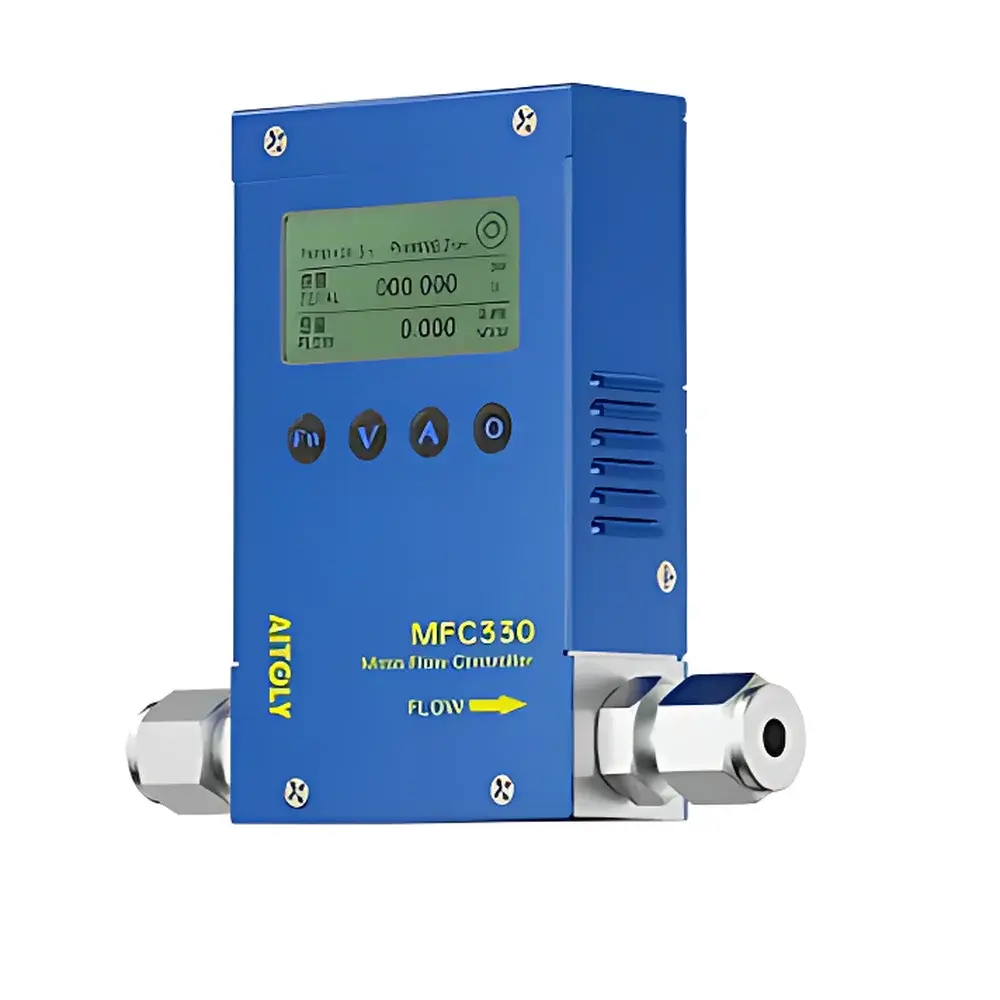
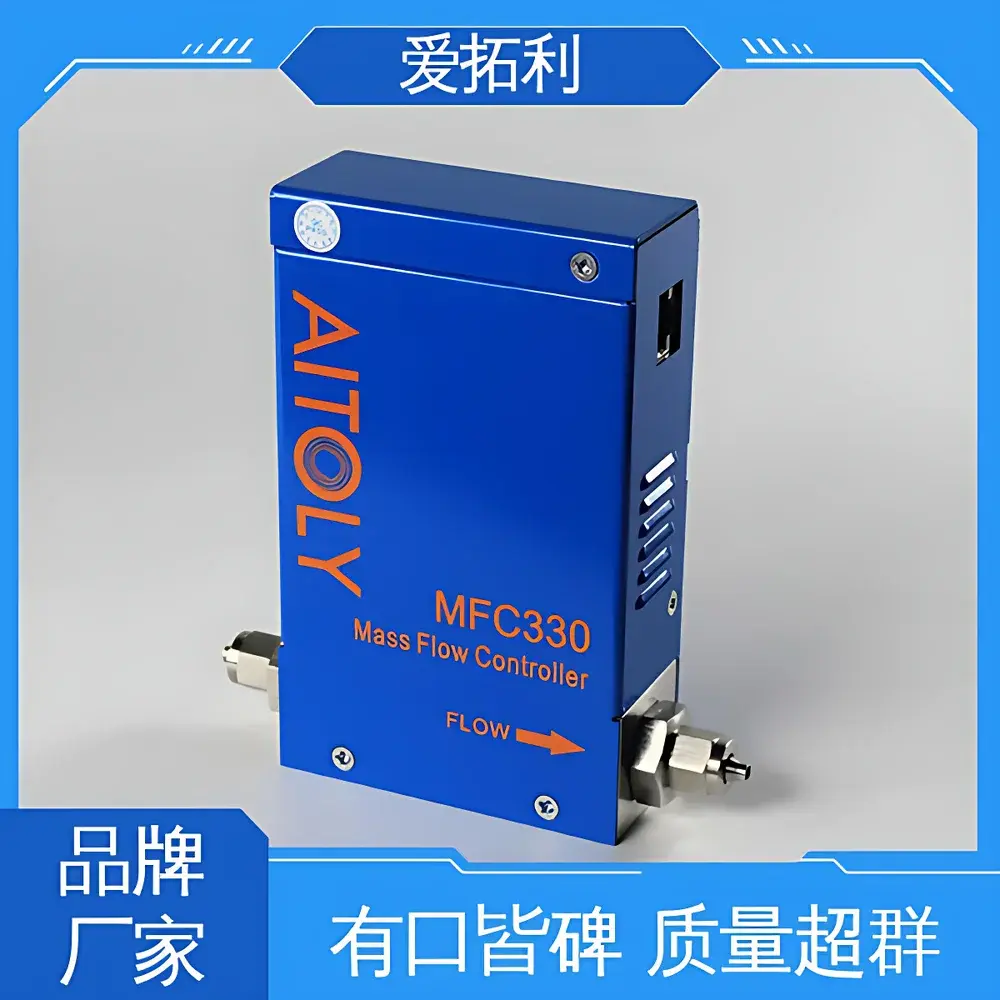
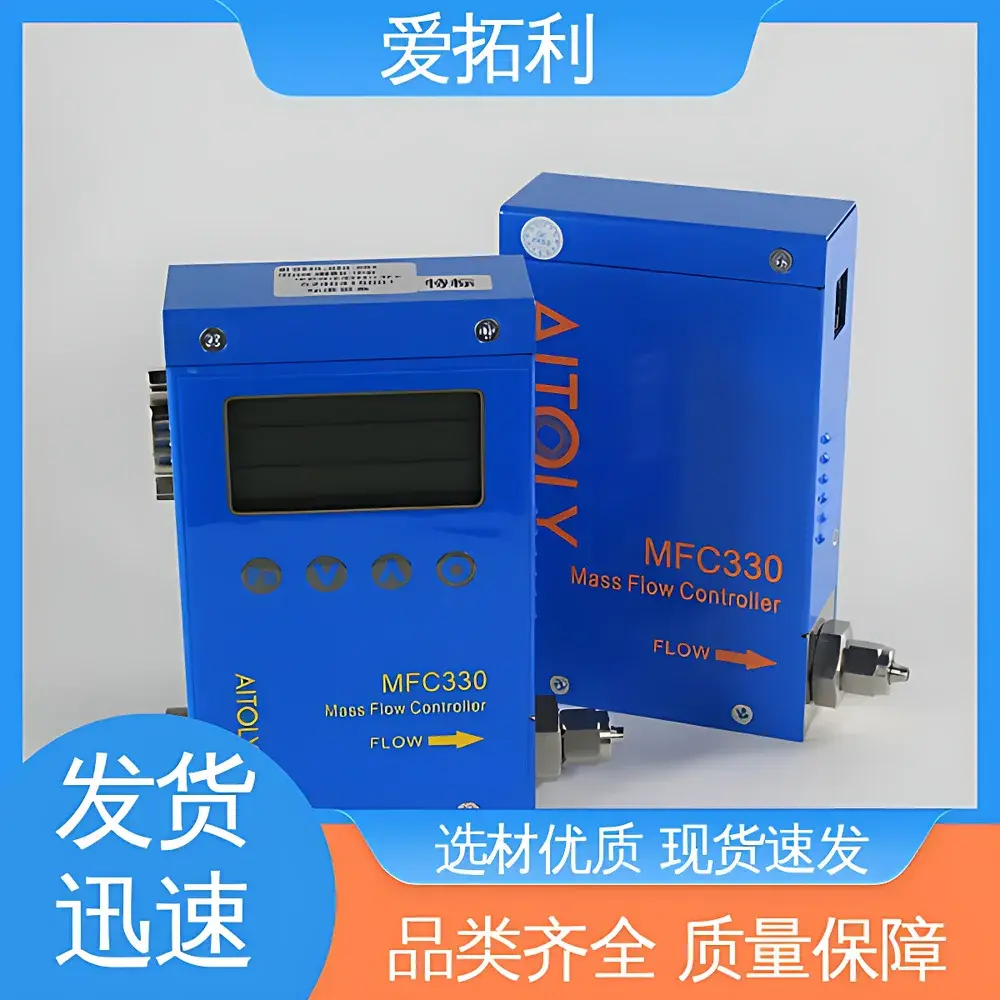
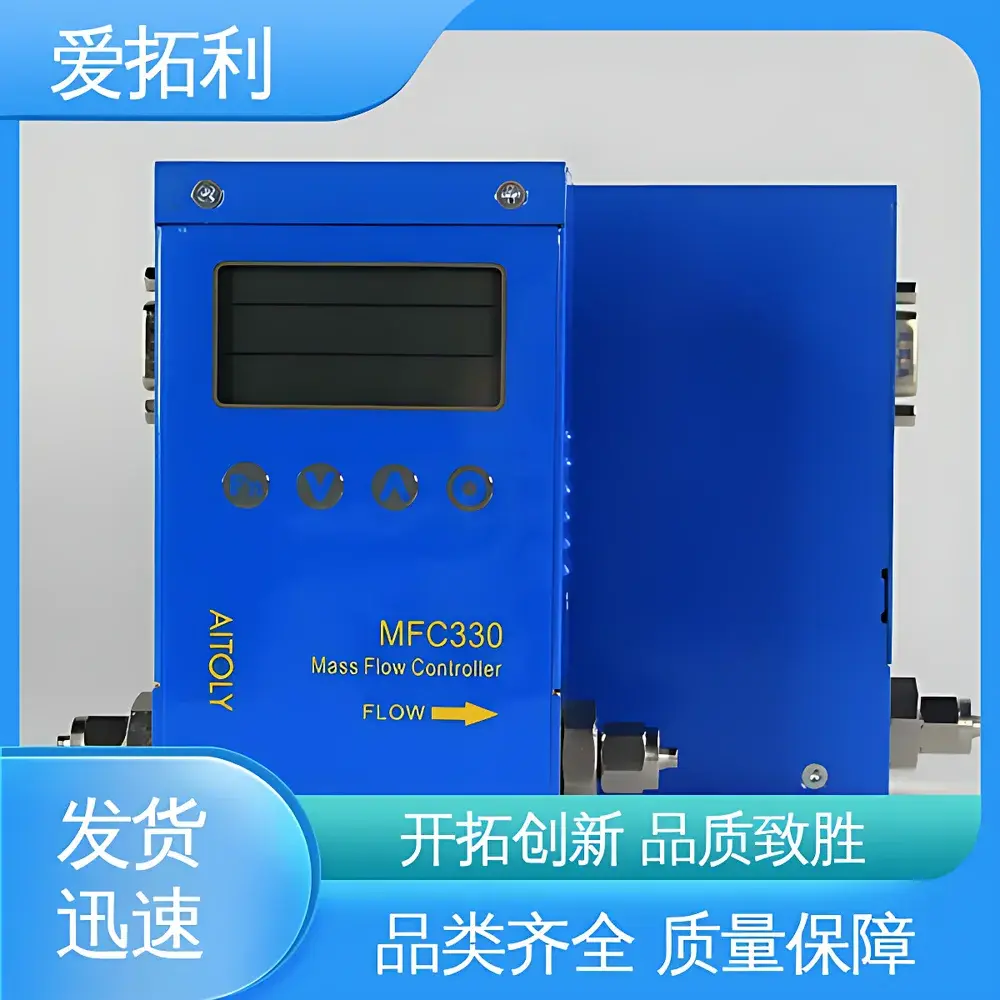
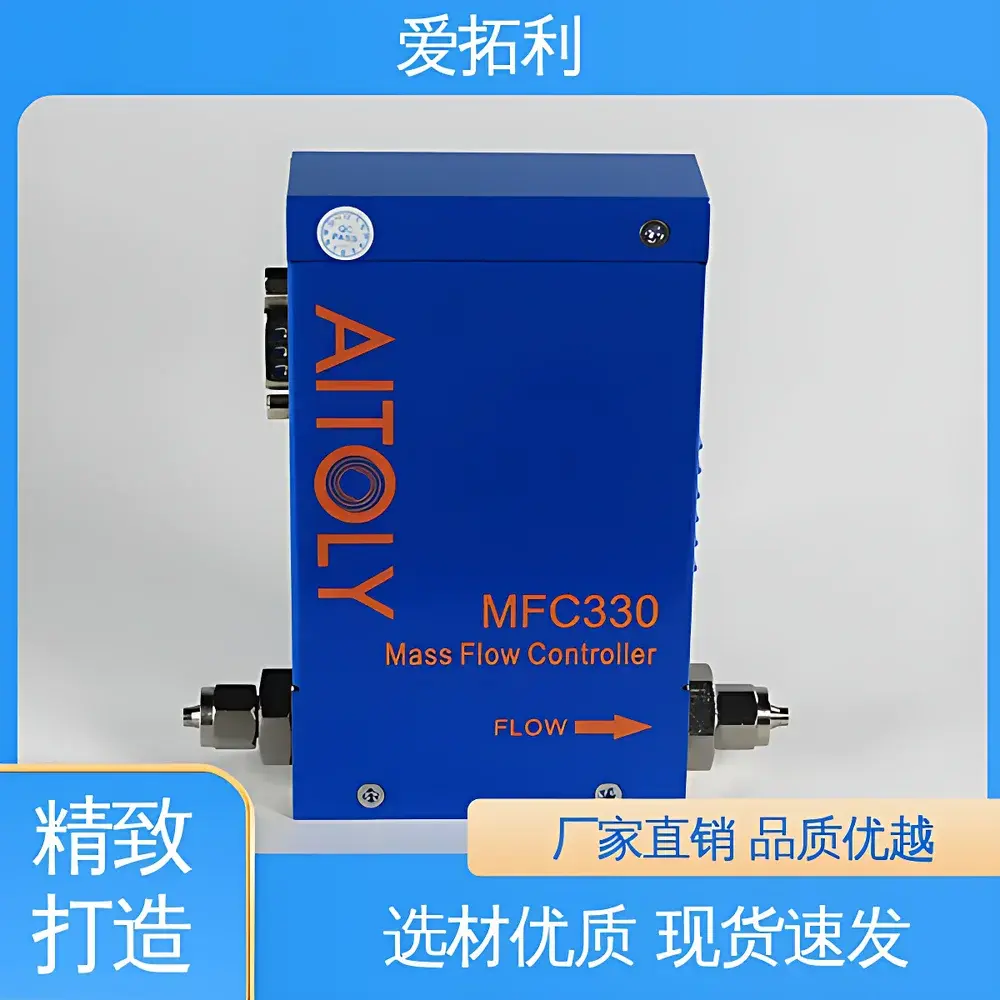
Aitoly MFC330 Thermal Mass Flow Controller
| Brand | Aitoly |
|---|---|
| Origin | Jiangsu, China |
| Model | MFC330 |
| Type | Thermal Mass Flow Controller |
| Flow Range Options | 0–2, 10, 20, 50, 100, 300, 500 sccm |
| Accuracy | ±1% FS |
| Repeatability | ±0.2% FS |
| Linearity | ±0.2% FS |
| Control Range | 1–100% FS (1:100) |
| Measurement Range | 0.5–100% FS (1:200) |
| Response Time | <3 s |
| Warm-up Time | 5 min (T95), 30 min recommended for optimal stability |
| Operating Pressure Drop | 0–1 MPa |
| Valve Type | Normally Closed Proportional Valve |
| Sensor Principle | Capillary-tube-based thermal mass flow sensing with bypass分流 architecture |
Overview
The Aitoly MFC330 Thermal Mass Flow Controller is an engineered solution for precise, real-time measurement and closed-loop control of gas mass flow in laboratory, pilot-scale, and light industrial process environments. Based on the constant-temperature anemometry (CTA) principle, the MFC330 employs a capillary-tube thermal sensor embedded within a calibrated bypass channel. As gas flows through the main conduit, a small, proportional fraction diverts through the capillary sensor—where heat transfer between a heated element and the flowing gas is measured. This thermally derived signal correlates directly to mass flow rate (in standard cubic centimeters per minute or standard liters per minute), independent of gas density variations caused by temperature or pressure fluctuations. The integrated high-bandwidth proportional valve dynamically adjusts flow to match user-defined setpoints, enabling stable operation across wide inlet/outlet pressure differentials (up to 1 MPa) and ambient temperature drifts—without requiring external pressure or temperature compensation.
Key Features
- Capillary-tube thermal sensing architecture ensures inherent mass flow measurement without dependence on gas-specific calibration curves for common gases (e.g., N₂, O₂, Ar, He, CO₂, H₂, air; up to 98% purity required)
- Closed-loop control system with <3-second response time and ±0.2% FS repeatability supports rapid process ramping and tight recipe adherence
- Wide dynamic control range of 1–100% FS (1:100) and extended measurement capability down to 0.5% FS (1:200) enable low-flow precision in deposition, oxidation, and purge applications
- Robust mechanical design with optional all-metal proportional valve suitable for clean, dry, non-corrosive gas service up to 1 MPa differential pressure
- Low-pressure drop configuration minimizes system backpressure impact—critical in vacuum-integrated or multi-stage gas delivery setups
- Modular configuration options include integrated local display (LED or LCD), analog I/O (0–5 V / 4–20 mA), and digital communication interfaces (RS-485 Modbus RTU)
Sample Compatibility & Compliance
The MFC330 is validated for use with clean, dry, non-condensing, non-corrosive gases meeting ISO 8573-1 Class 4 (solid particles ≤15 µm, dew point ≤3 °C, oil content ≤5 mg/m³). It complies with CE marking requirements under the EU Electromagnetic Compatibility Directive (2014/30/EU) and Low Voltage Directive (2014/35/EU). While not certified to IEC 61508 or SIL standards, its deterministic control loop architecture and fail-safe normally-closed valve design align with functional safety expectations for non-safety-critical process instrumentation. For regulated environments—including GLP-compliant analytical labs or GMP-aligned R&D facilities—the device supports audit-ready operation when paired with compliant SCADA or DCS systems that implement 21 CFR Part 11–compliant electronic records and signature protocols.
Software & Data Management
The MFC330 operates as a stand-alone instrument with local setpoint adjustment via front-panel controls or remote command via analog voltage/current signals. When configured with RS-485 Modbus RTU, it integrates seamlessly into LabVIEW, MATLAB, Python (via PyModbus), or commercial automation platforms (e.g., Ignition, Siemens SIMATIC). All configurations support real-time streaming of measured flow, valve position, internal temperature, and status flags. Firmware supports configurable averaging windows (1–10 s), alarm thresholds (flow deviation, overpressure, sensor fault), and non-volatile storage of up to 10 user-defined setpoints. No proprietary software installation is required; configuration and monitoring are achievable using open-standard tools compliant with IEEE 1641 and ASTM E2500 guidelines for instrument qualification.
Applications
- Precise gas dosing in CVD, PECVD, and ALD reactor feed systems
- Carrier and purge gas control in semiconductor wafer processing and photolithography tooling
- Calibration reference flow source for secondary flow meters and leak detection systems
- Controlled atmosphere generation in material aging chambers and environmental test enclosures
- Gas blending subsystems in analytical instrumentation (e.g., GC carrier gas modules, FTIR sample cell purging)
- R&D-scale fuel cell testing, where stoichiometric air/hydrogen ratios must be maintained under variable load conditions
FAQ
Is the MFC330 compatible with corrosive or humid gases?
No. The device requires clean, dry, non-corrosive gases per ISO 8573-1 Class 4 specifications. Exposure to moisture, condensables, or reactive species (e.g., Cl₂, NH₃, H₂S) will degrade sensor performance and void warranty.
Does the MFC330 require gas-specific calibration?
Factory calibration covers N₂ as primary reference gas. For other gases, a correction factor (based on thermal conductivity and specific heat ratio) must be applied in the host controller. Multi-gas calibration kits are available upon request for up to five pre-configured gases.
What is the recommended warm-up period before achieving full accuracy?
Electrical stabilization occurs within 5 minutes (T95), but thermal equilibrium across the sensor assembly requires 30 minutes for ±1% FS accuracy across the full operating temperature range (5–45 °C).
Can the MFC330 operate under vacuum downstream conditions?
Yes—provided the absolute pressure at the outlet remains above the vapor pressure of internal lubricants and the differential pressure does not exceed 1 MPa. Use with vacuum pumps requires careful consideration of backstreaming and outgassing effects on sensor integrity.
Is firmware update capability supported in-field?
Yes. Firmware updates are performed via RS-485 using vendor-provided HEX files and documented bootloader protocol. Updates preserve all user configuration parameters and do not require hardware re-calibration.