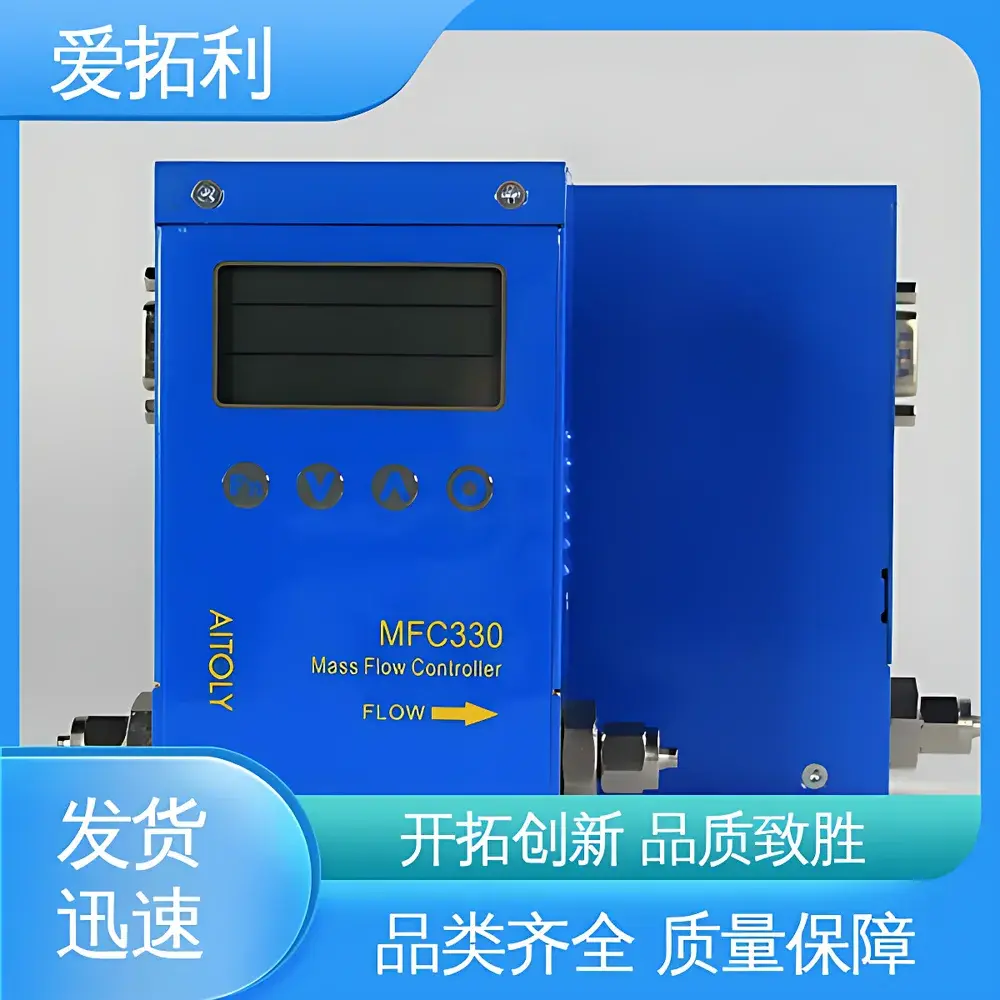
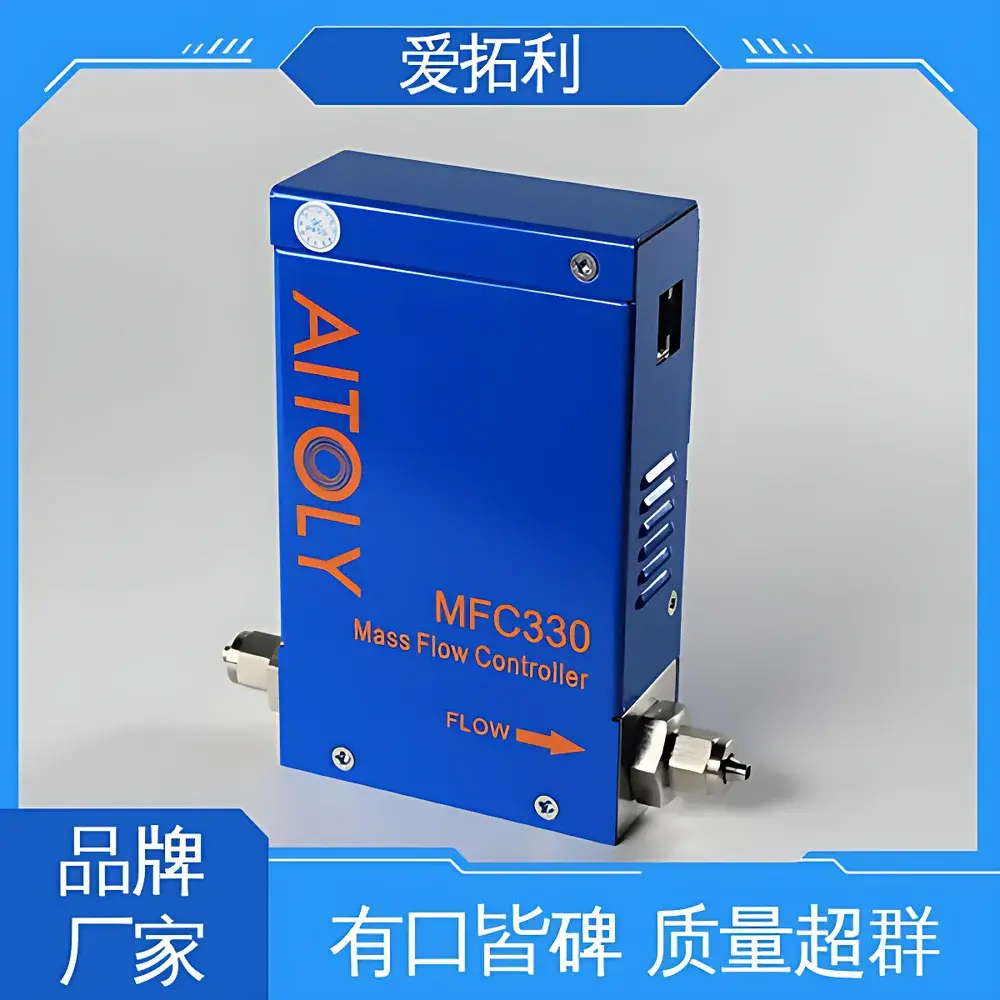
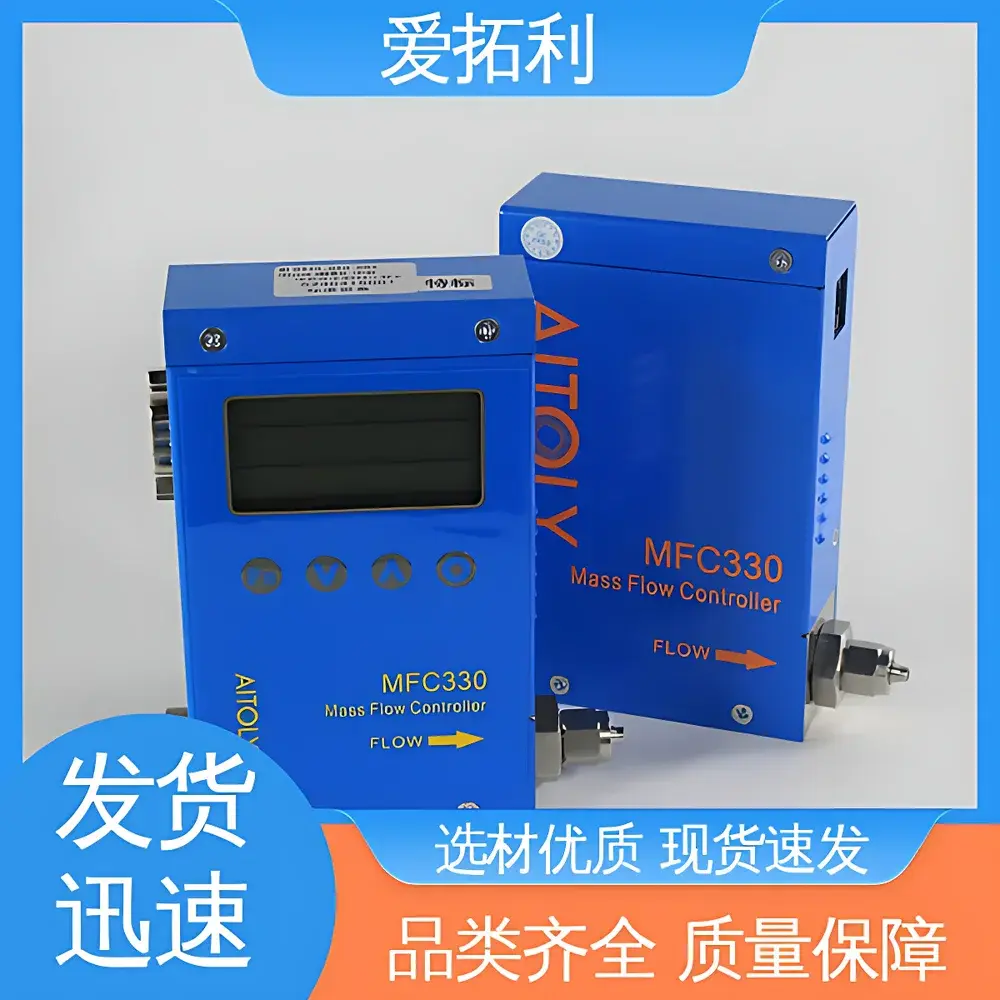
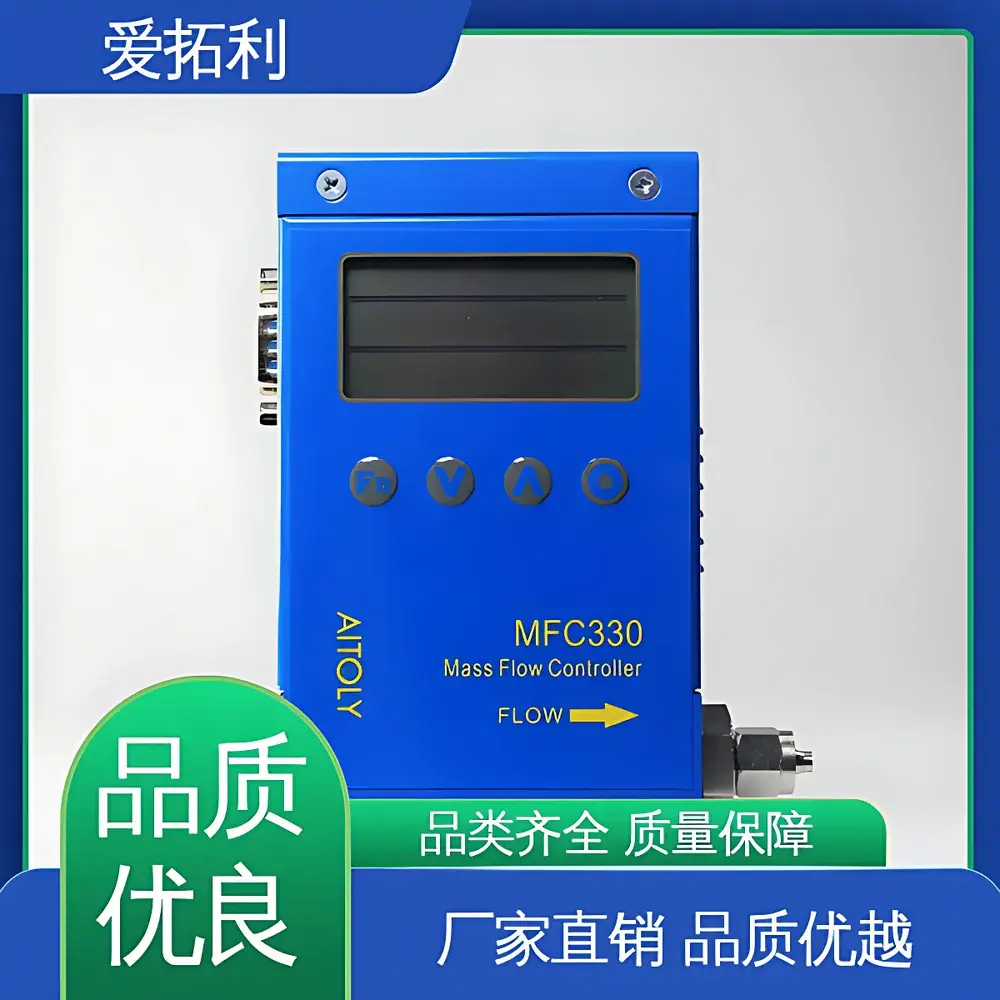
AITOLY MFC330 Thermal Mass Flow Controller
| Brand | AITOLY |
|---|---|
| Model | MFC330 |
| Type | Thermal Mass Flow Controller |
| Sensor Principle | Capillary Tube + Bypass Shunt |
| Flow Range Options | 0–2, 10, 20, 50, 100, 300, 500 sccm |
| Accuracy | ±1% FS |
| Repeatability | ±0.2% FS |
| Linearity | ±0.2% FS |
| Control Range | 1–100% FS (1:100) |
| Measurement Range | 0.5–100% FS (1:200) |
| Response Time | <3 s |
| Warm-up Time | 5 min (T95), 30 min for optimal stability |
| Operating Pressure Drop | 0–1 MPa |
| Valve Type | Normally Closed Proportional Solenoid Valve |
| Optional | All-Metal Proportional Valve, Integrated Digital Display |
| Gas Compatibility | Clean, dry gases (≥98% purity) |
| Power Supply | Standard 24 VDC input |
| Output Signal | 0–5 VDC / 0–10 VDC / 4–20 mA analog |
Overview
The AITOLY MFC330 is a precision-engineered thermal mass flow controller designed for stable, high-reproducibility gas flow measurement and closed-loop control in laboratory, pilot-scale, and light industrial process environments. It operates on the principle of thermal dispersion—where gas flowing across a heated capillary sensor element induces a measurable temperature differential proportional to mass flow rate—eliminating dependence on ambient temperature and pressure fluctuations when used with properly conditioned gas streams. Unlike volumetric flow devices, the MFC330 delivers true mass flow output in standardized cubic centimeters per minute (sccm) or standard liters per minute (slpm), referenced to 0 °C and 101.325 kPa (STP). Its integrated bypass shunt architecture ensures low pressure drop (<1 MPa max operating differential) while maintaining high sensitivity across its 1:200 turndown ratio (0.5–100% FS). The device is calibrated for clean, dry gases with ≥98% purity—including N₂, O₂, Ar, He, CO₂, H₂, and synthetic air—and is not suitable for corrosive, condensing, or particulate-laden media without upstream conditioning.
Key Features
- Capillary tube-based thermal sensor with integrated bypass shunt for enhanced signal-to-noise ratio and long-term drift resistance
- High-speed proportional solenoid valve (normally closed) enabling dynamic flow control with <3 s response time (10–90% step)
- Factory-calibrated accuracy of ±1% full scale (FS), repeatability ±0.2% FS, and linearity ±0.2% FS—verified per ISO 6358 and ASTM D7504 practices
- Wide operating pressure differential range: 0–1 MPa, supporting both vacuum and positive-pressure applications
- Optional all-metal proportional valve variant for compatibility with aggressive gases and extended service life in high-cycle duty
- Modular electronics architecture supporting analog (0–5 V, 0–10 V, 4–20 mA) and digital (RS485 Modbus RTU) interfaces for integration into PLC, SCADA, or custom DAQ systems
- Low-power 24 VDC operation with thermal stabilization circuitry achieving T95 warm-up in ≤5 minutes and metrological stability within 30 minutes
Sample Compatibility & Compliance
The MFC330 is intended exclusively for use with non-corrosive, particle-free, and moisture-free gases. Users must ensure upstream filtration (≤0.1 µm absolute) and desiccation (dew point ≤−40 °C) to prevent sensor fouling or thermal offset drift. It complies with CE marking requirements for electromagnetic compatibility (EN 61326-1) and low-voltage safety (EN 61010-1). While not certified to IEC 61508 or SIL standards, its deterministic control loop and fail-safe normally-closed valve configuration support integration into safety-rated systems under user-defined risk assessment. For regulated environments (e.g., pharmaceutical gas blending, semiconductor tool purging), the device supports audit-ready calibration records and can be included in GLP/GMP documentation packages when paired with traceable NIST-traceable calibration certificates.
Software & Data Management
The MFC330 operates as a standalone analog/digital instrument with no embedded firmware update capability; however, its analog outputs and Modbus RTU interface enable seamless integration with third-party data acquisition platforms such as LabVIEW, MATLAB, or Siemens SIMATIC. Configuration parameters—including setpoint scaling, zero offset correction, and gas selection (via multi-gas calibration factor tables)—are retained in non-volatile memory. When deployed in networked systems, the device supports timestamped flow logging at up to 10 Hz via external controllers. Though it does not natively implement FDA 21 CFR Part 11 electronic signature or audit trail functionality, its deterministic analog output and deterministic valve response make it compatible with validated systems where such compliance is enforced at the supervisory layer.
Applications
- Precise gas dosing in chemical vapor deposition (CVD) and atomic layer deposition (ALD) research reactors
- Carrier and purge gas control in GC and GC-MS sample introduction systems
- Flow regulation in fuel cell test stations (H₂, O₂, N₂, air)
- Leak testing and pressure decay analysis using controlled gas injection
- Environmental chamber gas mixing (CO₂ enrichment, O₂ depletion studies)
- Calibration transfer standards for secondary flow meters in metrology labs
- Process gas delivery in small-scale bioreactors and fermentation monitoring setups
FAQ
What gases are supported by the MFC330?
The MFC330 is calibrated for common industrial and laboratory gases including nitrogen, oxygen, argon, helium, carbon dioxide, hydrogen, and synthetic air. Custom calibration for other gases (e.g., NH₃, CH₄) is possible upon request, subject to material compatibility verification.
Is the MFC330 suitable for vacuum applications?
Yes—the device maintains specified accuracy across differential pressures from 0 to 1 MPa, making it suitable for both downstream (vacuum-side) and upstream (pressure-side) installation configurations, provided inlet pressure remains above vapor pressure limits of internal wetted materials.
Does the MFC330 include built-in temperature and pressure compensation?
No—its thermal mass flow measurement principle inherently compensates for variations in gas temperature and pressure *at constant composition*, eliminating the need for separate T&P sensors. However, gas composition changes require recalibration or gas-specific scaling factors.
Can the MFC330 be used in GMP-regulated environments?
It may be deployed in GMP contexts as a field instrument, provided users establish documented procedures for periodic verification, calibration traceability to national standards, and inclusion in equipment qualification (IQ/OQ/PQ) protocols.
What is the recommended maintenance interval?
Under typical clean-gas conditions, no scheduled maintenance is required. Annual verification against a traceable reference standard is advised; visual inspection of inlet filters and verification of zero stability should occur every 6 months in continuous operation.