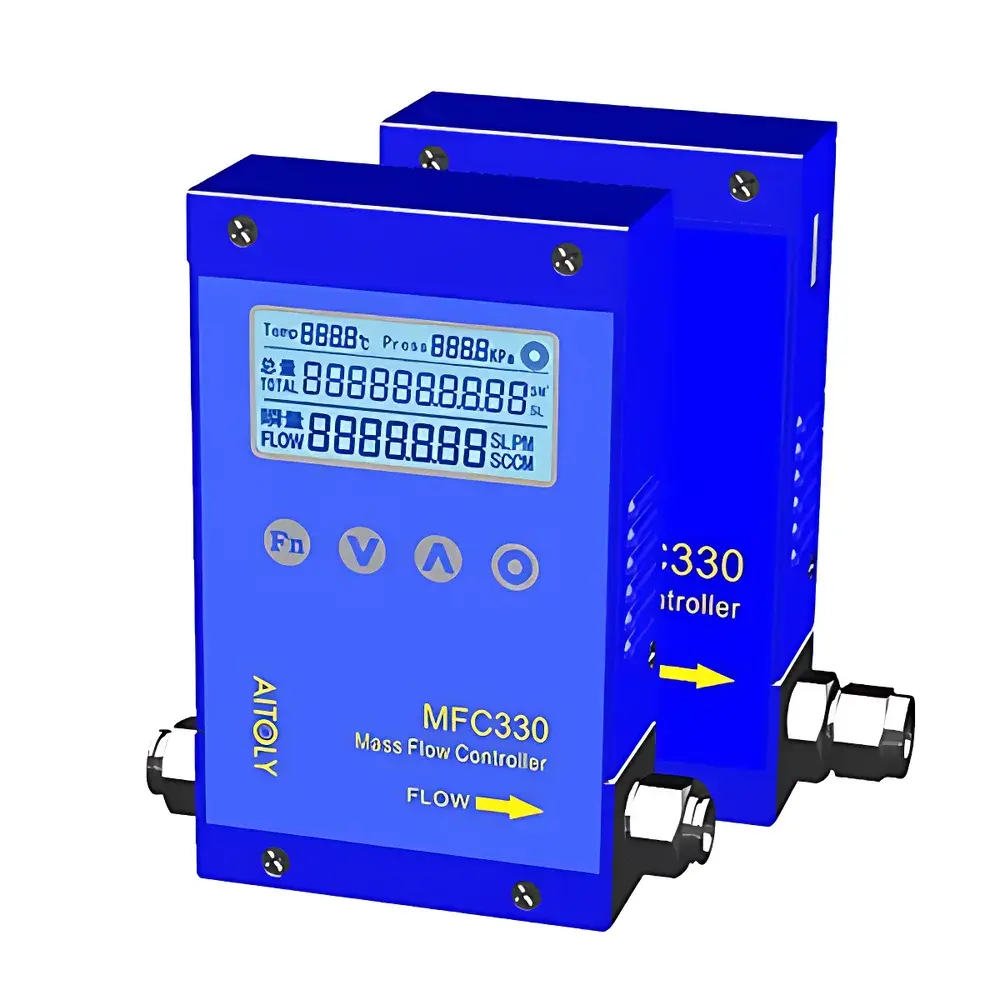
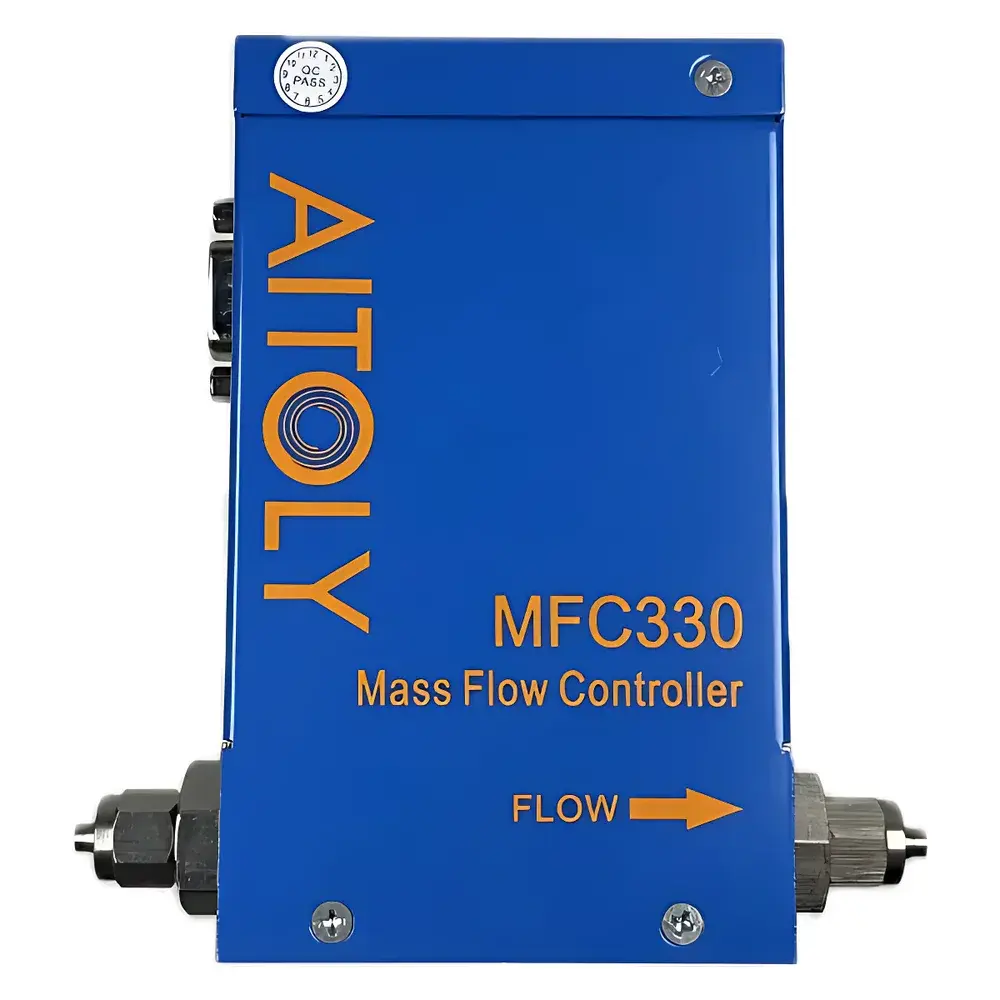
AITOLY MFC330 Thermal Mass Flow Controller
| Brand | AITOLY |
|---|---|
| Origin | Jiangsu, China |
| Model | MFC330 |
| Type | Thermal Mass Flow Controller |
| Compliance | ISO 9001 Certified |
| Communication Protocols | RS-485 (Modbus RTU), 0–5 V / 0–10 V analog output, optional CAN bus |
| Gas Compatibility | Air, N₂, O₂, Ar, CO₂, H₂, He, CH₄, and custom gas calibrations |
| Accuracy | ±(0.8% of reading + 0.2% of full scale) |
| Repeatability | ≤ ±0.2% FS |
| Response Time | < 100 ms (t₉₀) |
| Operating Pressure | 0.1–1.0 MPa (absolute) |
| Operating Temperature | –10°C to +60°C |
| Power Supply | 24 VDC ±10%, 1.5 A max |
Overview
The AITOLY MFC330 Thermal Mass Flow Controller is an industrial-grade, closed-loop gas flow regulation instrument engineered for precision, stability, and long-term reliability in demanding process environments. Based on the principle of thermal dispersion—where heat transfer from a heated sensor element to the flowing gas stream is directly proportional to mass flow rate—the MFC330 delivers true mass flow measurement independent of pressure and temperature fluctuations. Unlike volumetric flow devices requiring external compensation, this controller integrates real-time thermal sensing with a high-stability proportional control valve to achieve rapid, accurate setpoint tracking across dynamic operating conditions. Its compact, modular design supports seamless integration into semiconductor fabrication tools, vacuum deposition systems, fuel cell test benches, analytical instrumentation gas delivery modules, and bioprocess gas blending units.
Key Features
- Self-contained thermal mass flow sensor and proportional control valve—both fully developed and manufactured in-house by AITOLY, ensuring traceable calibration and consistent performance.
- High-speed digital control loop with sub-100 ms response time (t₉₀), enabling stable regulation even during rapid flow transients typical in ALD, CVD, and plasma etch processes.
- Multi-gas capability with factory calibration for up to 12 standard gases (including N₂, O₂, Ar, CO₂, H₂, He, CH₄); optional user-defined gas calibration via software interface.
- Dual-output architecture: isolated analog (0–5 V / 0–10 V) for PLC integration and RS-485 Modbus RTU for SCADA or centralized monitoring—fully compliant with industrial automation protocols.
- Ruggedized aluminum housing rated IP65, with stainless steel wetted parts (316L SS body, Hastelloy C-276 optional) suitable for corrosive or ultra-high-purity applications.
- ISO 9001-certified manufacturing process, including 100% functional testing, pressure leak verification (≤1×10⁻⁹ mbar·L/s He), and thermal drift validation over 72-hour burn-in cycles.
Sample Compatibility & Compliance
The MFC330 supports a broad range of process gases—from inert and reactive species to hydrogen-rich and hydrocarbon blends—without requiring recalibration when switching between pre-configured gases. It meets material compatibility requirements for Class 1 cleanroom environments (per SEMI F57) and is routinely deployed in ISO Class 5–7 controlled areas. While not intrinsically safe certified, its low-power DC operation and absence of ignition sources make it suitable for non-hazardous zone installations. The device adheres to electromagnetic compatibility standards per IEC 61326-1 (industrial environment) and undergoes full EMC immunity testing (EFT, surge, radiated RF). All firmware and calibration data are stored in non-volatile memory with write-protection, supporting audit-ready documentation for GLP/GMP-regulated workflows.
Software & Data Management
Configuration and diagnostics are performed via AITOLY’s PC-based MFC Manager software (Windows 10/11 compatible), which provides real-time flow visualization, step-response logging, and batch calibration report generation—including uncertainty budgets traceable to NIST-traceable reference standards. The software supports automated calibration certificate export in PDF format compliant with ISO/IEC 17025 documentation requirements. For enterprise integration, the Modbus RTU interface enables direct connection to MES platforms (e.g., Siemens SIMATIC IT, Rockwell FactoryTalk) with configurable data polling intervals (100 ms to 5 s). All configuration changes are timestamped and logged locally; optional firmware update history tracking satisfies FDA 21 CFR Part 11 requirements for electronic records and signatures when used with validated system configurations.
Applications
- Semiconductor manufacturing: Precise dopant gas dosing in diffusion furnaces and etch chamber purge sequences.
- Photovoltaic production: Controlled SiH₄/H₂ mixtures for PECVD thin-film deposition.
- Fuel cell R&D: Dynamic anode/cathode gas stoichiometry control during polarization curve mapping.
- Life science instrumentation: Carrier gas regulation in GC-MS sample introduction systems and cell culture bioreactor headspace control.
- Industrial gas generation: Real-time blending of medical air, nitrogen, and oxygen for on-site PSA and membrane systems.
- Calibration laboratories: Reference-grade flow verification using master meters traceable to national metrology institutes.
FAQ
What gases can the MFC330 measure and control out of the box?
The MFC330 ships with factory calibrations for air, N₂, O₂, Ar, CO₂, H₂, He, CH₄, and three additional user-selectable gases. Custom calibrations for specialty gas mixtures (e.g., forming gas, synthetic air) are available upon request.
Is the device suitable for ultra-high-purity (UHP) gas applications?
Yes—standard models feature electropolished 316L stainless steel flow paths with orbital welds and helium-leak-tested assemblies. Optional Hastelloy C-276 wetted parts and VCR® end fittings are available for UHP and aggressive gas service.
Does the MFC330 support field recalibration?
Field zero calibration is supported via software command; full span calibration requires connection to a traceable reference flow standard and must be performed in a controlled environment per ISO 6416 guidelines.
How is long-term stability ensured?
Each unit undergoes accelerated aging at elevated temperature and pressure for 72 hours prior to final test. Drift is monitored continuously; only units demonstrating ≤±0.5% FS change over 30 days qualify for shipment.
Can multiple MFC330 units be synchronized in a single system?
Yes—via Modbus RTU daisy-chaining or synchronized analog setpoint inputs. Timing jitter between units is maintained within ±200 µs under nominal load conditions.