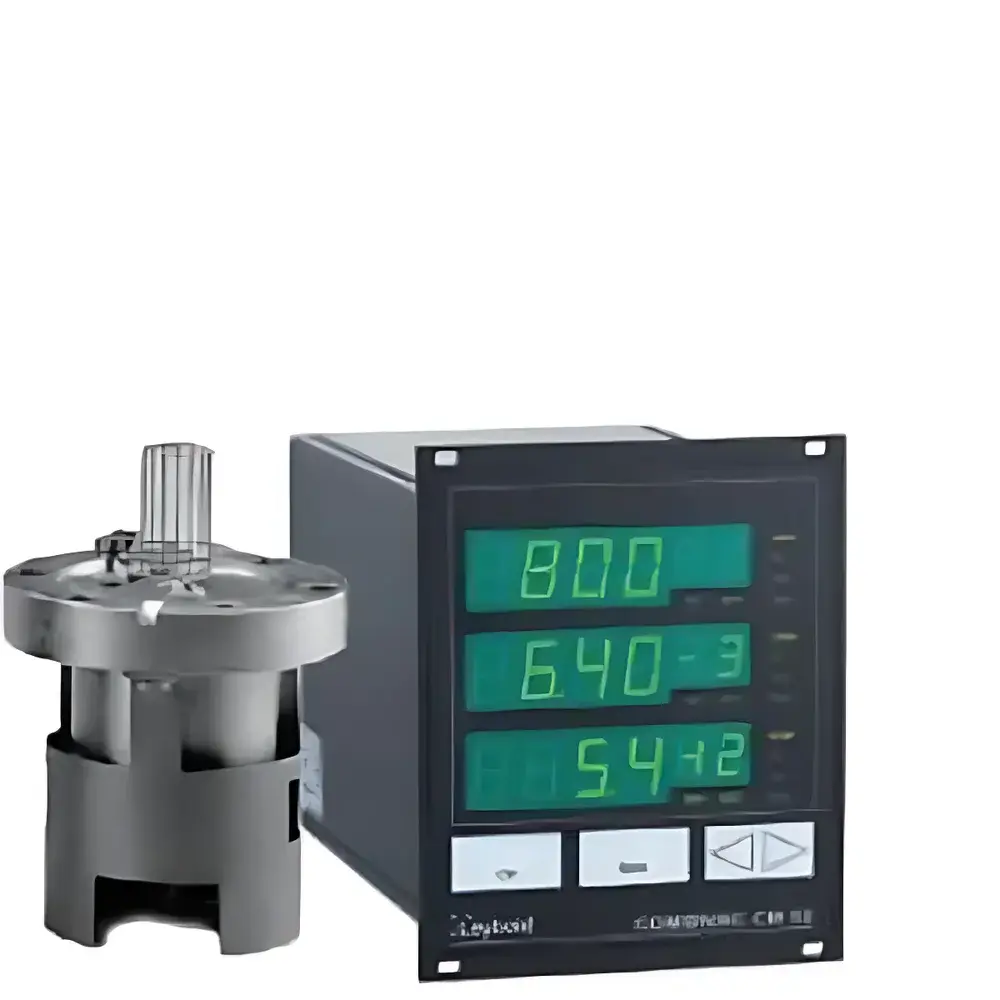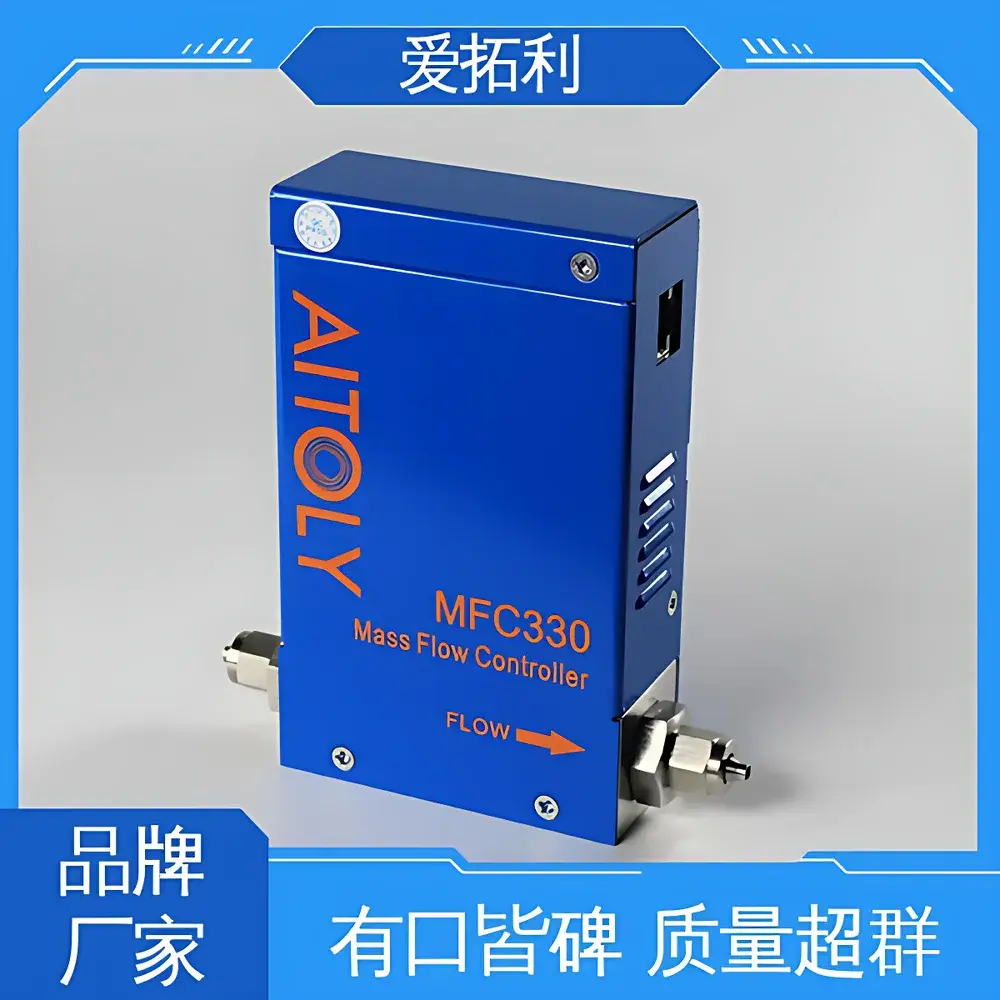
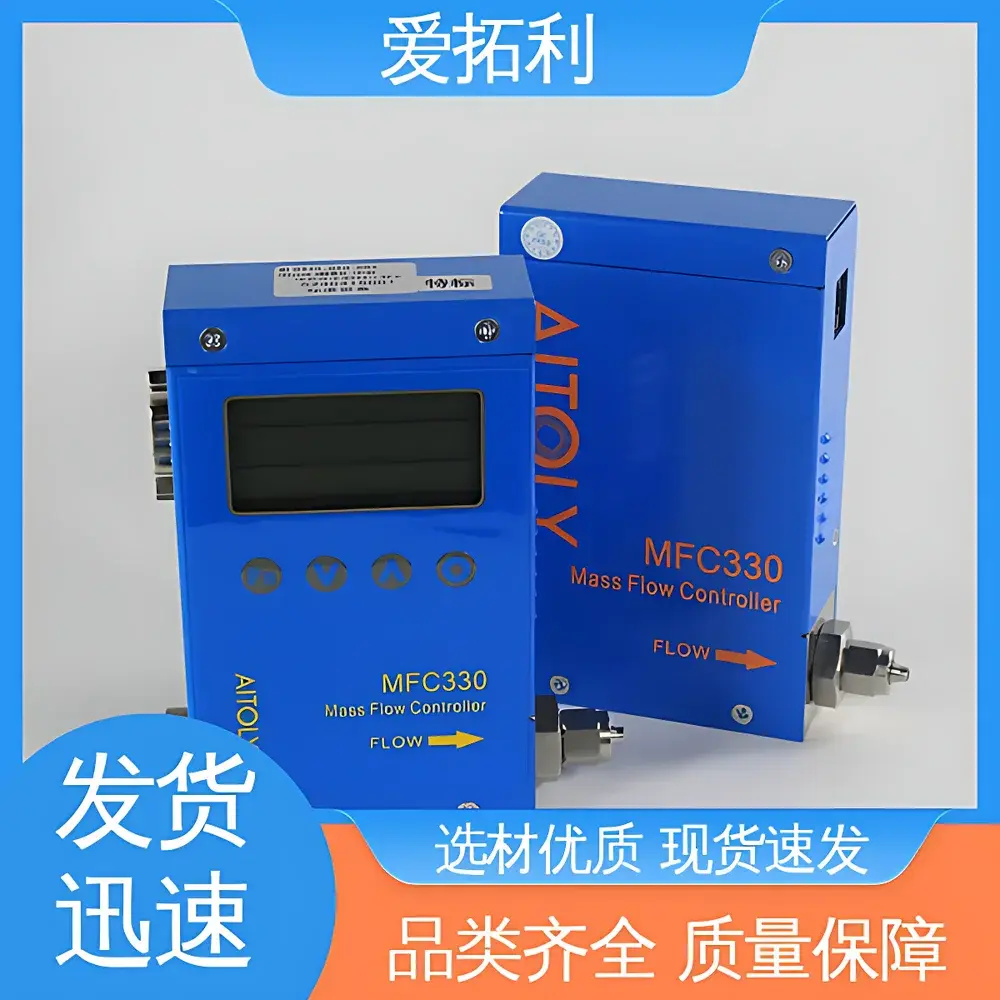
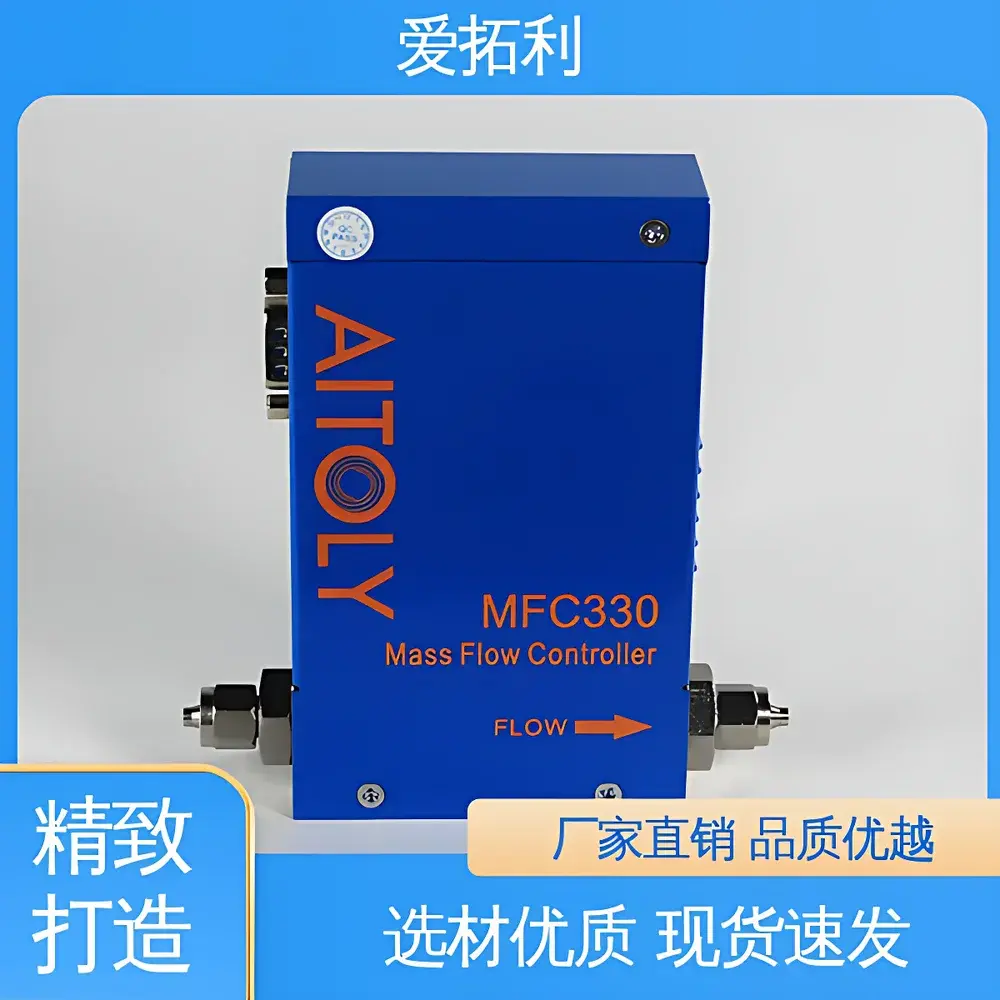
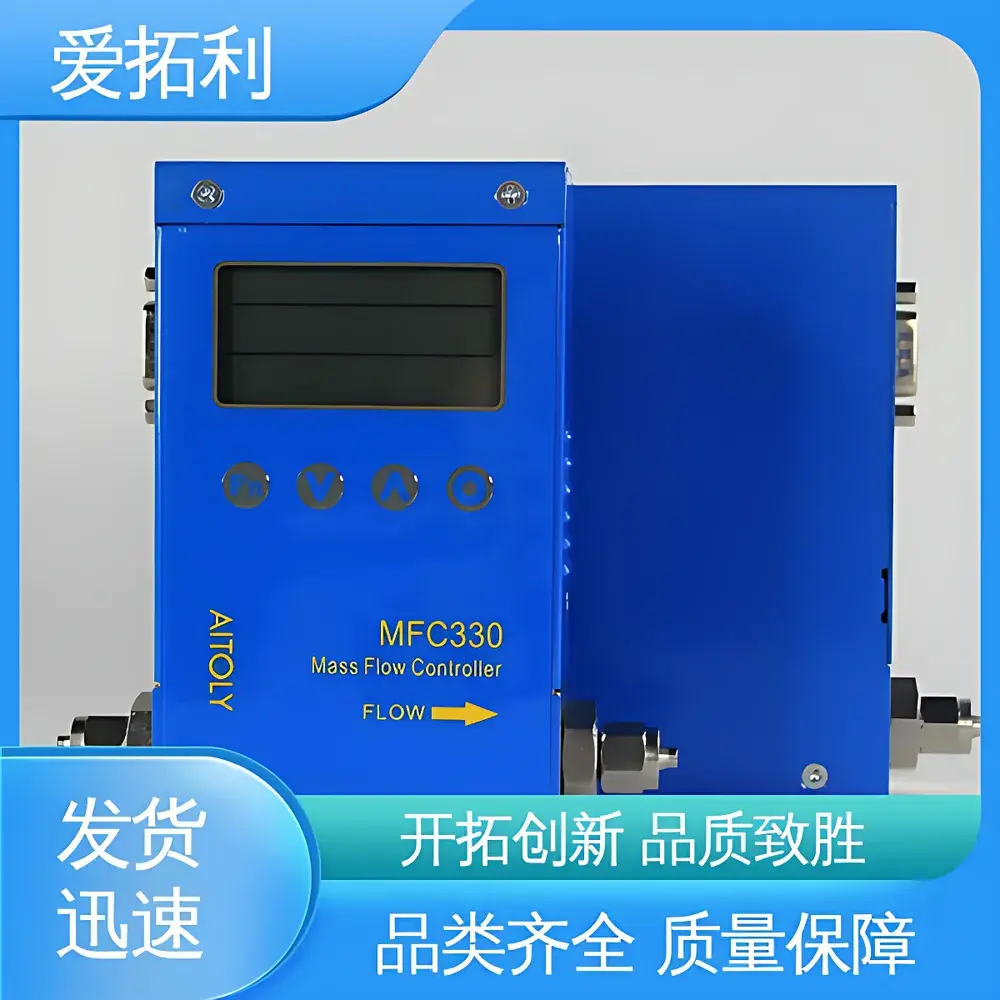
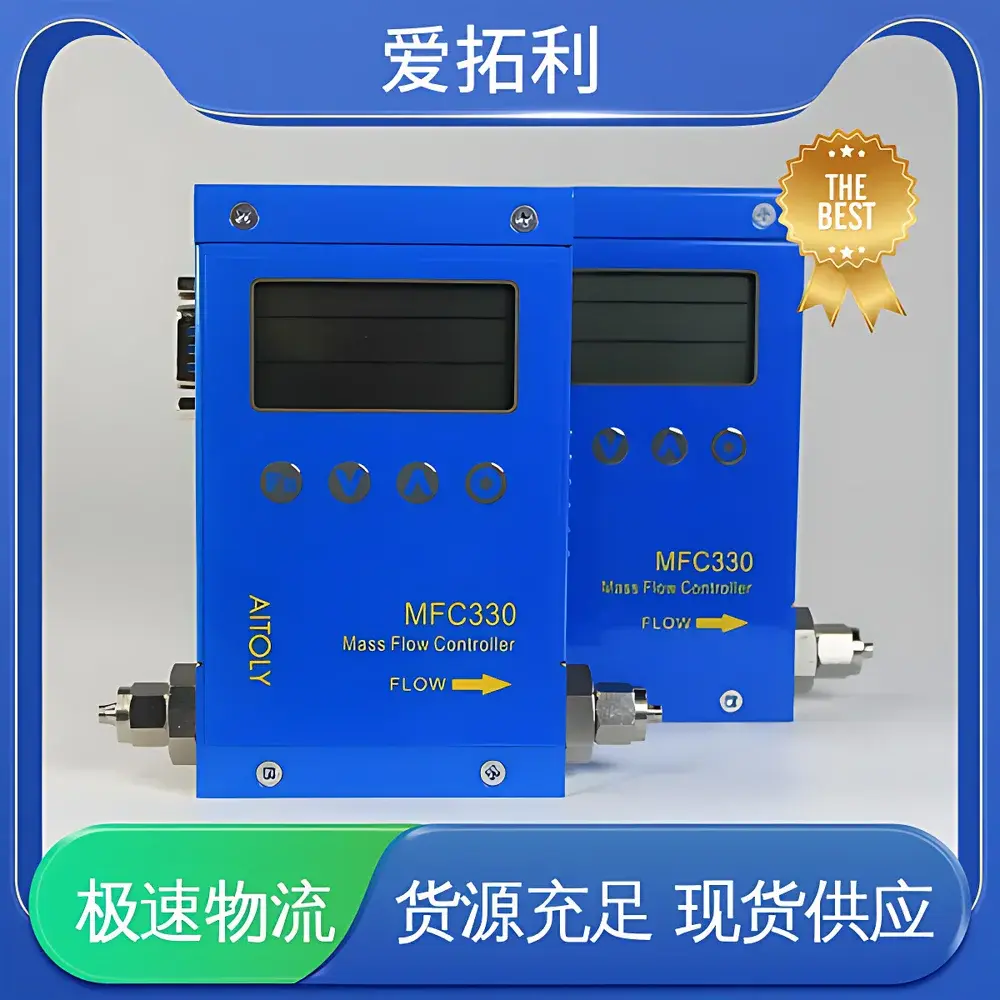
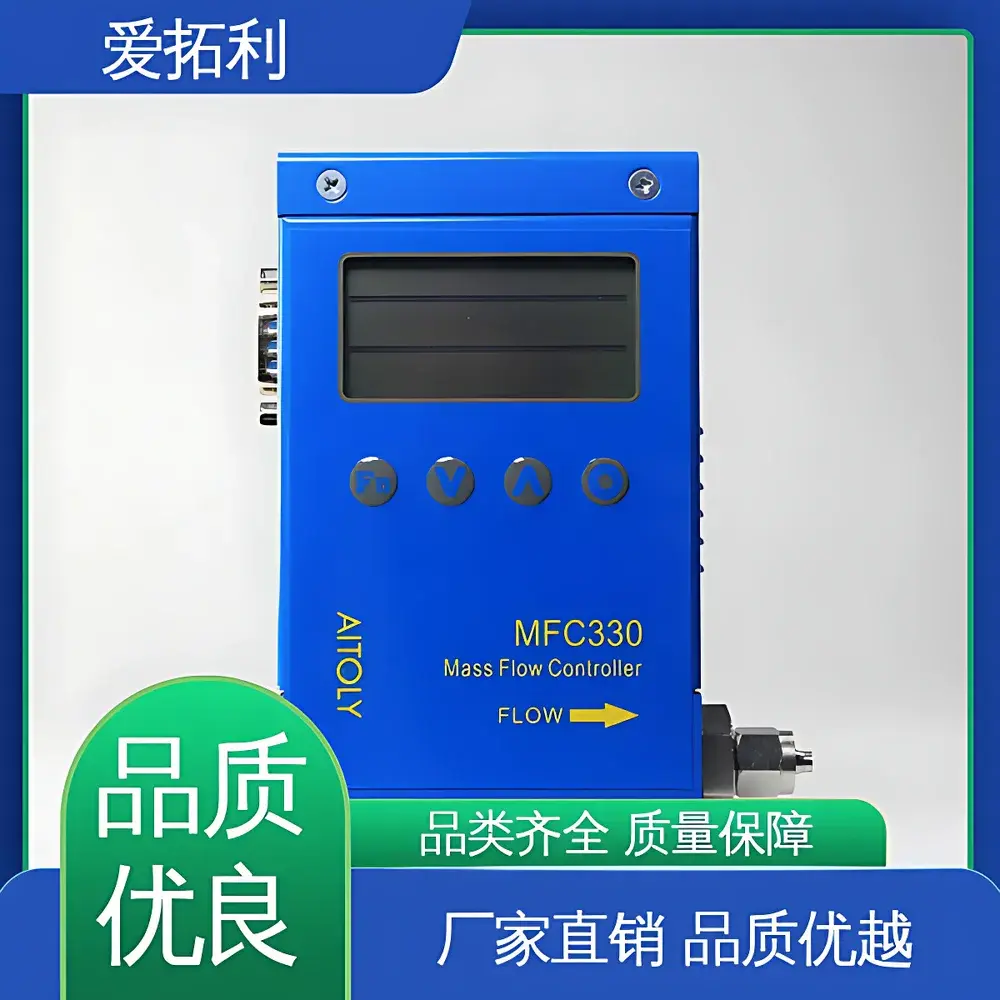
AITOLY MFC330 Thermal Mass Flow Controller
| Brand | AITOLY |
|---|---|
| Origin | Jiangsu, China |
| Model | MFC330 |
| Flow Principle | Thermal Mass Flow Measurement |
| Sensor Type | Capillary Tube with Bypass Shunt |
| Valve Type | Normally Closed Proportional Control Valve |
| Flow Range Options | 0–2 / 10 / 20 / 50 / 100 / 300 / 500 sccm |
| Accuracy | ±1% FS |
| Repeatability | ±0.2% FS |
| Linearity | ±0.2% FS |
| Flow Control Range | 1–100% FS (1:100) |
| Measurement Range | 0.5–100% FS (1:200) |
| Response Time | <3 s (t₉₀) |
| Warm-up Time | 5 min to 95% stability, 30 min for optimal performance |
| Gas Compatibility | Clean, dry gases |
Overview
The AITOLY MFC330 is a precision thermal mass flow controller engineered for stable, high-reproducibility gas flow regulation in low-flow applications. It operates on the principle of constant-temperature anemometry: a heated capillary tube sensor measures convective heat transfer from flowing gas, converting thermal dissipation into a linear mass flow signal independent of pressure and temperature fluctuations—provided gas composition remains consistent. The integrated bypass shunt architecture ensures laminar, low-pressure-drop flow distribution across the sensor and control path. A high-bandwidth proportional solenoid valve, coupled with closed-loop PID control firmware, dynamically adjusts flow in real time to match user-defined setpoints. This architecture enables robust operation under variable inlet pressure (±20% of rated supply), ambient temperature shifts (15–35 °C), and minor downstream backpressure changes—making the MFC330 suitable for integration into vacuum systems, gas chromatography sample introduction modules, semiconductor process tool purges, and analytical instrument calibration benches.
Key Features
- Capillary-tube thermal sensor with integrated bypass shunt for enhanced sensitivity and reduced zero drift
- Normally closed proportional control valve with sub-second actuation latency and hysteresis <0.1% FS
- Closed-loop digital control architecture supporting analog (0–5 V / 0–10 V / 4–20 mA) and RS-485 Modbus RTU interfaces
- Factory-calibrated for up to 12 preloaded gas types (N₂, O₂, Ar, He, CO₂, H₂, CH₄, Air, N₂O, SF₆, C₃H₈, and custom blends); gas selection via DIP switch or software
- Thermal compensation algorithm correcting for ambient temperature gradients across the sensor housing (±0.02% FS/°C typical)
- Stainless steel 316L wetted parts and VCR-compatible inlet/outlet ports (¼″ or ⅜″) compliant with UHP gas handling standards
- EMC-certified per IEC 61326-1 Class A; RoHS and CE marked
Sample Compatibility & Compliance
The MFC330 is validated for use with clean, dry, non-corrosive gases at purity levels ≥98%. Particulate filtration ≤0.1 µm and dew point ≤−40 °C are strongly recommended to prevent sensor fouling or valve stiction. It is not rated for use with condensable vapors, reactive halogens (e.g., Cl₂, F₂), or highly corrosive mixtures (e.g., HCl, NH₃). While not intrinsically safe certified, its low-power design (<2.5 W nominal) and absence of ignition sources permit deployment in Class 1, Division 2 environments when installed per NEC Article 500 guidelines. Calibration traceability follows ISO/IEC 17025 procedures; factory certificates include as-found/as-left data and uncertainty budgets per GUM (Guide to the Expression of Uncertainty in Measurement). The device supports audit-ready operation under GLP and GMP frameworks when paired with compliant SCADA or LIMS platforms enabling full electronic record retention.
Software & Data Management
Configuration and monitoring are supported via AITOLY’s PC-based MFC-Config Suite (Windows 10/11), offering real-time flow visualization, multi-channel synchronization, ramp/step profile programming, and CSV export with timestamped metadata (flow, setpoint, valve position, temperature, status flags). Firmware updates preserve user calibration tables and gas selections. For industrial integration, native Modbus RTU register mapping enables direct read/write access to all operational parameters—including flow setpoint (register 40001), measured flow (40002), valve output (40003), and diagnostic codes (40010–40015). All communication logs can be enabled for FDA 21 CFR Part 11 compliance when deployed with third-party validation packages supporting electronic signatures and audit trails.
Applications
- Precise carrier gas delivery in GC and GC-MS systems requiring sub-sccm repeatability
- Process gas metering and blending in thin-film deposition tools (PECVD, ALD)
- Leak testing and decay rate quantification in hermeticity validation (MIL-STD-883 Method 1014)
- Calibration of secondary flow sensors using gravimetric or bubble-meter reference standards
- Controlled atmosphere generation for material aging studies (ASTM D3045, ISO 11357)
- Low-flow purge management in optical cavity stabilization and laser cooling setups
FAQ
What gas calibration options are available?
Standard calibrations cover N₂, Air, O₂, Ar, He, CO₂, H₂, CH₄, N₂O, SF₆, C₃H₈, and custom binary/multi-component blends. Custom calibrations require certified reference gas and minimum order volume.
Can the MFC330 operate in vacuum or negative-pressure conditions?
No. It requires positive inlet pressure (minimum 0.1 MPa gauge) and is rated for operation up to 1.0 MPa. Downstream vacuum must be isolated by a pressure-regulating stage.
Is firmware upgrade capability field-accessible?
Yes—via USB-to-RS485 adapter and MFC-Config Suite. Firmware updates retain existing gas tables and calibration coefficients unless explicitly reset.
Does the device support automatic temperature compensation during extended operation?
Yes. Internal thermistors monitor sensor housing temperature, and the embedded algorithm applies real-time gain/offset corrections per ISO 14644-3 Annex B methodology.
What is the recommended recalibration interval?
Annual calibration is advised for critical applications. In stable laboratory environments with documented environmental controls, biannual verification against traceable standards may be justified per ISO/IEC 17025 Clause 7.7.