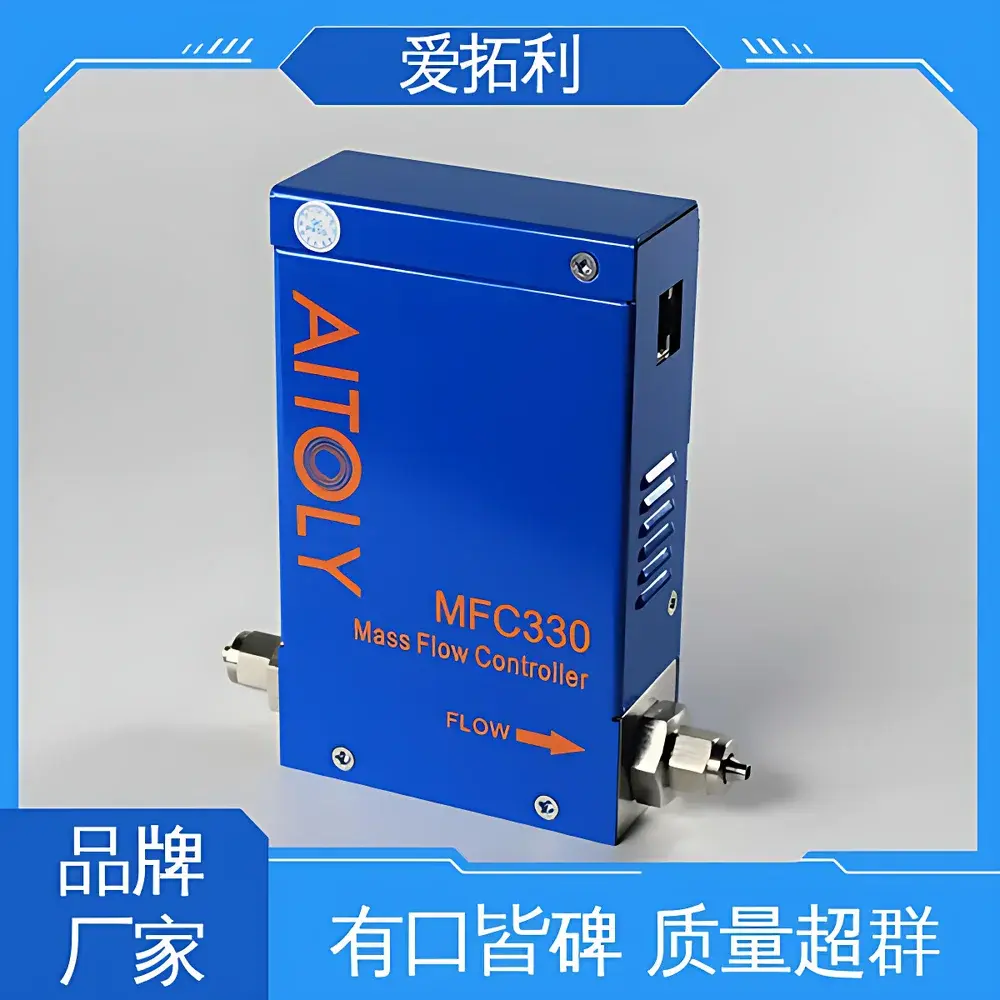
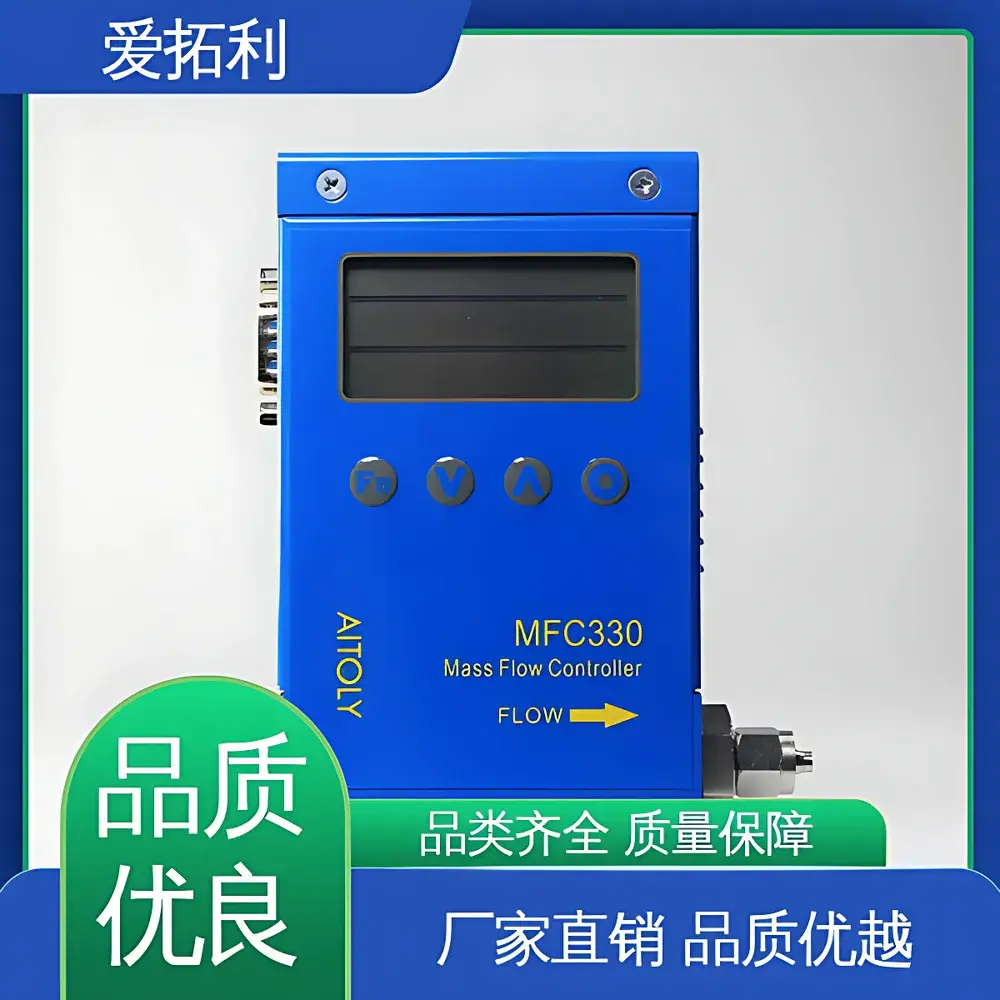
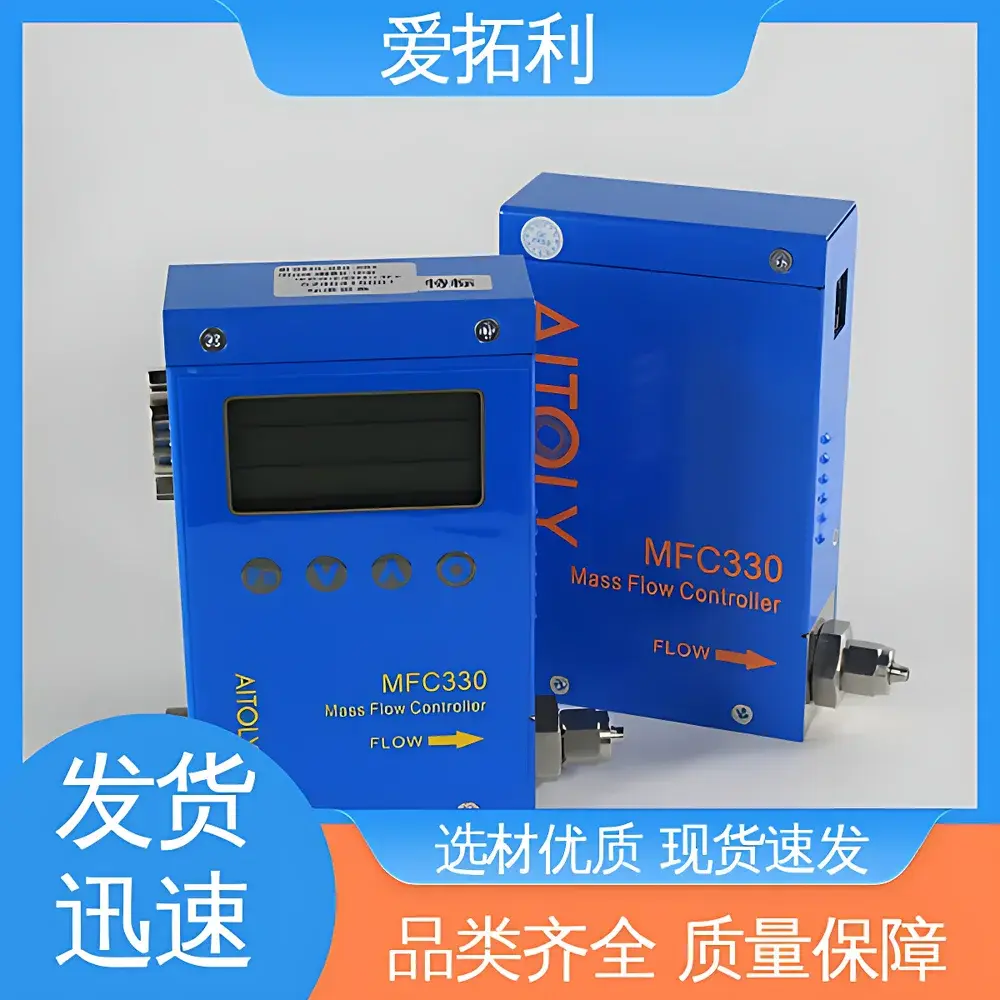
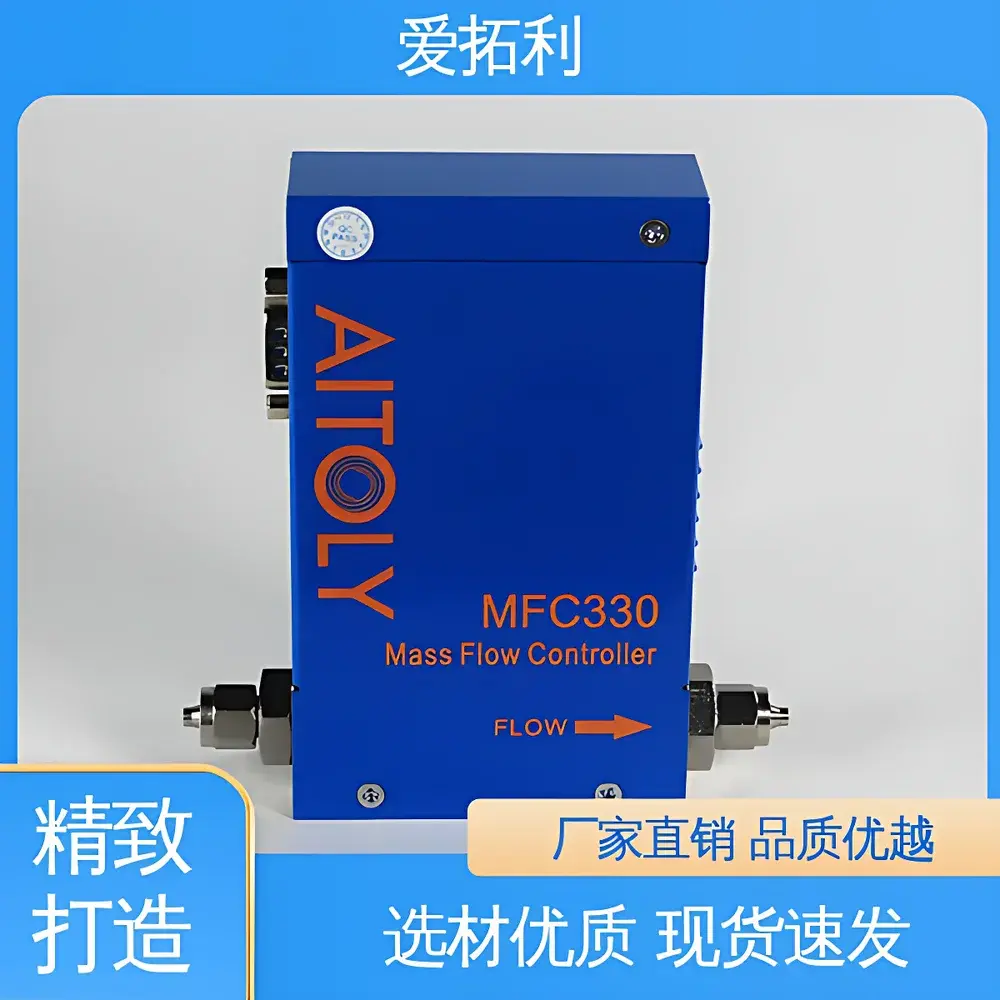
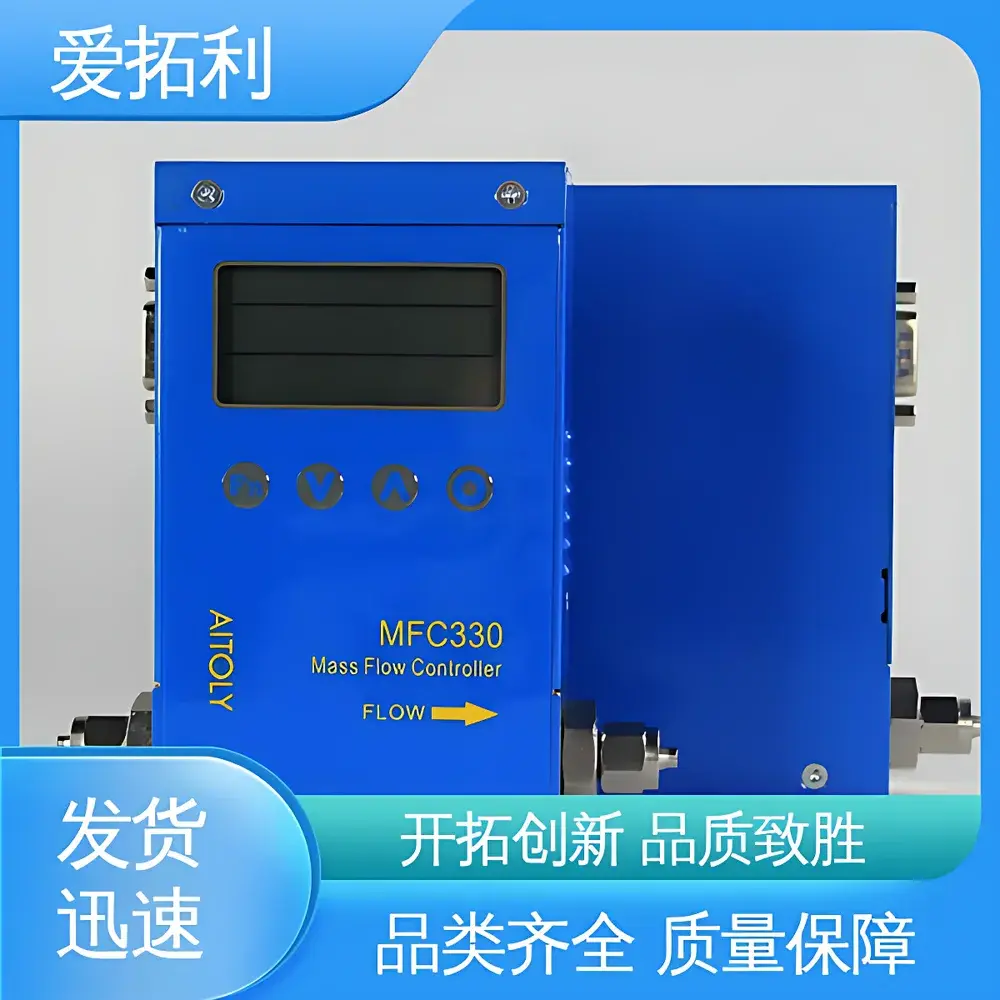
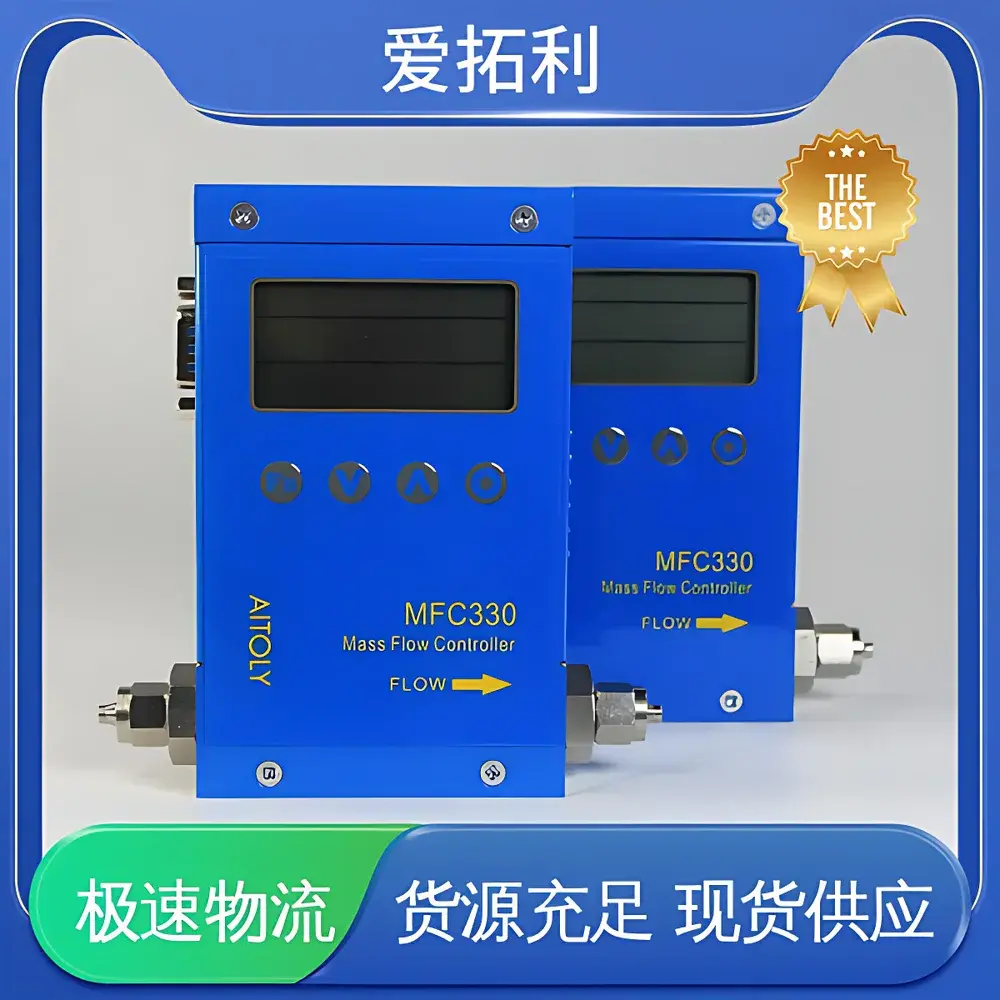
AITOLY MFC330 Thermal Mass Flow Controller
| Brand | AITOLY |
|---|---|
| Origin | Jiangsu, China |
| Model | MFC330 |
| Type | Thermal Mass Flow Controller |
| Flow Range Options | 0–2, 10, 20, 50, 100, 300, 500 sccm |
| Accuracy | ±1% FS |
| Repeatability | ±0.2% FS |
| Linearity | ±0.2% FS |
| Control Range | 1–100% FS (1:100) |
| Measurement Range | 0.5–100% FS (1:200) |
| Response Time | <3 s |
| Warm-up Time | 5 min (T95), 30 min recommended for optimal stability |
| Valve Type | Normally Closed |
Overview
The AITOLY MFC330 is a precision-engineered thermal mass flow controller designed for stable, repeatable gas flow regulation in laboratory, pilot-scale, and light industrial process environments. It operates on the principle of thermal dispersion—measuring mass flow rate by detecting heat transfer between a heated sensor element and the flowing gas stream. Unlike volumetric flow devices, the MFC330 delivers true mass flow output independent of pressure and temperature fluctuations, eliminating the need for external compensation in most standard applications. Its core architecture integrates a capillary-tube-based thermal sensor, a precision bypass分流 path, a high-resolution proportional control valve, and an embedded digital control loop. This closed-loop design continuously compares measured flow against user-defined setpoints and dynamically adjusts valve position to maintain target flow—even under varying inlet pressure, ambient temperature shifts, or downstream resistance changes. The device is calibrated for clean, dry gases and supports over 98 common industrial and laboratory gases via built-in gas selection tables, enabling rapid reconfiguration without hardware modification.
Key Features
- Thermal dispersion sensing with capillary-tube sensor element for high sensitivity and long-term stability
- Digital closed-loop control architecture ensuring fast dynamic response (<3 s typical settling time)
- Normally closed proportional solenoid valve with low hysteresis and high resolution actuation
- Wide turndown ratio: 1:100 for control (1–100% FS) and 1:200 for measurement (0.5–100% FS)
- Factory-calibrated accuracy of ±1% full scale (FS), repeatability ±0.2% FS, and linearity ±0.2% FS
- Integrated warm-up optimization: achieves T95 stability in 5 minutes; 30-minute stabilization recommended for metrological-grade operation
- Gas-specific scaling support for 98+ gases—including N₂, O₂, Ar, He, CO₂, H₂, CH₄, NH₃, and custom blends—via software-selectable calibration curves
Sample Compatibility & Compliance
The MFC330 is intended for use with non-corrosive, particle-free, and desiccated gases. It is not suitable for vapors, aerosols, condensable gases, or gases containing oil mist, particulates >0.1 µm, or moisture exceeding dew point –40 °C. All wetted materials—including stainless steel 316L body, glass-fused quartz capillary, and PTFE-sealed valve components—comply with ISO 8573-1 Class 2 for solid particle contamination and Class 3 for water content. While not certified to IEC 61508 or SIL standards, the controller meets general-purpose laboratory equipment requirements per IEC 61010-1 for electrical safety. Firmware supports configurable audit trails and parameter lockout modes, facilitating alignment with GLP documentation practices. Optional RS-485 Modbus RTU and analog 0–5 V / 4–20 mA interfaces enable integration into validated systems compliant with FDA 21 CFR Part 11 when paired with appropriate data acquisition infrastructure.
Software & Data Management
The MFC330 supports configuration and real-time monitoring via a Windows-based PC utility (provided on USB drive) featuring intuitive setpoint ramping, gas selection, unit conversion (sccm, slpm, g/min), and data logging at up to 10 Hz. Logged data exports directly to CSV format with timestamp, measured flow, setpoint, valve position (%), and internal sensor temperature. For OEM integration, ASCII command protocol over serial interface allows full remote control—including zero calibration initiation, gas type switching, and alarm threshold definition. Firmware revision history and configuration snapshots are retained in non-volatile memory, supporting traceability during routine maintenance or regulatory review. No cloud connectivity or proprietary cloud platform is included; all data remains local unless explicitly exported by the user.
Applications
- Gas delivery control in semiconductor CVD and PECVD process tools
- Calibration reference in gas analyzer verification setups (e.g., FTIR, NDIR, electrochemical sensors)
- Flow regulation in environmental chamber purge systems and controlled-atmosphere gloveboxes
- Mass flow feedback in fuel cell test stations and hydrogen safety validation rigs
- Carrier and reactant gas control in benchtop GC and microreactor systems
- Teaching labs for fluid dynamics, process control theory, and sensor physics education
FAQ
What gases can the MFC330 measure and control?
The MFC330 supports 98+ preloaded gases including nitrogen, oxygen, argon, helium, carbon dioxide, hydrogen, methane, ammonia, and synthetic air. Custom gas coefficients can be imported via PC software if required.
Is the MFC330 suitable for corrosive or humid gas streams?
No. It requires clean, dry, non-corrosive gases. Moisture must remain below –40 °C dew point; particulates must be filtered to <0.1 µm. Exposure to condensables or aggressive media may damage the thermal sensor.
Does the device require periodic recalibration?
Annual verification against a traceable standard is recommended for critical applications. Zero calibration can be performed in-field using the front-panel button or software command.
Can multiple MFC330 units be daisy-chained on one RS-485 bus?
Yes—up to 32 units with unique Modbus addresses can operate on a single RS-485 network, enabling synchronized multi-gas control in distributed systems.
What is the minimum measurable flow for the 500 sccm range?
With a full-scale range of 500 sccm and a measurement range of 0.5% FS, the lowest reliably quantifiable flow is 2.5 sccm (±1% FS uncertainty = ±5 sccm absolute error).