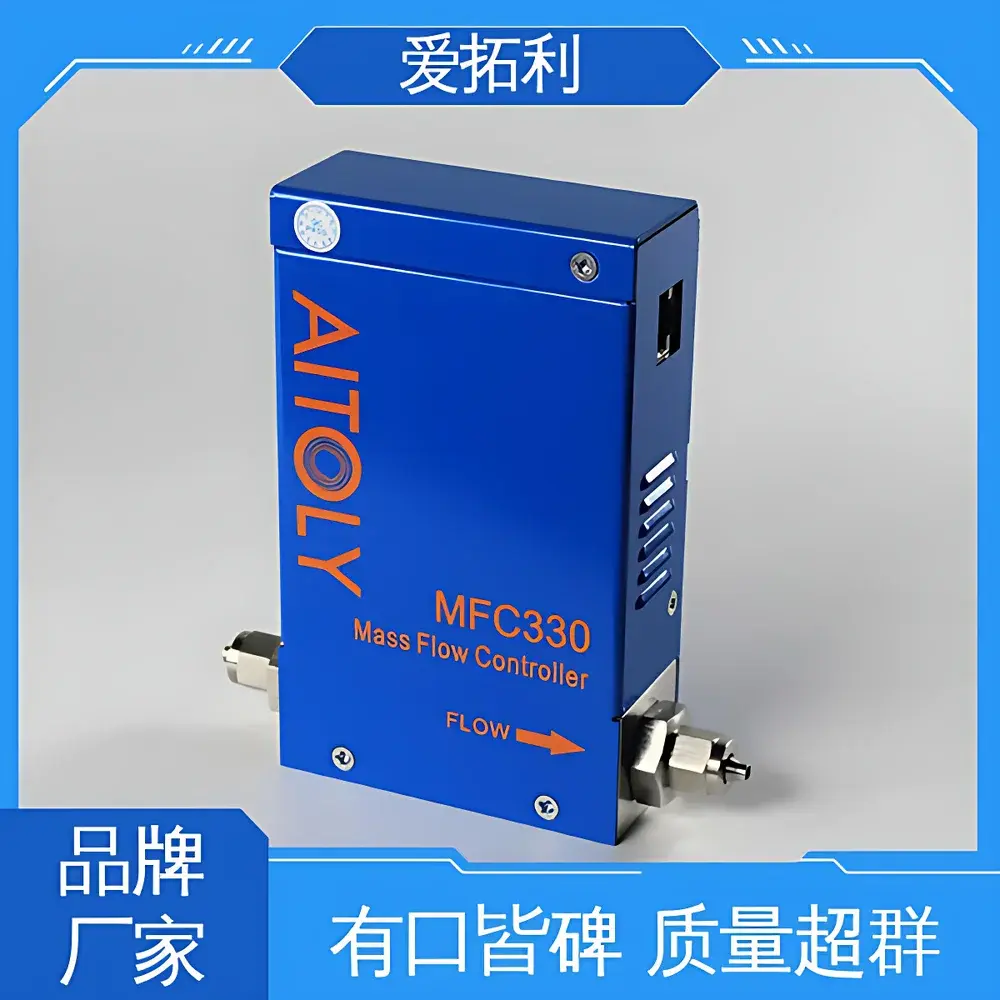
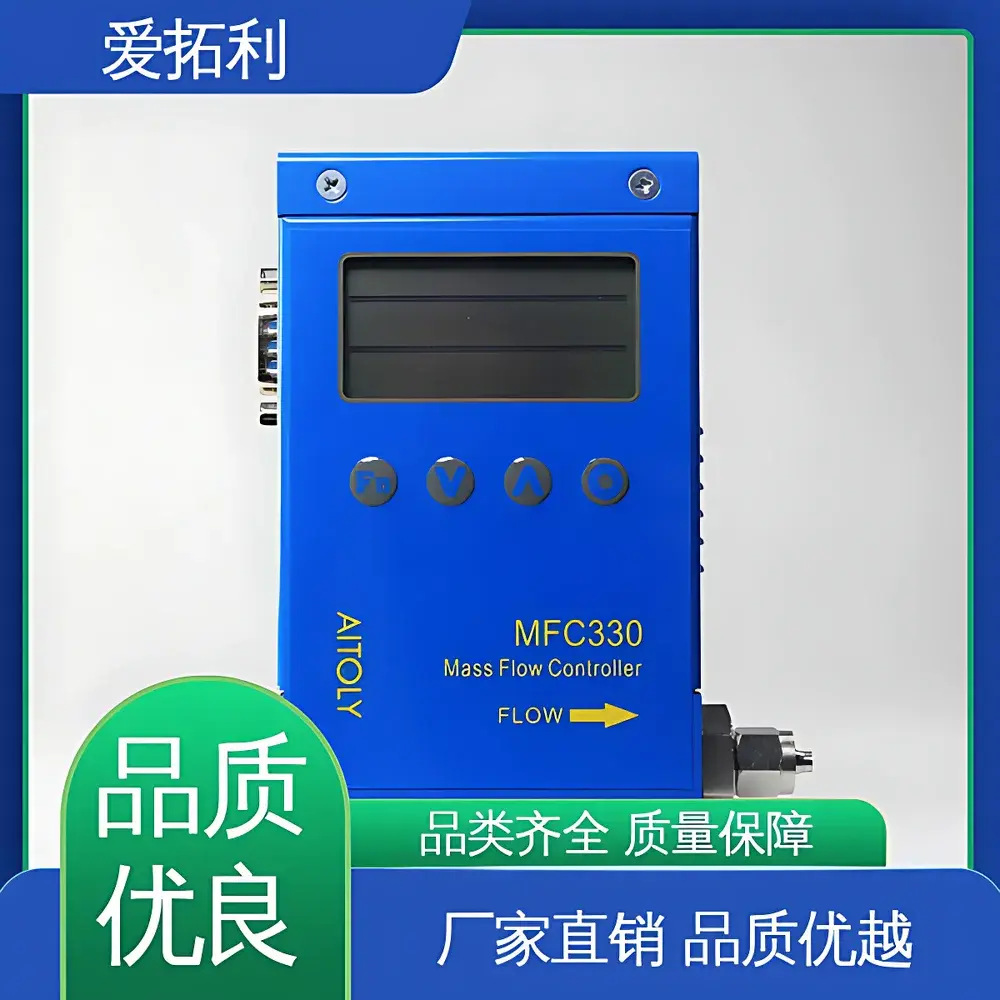
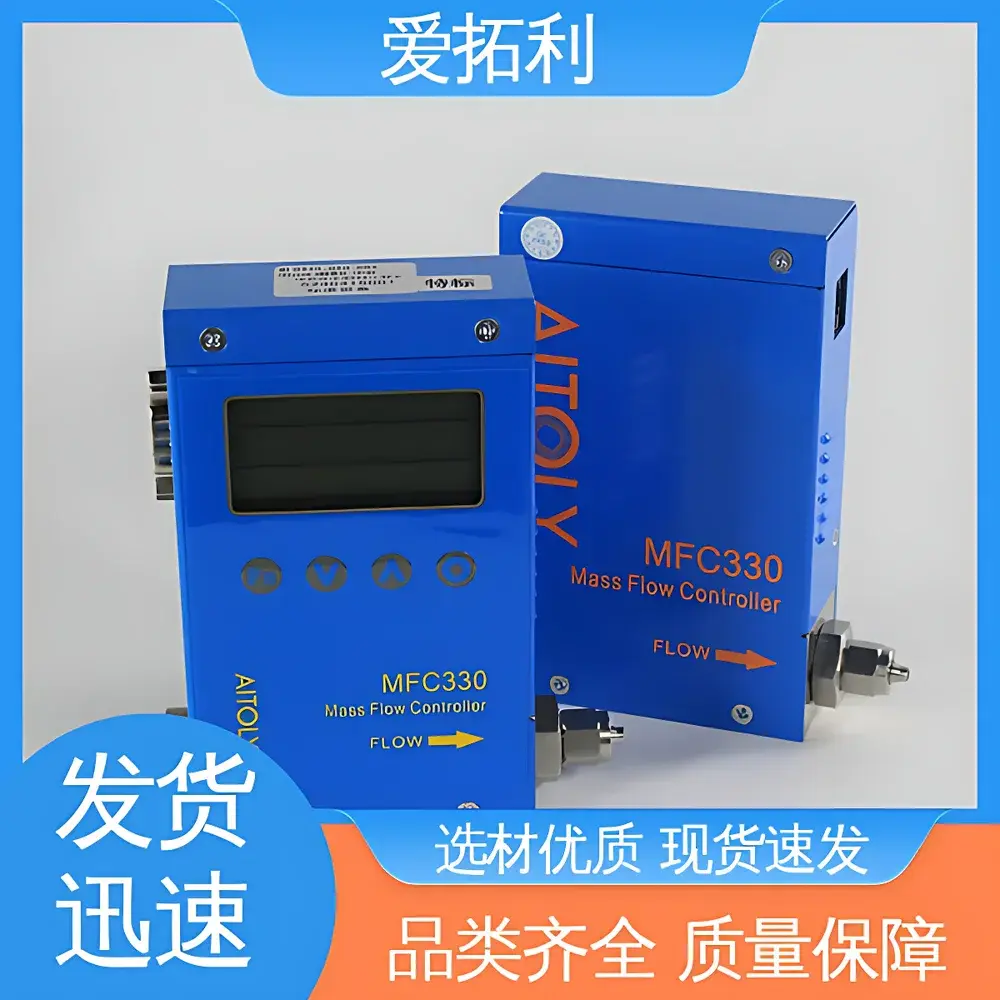
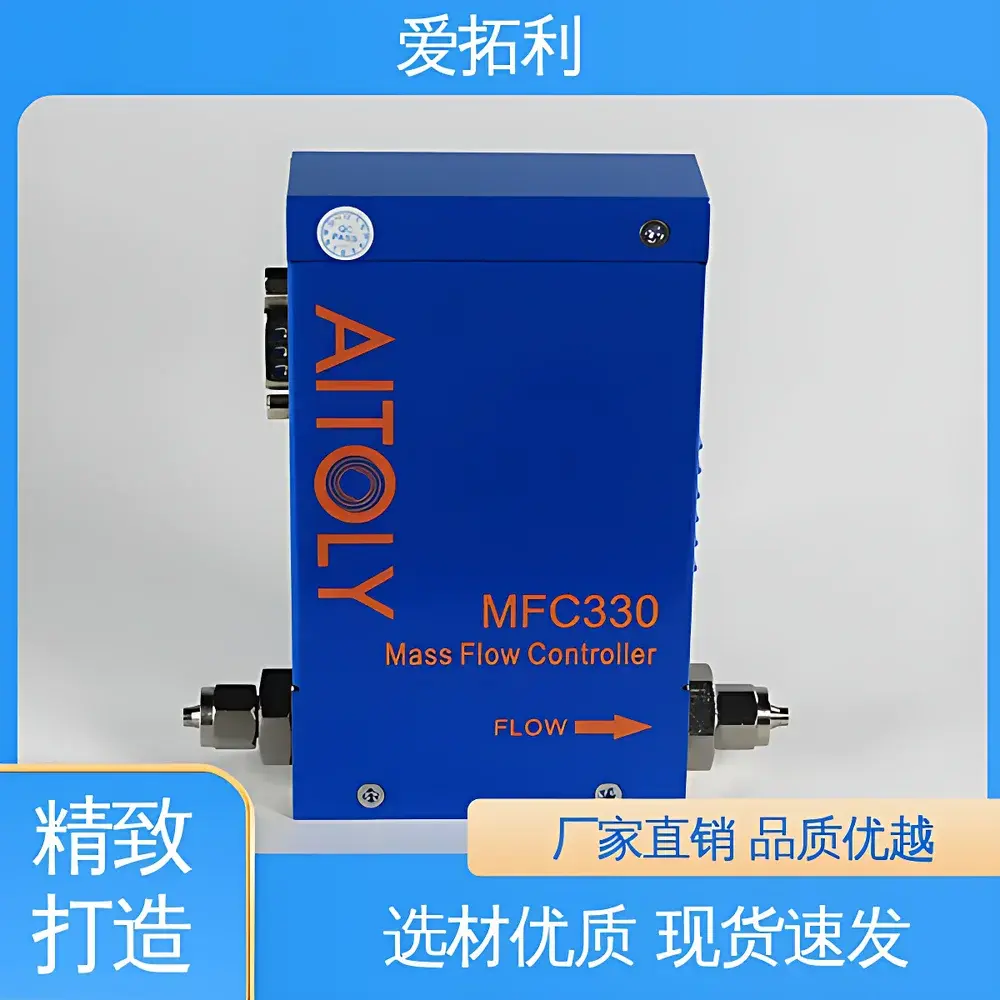
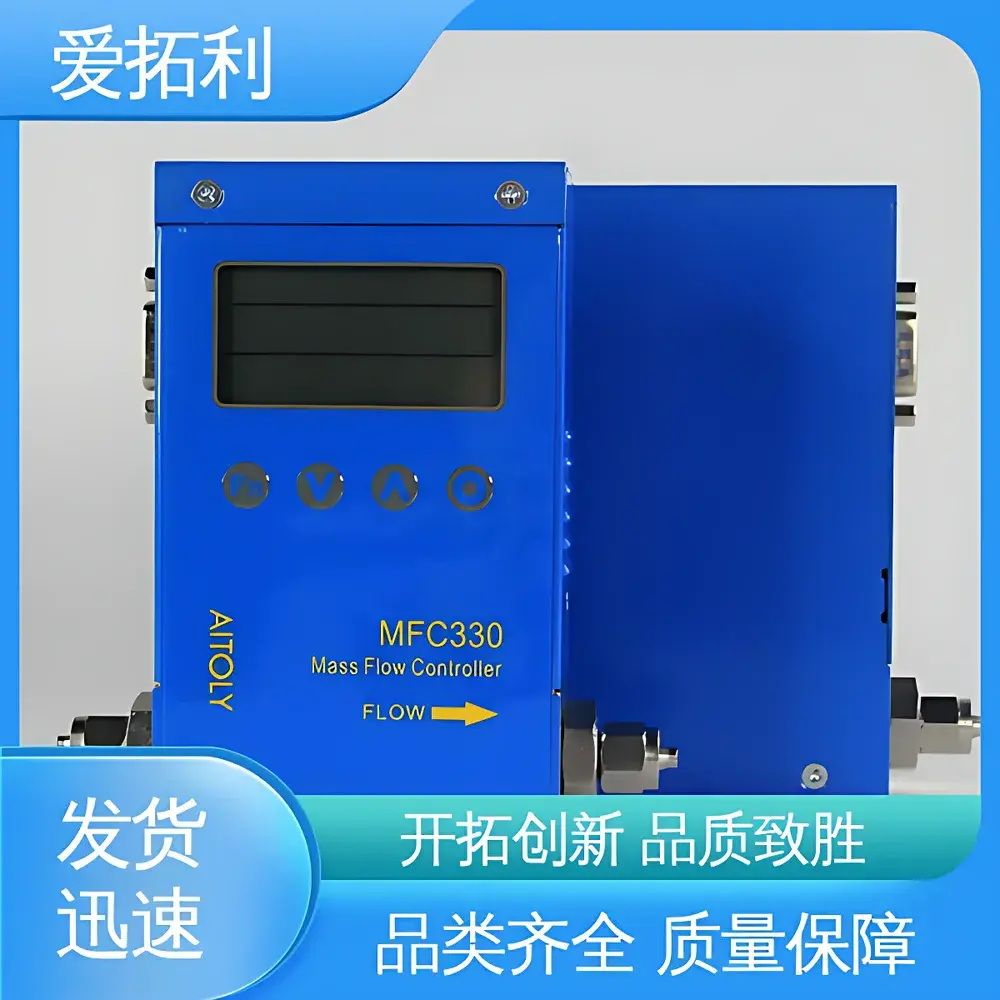
AITOLY MFC330 Thermal Mass Flow Controller
| Brand | AITOLY |
|---|---|
| Origin | Jiangsu, China |
| Model | MFC330 |
| Type | Thermal Mass Flow Controller |
| Operating Pressure Drop Range | 0–1 MPa |
| Flow Control Principle | Constant-Temperature Anemometry (CTA) with Bypass Configuration |
| Valve Type | Proportional Solenoid Valve (Optional All-Metal) |
| Display | Optional Integrated LCD |
| Pressure Drop | Low |
| Repeatability | ≤ ±0.5% FS |
| Response Time | < 1 s (typ.) |
| Accuracy | ±1.0% FS (standard), ±0.5% FS (with calibration certificate) |
| Gas Compatibility | Non-corrosive, non-condensing gases (e.g., N₂, O₂, Ar, He, Air, CO₂, H₂, CH₄) |
| Electrical Interface | 0–5 V / 0–10 V / 4–20 mA analog I/O |
| Power Supply | 24 VDC ±10% |
| Enclosure Rating | IP65 (optional IP67) |
Overview
The AITOLY MFC330 is a precision thermal mass flow controller engineered for stable, repeatable gas flow regulation in laboratory, pilot-scale, and light industrial process environments. It operates on the principle of constant-temperature anemometry (CTA), where a heated sensor element—mounted within a capillary bypass tube—measures convective heat loss proportional to mass flow rate. Unlike volumetric devices, the MFC330 directly quantifies mass flow (standard liters per minute, SLPM) independent of ambient temperature and absolute pressure fluctuations, eliminating the need for real-time P/T compensation in most applications. Its closed-loop architecture integrates a high-bandwidth proportional solenoid valve with digital control logic, enabling dynamic setpoint tracking and disturbance rejection under variable inlet pressure or downstream load changes. Designed for integration into gas delivery subsystems—including gas mixing panels, CVD/ALD tooling, environmental simulation chambers, and analytical instrument carrier gas lines—the MFC330 delivers metrologically traceable performance compliant with ISO 9001 manufacturing practices and aligned with key elements of ISO/IEC 17025 uncertainty reporting frameworks.
Key Features
- Thermal bypass sensing architecture ensures inherent insensitivity to upstream turbulence and laminar-to-turbulent flow transitions
- Proportional control valve with sub-second response time (<1 s typical step response) and ≤±0.5% full-scale repeatability
- Wide operating differential pressure range (0–1 MPa) supports both low-backpressure venting and high-resistance downstream configurations
- Low pressure drop design minimizes system energy loss and avoids unintended flow restriction in multi-MFC manifolds
- Optional all-metal valve body (stainless steel 316L or Hastelloy C-276) for compatibility with aggressive or ultra-high-purity gases
- Configurable analog I/O (0–5 V, 0–10 V, 4–20 mA) and optional RS-485 Modbus RTU interface for PLC or SCADA integration
- IP65-rated enclosure standard; IP67 available for humid or washdown-prone installations
Sample Compatibility & Compliance
The MFC330 is validated for use with dry, non-corrosive, non-condensing gases including nitrogen, oxygen, argon, helium, carbon dioxide, hydrogen, methane, and compressed air. It is not rated for use with halogenated compounds, ammonia, chlorine, or vapors that may condense at operating temperatures. While not certified to ATEX or IECEx standards, its 24 VDC operation and intrinsic safety-compatible output signals permit deployment in Zone 2/Class I, Div. 2 environments when installed per local electrical codes. The device conforms to EMC Directive 2014/30/EU (EN 61326-1) and Low Voltage Directive 2014/35/EU. Calibration certificates (traceable to NIM or NIST-equivalent national standards) are available upon request and include uncertainty budgets per ISO/IEC 17025 guidelines.
Software & Data Management
The MFC330 operates as a stand-alone analog-controlled device but supports digital configuration via optional PC-based utility software (Windows/Linux compatible). This utility enables zero/span adjustment, setpoint ramping profiles, alarm threshold definition (e.g., flow deviation >±3% FS), and firmware updates. All configuration parameters are stored in non-volatile memory. When integrated with Modbus-enabled supervisory systems, the controller provides real-time access to measured flow, valve position %, internal temperature, and diagnostic status flags (e.g., sensor fault, over-pressure warning). Audit trail functionality is implemented via external data loggers; native FDA 21 CFR Part 11 compliance requires third-party validation of the host SCADA platform.
Applications
- Precise carrier and purge gas control in semiconductor fabrication tools (e.g., etch, deposition, annealing)
- Gas blending for medical gas mixtures, anesthesia delivery systems, and respiratory simulators
- Calibration reference for secondary flow meters in metrology labs
- Controlled atmosphere generation in material aging chambers and corrosion test cabinets
- Feedstock dosing in small-scale catalytic reactors and fuel cell test stations
- Leak detection support via controlled upstream flow injection in vacuum integrity testing
FAQ
Does the MFC330 require gas-specific calibration?
Yes—each unit is calibrated for a single gas or gas mixture. Switching to a different gas without recalibration introduces measurement error due to variations in thermal conductivity and specific heat.
Can multiple MFC330 units be daisy-chained via RS-485?
Yes—Modbus RTU implementation supports up to 32 nodes on a single bus with configurable slave IDs and termination resistors.
What is the minimum measurable flow rate for nitrogen at standard conditions?
The lower limit depends on full-scale range selection; common configurations span 0–10 SLPM to 0–1000 SLPM, with resolution down to 0.01% FS.
Is field recalibration possible without returning the unit to the manufacturer?
Zero calibration can be performed in situ using clean, dry zero gas; full-span recalibration requires certified flow standards and is recommended annually or after mechanical shock.
How does the MFC330 handle transient pressure spikes?
Internal pressure relief paths and valve actuator damping prevent damage up to 1.5× rated max differential pressure; sustained exposure above 1 MPa voids warranty.