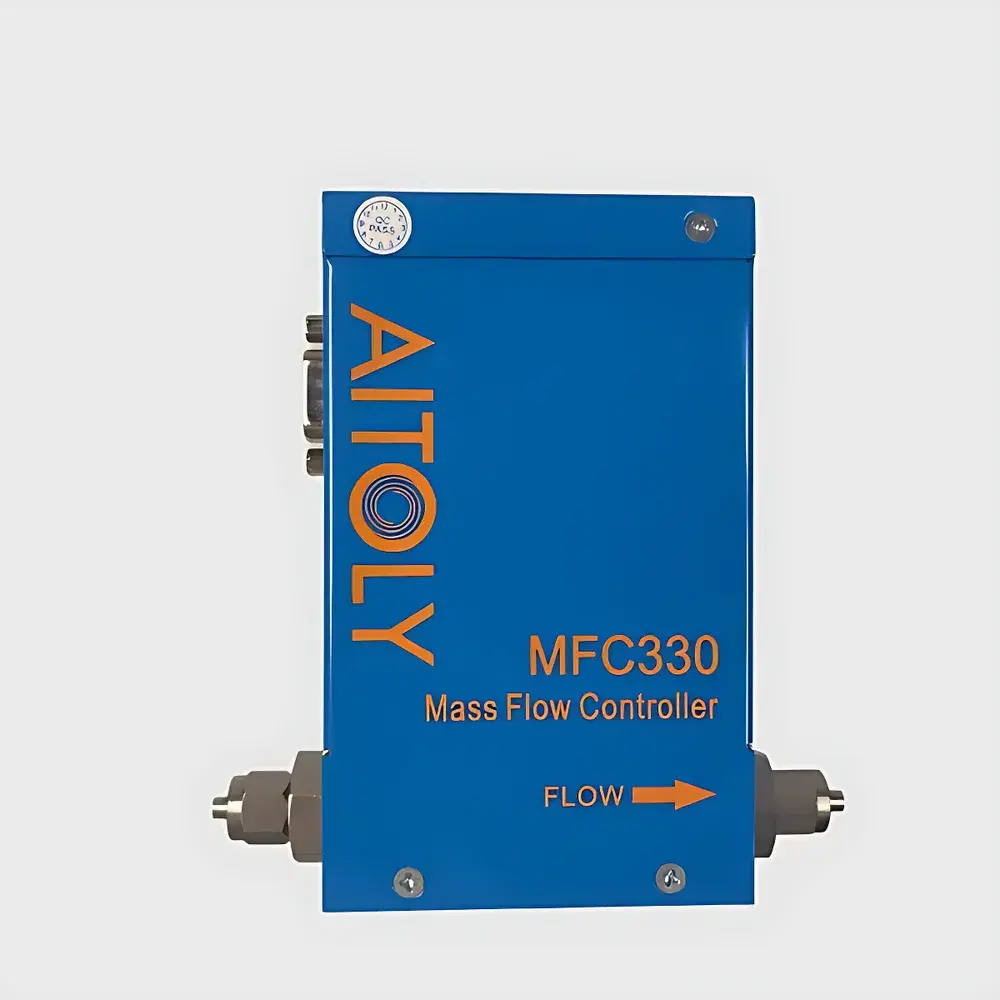
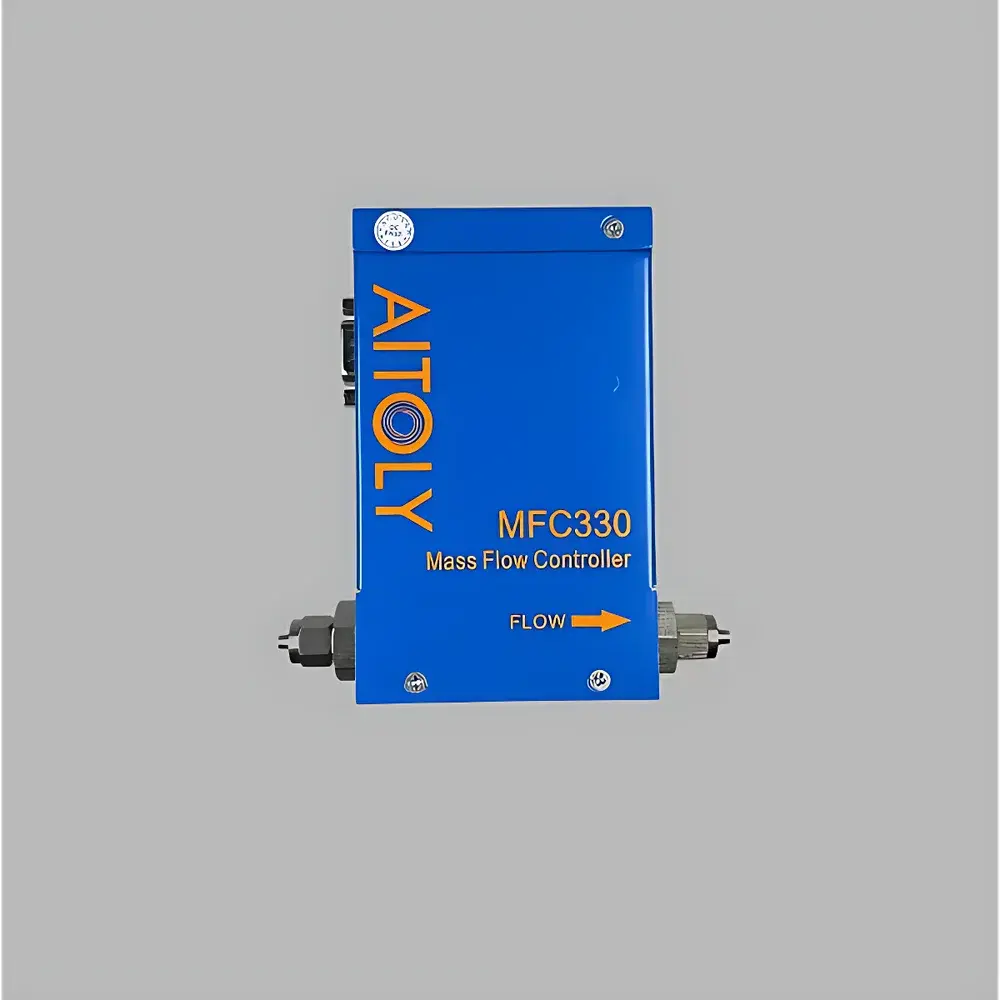
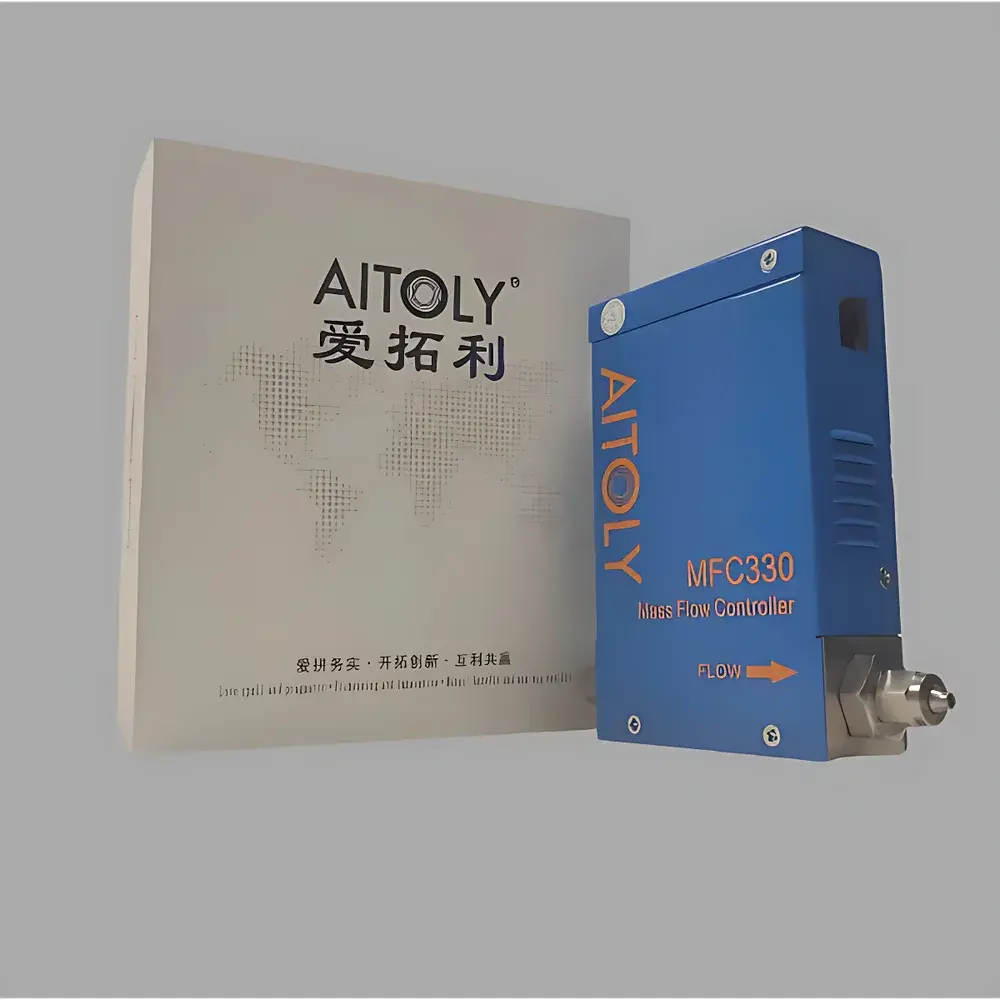
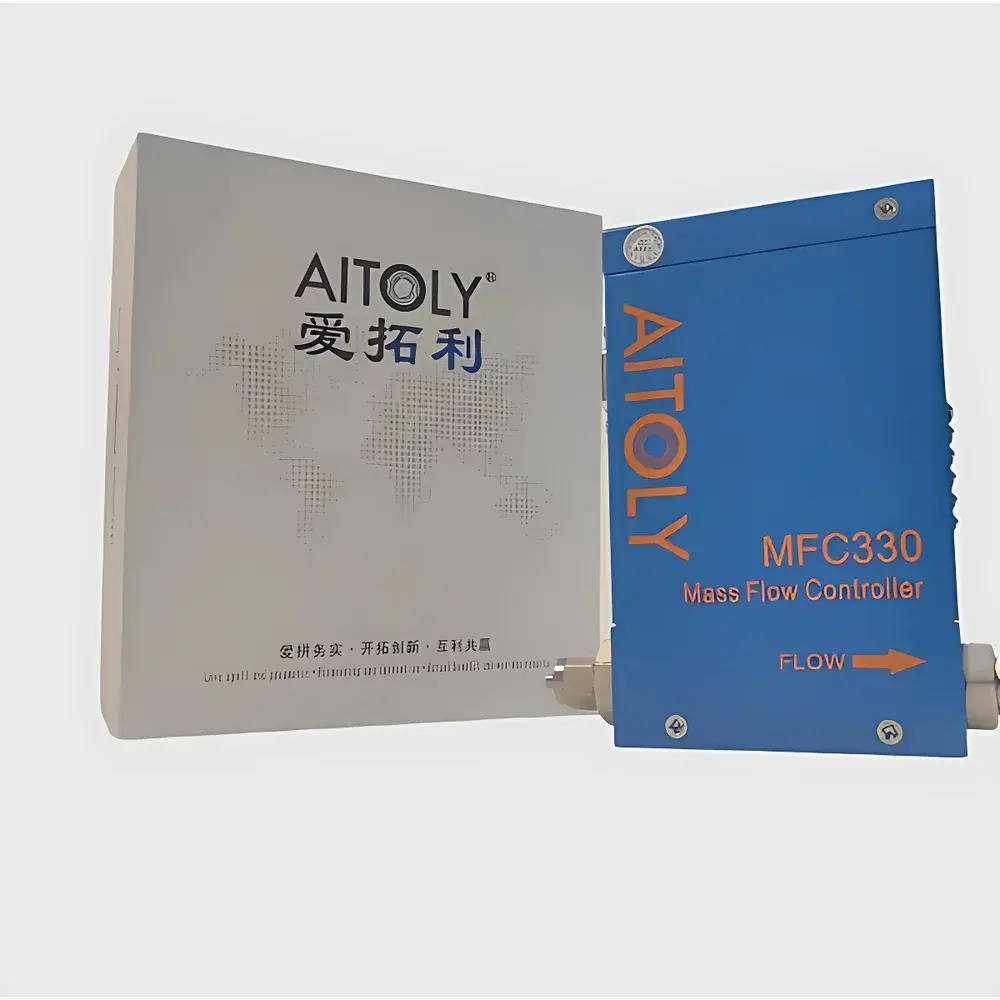
AITOLY MFC330 Thermal Mass Flow Controller
| Brand | AITOLY |
|---|---|
| Model | MFC330 |
| Type | Thermal Mass Flow Controller |
| Accuracy | ±0.5% FS |
| Repeatability | ±0.2% FS |
| Flow Range | 2–100% FS |
| Operating Temperature | −20 to +65 °C |
| Operating Humidity | 0–98% RH (non-condensing) |
| Max Working Pressure | 3 MPa |
| Response Time | <1 s |
| Power Supply | 15–40 VDC |
| Power Consumption | <5 W |
| Communication Interfaces | RS232, RS485, CAN, 0–5 VDC, 4–20 mA |
| Wetted Materials | SUS304 / SUS316L |
| Seals | FKM (Viton®) |
| Connection Types | Push-to-Connect, Compression, VCR, Quick-Release |
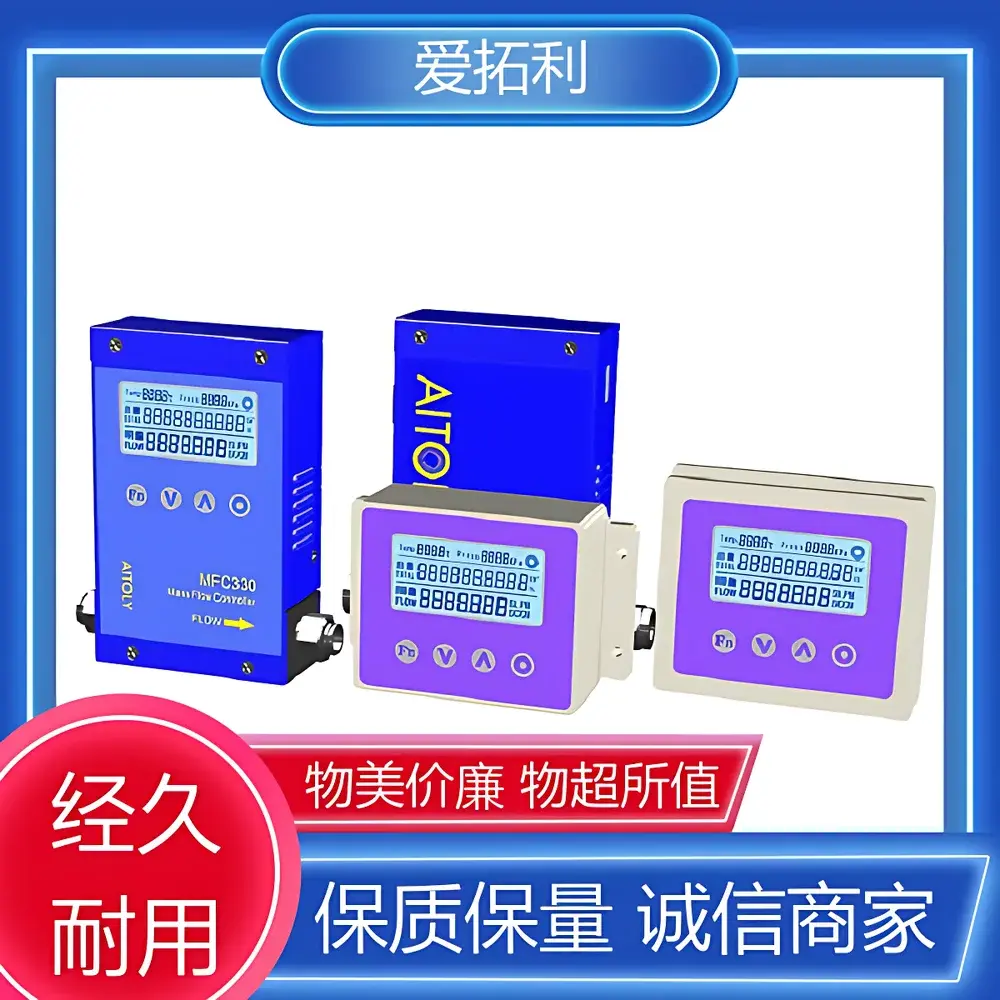
| Display | Integrated LCD with Keypad |
| Built-in Sensors | Temperature & Pressure Compensation |
| Gas Compatibility | Multi-gas (N₂, O₂, Ar, He, CO₂, H₂, Air, etc.) |
| Compliance | Designed for industrial process control environments requiring stable thermal mass flow measurement and closed-loop regulation |
Overview
The AITOLY MFC330 is a high-performance thermal mass flow controller engineered for precise, real-time regulation of gas mass flow in demanding industrial and laboratory applications. Unlike volumetric flow devices, the MFC330 employs constant-temperature anemometry (CTA) — a well-established thermal dispersion principle — to directly measure and control mass flow rate independent of pressure and temperature fluctuations. Its sensor design features dual platinum RTD elements embedded in a stainless-steel flow path: one heated, one reference. The power required to maintain a fixed temperature differential between them correlates linearly with gas mass flow, enabling inherently temperature- and pressure-compensated output. This architecture eliminates moving parts, ensuring long-term stability, minimal zero drift (<0.05% FS/month), and high reliability across continuous operation cycles. The unit integrates on-board temperature and absolute pressure sensors to support multi-gas calibration tables and dynamic compensation algorithms, making it suitable for mixed-gas processes where composition may vary within defined limits.
Key Features
- No moving parts — no mechanical wear, no periodic recalibration due to component degradation
- Integrated backlit LCD display with intuitive keypad interface for local setup, real-time monitoring, and diagnostic access
- Simultaneous display of instantaneous mass flow (SCCM or SLPM) and totalized flow (SCC or SL)
- Multi-protocol digital and analog I/O: RS232, RS485 (Modbus RTU), CAN bus, 0–5 VDC, and isolated 4–20 mA current loop
- Wide operating range: 2–100% of full scale with sub-second response time (<1 s to 90% step change)
- Robust wetted materials: 316L stainless steel flow body and orifice; FKM (Viton®) seals compatible with aggressive gases including O₂, Cl₂, NH₃, and H₂
- High accuracy: ±0.5% of full scale (FS) under calibrated conditions; repeatability ±0.2% FS
- Extended environmental tolerance: −20 to +65 °C ambient, 0–98% RH non-condensing
- Maximum working pressure rating: 3 MPa (435 psi) — suitable for high-pressure process lines and vacuum-compatible configurations (down to 10⁻³ mbar base pressure with optional low-leakage fittings)
Sample Compatibility & Compliance
The MFC330 supports over 20 preloaded gas calibrations (including N₂, O₂, Ar, He, CO₂, CH₄, H₂, air, and synthetic blends), with user-definable gas coefficients via configuration software. It complies with industrial electromagnetic compatibility standards (IEC 61326-1) and meets RoHS 2011/65/EU requirements. While not certified for SIL or ATEX zones out-of-the-box, its intrinsic safety profile — low power consumption (<5 W), absence of spark-prone components, and sealed enclosure — enables integration into Class 1 Div 2 or Zone 2 hazardous area systems when installed behind appropriate barriers. The device is routinely deployed in applications governed by ISO 9001-controlled manufacturing environments and supports audit-ready data logging when paired with compliant SCADA or MES platforms.
Software & Data Management
Configuration, calibration, and firmware updates are performed using AITOLY’s cross-platform PC utility (Windows/macOS/Linux), which provides secure parameter locking, multi-gas table editing, and traceable calibration history export (CSV/Excel). All communication protocols support bi-directional command sets per the industry-standard MFC Command Language (MCL), enabling seamless integration into LabVIEW, Python (PySerial/PyModbus), MATLAB, and PLC-based control architectures. Optional firmware enables 21 CFR Part 11-compliant audit trails — including operator ID, timestamped parameter changes, and electronic signature fields — when used with validated host systems meeting GLP/GMP documentation requirements.
Applications
- Semiconductor fabrication: Precise gas dosing in RIE, DRIE, PECVD, and sputtering tools
- Analytical instrumentation: Carrier and makeup gas control in GC, GC-MS, and ICP-MS systems
- Fuel cell testing: Anode/cathode stoichiometry management and humidity control loops
- Laser welding & cutting: Shielding gas flow regulation for beam stability and weld integrity
- Vacuum coating: Reactive gas injection (O₂, N₂) during magnetron sputtering and e-beam evaporation
- Bio-pharmaceutical processing: Sterile gas delivery in bioreactor sparging and lyophilization cycles
- Research laboratories: Multi-gas blending systems, catalytic reaction studies, and environmental simulation chambers
FAQ
Does the MFC330 require external temperature or pressure transmitters for accurate operation?
No — integrated Pt100 temperature and piezoresistive absolute pressure sensors provide real-time compensation without external hardware.
Can the MFC330 be used with corrosive gases such as chlorine or hydrogen sulfide?
Yes, provided wetted materials are upgraded to Hastelloy C-276 or custom-sealed variants; standard 316L/FKM configuration is rated for Cl₂ at ≤1 bar and H₂S at ≤50 ppm.
Is firmware update capability available in the field?
Yes — firmware upgrades are delivered via USB-to-serial adapter and supported by version-locked configuration files to prevent inadvertent downgrade.
What is the recommended calibration interval under continuous operation?
Annual calibration is advised for GMP/GLP environments; biannual verification suffices for general industrial use, with zero-check functionality accessible via front-panel menu.
How does the MFC330 handle gas mixtures not included in its factory calibration table?
Users may input custom gas properties (specific heat ratio, thermal conductivity, molecular weight) via software to generate interpolated calibration curves with typical uncertainty <±1.0% FS.