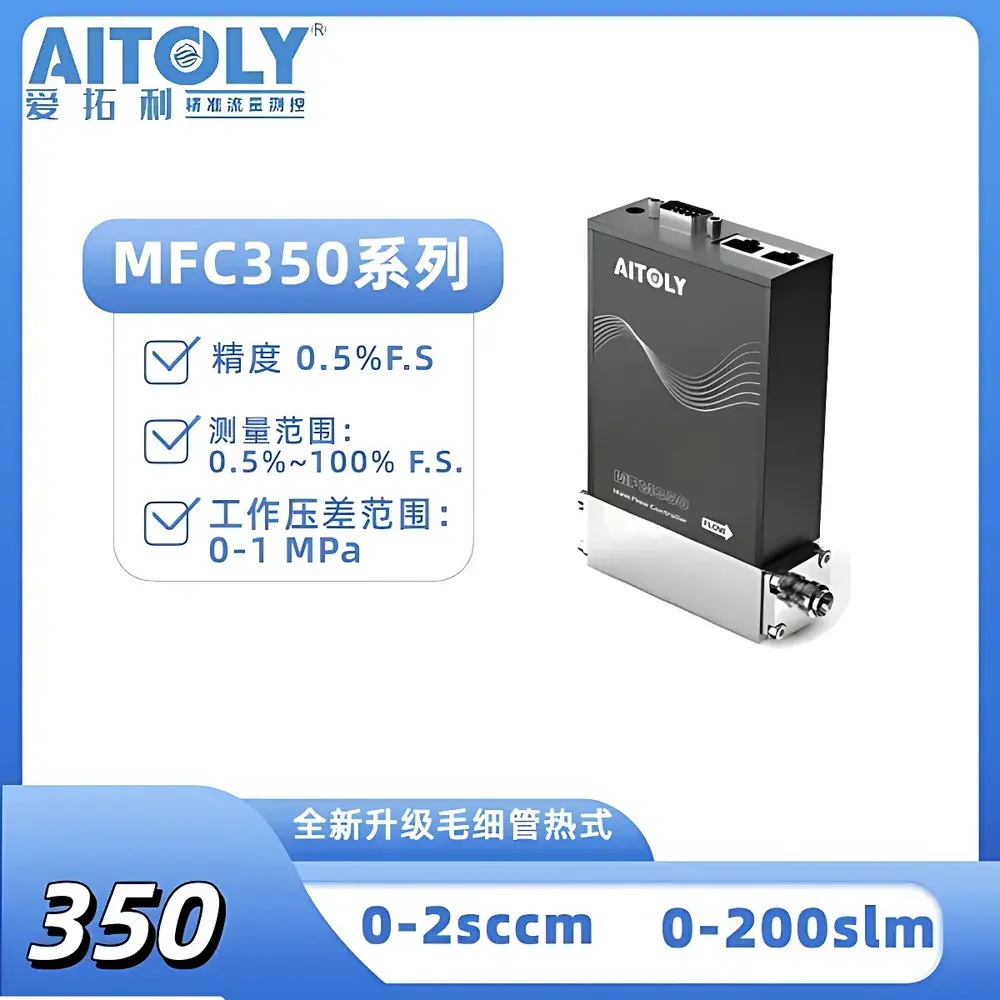
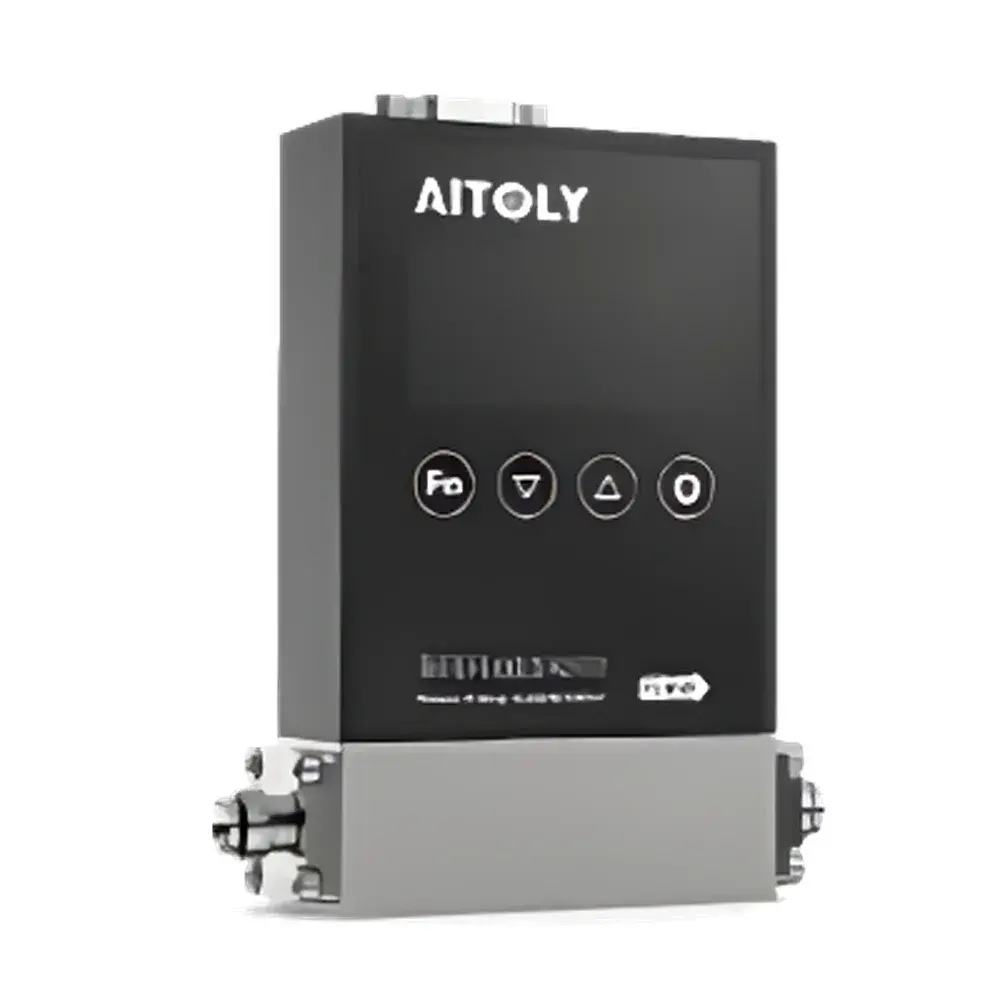
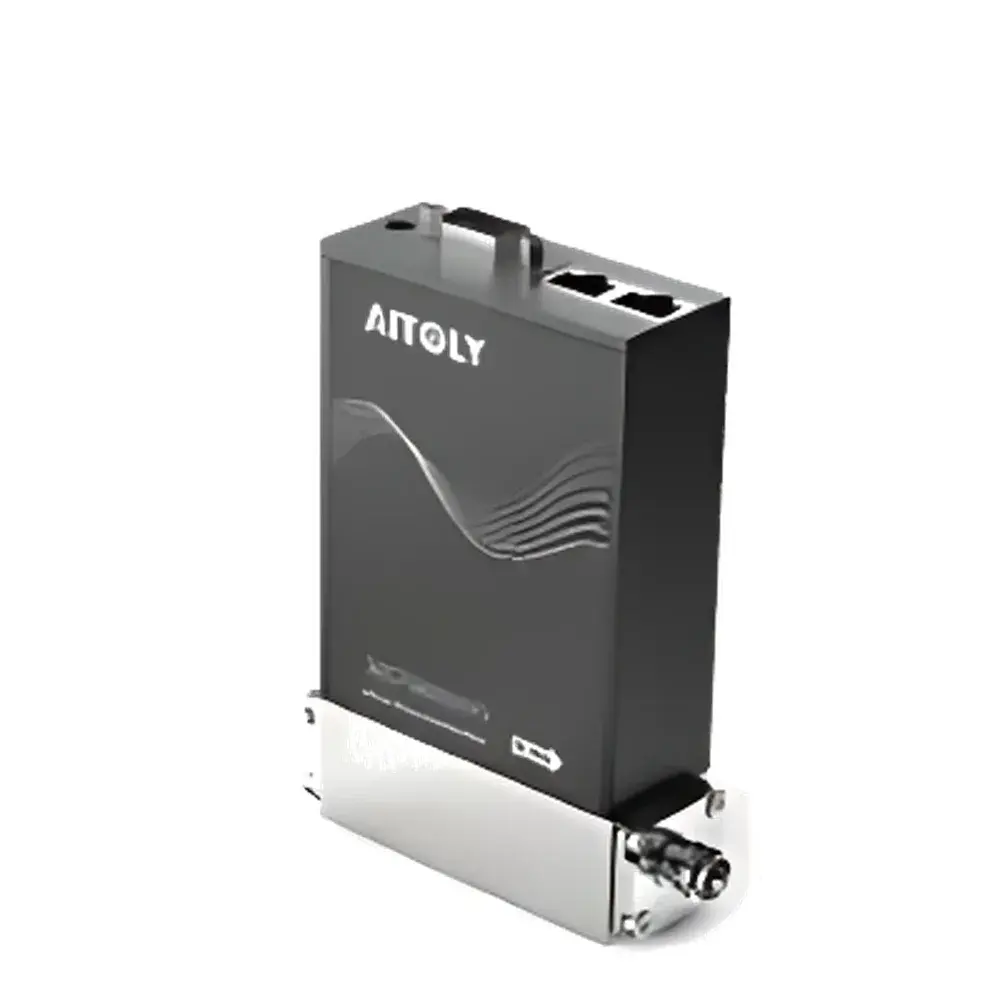
Aitoly MFC350 Capillary Thermal Mass Flow Controller
| Brand | Aitoly |
|---|---|
| Origin | Jiangsu, China |
| Model | MFC350 |
| Flow Sensing Principle | Capillary Thermal Mass Flow Measurement |
| Flow Control Type | Integrated Mass Flow Controller (MFC) |
| Sensor Technology | Patented Capillary Tube-Based Thermal Sensor |
| Valve Type | High-Precision Proportional Control Valve |
| Certification | ISO 9001 Certified Manufacturing |
| Compliance | Designed for GLP/GMP-adjacent laboratory and industrial process environments |
| Output Signal | 0–5 VDC / 4–20 mA (configurable) |
| Power Supply | 24 VDC ±10% |
| Accuracy | ±1% FS (typical, per manufacturer specification) |
| Repeatability | ±0.2% FS |
| Response Time | <1 sec (t₉₀) |
| Operating Temperature Range | 0–50 °C |
| Gas Compatibility | Air, N₂, O₂, CO₂, Ar, He, H₂, and other non-corrosive gases (custom calibration available) |
Overview
The Aitoly MFC350 is a compact, high-stability capillary thermal mass flow controller engineered for precise measurement and active regulation of low-to-medium gas flow rates in analytical instrumentation, semiconductor process tools, environmental monitoring systems, and R&D laboratories. Unlike volumetric flow devices, the MFC350 employs constant-temperature anemometry (CTA) across a micro-machined capillary sensor tube—enabling direct mass flow measurement independent of pressure and temperature fluctuations. Its integrated proportional control valve allows closed-loop setpoint regulation with sub-second dynamic response, making it suitable for applications requiring real-time gas dosing, purge sequencing, or stoichiometric gas blending. The device operates on the principle of heat transfer differential between upstream and downstream thermistors embedded within the capillary channel; this thermal signature is linearly correlated to mass flow rate via factory-calibrated polynomial coefficients stored in onboard non-volatile memory.
Key Features
- Proprietary capillary thermal sensor architecture—fully designed and manufactured in-house, eliminating third-party dependency and ensuring long-term calibration stability.
- Integrated high-resolution proportional solenoid valve with 10,000+ cycle lifetime and <0.5% linearity error across full scale.
- Dual analog output (0–5 VDC and 4–20 mA) with selectable scaling and zero/span adjustment via front-panel potentiometers or remote command.
- Robust aluminum alloy housing with IP54-rated enclosure for operation in controlled industrial and laboratory environments.
- ISO 9001-certified production process with traceable component lot documentation and 100% functional testing prior to shipment.
- Support for multi-gas calibration via user-loadable gas-specific coefficients (NIST-traceable calibration certificates available upon request).
Sample Compatibility & Compliance
The MFC350 is validated for use with common non-corrosive and non-condensing gases including nitrogen, oxygen, argon, carbon dioxide, helium, hydrogen, and synthetic air. It is not rated for use with aggressive halogenated compounds, ammonia, or highly reactive silanes without custom wetted material upgrades (e.g., Hastelloy C-276 or electropolished 316L SS). All units are assembled and tested under documented quality procedures aligned with ISO 9001:2015 requirements. While not FDA 21 CFR Part 11–compliant out-of-the-box, the device supports audit-ready operation when integrated into validated systems featuring electronic logbooks, user access controls, and change management protocols—commonly implemented in pharmaceutical and medical device manufacturing settings.
Software & Data Management
The MFC350 operates as a stand-alone analog-controlled instrument but is compatible with standard PLC and DAQ systems via its native analog I/O interface. Optional RS-485 Modbus RTU communication module (sold separately) enables integration into SCADA platforms and centralized process control architectures. Firmware supports configurable damping filters, alarm thresholds (high/low flow deviation), and automatic zero stabilization routines. Raw flow data can be logged at up to 10 Hz resolution using external acquisition hardware. For regulated environments, users may implement supplementary software layers to meet ALCOA+ data integrity principles—including attributable, legible, contemporaneous, original, accurate, complete, consistent, enduring, and available records.
Applications
- Precise carrier and reactant gas delivery in plasma etching and CVD systems.
- Gas flow stabilization in FTIR, GC, and laser absorption spectroscopy setups.
- Controlled atmosphere generation for material aging chambers and fuel cell test benches.
- Leak detection system calibration and verification using known flow standards.
- Environmental chamber purging with programmable ramp profiles and dwell times.
- Microreactor feed control where stoichiometric accuracy below 5 sccm is critical.
FAQ
What gases can the MFC350 measure accurately?
The standard configuration is calibrated for air, N₂, O₂, CO₂, Ar, He, and H₂. Custom calibrations for other gases—including mixtures—are available upon request with supporting gas composition data.
Is the MFC350 suitable for vacuum-side installation?
No—it is rated for operation at atmospheric to 10 bar(g) inlet pressure only. For vacuum-line applications, a downstream pressure-regulated configuration with appropriate backpressure control is required.
Does the MFC350 support digital communication protocols?
Yes—via optional RS-485 Modbus RTU module. Ethernet/IP or Profibus variants are not supported natively but may be enabled through third-party protocol gateways.
How often does the MFC350 require recalibration?
Annual recalibration is recommended for applications demanding metrological traceability. In stable lab environments with consistent gas composition and temperature, recalibration intervals may extend to 18–24 months based on internal verification logs.
Can the MFC350 be used in GMP-compliant facilities?
Yes—as a field device within a larger validated system. It provides the mechanical and electrical foundation required; final compliance depends on system-level validation, including IQ/OQ/PQ protocols, change control, and data governance infrastructure.