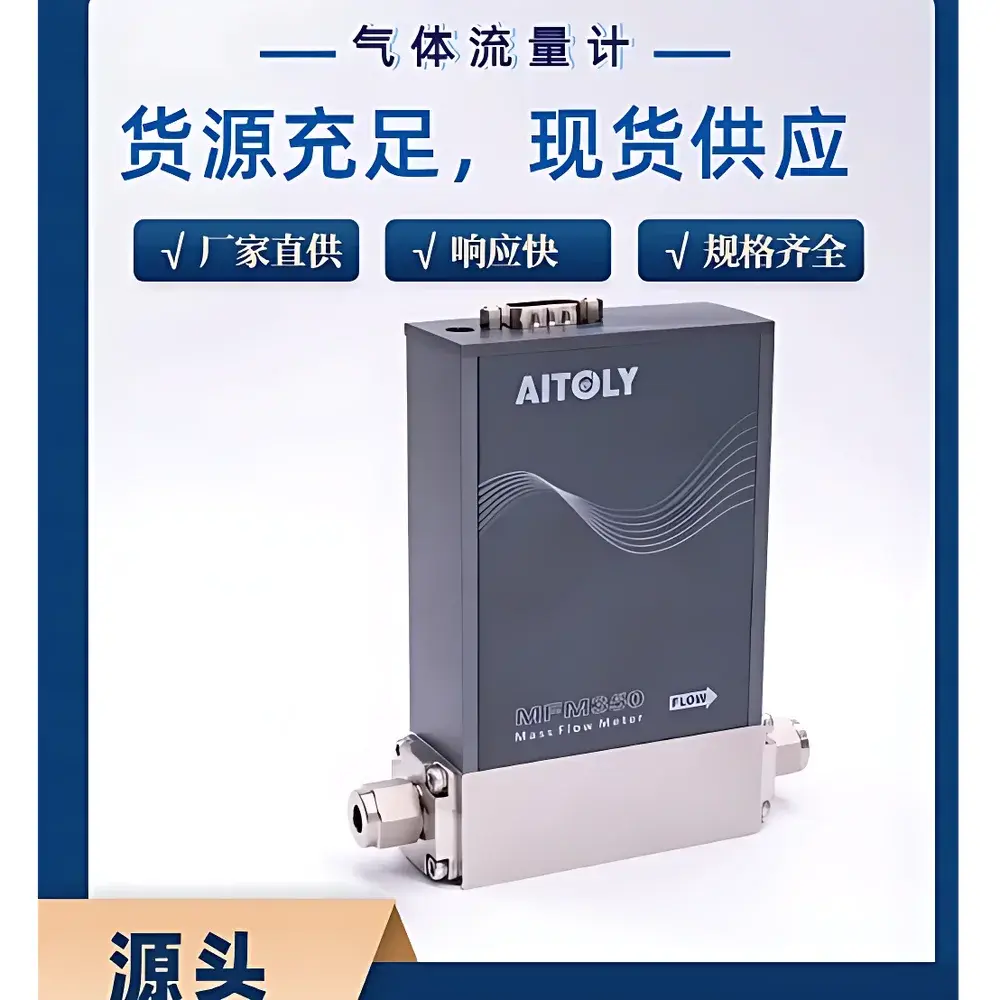
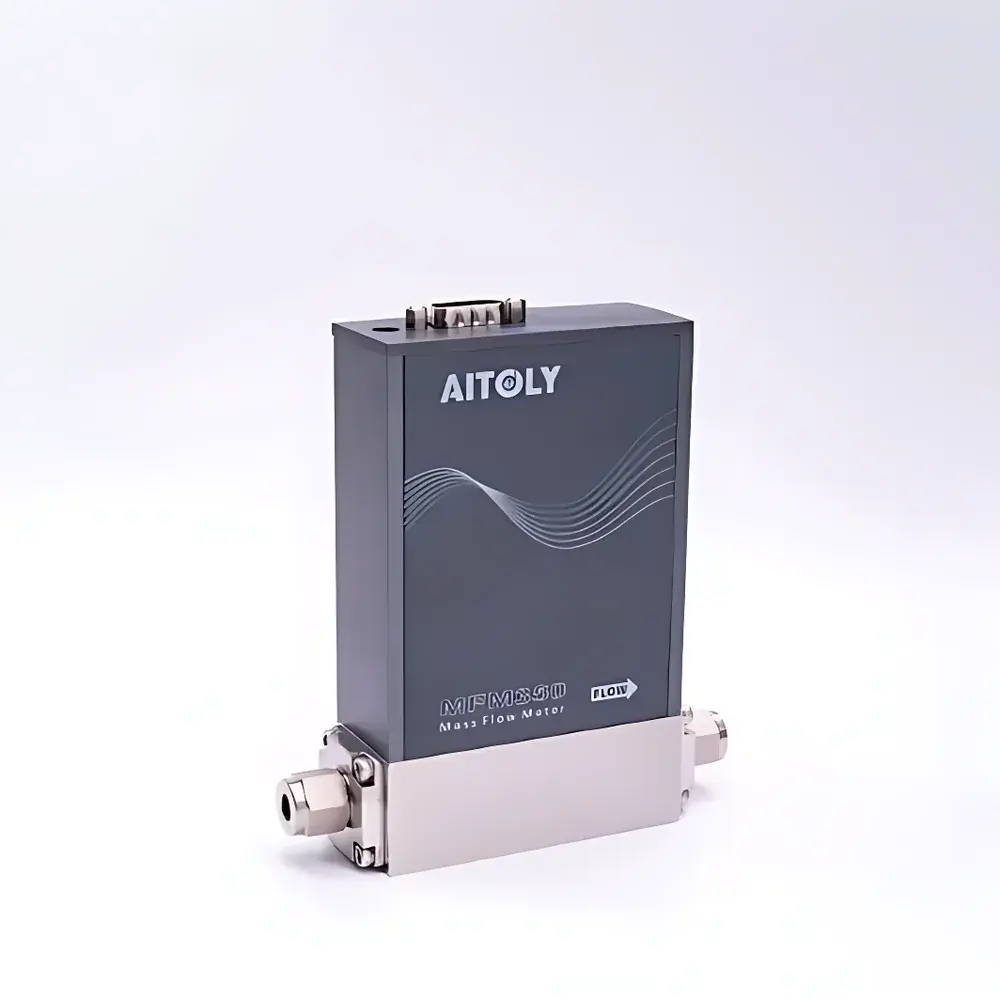
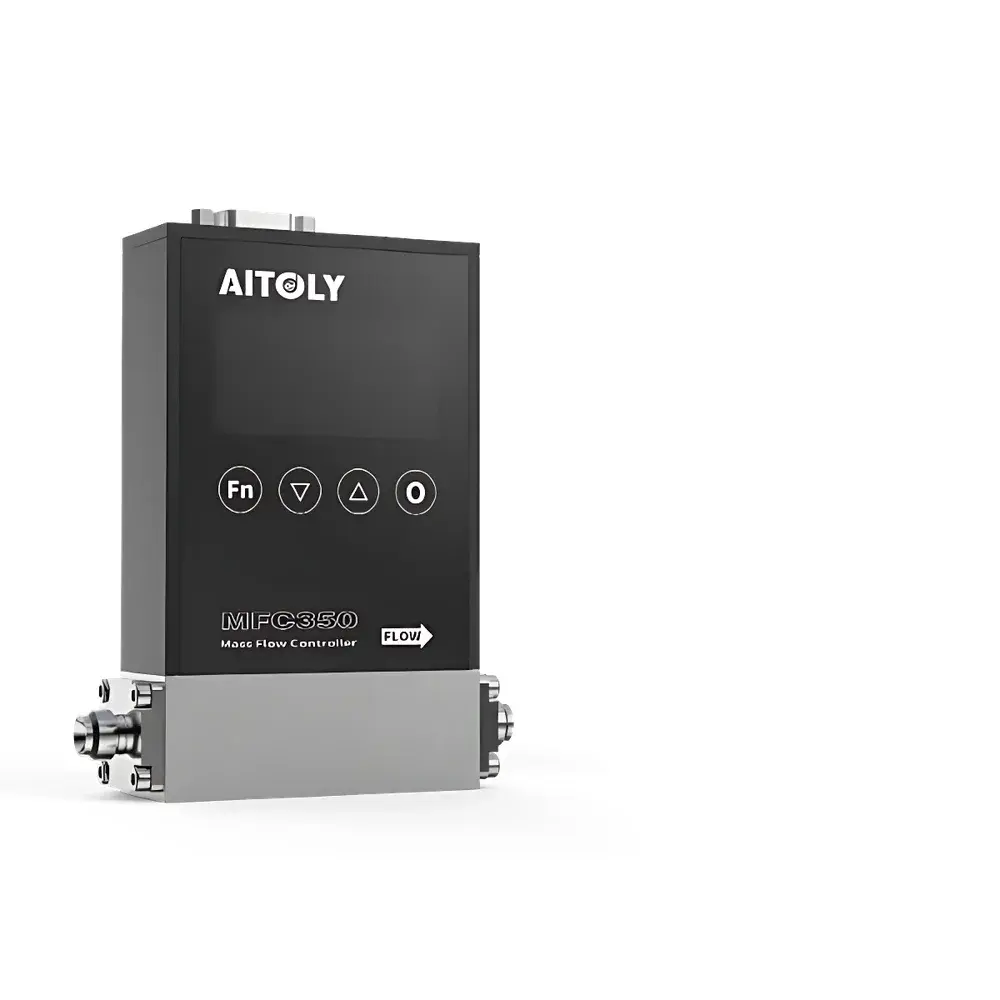
AITOLY MFC350 Thermal Mass Flow Meter / Controller
| Brand | AITOLY |
|---|---|
| Origin | Jiangsu, China |
| Model | MFC350 |
| Type | Thermal Mass Flowmeter/Controller |
| Accuracy | ±0.5% FS |
| Flow Range | 0.5–100% FS (measuring), 1–100% FS (controlling) |
| Response Time | ≤1 s (to 90% of final value) |
| Gas Compatibility | >90 gases pre-calibrated |
| Full-Scale Range | 2 sccm to 200 slm |
| Operating Pressure Drop | 0–0.08 MPa |
| Max Working Pressure | 3 MPa |
| Operating Temperature | 0–65 °C |
| Humidity | 0–98% RH (non-condensing) |
| Electrical Interfaces | Analog (0–5 V / 4–20 mA), RS232, RS485, CAN, EtherCAT |
| Wetted Materials | 316L stainless steel, FKM elastomers (all-metal seal option available) |
| End Connections | Push-to-connect, Swagelok®-style ferrule, VCR, IGS |
| IP Rating | IP40 |
| Mounting | Free installation with M4 mounting holes (5 mm depth) |
| Weight | 1.0 kg (MFM), 1.4 kg (MFC) |
Overview
The AITOLY MFC350 is a high-performance thermal mass flow meter and controller engineered for precise, real-time measurement and regulation of nitrogen and other industrial gases in laboratory, pilot-scale, and light industrial process environments. Based on constant-temperature anemometry (CTA), the device employs a capillary-tube sensor architecture where gas flowing over heated and reference platinum resistance temperature detectors (RTDs) induces convective heat transfer proportional to mass flow rate—eliminating dependence on pressure and temperature fluctuations. Unlike volumetric flow devices, the MFC350 delivers true mass flow output (standard cubic centimeters per minute or standard liters per minute) referenced to NTP (0 °C, 101.325 kPa), making it ideal for applications requiring stoichiometric control, gas blending, purge monitoring, and reactor feed management where repeatability and traceability are critical.
Key Features
- High-accuracy thermal sensing platform with ±0.5% full-scale (FS) linearity error, verified across calibrated gas species including N₂, O₂, Ar, He, CO₂, H₂, and synthetic air.
- Wide dynamic range: 0.5–100% FS measurement capability and 1–100% FS closed-loop control, supporting both low-flow precision (down to 2 sccm) and high-throughput operation (up to 200 slm).
- Rapid transient response: ≤1 second to reach 90% of final reading—enabling integration into fast-cycling processes such as ALD, CVD, and automated gas switching systems.
- Multi-protocol digital interface suite: native support for RS232, RS485 (Modbus RTU), CANopen, and EtherCAT for deterministic real-time communication in distributed automation architectures.
- Robust mechanical design: 316L stainless steel flow body rated for 3 MPa maximum working pressure; optional all-metal (metal-to-metal) seals available for ultra-high-purity or high-temperature service.
- Flexible installation: compact form factor (≤1 kg for MFM variant) with M4 threaded mounting holes and multiple end connection options—including push-to-connect, Swagelok®-style ferrule, VCR, and IGS—to accommodate diverse piping standards and cleanroom requirements.
Sample Compatibility & Compliance
The MFC350 supports over 90 pre-characterized gases via internal lookup tables, including inert, reactive, and corrosive species—each calibrated using NIST-traceable reference standards under ISO/IEC 17025-accredited conditions. Its wetted path materials (316L SS + FKM) comply with USP Class VI and FDA 21 CFR Part 11 requirements for non-reactivity and extractables control in pharmaceutical gas delivery systems. While not intrinsically safe certified, the unit meets CE marking requirements per EMC Directive 2014/30/EU and Low Voltage Directive 2014/35/EU. For GxP environments, audit trail logging, user access levels, and electronic signature support can be implemented via external SCADA or DCS integration.
Software & Data Management
The MFC350 operates without proprietary host software—its analog and digital outputs integrate directly with PLCs, DAQ systems, and LabVIEW™ or Python-based control frameworks. Factory-default configuration is stored in non-volatile EEPROM with write-protection against accidental overwrite. Optional firmware updates (via RS232 or USB-to-serial adapter) include enhanced gas mixture compensation algorithms and improved zero-stability routines. All calibration data—including date, technician ID, gas type, and deviation logs—is retained onboard and accessible via Modbus register reads, satisfying basic GLP documentation needs for instrument qualification (IQ/OQ).
Applications
- Nitrogen blanketing and purging control in chemical reactors and storage vessels
- Gas dosing in semiconductor thin-film deposition tools (PECVD, sputtering)
- Leak testing and helium mass spectrometer sample introduction
- Environmental chamber gas mixing (e.g., CO₂/O₂/N₂ blends for bioreactor simulation)
- Calibration transfer standards for secondary flow verification in metrology labs
- Automated analytical instrumentation interfaces (e.g., GC carrier gas control, FTIR sample cell purging)
FAQ
Is the MFC350 suitable for use with hydrogen or ammonia?
Yes—hydrogen (H₂) and ammonia (NH₃) are included in the factory-calibrated gas list. For NH₃, FKM seals are compatible up to 65 °C; for extended exposure, all-metal sealing is recommended.
Can the device operate at vacuum conditions?
The MFC350 is designed for positive-pressure differential applications only. It requires a minimum upstream pressure of ~0.1 MPa (gauge) to maintain laminar flow through the capillary sensor and ensure measurement integrity.
Does it support custom gas calibration?
Custom gas calibrations are supported via AITOLY’s authorized service centers using certified reference flows and certified gas mixtures. Calibration certificates include uncertainty budgets per ISO 5167 and ISO 14040 guidelines.
What is the warranty and recalibration interval?
Standard warranty is 24 months from shipment. Annual recalibration is recommended for GMP/GLP compliance; typical drift remains within ±0.2% FS/year under stable operating conditions.
How is zero drift compensated during operation?
The unit performs automatic zero stabilization during flow stoppage (if enabled), referencing ambient temperature and pressure sensors to correct for thermal drift—no manual zero adjustment required.