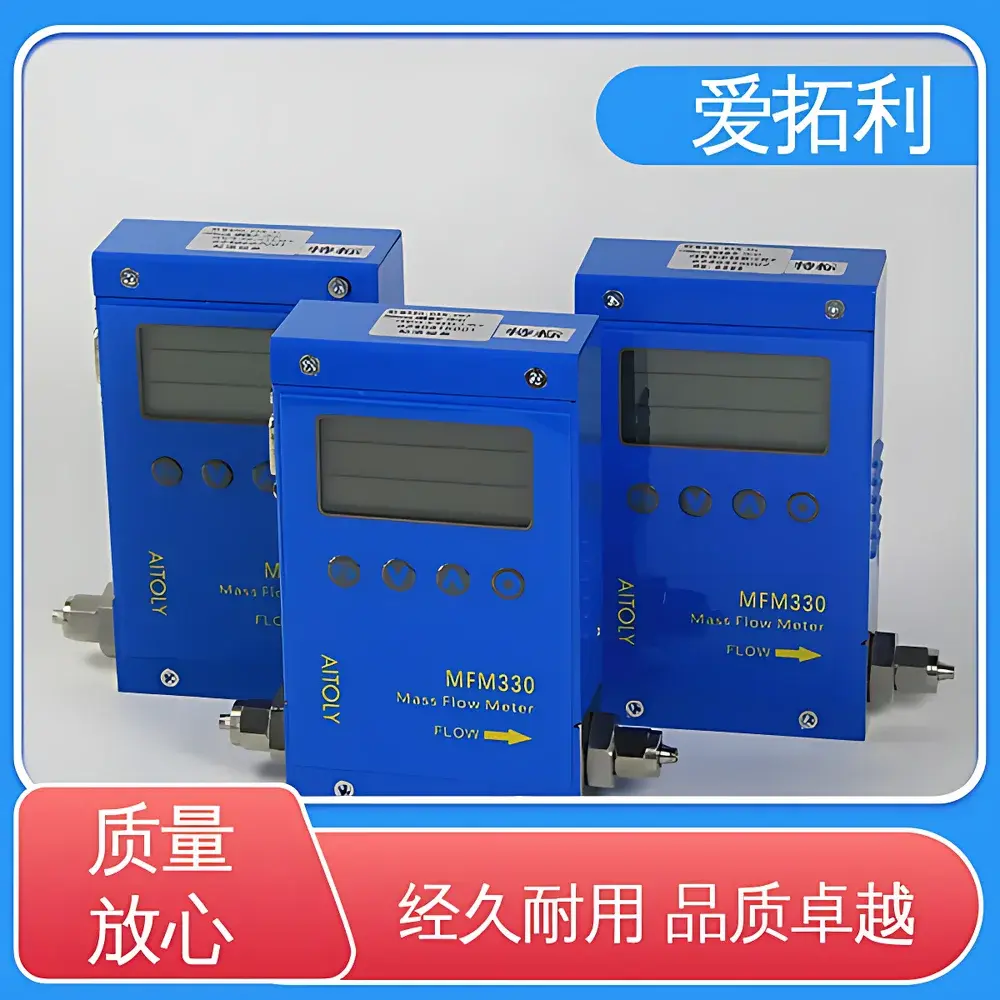
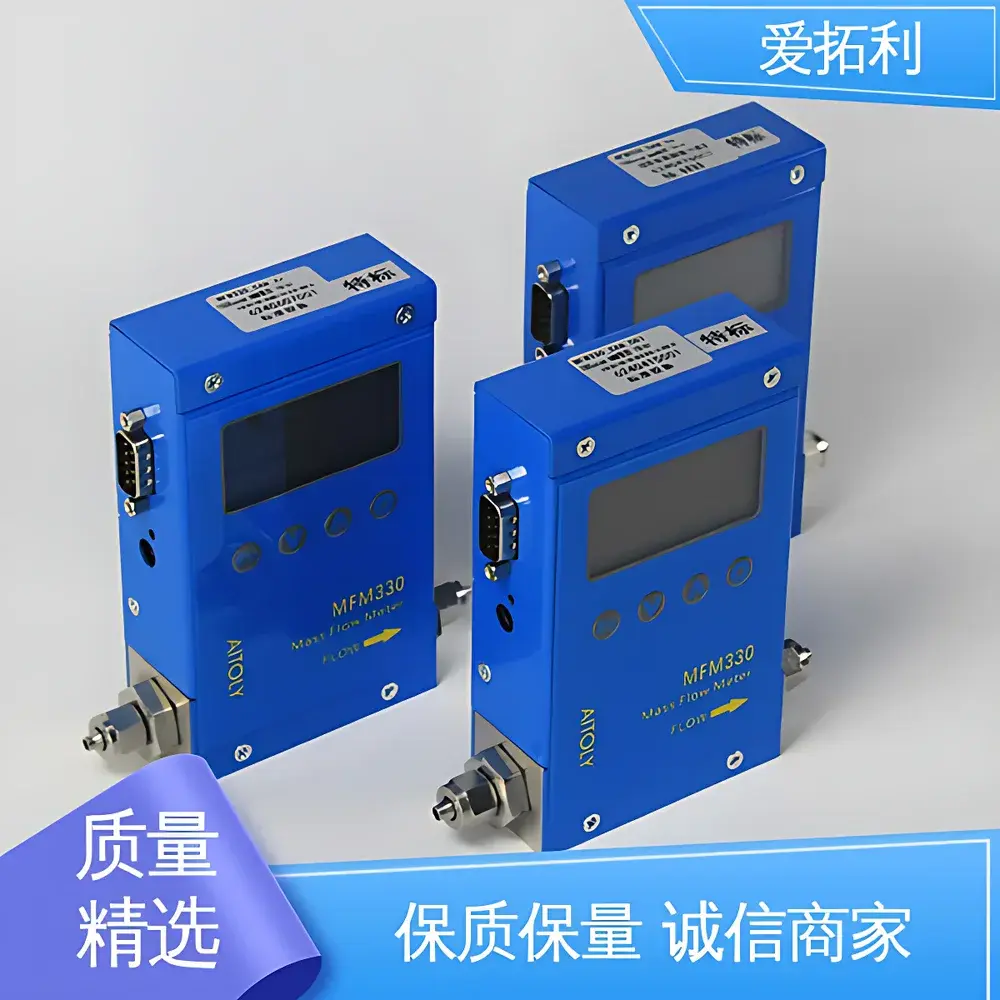
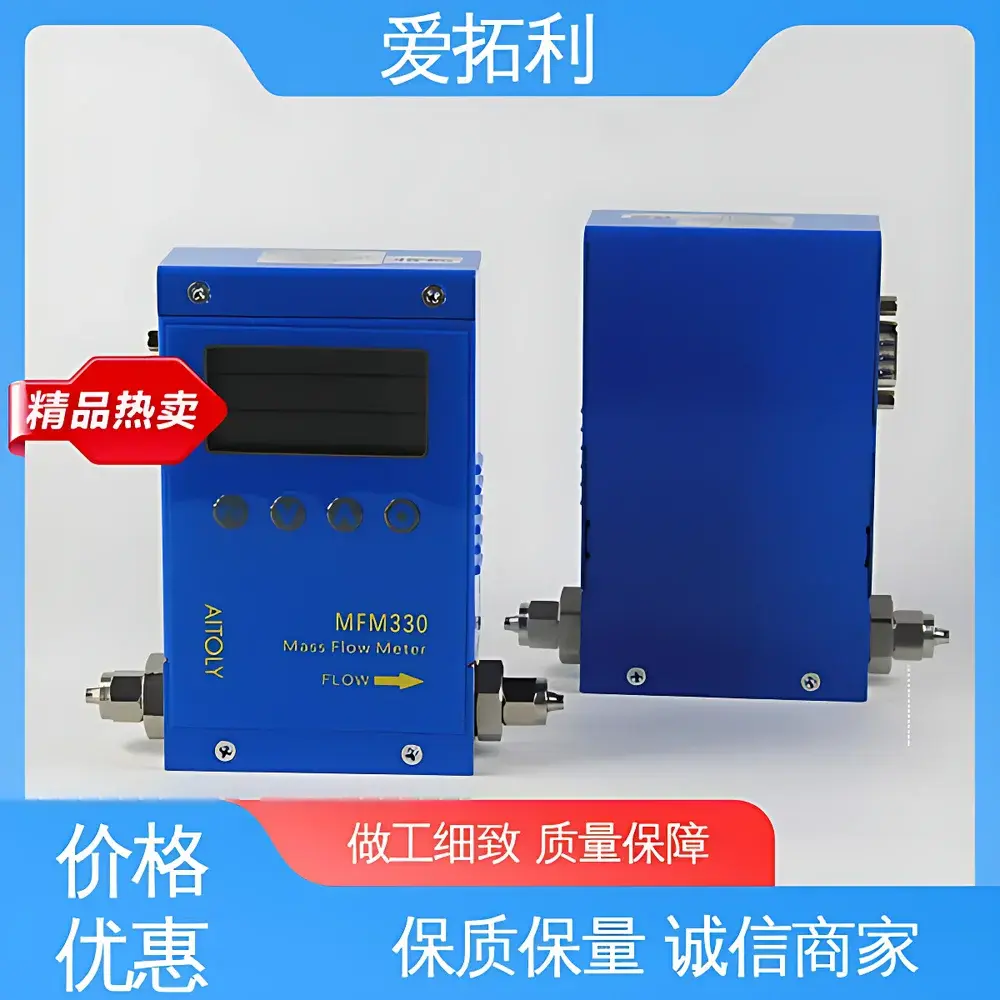
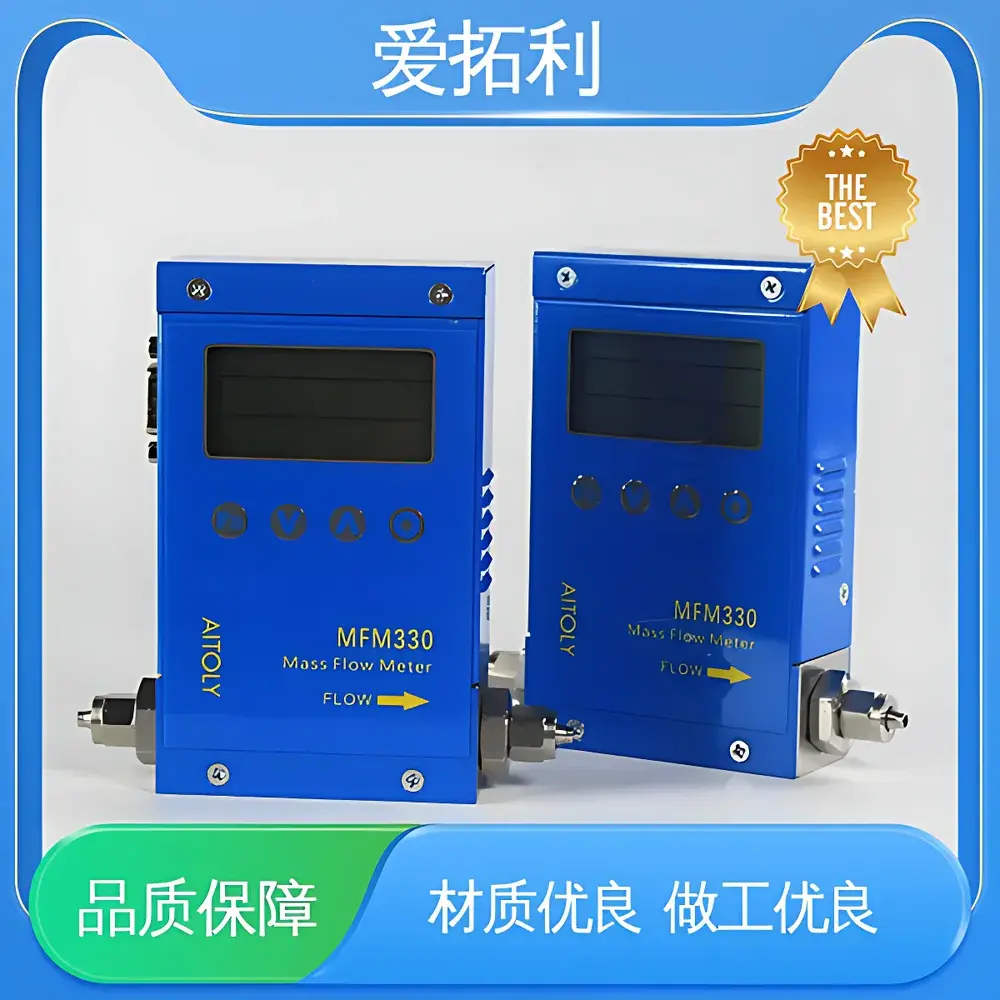
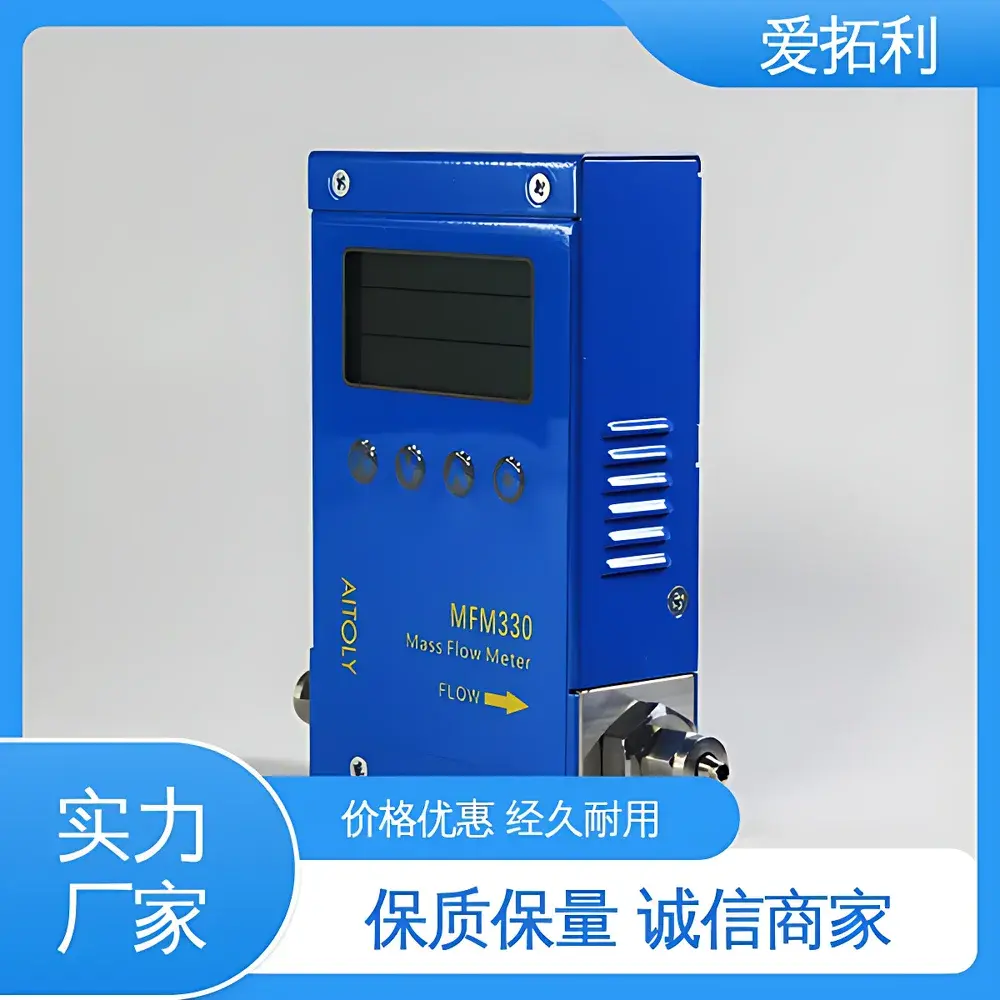
Aitoly MFM330 Thermal Mass Flow Controller
| Brand | Aitoly |
|---|---|
| Origin | Jiangsu, China |
| Model | MFM330 |
| Flow Principle | Thermal (Capillary-Type) |
| Measurement Type | Direct Mass Flow |
| Media | Clean, Dry Gases |
| Gas Compatibility | ≥98% of Common Industrial and Process Gases |
| Full-Scale Ranges | 10–500 sccm / 0.001–500 slpm (selectable) |
| Accuracy | ±0.5% FS |
| Repeatability | ±0.2% FS |
| Linearity | ±0.2% FS |
| Resolution | 0.001 sccm (<10 L/min) |
| Response Time | <1 s (t₉₀) |
| Warm-up Time | 5 min to 95% stability |
| Power Supply | 24 VDC ±10% |
| Output Signal | 0–5 VDC / 0–10 VDC / 4–20 mA (configurable) |
| Communication Interface | RS-485 Modbus RTU (optional) |
| Operating Temperature | 0–50 °C |
| Pressure Rating | ≤1 MPa (gauge) |
| Materials | 316L SS body, fused silica capillary sensor, EPDM or Viton seals |
Overview
The Aitoly MFM330 Thermal Mass Flow Controller is an engineered solution for precise, real-time mass flow measurement and closed-loop control of clean, dry gases in low-flow applications. Based on the constant-temperature anemometry (CTA) principle, the MFM330 employs a capillary-tube thermal sensor architecture—where gas flows through a micro-bore fused silica tube heated by precision-wound platinum resistance elements. The differential temperature drop between upstream and downstream sensing points is directly proportional to mass flow rate, eliminating dependence on pressure and temperature fluctuations. Unlike volumetric devices, this design delivers true mass flow output in standard cubic centimeters per minute (sccm) or standard liters per minute (slpm), traceable to NIST-traceable calibration standards. It is optimized for laboratory gas delivery systems, semiconductor process tool purging, analytical instrument carrier gas regulation, and small-scale reactor feed control—where reproducibility, fast dynamic response, and long-term zero stability are critical.
Key Features
- Capillary-based thermal sensing with high signal-to-noise ratio and minimal pressure drop (<0.5 kPa at full scale)
- Wide selectable flow range coverage—from 10 sccm to 500 slpm—via factory-configured full-scale settings
- High metrological performance: ±0.5% full-scale accuracy, ±0.2% repeatability, and ±0.2% linearity across the operating range
- Sub-second dynamic response (t₉₀ < 1 s), enabling integration into fast-cycling automated processes
- Stable zero and span behavior after 30-minute warm-up; compliant with ISO 4064-1:2019 requirements for thermal flowmeter stabilization protocols
- Robust 316L stainless steel wetted parts and chemically resistant seals (EPDM standard; Viton optional) for compatibility with inert, corrosive, and mixed gases
- Configurable analog outputs (0–5 VDC, 0–10 VDC, or 4–20 mA) and optional RS-485 Modbus RTU interface for PLC or SCADA integration
Sample Compatibility & Compliance
The MFM330 is validated for use with non-condensing, particle-free gases meeting ISO 8573-1 Class 4 purity (≤5 µm particulates, dew point ≤ −20 °C). It supports over 98% of common industrial gases—including N₂, O₂, Ar, He, CO₂, H₂, CH₄, NH₃, and custom gas mixtures—provided they fall within specified thermal conductivity and viscosity envelopes. Calibration is performed using certified reference gases (e.g., N₂, Air) under controlled environmental conditions (23 ±1 °C, 101.325 kPa), with documentation supporting ISO/IEC 17025-compliant traceability. The device meets CE marking requirements (EMC Directive 2014/30/EU, RoHS 2011/65/EU) and is designed to support GLP/GMP environments through configurable digital logging and audit-ready output signals.
Software & Data Management
While the MFM330 operates as a standalone analog controller, its optional Modbus RTU interface enables bidirectional communication with host systems for remote setpoint adjustment, real-time flow monitoring, and diagnostic status retrieval (e.g., sensor health, over-range alerts, temperature deviation). When integrated into validated laboratory networks, the device supports time-stamped data export compatible with CSV or OPC UA frameworks. Although it does not embed FDA 21 CFR Part 11-compliant electronic signatures, its analog outputs and deterministic response characteristics allow seamless incorporation into Part 11–validated control architectures when paired with compliant data acquisition hardware and procedural controls.
Applications
- Gas flow regulation in GC carrier lines and detector make-up gas circuits
- Precise dosing of reactive gases in plasma-enhanced chemical vapor deposition (PECVD) and atomic layer deposition (ALD) tools
- Calibration transfer standards for secondary flow meters in metrology labs
- Leak testing subsystems requiring sub-sccm resolution and rapid step-response verification
- Environmental chamber purge control with multi-gas blending capability
- Bioreactor sparging and dissolved oxygen control loops in upstream bioprocessing
FAQ
Does the MFM330 require external temperature or pressure compensation?
No—its thermal mass flow measurement principle inherently compensates for ambient temperature and line pressure variations within rated operating limits.
Can the MFM330 measure humidified or particulate-laden gases?
Not without upstream conditioning; moisture condensation or particulate buildup on the capillary sensor will impair accuracy and may cause permanent damage.
What is the recommended recalibration interval?
Annual calibration is advised for GMP-critical applications; biannual verification suffices for general lab use, per ISO 9001:2015 clause 7.1.5.
Is firmware upgrade supported in-field?
Firmware updates are only available via authorized service centers using proprietary calibration utilities—no user-accessible field update path exists.
How does the MFM330 handle gas mixture changes?
For non-calibrated gas blends, accuracy degrades proportionally to thermal property deviation from the calibration gas; optional multi-gas calibration kits are available for up to five user-defined mixtures.