
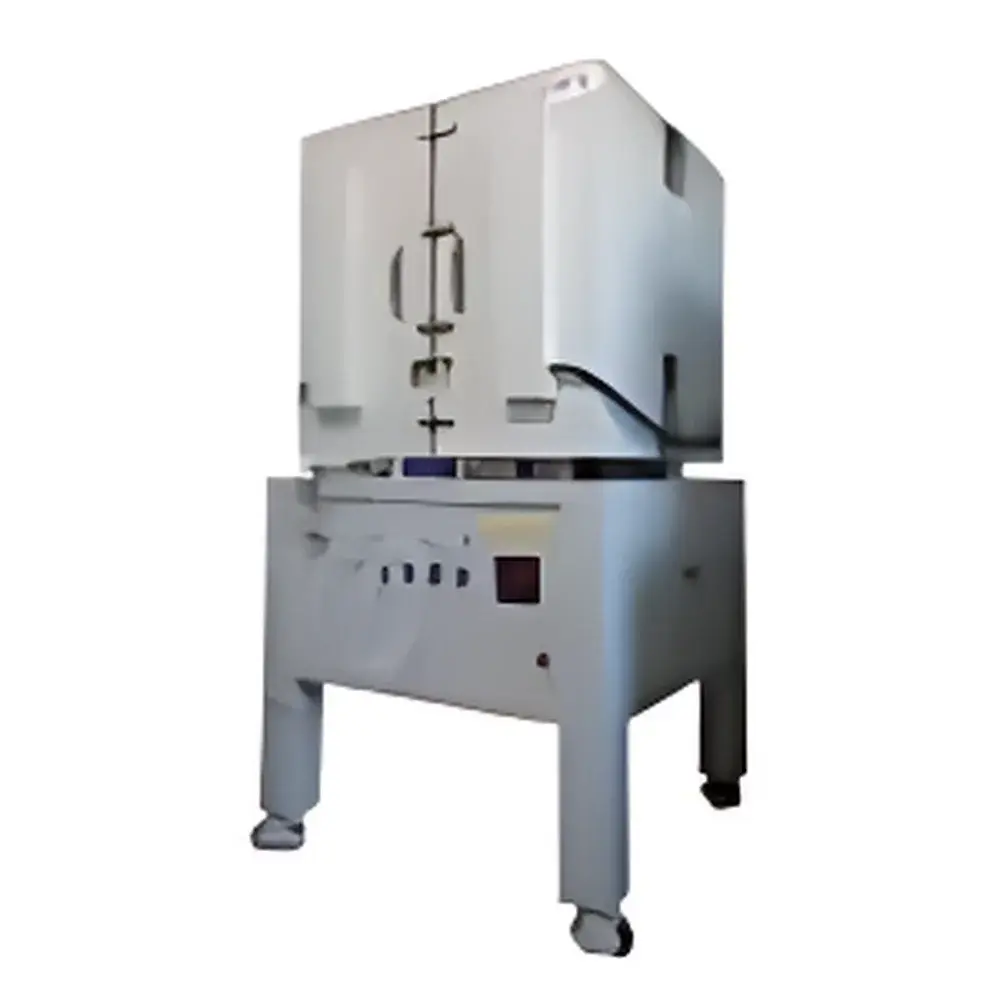
AIWEI落地型SOFC测试工作站
| Brand | AIWEI |
|---|---|
| Origin | Tianjin, China |
| Manufacturer Type | Authorized Distributor |
| Country of Origin | China |
| Model | FS-SOFC-1000 |
| Instrument Type | Electrochemical Workstation |
| Channel Count | Single-Channel |
| Current Accuracy | ±0.1 mA |
| Potential Accuracy | ±1 mV |
| Maximum Furnace Power | 22 kW |
| Max Operating Temperature | 1000 °C |
| Internal Chamber Dimensions | 500 × 550 × 500 mm |
| Load Capacity | Up to 5 kW Electronic Load |
| Gas Control | Multi-channel Mass Flow Controllers (O₂, Air, N₂, H₂, etc.) |
| Humidification | Optional Bubble-Type Humidifier |
| Temperature Ramp Rate | Programmable Heating/Cooling Control |
Overview
The AIWEI FS-SOFC-1000 is a floor-standing, integrated test station engineered for the rigorous electrochemical and thermal characterization of solid oxide fuel cells (SOFCs), single-cell stacks, and planar or tubular SOFC prototypes under realistic operating conditions. Unlike benchtop potentiostats, this system combines high-fidelity electrochemical measurement with precise thermal management, gas delivery, and load control—enabling full-stack performance mapping, degradation studies, and long-term stability testing per ISO 14687, ASTM D7566 Annex A5, and IEC 62282-2 standards. Its core architecture implements four-quadrant galvanostatic/potentiostatic control synchronized with real-time furnace temperature profiling and multi-gas flow regulation—essential for simulating anode/cathode gas composition shifts, redox cycling, and thermal stress protocols common in SOFC R&D and pre-commercial validation.
Key Features
- Integrated 22 kW high-stability resistance furnace with programmable ramp rates (0.1–10 °C/min), uniformity ±3 °C across 500 × 550 × 500 mm internal chamber volume, and maximum setpoint of 1000 °C—certified for continuous operation at 950 °C.
- Dedicated 5 kW electronic load module with four-quadrant operation, enabling dynamic current sourcing/sinking for polarization curve acquisition, current interruption, and impedance spectroscopy under load.
- Multi-channel mass flow controller (MFC) subsystem supporting up to six independent gases (O₂, air, N₂, H₂, CO, CH₄) with ±1% full-scale accuracy, digital PID temperature compensation, and automated sequence-based gas switching.
- Optional bubble-type humidifier with temperature-controlled water bath (20–80 °C) and inline dew point monitoring—compatible with both anode and cathode humidification configurations.
- Modular hardware design permits future expansion: optional integration of exhaust gas analysis (via external GC or MS), pressure regulation modules, and thermocouple arrays for spatial temperature mapping.
Sample Compatibility & Compliance
The FS-SOFC-1000 accommodates standard 25–100 cm² planar SOFC single cells, button cells (20–50 mm diameter), and short stacks (up to 5 cells, ≤200 mm height). Fixture interfaces comply with DIN 43650 and ISO 13485 mechanical mounting conventions. All electrical isolation meets IEC 61010-1 CAT II 1000 V safety requirements. Gas handling components conform to ISO 8573-1 Class 2 purity standards. Data acquisition and software execution support audit trails, user role-based access control, and electronic signature capability—aligned with FDA 21 CFR Part 11 and EU Annex 11 expectations for GLP/GMP-compliant fuel cell qualification studies.
Software & Data Management
The proprietary AIWEI SOFCControl Suite provides unified automation of electrochemical, thermal, and gas parameter sequencing via intuitive graphical workflow builder. Real-time data streams—including voltage, current, impedance spectra (10 mHz–100 kHz), furnace thermocouple readings, MFC setpoints/actuals, and humidifier status—are time-synchronized and logged in HDF5 format with metadata tagging (user, experiment ID, calibration timestamp). Export options include CSV, MATLAB .mat, and ASTM E1447-compliant XML. Built-in statistical post-processing supports degradation rate calculation (mV/1000 h), ASR (Area-Specific Resistance) trend analysis, and Weibull lifetime modeling. Software validation documentation (IQ/OQ/PQ templates) and source code traceability reports are available upon request.
Applications
- Single-cell and short-stack polarization curve generation under variable temperature, gas stoichiometry, and humidity conditions.
- Accelerated stress testing (AST) including thermal cycling (300–900 °C), fuel starvation, and air leakage simulation.
- In-situ electrochemical impedance spectroscopy (EIS) for electrode process deconvolution and interfacial resistance tracking.
- Long-term durability assessment (>5000 h) with automated shutdown on voltage decay thresholds or open-circuit voltage (OCV) deviation.
- Material screening of novel electrolytes, anodes (Ni-YSZ, Ni-GDC), and cathodes (LSCF, BSCF) under representative operating environments.
FAQ
Does the system support impedance spectroscopy at elevated temperatures?
Yes—the workstation integrates a built-in frequency response analyzer (FRA) capable of acquiring EIS spectra from ambient to 1000 °C with automatic temperature-compensated cable calibration.
Can multiple gases be humidified simultaneously?
No—humidification is configurable per gas line; the optional bubble humidifier is installed upstream of either anode or cathode feed, not both concurrently.
Is third-party software integration possible?
Yes—via TCP/IP API and LabVIEW-compatible DLLs; Python and MATLAB drivers are provided for custom automation and machine learning–driven protocol optimization.
What safety interlocks are implemented?
The system features redundant overtemperature cutoff (dual K-type thermocouples + independent limit controller), gas leak detection (optional H₂ sensor integration), emergency power-off (EPO) circuit, and interlocked furnace door switch with zero-voltage release.
Is calibration traceable to national standards?
All current/voltage channels are factory-calibrated against NIST-traceable references; calibration certificates with uncertainty budgets are included with each shipment.







