
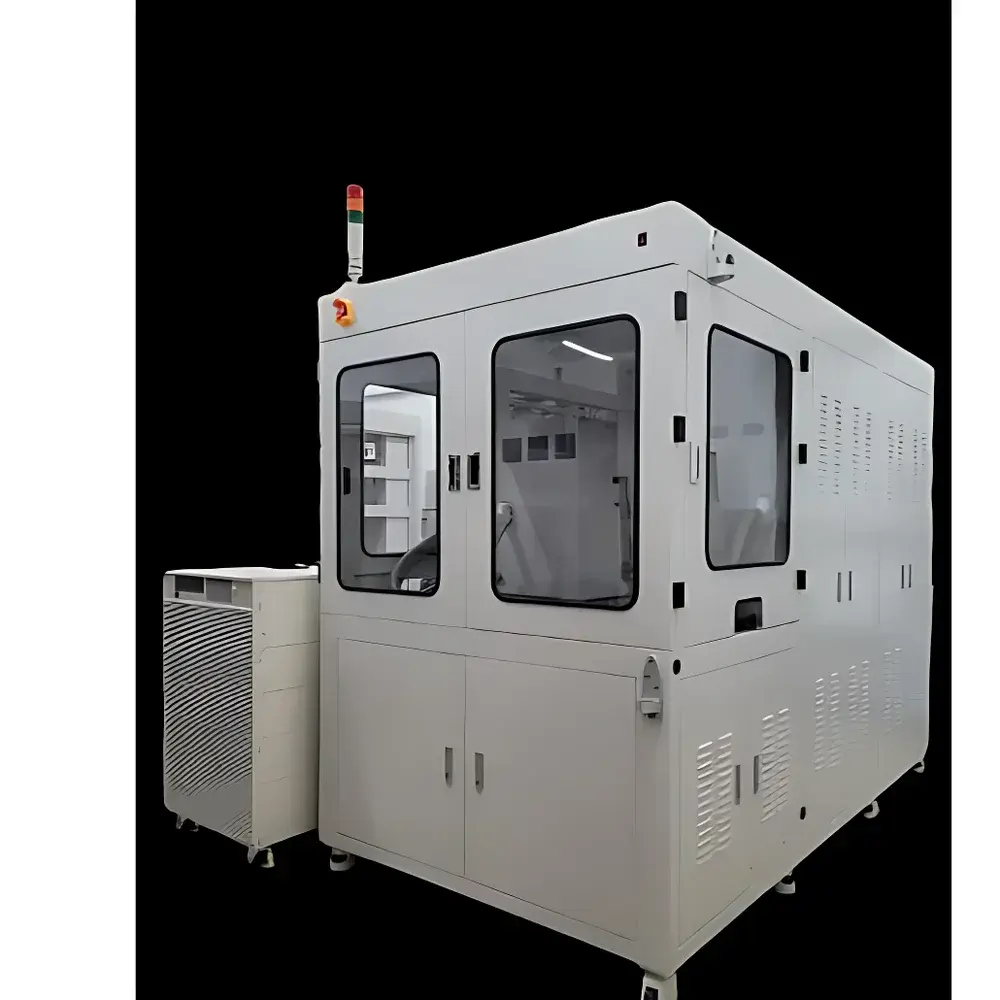
AIWEI 30kW Fuel Cell Stack Test Station
| Brand | AIWEI |
|---|---|
| Origin | Tianjin, China |
| Model | 30kW Fuel Cell Stack Test Station |
| Instrument Type | Electrochemical Workstation |
| Current Range | 0–1500 A |
| Power Rating | 30 kW (DC output) |
| Electronic Load Capacity | 36 kW (optional) |
| Voltage Range | 0–400 V DC |
| AC Input | Three-phase 220/380 VAC, Max 150 A |
| Dimensions (W×D×H) | 1300 × 2500 × 2000 mm |
| Mass Flow Control | Anode (H₂/N₂) up to 500 SLPM |
| Humidification | Direct-injection humidifier with temperature-controlled heating chamber & pressure pump |
| Backpressure Control | 0–3.5 bar, proportional control, ΔP < 2 kPa at max flow |
| Cooling System | 100 L water reservoir, 0–95 °C heating/cooling, conductivity monitoring |
| Software Platform | LabVIEW-based real-time control & data acquisition, ASTM/ISO-compliant test sequencing, FDA 21 CFR Part 11-ready audit trail (optional) |
Overview
The AIWEI 30kW Fuel Cell Stack Test Station is a fully integrated, turnkey electrochemical testing platform engineered for high-fidelity characterization and durability validation of proton exchange membrane (PEM) fuel cell stacks under realistic operating conditions. Designed in accordance with ISO 8528-1, ASTM D6252, and IEC 62282-2 standards, the system implements a closed-loop, multi-subsystem architecture that synchronizes electrical load management, gas delivery and conditioning, thermal regulation, humidity control, and real-time electrochemical diagnostics. Its core measurement capability centers on galvanostatic/potentiostatic control of stack current (0–1500 A) and voltage (0–400 V), enabling precise polarization curve acquisition, dynamic load cycling, and accelerated stress testing (AST) protocols per DOE and FCHEA guidelines. The station operates as a bidirectional power interface—capable of both power absorption (as an electronic load) and controlled discharge—and supports full-stack impedance spectroscopy (EIS) down to 10 mHz.
Key Features
- High-power electronic load module rated at 36 kW (derated to 30 kW continuous operation), featuring active cooling, regenerative braking capability (optional), and programmable slew rate limiting for transient stability.
- Integrated gas subsystem with dual-channel mass flow controllers (MFCs): anode-side H₂/N₂ up to 500 SLPM; cathode-side air/N₂ up to 2000 SLPM—each with NIST-traceable calibration certificates and ±0.5% FS accuracy.
- Direct-injection humidification system with PID-controlled heating chamber (ambient to 95 °C), pressure-regulated water injection, and selectable wet-mode/bypass-mode operation for independent RH control at inlet and outlet streams.
- Automated backpressure regulation using proportional solenoid valves, maintaining stack inlet/outlet differential pressure within ±0.5 kPa across full flow range (0–3.5 bar absolute), with redundant pressure transducers compliant with EN 837-1.
- Dual-loop thermal management: primary coolant circuit (100 L deionized water reservoir) with electric heating (0–95 °C) and chiller-based cooling (5–40 °C); secondary gas preheater (SUS316 tubing, anode 3/4″, cathode 1¼″) for precise inlet gas temperature control (±0.3 °C).
- Real-time water management: auto-refill deionized water system with inline resistivity monitor (0.055–18.2 MΩ·cm), condensate trap with level-sensing drain valve, and heat-exchange-cooled water separator.
Sample Compatibility & Compliance
The station accommodates PEM fuel cell stacks ranging from 10-cell to 400-cell configurations, with active area up to 400 cm² per cell and total active area exceeding 12,000 cm². It supports both hydrogen/air and hydrogen/nitrogen operating modes, and is compatible with MEA materials incorporating Nafion™, Gore-Select®, or Sustainion® membranes. All hardware interfaces comply with UL 61010-1 and IEC 61000-6-4 EMC requirements. Gas lines meet ASME B31.12 hydrogen service specifications. Pressure vessels and humidifiers are CE-marked per PED 2014/68/EU. Optional GMP/GLP configuration includes 21 CFR Part 11-compliant electronic signatures, role-based access control, and immutable audit trails for all parameter changes and test executions.
Software & Data Management
Control and analysis are executed via a LabVIEW-based software suite with modular architecture: Core Control Engine (real-time deterministic loop ≤10 ms), Test Protocol Manager (drag-and-drop sequence builder supporting ISO 14687-2 purity checks and DOE AST cycles), and DAQ Framework (simultaneous sampling of >128 analog channels at 1 kHz). Data is stored in HDF5 format with embedded metadata (test ID, operator, timestamp, environmental conditions, calibration history). Export options include CSV, MATLAB .mat, and standardized FCS (Fuel Cell Standard) XML schema. Optional modules include EIS spectral analysis with Kramers-Kronig validation, HFR/IR-drop decoupling algorithms, and automated degradation rate calculation per IEA Annex 32 reporting templates.
Applications
- Performance mapping: polarization curves, efficiency vs. current density, voltage transient response under step-load changes.
- Durability assessment: open-circuit voltage (OCV) hold tests, cyclic load testing (CLT), humidity cycling, and freeze-thaw validation per SAE J2380.
- Diagnostic testing: single-cell voltage monitoring (±5 V per channel, up to 128 cells), high-frequency resistance (HFR) tracking, and multi-channel electrochemical impedance spectroscopy (10 mHz–10 kHz) with distributed parameter modeling.
- System integration validation: coupling with balance-of-plant (BoP) components including compressors, recirculators, and DC/DC converters under hardware-in-the-loop (HIL) conditions.
- Standards compliance testing: execution of ISO/TS 14687-2 impurity tolerance screening, ISO 17268 hydrogen quality verification, and UN GTR 13 safety protocol validation.
FAQ
What is the maximum continuous power dissipation capacity of the electronic load?
The system is rated for 30 kW continuous DC power absorption; the 36 kW rating reflects peak short-term capability (≤5 min) with forced-air or liquid cooling enabled.
Can the station perform simultaneous EIS on multiple cells within a stack?
Yes—using optional multi-channel potentiostat modules, up to 16 individual cells can be subjected to frequency-swept EIS while maintaining stack-level galvanostatic control.
Is the humidification system capable of achieving 100% relative humidity at the stack inlet?
Yes—the direct-injection design with heated chamber and pressure-assisted water delivery enables RH control from 20% to 100% at inlet temperatures up to 95 °C, verified by chilled-mirror hygrometry.
Does the software support automated pass/fail evaluation against predefined acceptance criteria?
Yes—protocol scripts can embed conditional logic and statistical limits (e.g., voltage decay rate < 1 µV/h over 100 h), triggering alerts, data archiving, and report generation upon criterion violation.
Are calibration certificates provided for all critical sensors?
All pressure transducers, thermocouples, MFCs, and conductivity cells ship with factory calibration reports traceable to NIST or PTB standards; on-site recalibration services are available under ISO/IEC 17025-accredited procedures.






