
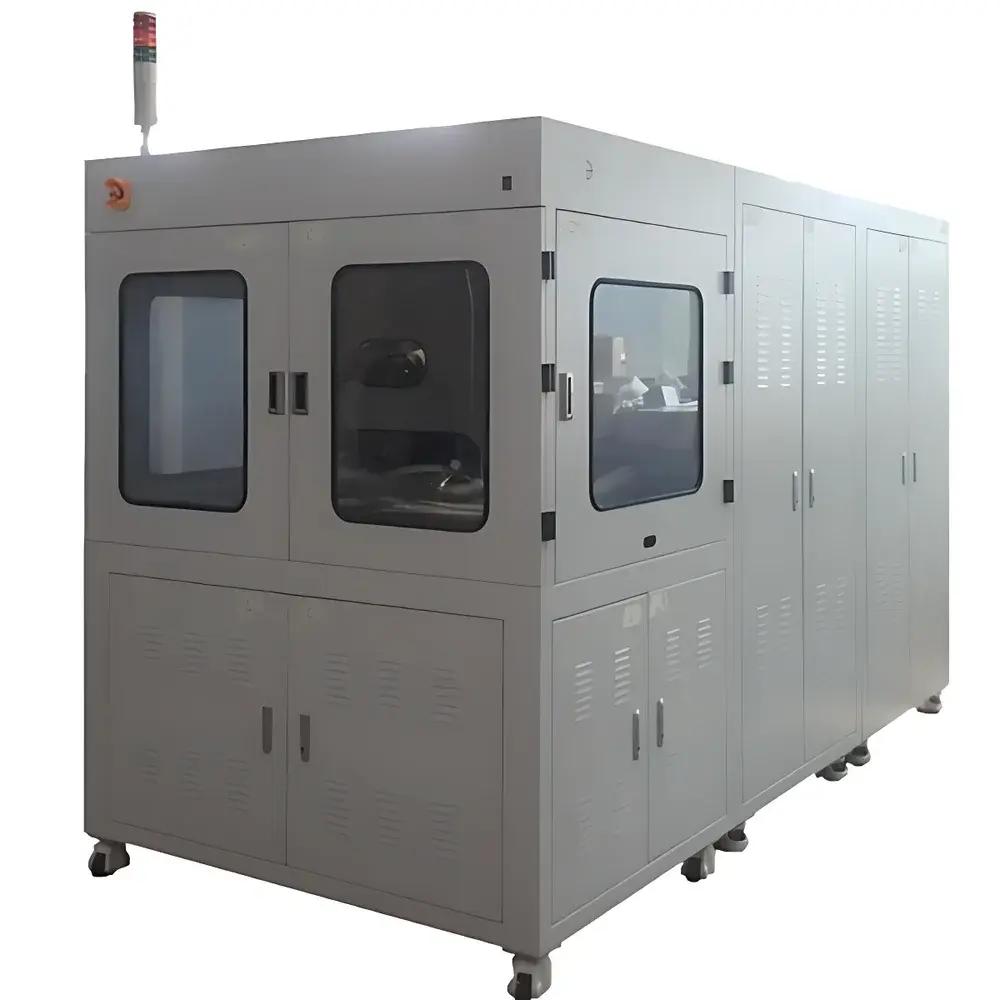
AIWEI 50–200 kW Fuel Cell Stack Test Station
| Brand | AIWEI |
|---|---|
| Model | 50–200 kW Electrochemical Workstation |
| Type | Regenerative/Energy-Dissipative Stack Test System |
| Power Range | 50–200 kW |
| Current Range | ±1000 A / ±1500 A |
| Voltage Range | 0–400 V / 0–600 V / 0–800 V |
| Enclosure Dimensions | 1500(W) × 3300(D) × 2000(H) mm |
| Input Power | 3-phase 220 VAC or 380 VAC, up to 200 A |
| Anode Gas Flow Control | H₂/N₂, up to 2000/4000 SLPM |
| Cathode Gas Flow Control | Air/N₂, up to 6000/12000 SLPM |
| Humidification | Direct-injection humidifier with temperature-controlled heating chamber & pressure pump |
| Backpressure Control | 0–3.5 bar, proportional control, ΔP < 2 kPa at max flow |
| Cooling/Heating | 100 L water reservoir, 20–95 °C temperature range, conductivity monitoring |
| DI Water System | Integrated deionization filtration with auto-regeneration |
| Condensate Management | Automated drainage with heat-exchange cooling loop |
| Preheater | SUS 316 tubing (anode: 1.5", cathode: 2"), inline gas temperature control |
| Data Acquisition | LabVIEW-based platform with DAQ integration, real-time visualization, automated protocol execution, load-following control, and customizable test sequencing |
| Optional Modules | Individual cell voltage monitoring (±5 V per cell), multi-channel EIS (10 mHz–10 kHz), HFR/IR drop analysis, combined IV + EIS operation |
Overview
The AIWEI 50–200 kW Fuel Cell Stack Test Station is a high-power, modular electrochemical test platform engineered for the rigorous evaluation of proton exchange membrane (PEM) and solid oxide fuel cell (SOFC) stacks under realistic operating conditions. Unlike conventional potentiostat-based electrochemical workstations, this system operates as a full-stack energy interface—capable of both regenerative (grid-feedback) and dissipative (resistive load) modes—enabling dynamic load cycling, durability testing, and system-level thermal–electrochemical co-optimization. Its architecture integrates galvanostatic/potentiostatic control with precision gas management, thermal regulation, and real-time impedance analytics, making it suitable for R&D laboratories, stack manufacturers, and certification bodies performing validation in accordance with ISO 8528-10, ASTM D7566 Annex A5, and IEC 62282-2 compliance frameworks.
Key Features
- Scalable power handling from 50 kW to 200 kW with dual current ratings (±1000 A and ±1500 A) and selectable voltage ranges (up to 800 V), supporting large-format automotive and stationary PEM stacks.
- Integrated regenerative DC-to-AC inverter module compliant with IEEE 1547-2018 grid-synchronization standards, enabling energy recovery during transient discharge cycles.
- Dual-path mass flow control with NIST-traceable thermal mass flow controllers (MFCs): anode side (H₂/N₂, 2000–4000 SLPM) and cathode side (air/N₂, 6000–12000 SLPM), each equipped with independent pressure-compensated calibration.
- Direct-injection humidification system featuring PID-controlled heating chamber, programmable dew-point setpoint (±0.5 °C accuracy), and dual-mode operation (wet-bulb bypass and saturation-only).
- Automated backpressure regulation via servo-driven proportional valves, supporting differential pressure control across inlet/outlet manifolds for H₂ and air streams with sub-kPa resolution.
- Closed-loop coolant circuit with 100 L stainless-steel reservoir, electric immersion heaters (0–95 °C), plate-type heat exchangers, and inline conductivity sensors (range: 0.05–5 µS/cm) for continuous water quality monitoring.
- LabVIEW Real-Time embedded controller with FPGA-accelerated DAQ (NI PXIe-6368), supporting synchronized sampling at ≥10 kHz across voltage, current, temperature, pressure, and flow channels.
Sample Compatibility & Compliance
The station accommodates fuel cell stacks ranging from 10-cell to >400-cell configurations, with mechanical interfaces conforming to SAE J2718 and DIN EN 1591-1 flange specifications. Gas delivery lines utilize electropolished 316L stainless steel tubing with VCR fittings to minimize catalytic decomposition and moisture adsorption. All wetted materials—including humidifier chambers, water traps, and DI filters—are certified to USP Class VI and ISO 10993-5 biocompatibility standards. The system meets electromagnetic compatibility (EMC) requirements per EN 61326-1 and functional safety criteria aligned with IEC 61508 SIL2 for critical shutdown sequences.
Software & Data Management
The native LabVIEW-based software suite provides ISO/IEC 17025-compliant data traceability through audit-ready logging, electronic signatures, and 21 CFR Part 11–enabled user access controls. Test protocols—including polarization sweeps, accelerated stress tests (ASTs), and humidity-cycling profiles—are scriptable via XML-based templates. Raw DAQ data is stored in TDMS format with metadata embedding (timestamp, operator ID, environmental conditions). Export options include CSV, HDF5, and MATLAB .mat; optional integration with LIMS platforms via OPC UA or RESTful API is available. Firmware updates are delivered via signed OTA packages with SHA-256 verification.
Applications
- Durability assessment of MEA degradation mechanisms under variable stoichiometry, RH cycling, and load-following transients.
- Thermal mapping and coolant flow distribution analysis using embedded thermocouple arrays and differential pressure sensors.
- High-frequency resistance (HFR) tracking correlated with electrochemical impedance spectroscopy (EIS) to decouple ohmic, charge-transfer, and mass-transport losses.
- System-level efficiency optimization via simultaneous control of air stoichiometry, backpressure, coolant temperature, and humidification setpoints.
- Validation of stack-level control algorithms for automotive FCU integration, including start-up/shutdown sequencing and freeze-thaw tolerance testing.
- Third-party certification support for UL 2261, CSA C22.2 No. 107.1, and GB/T 20042 series standards.
FAQ
What is the maximum allowable stack open-circuit voltage (OCV) during startup?
The system supports OCV ramping up to 800 V with programmable slew rate limiting (0.1–10 V/s) to prevent membrane dry-out or catalyst oxidation.
Can the workstation operate in constant-power mode with dynamic voltage-current coupling?
Yes—real-time power setpoint control is implemented via closed-loop PI regulation with feedforward compensation for gas flow inertia and thermal lag.
Is the EIS module compatible with frequency modulation during load transients?
The multi-channel EIS subsystem supports hybrid measurement modes, including current-interrupt HFR, galvanostatic EIS superimposed on DC load steps, and potentiostatic EIS during voltage ramps.
How is data integrity ensured during extended unattended tests (e.g., 1000-hour AST)?
Continuous checksum validation, redundant SD card + network-attached storage (NAS) mirroring, and automatic recovery from power interruption via UPS-triggered graceful shutdown are standard.
Are third-party gas analyzers (e.g., HORIBA PG200) supported via analog/digital I/O?
Yes—the DAQ chassis includes eight isolated analog inputs (±10 V, 24-bit resolution) and four TTL-compatible digital I/O banks for seamless integration with external analyzers and safety interlocks.




