
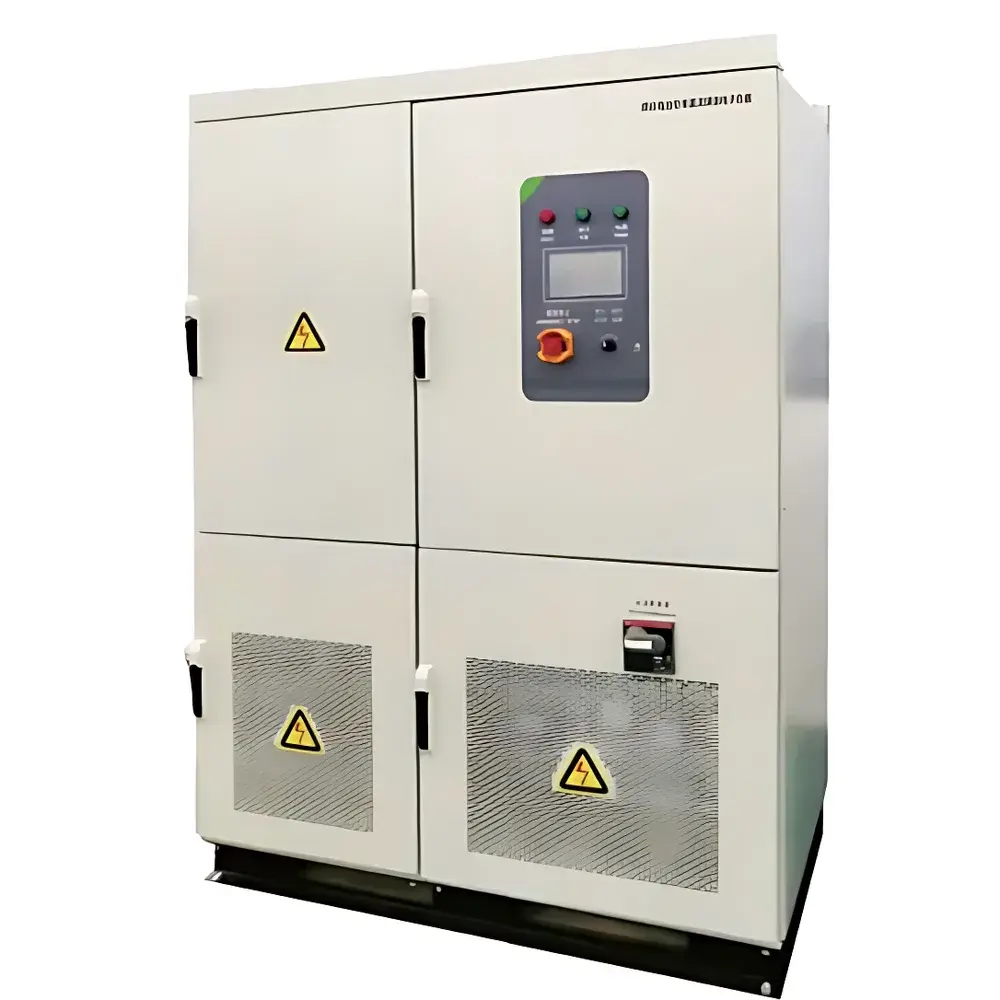
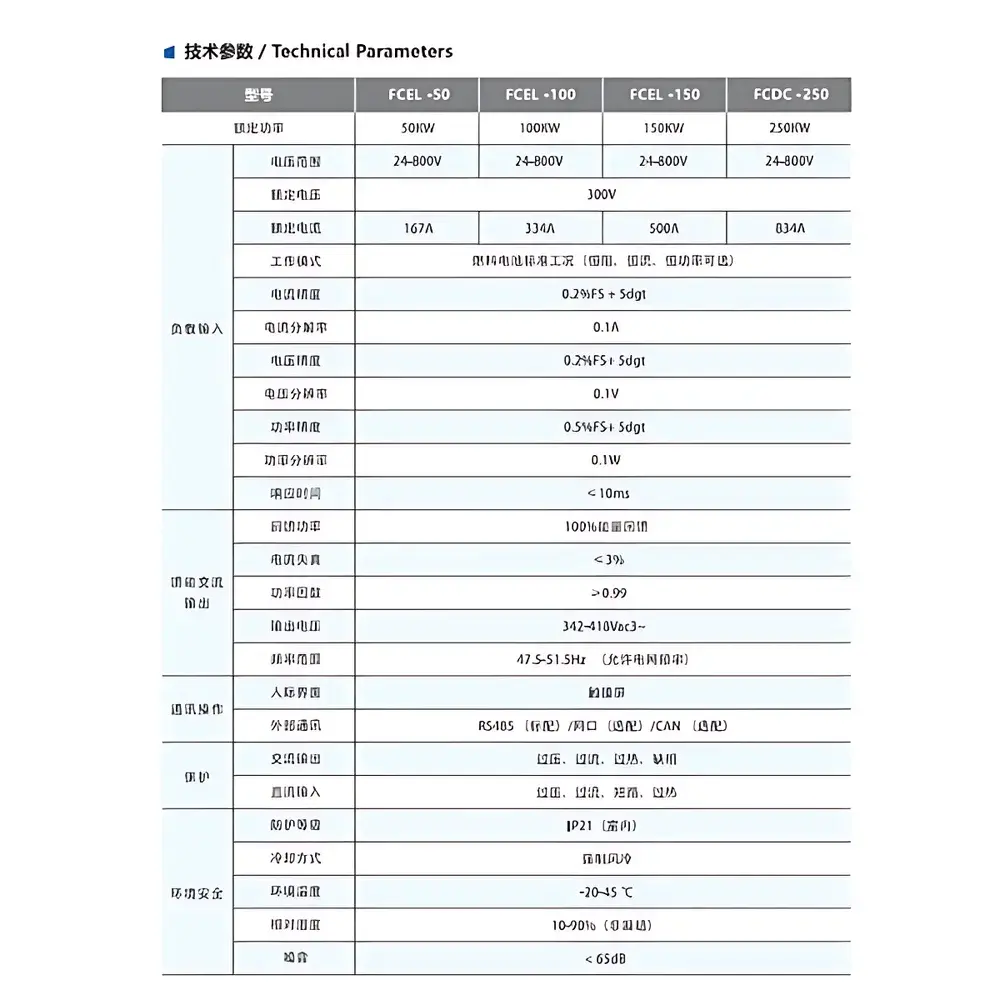
AIWEI FCEL-50 / FCEL-100 / FCEL-150 / FCDC-250 Fuel Cell-Specific Regenerative DC Electronic Load
| Brand | AIWEI |
|---|---|
| Origin | Tianjin, China |
| Model | FCEL-50 / FCEL-100 / FCEL-150 / FCDC-250 |
| Current Range | 167 A / 334 A / 500 A / 834 A |
| Current Accuracy | ±0.2% FS + 5 digits |
| Voltage Accuracy | ±0.2% FS |
| Voltage Range | 24–800 V DC |
| Insulation Resistance Measurement Range | 1 kΩ–1 MΩ |
| Insulation Resistance Accuracy | ±0.2% FS |
| Operating Quadrants | Four-quadrant (bidirectional energy flow) |
| Communication Interfaces | RS485, Ethernet, CAN 2.0B |
| Compliance | GB/T 24554–2009 |
Overview
The AIWEI FCEL and FCDC series are purpose-built regenerative DC electronic loads engineered specifically for fuel cell system validation, stack characterization, and powertrain integration testing. Unlike conventional resistive or passive electronic loads, these units operate in true four-quadrant mode—enabling seamless bidirectional energy flow between the device under test (DUT) and the utility grid. This architecture is critical for high-fidelity emulation of real-world fuel cell operating conditions, including cold-start sequencing, thermal ramping, dynamic load cycling, and shutdown profiling. The integrated DC/DC converter stage is optimized for low-voltage, high-current fuel cell output profiles (24–800 V DC), ensuring minimal voltage droop and precise current regulation even under rapid transients. Designed to meet the stringent requirements of GB/T 24554–2009 (“Test Methods for Fuel Cell Engine Performance”), the system supports full-cycle, standards-compliant evaluation of proton exchange membrane (PEM) and solid oxide fuel cell (SOFC) stacks under controlled electrochemical loading.
Key Features
- Multi-mode operational architecture: Fuel cell load mode (with programmable cold-start, pre-heating, ramp-up/down, and shutdown sequences), fuel cell emulator mode, battery simulator mode (supporting Pb-acid, Ni-MH, LiFePO₄, LiMn₂O₄, and LiCoO₂ characteristic curves), and universal DC load modes (constant current, constant resistance, constant power).
- Regenerative energy recovery: Up to 100% of absorbed energy returned to the AC grid with >92% system efficiency, significantly reducing facility cooling load and operational electricity cost during extended testing.
- High-precision regulation: Current control accuracy of ±0.2% FS + 5 digits and voltage control accuracy of ±0.2% FS across full operating range; fast transient response (<100 µs rise time) ensures fidelity in dynamic polarization curve acquisition.
- Integrated insulation resistance monitoring: Real-time, non-intrusive measurement of system isolation integrity from 1 kΩ to 1 MΩ (±0.2% FS), supporting functional safety verification per ISO 26262 and IEC 60601-1 requirements in automotive and medical-grade fuel cell applications.
- Comprehensive protection suite: Reverse polarity, overvoltage, overcurrent, overtemperature, phase loss (for three-phase input variants), and short-circuit protection with hardware-level interlock capability.
Sample Compatibility & Compliance
The AIWEI FCEL/FCDC series is validated for use with low- to medium-power PEM fuel cell stacks (5–250 kW), reformate-tolerant anode systems, and hybrid fuel cell–battery power modules. It supports both single-stack and multi-stack parallel configurations via master-slave synchronization over CAN 2.0B. All models comply with GB/T 24554–2009 for static and dynamic performance testing—including polarization curve mapping, impedance spectroscopy support (when paired with external potentiostat), and durability cycle validation. Electrical safety conforms to IEC 61000-6-3 (EMI emission) and IEC 61000-6-2 (immunity). Optional firmware packages enable traceable test execution aligned with GLP/GMP documentation workflows, including audit-ready event logging and user-access-controlled parameter locking.
Software & Data Management
The embedded controller supports local operation via intuitive touchscreen HMI or remote orchestration through TCP/IP (Modbus TCP, EtherCAT optional), RS485 (Modbus RTU), and CAN 2.0B protocols. AIWEI’s FuelCellTest Suite software provides script-based test sequencing, real-time waveform capture (up to 10 kHz sampling), and automated report generation compliant with ISO/IEC 17025 data integrity guidelines. All configuration changes, protection triggers, and energy return metrics are timestamped and stored with SHA-256 hashing—ensuring data provenance for regulatory review. Integration with LabVIEW, MATLAB/Simulink, and Python (via PySerial or socket API) enables closed-loop co-simulation with system-level vehicle or balance-of-plant models.
Applications
- Fuel cell stack qualification per SAE J2718 and ISO 14687-2 impurity tolerance testing.
- Dynamic load profiling for automotive FCU (fuel cell control unit) validation under WLTC and UDDS drive cycles.
- Battery–fuel cell hybrid system emulation, including state-of-charge (SOC)-dependent load sharing logic.
- Electrolyzer reverse-mode testing (where applicable) using bidirectional DC bus capability.
- Grid-supportive R&D for microgrid-integrated fuel cell plants, leveraging regenerative feedback for active power balancing.
FAQ
Does this load support real-time impedance spectroscopy (EIS) measurements?
No—the FCEL/FCDC series is a dedicated power interface and does not include built-in frequency response analysis. However, it can be synchronized with third-party potentiostats (e.g., BioLogic SP-300, Gamry Interface 5000) via TTL trigger and analog voltage/current monitoring outputs for coordinated EIS experiments.
What is the maximum allowable voltage ripple during constant-current operation?
Ripple is maintained below 0.15% RMS of set current at full load, verified per IEC 62040-3 Annex B test methodology using 20 MHz bandwidth oscilloscope measurement.
Can multiple units operate in parallel for higher current capacity?
Yes—up to four units can be synchronized in master-slave configuration via CAN bus, maintaining current sharing accuracy within ±0.5% across all channels without external current-sharing resistors.
Is firmware update capability available over network connection?
Yes—secure OTA (over-the-air) updates are supported via HTTPS with X.509 certificate authentication; version history and rollback functionality are retained in non-volatile memory.
How is grid synchronization handled during regenerative operation?
The integrated active front-end (AFE) inverter complies with IEEE 1547-2018 for anti-islanding, harmonic distortion (<3% THD), and reactive power support (Q(V) and Q(f) droop curves configurable).




