
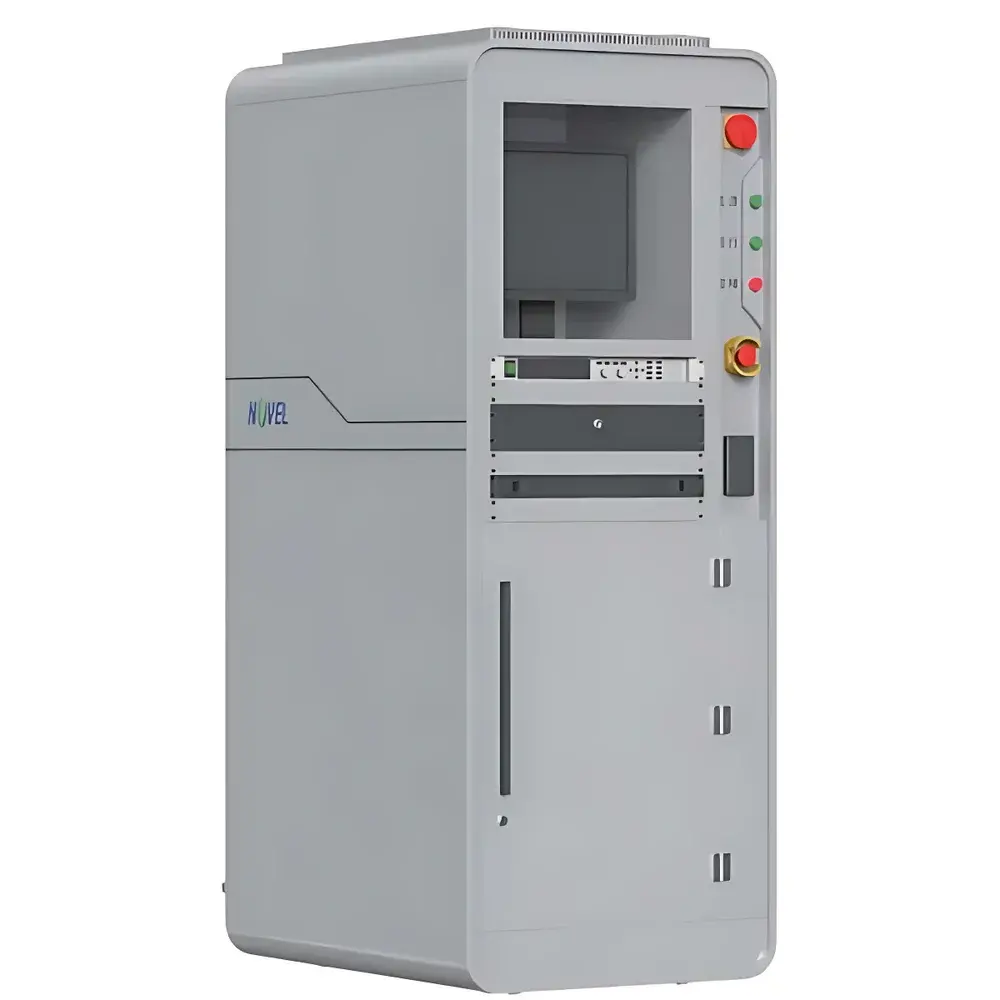
AIWEI HMS Hydrogen System Electrical Test Platform
| Brand | AIWEI |
|---|---|
| Origin | Tianjin, China |
| Manufacturer Type | Authorized Distributor |
| Product Category | Domestic |
| Model | HMS |
| Instrument Type | Electrochemical Workstation |
| Voltage Compatibility | 12 V & 24 V DC |
| Pressure Rating Compatibility | 35 MPa & 70 MPa Cylindrical Valve Testing |
| CAN Channels | 2 × CAN 2.0B |
| Digital Input (DI) Channels | 16 (12/24 V compatible) |
| Analog Output (AO) Channels | 24 (0–5 V, 0–V range) |
| PWM Outputs | 4 (12/24 V compatible) |
| Digital Output (DO) Channels | 6 |
| Power Input | 9–36 V DC / 20 A |
| DTC Strategy Emulation | Yes |
| Control Command Emulation | Vehicle ECU & FCU Command Simulation |
| HIL Integration | Fully Compatible |
| Offline Production Test Support | Yes |
| DBC File Import | Supported |
| Protocol Configuration | User-Configurable Multi-Protocol Stack |
Overview
The AIWEI HMS Hydrogen System Electrical Test Platform is a purpose-built electrochemical workstation engineered for functional validation, hardware-in-the-loop (HIL) simulation, and end-of-line (EOL) electrical verification of high-pressure hydrogen storage and delivery systems used in fuel cell electric vehicles (FCEVs) and stationary hydrogen energy infrastructure. Unlike conventional electrochemical analyzers focused on material characterization or corrosion studies, the HMS platform operates at the system integration layer—emulating real-time sensor signals, actuator responses, communication protocols, and fault logic to validate the electrical and control behavior of hydrogen subsystems under defined operational and failure conditions. Its architecture is grounded in deterministic I/O timing, galvanically isolated signal conditioning, and synchronized multi-channel stimulus-response capture—enabling repeatable, traceable, and auditable test sequences aligned with automotive functional safety development practices.
Key Features
- Multi-signal emulation capability: Simulates bottle valve drive signals (16 DI channels), temperature feedback (16 AO channels), hydrogen concentration sensor outputs (4 AO/PWM channels), high-pressure (2 × AO) and medium-pressure (2 × AO) sensor analog signals, and medium-pressure valve actuation (2 DI channels).
- Dual CAN 2.0B interfaces supporting configurable bit rates, message filtering, and full DBC file import for seamless integration with vehicle network architectures.
- Flexible I/O configuration: 6 programmable digital outputs (DO) and wide-range DC power supply (9–36 V, 20 A) for powering and stimulating external hydrogen components during bench testing.
- Onboard diagnostic trouble code (DTC) strategy emulation: Reproduces ISO 15031-6–compliant fault detection logic—including time-based thresholds, signal plausibility checks, and cascaded error propagation—to verify hydrogen system response latency and mitigation actions.
- Control command emulation module: Mimics commands from vehicle ECUs and fuel cell controllers (FCUs) via configurable digital/analog/CAN stimuli, enabling closed-loop verification of hydrogen system actuation sequencing and interlock compliance.
- Automated test execution engine with built-in report generation: Supports script-based test case definition, pass/fail criteria assignment, and one-click export of PDF/CSV-formatted test records compliant with internal quality management systems (QMS) and ISO/IEC 17025 documentation requirements.
Sample Compatibility & Compliance
The HMS platform is designed for bench-level verification of hydrogen system subassemblies—including Type IV composite cylinders, integrated pressure regulators, solenoid valves, purge valves, leak detection sensors, and electronic control units (ECUs). It supports both 12 V and 24 V automotive-grade electrical architectures and is mechanically and electrically rated for use with 35 MPa and 70 MPa hydrogen storage systems per ISO 15869 and SAE J2579 standards. All I/O modules meet IEC 61000-4-2 (ESD), -4-4 (EFT), and -4-5 (surge) immunity requirements. The platform’s test procedures align with OEM-specific validation protocols (e.g., Toyota FCHV, Hyundai NEXO, and BMW iX5 Hydrogen test matrices) and support audit readiness for IATF 16949 and ISO 9001 manufacturing certifications.
Software & Data Management
The HMS platform runs on a deterministic real-time operating system (RTOS) with a Windows-based host application for test configuration, sequence scripting, and result analysis. The software environment supports DBC file import for automatic CAN message decoding, user-defined protocol templates (J1939, UDS, custom CAN), and timestamp-synchronized acquisition across all analog, digital, and bus channels. Audit trails include operator ID, test start/stop timestamps, firmware version, calibration status, and environmental metadata. Exported reports embed digital signatures and are structured to satisfy FDA 21 CFR Part 11 and EU Annex 11 requirements for electronic records and signatures in regulated environments.
Applications
- Pre-validation of hydrogen system ECUs prior to vehicle integration
- HIL testing of hydrogen control strategies under simulated fault injection scenarios
- Production line EOL testing for hydrogen storage subsystems
- Verification of sensor signal conditioning accuracy and noise rejection performance
- Functional safety validation (ISO 26262 ASIL-B/C level) of hydrogen system fail-safe behaviors
- Support for hydrogen system certification documentation per GB/T 35544–2017, ISO 17268, and UN GTR 13
FAQ
Does the HMS platform support real-time closed-loop control during HIL testing?
Yes—the platform provides sub-millisecond I/O latency and deterministic scheduling to maintain synchronization between simulated sensor inputs and actuator command responses within HIL environments.
Can test scripts be exported and reused across multiple HMS units?
Yes—test definitions, DBC configurations, and report templates are stored in portable XML/JSON formats and fully interoperable across identical HMS installations.
Is calibration traceability provided with the system?
Each HMS unit ships with a factory calibration certificate traceable to NIM (National Institute of Metrology, China) standards; optional annual recalibration services are available with ISO/IEC 17025–accredited documentation.
What cybersecurity features are implemented in the host software?
Role-based access control (RBAC), encrypted local database storage, TLS 1.2–secured remote diagnostics, and configurable audit log retention policies are embedded per ISO/SAE 21434 recommendations.
Does the platform support third-party test automation frameworks such as NI TestStand or Python-based PyVISA?
Yes—RESTful API and TCP/IP socket interfaces are provided for integration with external test orchestration tools and CI/CD pipelines.
Related Products




