
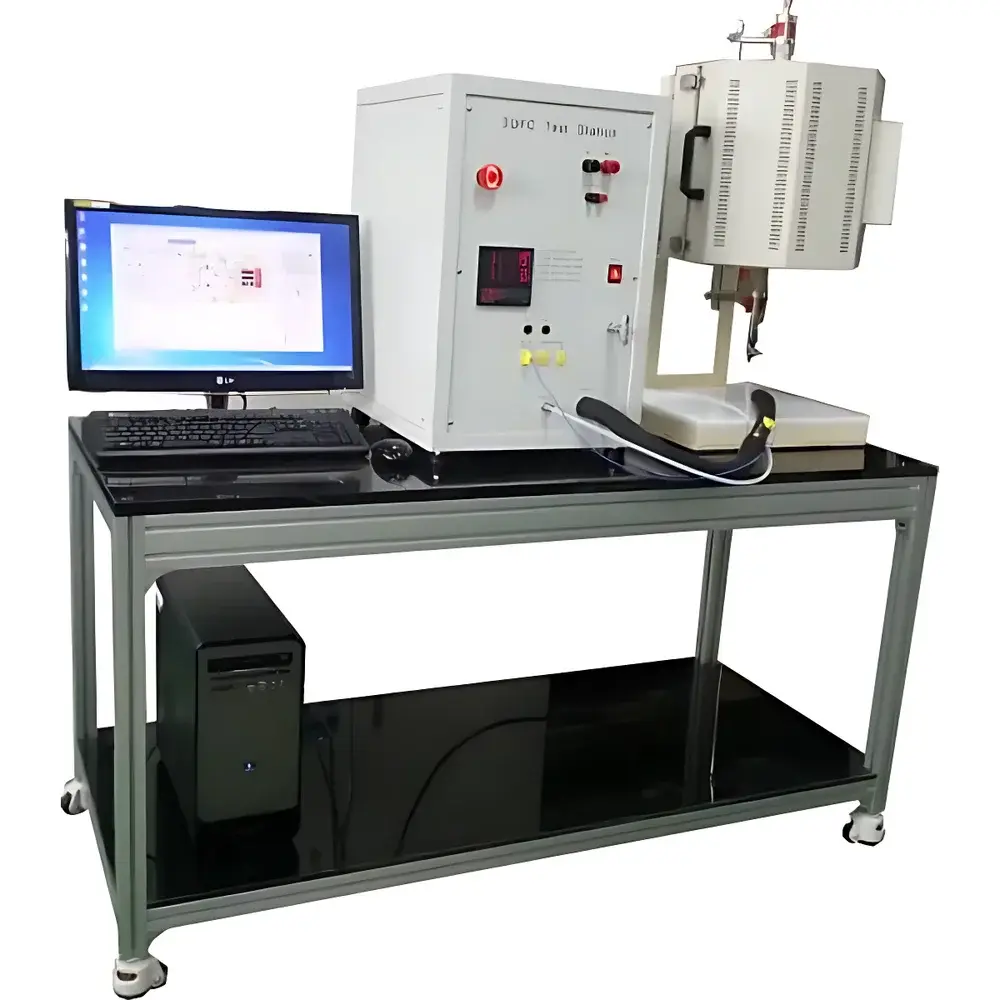
AIWEI SOFC-1000 Desktop Solid Oxide Fuel Cell Testing Workstation
| Brand | AIWEI |
|---|---|
| Origin | Tianjin, China |
| Model | SOFC-1000 |
| Instrument Type | Electrochemical Workstation |
| Channel Count | Single-Channel |
| Current Accuracy | ±0.01 mA |
| Potential Accuracy | ±1 mV |
| Furnace Power | 2 kW |
| Max Operating Temperature | 1000 °C |
| Gas Control | Multi-channel Mass Flow Controllers (O₂, Air, N₂, H₂) |
| Humidification | Optional Bubbling-Type Humidifier |
| Load Capability | Button-cell-compatible Electronic Load |
| Software | Fully Automated Control & Real-time Monitoring Suite |
Overview
The AIWEI SOFC-1000 is a purpose-engineered desktop-scale electrochemical workstation designed specifically for the characterization and performance evaluation of solid oxide fuel cells (SOFCs) and related high-temperature electrochemical systems. Unlike general-purpose potentiostats, this system integrates thermal, gas-phase, and electrical control subsystems into a unified platform—enabling precise, synchronized operation under realistic operating conditions up to 1000 °C. Its core architecture follows the principles of galvanostatic/potentiostatic polarization, electrochemical impedance spectroscopy (EIS), and dynamic current–voltage (I–V) profiling, all referenced to a thermally stable reference electrode configuration compatible with ceramic-based cell architectures. The system is engineered for laboratory environments where reproducibility, traceable calibration, and long-term thermal–electrochemical stability are prerequisites for R&D validation and pre-commercial prototype testing.
Key Features
- Integrated 2 kW programmable furnace with PID-controlled heating profile, capable of ramping to 1000 °C with ±2 °C spatial uniformity across the test zone—optimized for planar and tubular single-cell configurations.
- Single-channel electrochemical module featuring ±0.01 mA current resolution and ±1 mV potential accuracy, compliant with ASTM D6866 and ISO 17025 traceability requirements when paired with calibrated shunt resistors and reference electrodes.
- Dedicated electronic load module supporting constant-current, constant-power, and pulse-discharge modes—specifically adapted for button-cell–style SOFC subassemblies and micro-tubular test units.
- Multi-gas mass flow control system with independent MFC channels for O₂, air, N₂, and H₂, each equipped with digital setpoint interfaces and real-time flow feedback (±1% full scale accuracy), enabling stoichiometric ratio tuning and inert purge sequencing.
- Optional bubbling-type humidifier with temperature-regulated water bath (20–80 °C range), allowing controlled steam partial pressure introduction into anode or cathode streams—critical for evaluating Ni/YSZ anode degradation mechanisms.
- Rugged mechanical design with ceramic tube fixtures, alumina insulation, and modular cabling pathways—facilitating rapid reconfiguration between symmetric cell, half-cell, and full-cell test geometries.
Sample Compatibility & Compliance
The SOFC-1000 accommodates standard 10–25 mm diameter planar electrolyte-supported or anode-supported cells, as well as 10–15 mm outer-diameter tubular cells mounted on custom ceramic support rods. Fixture geometry supports both current-collecting mesh contact and spring-loaded compression terminals to minimize interfacial resistance variability. All gas-wetted components comply with ASTM F2129 for corrosion resistance in humidified oxidizing atmospheres. The system’s firmware and data logging architecture support audit-ready operation per GLP and GMP guidelines, including user-access controls, electronic signature fields, and time-stamped event logs aligned with FDA 21 CFR Part 11 requirements when deployed with validated software licensing.
Software & Data Management
The workstation operates via AIWEI’s proprietary SOFCControl v3.x software suite, a Windows-based application built on .NET Framework with native support for multi-threaded acquisition and real-time visualization. It provides synchronized logging of voltage, current, temperature (thermocouple inputs), gas flow rates, and humidity levels at configurable sampling intervals (10 ms–10 s). Data export formats include CSV, HDF5, and MATLAB-compatible .mat files. The software includes built-in EIS fitting modules (based on ZView-compatible equivalent circuit templates), polarization curve interpolation, and degradation rate calculation (e.g., mΩ·cm²·h⁻¹ for area-specific resistance drift). All experimental protocols are scriptable using Python API hooks, enabling integration into automated screening workflows.
Applications
- Performance mapping of novel cathode materials (e.g., LSCF, BSCF) under varying pO₂ and temperature gradients.
- Long-term stability assessment of anode-supported cells under redox cycling and fuel starvation conditions.
- Electrochemical impedance spectroscopy (EIS) deconvolution of ohmic, charge-transfer, and diffusion overpotentials across 10 mHz–100 kHz frequency range.
- Dynamic load-following behavior analysis for hybrid SOFC–gas turbine system modeling.
- Validation of sealing integrity and interconnect compatibility through open-circuit voltage (OCV) decay monitoring under thermal soak conditions.
- Accelerated stress testing (AST) protocols aligned with DOE SECA and EU SOFC-DEMO project benchmarks.
FAQ
What types of fuel cell configurations can be tested on the SOFC-1000?
The system supports planar electrolyte-supported, anode-supported, and tubular single-cell geometries—provided physical dimensions fall within the fixture envelope and thermal expansion coefficients are compatible with alumina-based mounting hardware.
Is the software compatible with third-party data analysis tools?
Yes—raw time-series data exports in CSV and HDF5 formats are fully interoperable with OriginLab, Python (NumPy/Pandas), and MATLAB. EIS spectra are saved in ZSimpWin-compatible ASCII format.
Can the system perform simultaneous dual-gas humidification?
Not natively; the optional bubbling humidifier is configured for single-stream conditioning. Dual-humidification requires external manifold integration and is supported via analog I/O expansion ports.
Does the workstation include calibration certificates for electrical and thermal sensors?
Factory calibration reports are supplied with each unit. NIST-traceable recalibration services are available through AIWEI’s authorized service centers in Europe and North America.
What safety interlocks are implemented?
Hardware-level thermal cutoff (1050 °C), gas leak detection via pressure decay monitoring, emergency power-off relay, and software-enforced maximum current/voltage limits based on user-defined cell specifications.




