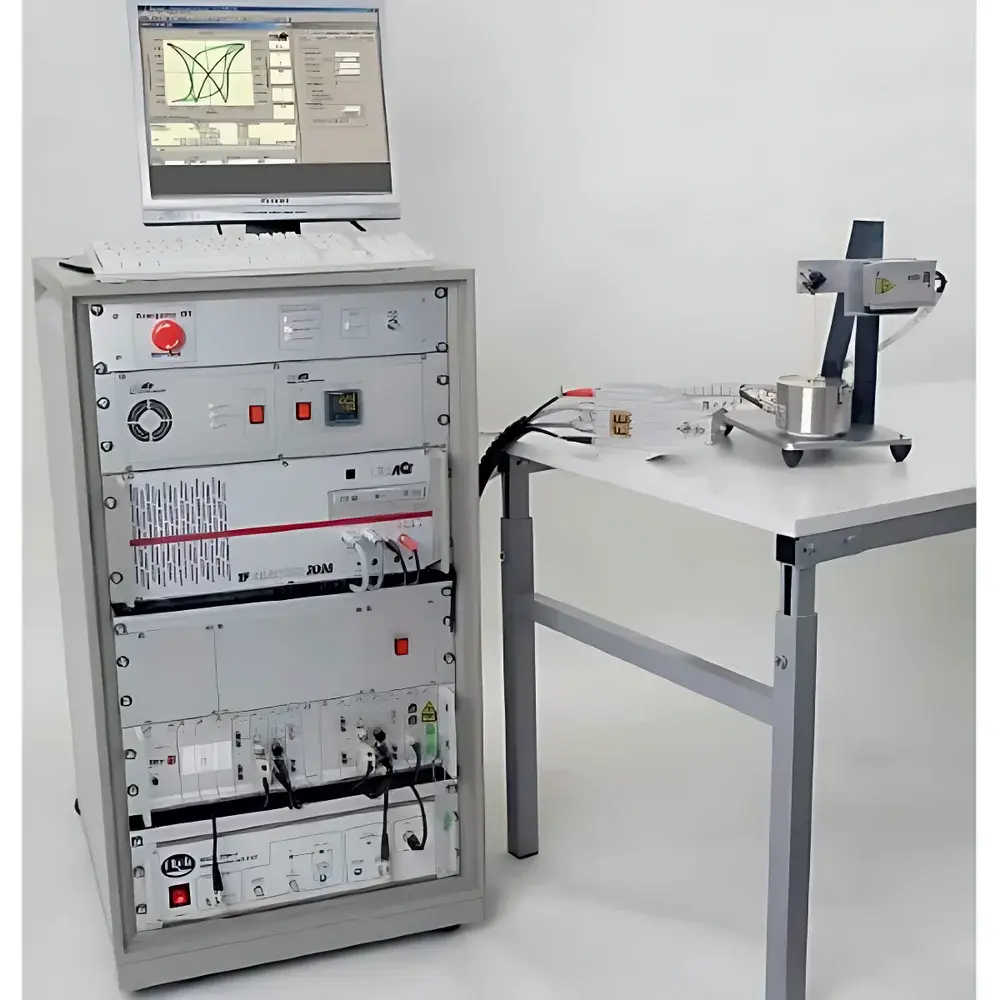
aixACCT TF Analyzer 1000 Ferroelectric Test System
| Brand | aixACCT |
|---|---|
| Origin | Germany |
| Model | TF Analyzer 1000 |
| Voltage Range | ±12 V (expandable to ±10 kV) |
| Frequency Range | 0.01 Hz – 1 kHz |
| Fatigue Test Frequency | up to 50 kHz |
| Minimum Pulse Width | 20 µs |
| Output Impedance | 50 Ω |
| Max Capacitive Load | 100 nF |
| Output Current | ±50 mA |
| Current Amplification Range | 1 nA – 1 A |
Overview
The aixACCT TF Analyzer 1000 is a compact, high-precision ferroelectric and piezoelectric characterization system engineered for rigorous academic research and industrial R&D in advanced functional materials. Designed and manufactured in Germany by aixACCT Systems—a leader in electromechanical material testing since 1995—the instrument implements standardized ferroelectric measurement principles based on the Sawyer–Tower circuit topology, combined with digitally synchronized voltage sourcing and high-fidelity current/voltage acquisition. It enables quantitative evaluation of polarization switching behavior, domain dynamics, charge transport mechanisms, and electromechanical coupling in thin films, bulk ceramics, multilayer capacitors, and microstructured devices. The system complies with fundamental metrological requirements for ferroelectric testing as defined in IEC 62047-22 (Micro-electromechanical systems — Part 22: Test methods for piezoelectric and ferroelectric thin films) and supports traceable calibration protocols aligned with ISO/IEC 17025 laboratory accreditation frameworks.
Key Features
- Integrated dual-channel high-voltage amplifier with ±12 V standard output (extendable to ±10 kV via optional HV module)
- Programmable waveform generation supporting sine, triangle, square, and arbitrary pulse shapes with resolution down to 20 µs pulse width
- Real-time current monitoring with 1 nA–1 A dynamic range and sub-nanosecond timing synchronization
- Dedicated ferroelectric test modes: dynamic hysteresis (0.01–1 kHz), fatigue cycling (up to 50 kHz), retention, imprint, leakage current spectroscopy, C(V) profiling, and piezoelectric butterfly/d33 response
- Thermal measurement interface compatible with commercial cryostats and heating stages (−180 °C to +600 °C)
- Modular architecture enabling future expansion with laser interferometry, SPM integration, or external temperature controllers
- Low-noise analog front-end with 50 Ω output impedance and 100 nF maximum capacitive load tolerance
Sample Compatibility & Compliance
The TF Analyzer 1000 accommodates a broad spectrum of dielectric and ferroelectric specimens—including sol-gel and sputtered thin films (<100 nm), screen-printed thick films (1–100 µm), bulk PZT/BLT/BFO ceramics, single-crystal substrates, and MEMS-scale capacitor arrays. Electrode configurations support top-bottom, interdigitated, and lateral geometries using standard probe stations or custom fixtures. All measurements adhere to ASTM D991 (Standard Test Method for Dielectric Properties of Solid Electrical Insulating Materials at Power Frequencies) and are compatible with GLP-compliant workflows when paired with audit-trail-enabled software configurations. While the base unit does not include FDA 21 CFR Part 11 compliance out-of-the-box, its data export architecture (CSV, HDF5, MATLAB .mat) facilitates integration into validated QA/QC environments under ISO 13485 or IATF 16949 quality management systems.
Software & Data Management
Controlled by the aixPlorer software suite—developed exclusively for Windows 7 (32-bit)—the system delivers deterministic real-time operation with deterministic loop timing and hardware-triggered acquisition. aixPlorer provides intuitive graphical configuration of test sequences, automatic parameter sweep generation, and synchronized multi-parameter logging (voltage, current, temperature, displacement where interfaced). Raw datasets are stored with embedded metadata including timestamp, user ID, instrument firmware version, and calibration history. Export formats include ASCII-delimited tables for statistical analysis and hierarchical HDF5 containers for long-term archival. Optional scripting modules (Python API) enable automated batch processing, DOE-driven experiment scheduling, and integration with LabVIEW or MATLAB-based modeling pipelines. Data integrity safeguards include write-once filesystem logging and SHA-256 checksum generation per acquisition session.
Applications
This system serves critical roles across multiple domains: fundamental studies of polarization reversal kinetics in perovskite oxides; reliability assessment of FeRAM and FRAM memory cells under accelerated fatigue stress; qualification of lead-free piezoceramics (e.g., KNN, BNT-BT) for actuator applications; evaluation of thermal depolarization stability in pyroelectric detectors; and correlation of domain wall mobility with leakage pathways in doped HfO2-based ferroelectrics. In semiconductor process development, it supports inline screening of gate-stack ferroelectricity in FET architectures and quantification of imprint drift in embedded non-volatile memory stacks. Industrial users leverage its reproducible hysteresis metrics for supplier qualification and lot-to-lot consistency verification per JEDEC JESD22-A117 standards.
FAQ
Is the TF Analyzer 1000 compatible with ultra-high vacuum or controlled-atmosphere chambers?
Yes—its low-noise analog I/O architecture and galvanically isolated trigger lines support integration with vacuum feedthroughs and environmental enclosures. Custom cabling kits and shielded BNC extensions are available upon request.
Can the system perform simultaneous polarization and strain measurement?
It supports synchronized external input channels for displacement signals from laser Doppler vibrometers or capacitive sensors, enabling direct correlation of Q-V and d33-V responses without time-domain interpolation.
What level of current resolution is achievable during low-frequency hysteresis sweeps?
At 0.01 Hz, the system achieves <10 pA RMS noise floor over 1-second integration windows, sufficient for detecting imprint-related asymmetries in high-resistivity thin films.
Does the instrument support automated wafer-level probing?
While the base model lacks integrated robotic positioning, it interfaces seamlessly with third-party probe stations (e.g., Cascade Microtech, MPI) via TTL triggers and analog voltage control signals for semi-automated mapping.
Are calibration certificates provided with the system?
Each unit ships with factory calibration reports traceable to PTB (Physikalisch-Technische Bundesanstalt) standards, covering voltage source accuracy (±0.2% of reading), current measurement linearity (±0.5% FS), and timing jitter (<50 ns RMS).