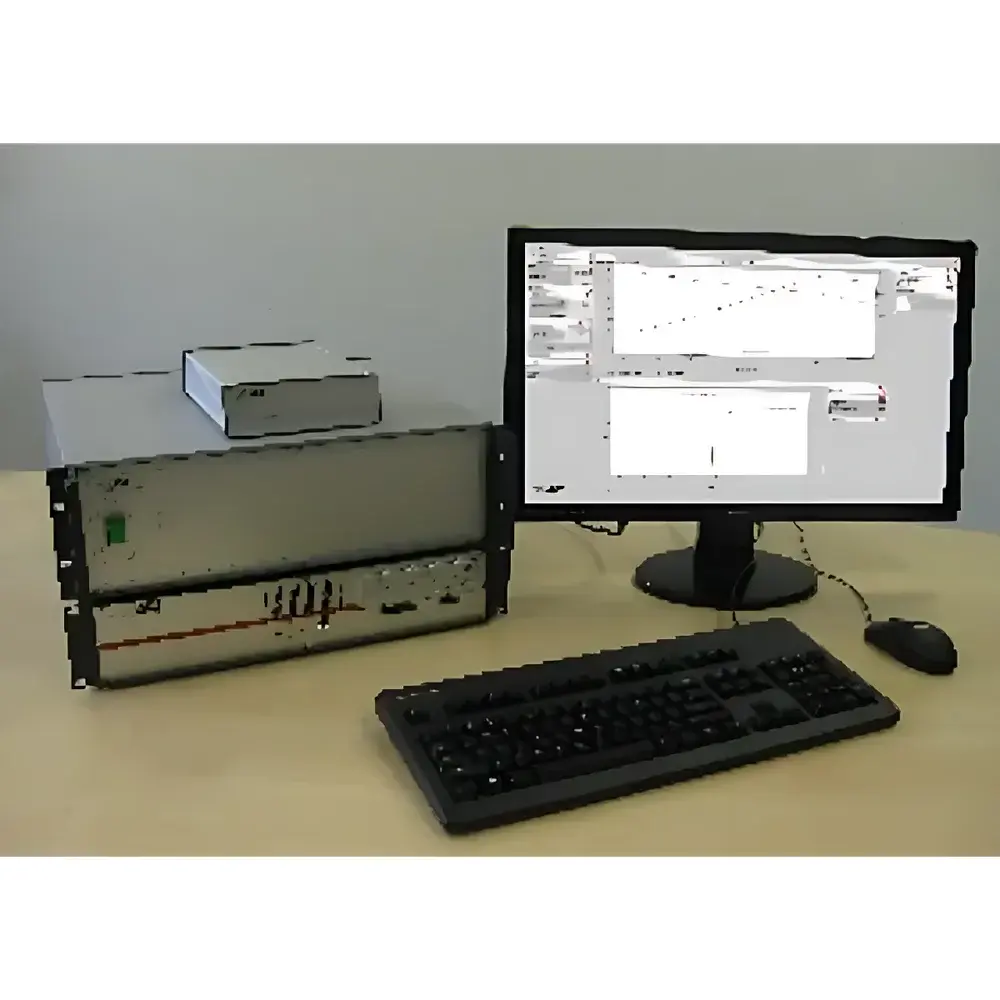
aixACCT TF Analyzer 2000E Modular Ferroelectric Test System
| Brand | aixACCT |
|---|---|
| Origin | Germany |
| Model | TF Analyzer 2000E |
| Voltage Range | ±25 V (extendable to ±10 kV) |
| Hysteresis Frequency | 0.001 Hz – 5 kHz |
| Minimum Pulse Width | 2 µs |
| Rise Time | ≤1 µs |
| Current Measurement Range | 1 pA – 1 A |
| Max Capacitive Load | 1 µF |
| Peak Output Current | ±1 A |
| Module Options | FE (Ferroelectric), MR (Magnetoresistive), RX (Relaxation Current), DR (Dielectric Retention) |
| Channel Count | 256-channel automated testing capability |
| Operating System | Windows 7 embedded |
Overview
The aixACCT TF Analyzer 2000E is a high-precision, modular ferroelectric test system engineered for quantitative characterization of polarization switching dynamics, dielectric response, and electromechanical coupling in advanced functional materials. Based on the principle of controlled voltage waveform application and high-fidelity current/voltage transient acquisition, the system implements standardized measurement protocols aligned with IEEE Std 1789, IEC 62047-23, and ASTM D991 for ferroelectric thin films and bulk ceramics. Its architecture integrates a low-noise bipolar voltage source, ultra-low-current amplification stages, real-time digital signal processing, and synchronized data acquisition — all housed within a single rack-mountable unit containing an embedded industrial PC running Windows 7. Designed explicitly for R&D laboratories and semiconductor process development environments, the TF Analyzer 2000E supports traceable, repeatable measurements under ambient, variable-temperature, and multi-field (electric/magnetic/thermal) conditions — enabling correlation between macroscopic hysteresis behavior and nanoscale domain physics.
Key Features
- Modular hardware architecture supporting independent configuration of FE (ferroelectric), MR (magnetoresistive), RX (relaxation current), and DR (dielectric retention) modules — each optimized for specific physical mechanisms and compliant with ISO/IEC 17025 calibration traceability requirements.
- FE module delivers dynamic hysteresis loops at frequencies from 1 mHz to 5 kHz, static imprint/retention tests with sub-second voltage hold stability (<0.01% drift over 10 s), and PUND (Positive-Up-Negative-Down) sequences for decoupling switching and leakage contributions.
- Ultra-fast pulse generation with ≤2 µs minimum width and ≤1 µs rise time enables accurate fatigue testing up to 50 kHz and domain nucleation studies in high-coercivity perovskites (e.g., BiFeO₃, Pb(Zr,Ti)O₃).
- Current measurement sensitivity spanning 12 decades (1 pA–1 A) with auto-ranging feedback amplifiers ensures reliable quantification of both displacement current (pA–nA range) and conduction current (µA–mA range) during polarization reversal.
- Integrated high-voltage amplifier option extends voltage compliance to ±10 kV, facilitating characterization of thick-film capacitors, multilayer actuators, and high-breakdown-field relaxor ferroelectrics.
- 256-channel automated test sequencing supports high-throughput screening of combinatorial libraries or wafer-level process qualification — fully programmable via LabVIEW-compatible APIs and compatible with MES integration frameworks.
Sample Compatibility & Compliance
The TF Analyzer 2000E accommodates planar and bulk geometries including sputtered/pulsed-laser-deposited thin films (5 nm–5 µm), screen-printed thick films (10–100 µm), pressed ceramic pellets (Ø6–20 mm), and packaged MEMS devices. It interfaces natively with commercial probe stations (e.g., Cascade Microtech, MPI), cryogenic temperature controllers (Janis, BlueFors), laser Doppler vibrometers (Polytec), and atomic force microscopes (Keysight, Bruker) via TTL synchronization and analog I/O. All measurement routines adhere to GLP/GMP documentation standards: audit trails record operator ID, timestamp, instrument configuration, raw waveform files (.bin), and post-processed datasets (.csv/.xlsx) with SHA-256 checksums. Software-generated reports include uncertainty budgets per GUM (JCGM 100:2008) and support FDA 21 CFR Part 11 electronic signature compliance when deployed with validated Windows domain authentication.
Software & Data Management
Control and analysis are performed using aixPlorer v5.x — a deterministic, real-time application built on Microsoft .NET Framework with deterministic thread scheduling for sub-millisecond timing accuracy. The GUI provides intuitive workflow templates for hysteresis, fatigue, retention, C(V), piezoelectric d₃₃/d₃₁, pyroelectric coefficient (p), and impedance spectroscopy (when paired with optional external analyzers). Raw data streams are stored in HDF5 format with embedded metadata (sample ID, ambient T/P, electrode configuration, filter settings). Batch processing scripts enable automated fitting of Preisach distributions, Rayleigh law parameters, and modified Kolmogorov-Avrami-Johnson-Mehl (KAJM) models. Export options include NIST-traceable calibration certificates, MATLAB-compatible structures, and direct SQL database insertion for LIMS integration.
Applications
- Ferroelectric memory (FeRAM) development: endurance cycling (>10¹² cycles), wake-up effect quantification, imprint evolution under bias-temperature stress (BTS).
- Energy storage capacitor qualification: charge/discharge efficiency, loss tangent mapping vs. frequency/field, self-discharge kinetics modeling (DR module).
- Piezoelectric MEMS transducer design: strain-field coupling coefficients (e₃₁, e₃₃), resonance dispersion analysis, aging behavior under DC bias.
- Thermally tunable RF filters: pyroelectric coefficient extraction across −55°C to +200°C using integrated thermal stages.
- High-k gate stack reliability: interfacial trap density estimation via low-frequency C(V) hysteresis and DLCC-corrected leakage decomposition.
- Multi-ferroic heterostructures: concurrent electric field and magnetic field application (MR+FE co-activation) for magnetoelectric coefficient αME determination.
FAQ
What standards does the TF Analyzer 2000E comply with for ferroelectric testing?
It supports measurement protocols referenced in IEEE Std 1789-2020 (ferroelectric hysteresis), IEC 62047-23:2017 (piezoelectric coefficient), and ASTM D991-19 (dielectric breakdown strength) — with full traceability to national metrology institutes (PTB, NIST) via factory calibration certificates.
Can the system perform simultaneous electric and thermal stimulation?
Yes — the integrated thermal interface supports bidirectional communication with commercial temperature controllers (Lakeshore 336, Janis ST-100), enabling synchronized ramp-and-hold, step-and-integrate, and isothermal polarization recovery protocols.
Is remote operation and data security supported?
All network communications use TLS 1.2 encryption; role-based access control (RBAC) enforces read/write privileges per user group; audit logs meet ISO 27001 Annex A.9 requirements for information access control.
How is calibration maintained over time?
The system includes automated self-calibration routines for voltage/current gain, offset, and timing jitter — executed before each session or scheduled daily; external verification uses Fluke 8508A reference standards traceable to SI units.
What sample mounting configurations are supported?
Standard configurations include vacuum chuck probe stations (DC–1 MHz), cryogenic cold-finger holders (4 K–473 K), and atmospheric furnace stages (up to 1000°C); custom fixtures can be designed using provided mechanical CAD templates and API hooks.
Related Products