
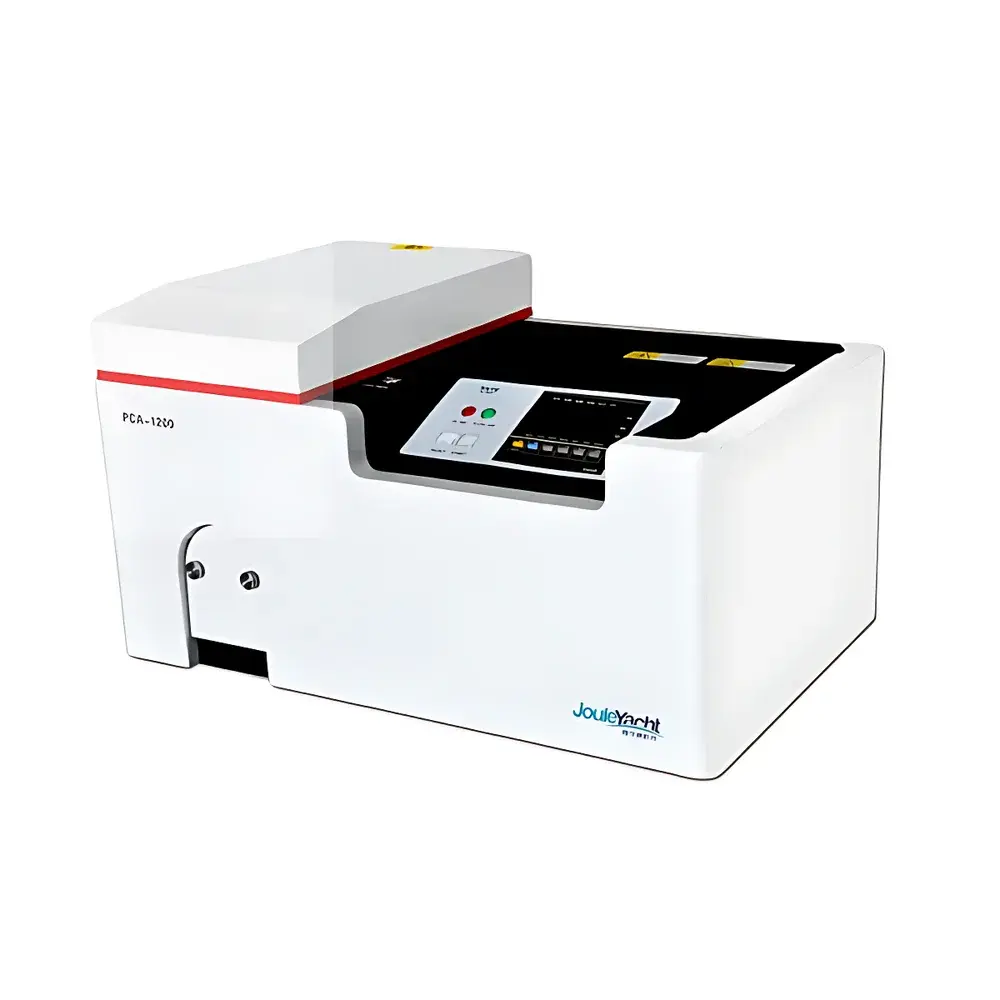
Aiyao PCA Phase Transition Temperature Analyzer
| Brand | Aiyao Instruments |
|---|---|
| Origin | Hubei, China |
| Manufacturer Type | Authorized Distributor |
| Country of Origin | China |
| Model | PCA |
| Pricing | Available Upon Request |
Overview
The Aiyao PCA Phase Transition Temperature Analyzer is a precision thermal-optical instrument engineered for the non-destructive determination of phase transition temperatures—including melting, crystallization, softening, and solid-solid transitions—in both bulk and thin-film materials. It operates on the well-established principle that optical reflectance (specifically, reflected laser power) exhibits abrupt, reproducible changes at critical phase boundaries due to alterations in electronic structure, surface morphology, and dielectric function. By integrating a stabilized collimated laser source, high-resolution temperature-controlled stage, and real-time photodetector array, the PCA captures reflectance-temperature profiles with sub-degree thermal resolution under programmable heating/cooling ramps (typically 0.1–10 °C/min). This methodology aligns with fundamental thermodynamic characterization frameworks used in materials science research and quality control laboratories, offering a complementary alternative to differential scanning calorimetry (DSC) where sample mass limitations, encapsulation constraints, or surface-sensitive transitions are concerns.
Key Features
- Non-contact, non-destructive optical detection: Preserves sample integrity for subsequent analysis or reuse.
- Dual-sample capability: Optimized for both free-standing bulk specimens (e.g., metal alloys, polymer pellets, ceramic compacts) and substrate-supported thin films (e.g., GeSbTe, VO₂, organic semiconductors, oxide heterostructures) ranging from 5 nm to several micrometers in thickness.
- Patented optical path design: Minimizes stray light interference and thermal drift effects; includes automatic beam alignment verification and real-time power normalization.
- High-stability temperature control: PID-regulated heating stage with ±0.3 °C accuracy over 25–600 °C range (optional extended range up to 800 °C); compatible with inert or reactive atmospheres via sealed chamber configuration.
- User-intuitive sample loading mechanism: Modular sample holder accommodates standard microscope slides, silicon wafers (up to 4″), and custom substrates; enables rapid exchange without recalibration.
Sample Compatibility & Compliance
The PCA supports a broad spectrum of inorganic, organic, and hybrid materials—including chalcogenide glasses, shape-memory alloys, ferroelectric thin films, thermochromic polymers, and phase-change memory (PCM) candidates. Its measurement protocol is consistent with ASTM E2070 (Standard Practice for Determining Phase Transitions by Optical Methods) and ISO 11357-6 (Plastics—Differential Scanning Calorimetry—Part 6: Determination of Crystallization Kinetics). While not a regulated medical device, its data output format and audit trail capabilities (via optional software module) support GLP-compliant documentation requirements. Instrument calibration traceability is maintained against NIST-traceable temperature standards and certified reference materials (e.g., indium, zinc, and bismuth standards for melting point validation).
Software & Data Management
The PCA is operated via Aiyao’s proprietary PCAControl™ software (Windows-based), which provides full instrument control, real-time curve visualization, multi-segment ramp programming, and automated baseline correction. Raw reflectance vs. temperature datasets are exported in CSV and HDF5 formats for post-processing in MATLAB, Python (NumPy/Pandas), or OriginLab. The software includes built-in algorithms for derivative analysis (dR/dT), onset/peak/midpoint temperature extraction per ASTM E2070 Annex A1, and comparative overlay of multiple runs. Optional 21 CFR Part 11 compliance package adds electronic signature support, user role management, and immutable audit logs for regulated environments.
Applications
- Crystallization kinetics modeling of amorphous thin films used in PCM devices.
- Size-dependent melting point depression studies in nanoscale metallic or semiconductor thin films.
- Thermal stability assessment of organic photovoltaic active layers under controlled atmosphere.
- Softening temperature mapping of thermoplastic polymer coatings during thermal cycling.
- Validation of DSC-derived transition temperatures where small sample mass (<1 mg) or substrate interference limits conventional calorimetry.
- Process development support for physical vapor deposition (PVD) and atomic layer deposition (ALD) of functional oxides.
FAQ
What types of phase transitions can the PCA detect?
The PCA detects first-order transitions (e.g., melting, solidification, solid-state polymorphic transitions) and certain second-order transitions (e.g., glass transition onset in highly reflective systems) via discontinuities or inflection points in the reflectance-temperature curve.
Is vacuum or controlled-atmosphere operation supported?
Yes—optional quartz-glass chamber with gas inlet/outlet ports enables measurements under nitrogen, argon, oxygen, or forming gas environments, critical for oxidation-sensitive materials.
Can the PCA be integrated into an automated materials screening platform?
The instrument supports TCP/IP and RS-232 communication protocols; API documentation and LabVIEW drivers are available for OEM integration and high-throughput workflows.
Does the system require routine optical recalibration?
No—patented self-referencing optical design ensures long-term signal stability; annual verification using certified reference materials is recommended for metrological traceability.



