
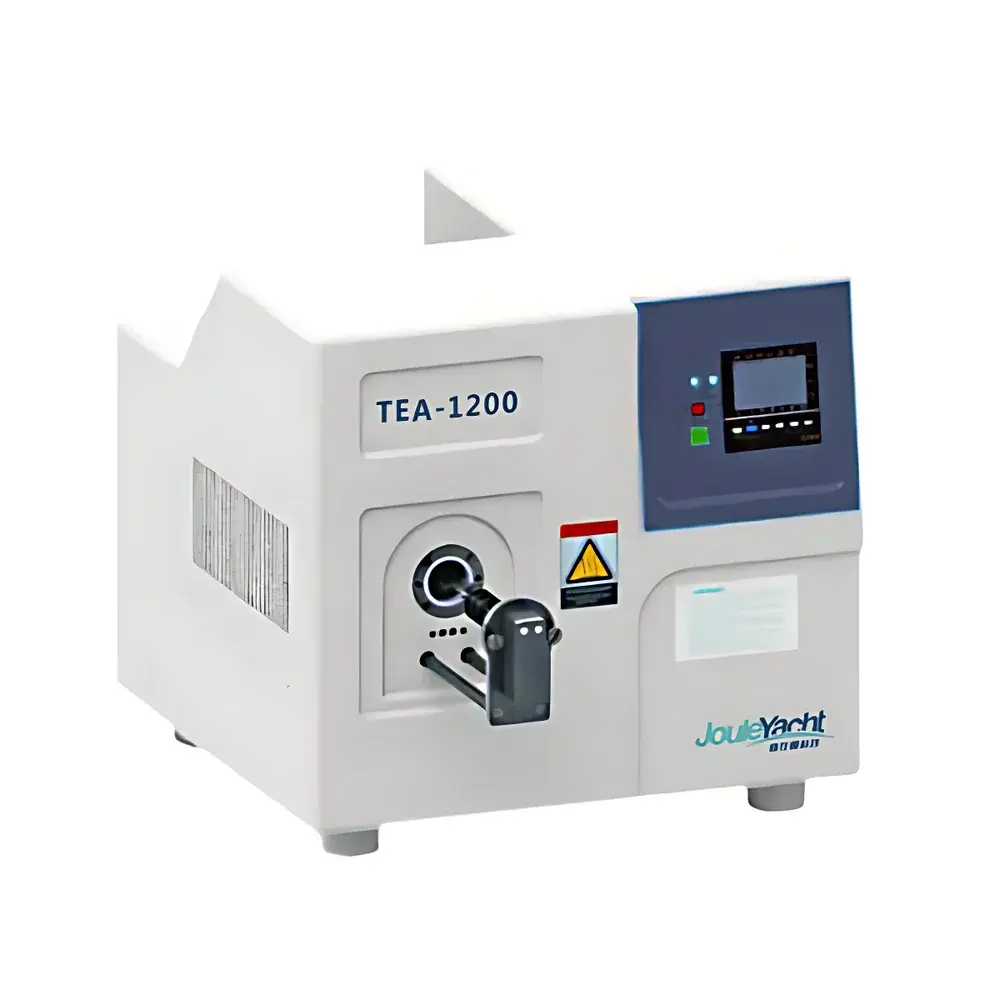
Aiyao TEA Thermal Dilatometer
| Brand | Aiyao Instruments |
|---|---|
| Model | TEA |
| Measurement Principle | Optical Interferometry |
| Sample Type | Transparent Bulk & Thin-Film Materials |
| Heating Method | IR Heater with PID + Fuzzy Logic Control |
| Temperature Control Mode | Programmable Ramp & Isothermal Hold |
| Vacuum Port | Yes |
| Cooling Interface | Water-Cooled Heat Exchanger & Optional Cryogenic/Gas Purge Connection |
| Origin | Hubei, China |
| Distributor Type | Authorized Domestic Distributor |
| Compliance | Designed for ISO 11359-2 and ASTM E228 Conformance Context |
Overview
The Aiyao TEA Thermal Dilatometer is a precision optical dilatometric instrument engineered for the non-contact, high-resolution measurement of linear thermal expansion coefficients (CTE) in transparent solid materials. Unlike conventional push-rod or capacitance-based dilatometers, the TEA employs a patented optical interferometry method—where collimated laser light reflects from both the top and bottom surfaces of a sample, generating an interference pattern whose phase shift is directly correlated to dimensional change as a function of temperature. This principle enables sub-micrometer displacement resolution without mechanical contact, eliminating probe-induced stress, thermal lag, or surface damage—critical for fragile thin films, optical coatings, and brittle ceramic substrates. The system operates across a wide, programmable temperature range using an infrared heating module integrated with dual-mode thermal control (PID feedback combined with fuzzy logic optimization), ensuring stable ramp rates (0.1–20 °C/min), precise isothermal dwell (< ±0.05 °C stability over 30 min), and reproducible thermal histories required for comparative CTE profiling.
Key Features
- Optical interferometric detection with nanometer-level displacement sensitivity—no physical contact with sample surface
- IR heating assembly with closed-loop PID + fuzzy logic control for dynamic thermal response and minimal overshoot
- Programmable temperature profiles: multi-segment ramps, holds, and cooling cycles under inert gas, vacuum, or cryogenic environments
- Dual-interface thermal management: integrated water-cooled heat exchanger for rapid cooldown; optional gas purge (N₂, Ar) or liquid nitrogen cryo-jacketing
- Modular vacuum compatibility: direct flange connection to standard turbomolecular pump systems (≤10⁻⁴ mbar operational base pressure)
- Sample stage accommodates discs up to Ø25 mm × 5 mm thick and freestanding films ≥50 nm thickness on transparent substrates
Sample Compatibility & Compliance
The TEA is optimized for optically transparent or semi-transparent materials including fused silica, sapphire, BK7 glass, polymer films (e.g., PET, PI), perovskite thin-film stacks, and oxide dielectrics used in microelectronics and photonic devices. Its non-destructive methodology satisfies requirements for pre- and post-process characterization in R&D and production QA workflows. From a regulatory standpoint, the instrument’s data acquisition architecture supports audit-ready operation: timestamped raw interferogram logs, calibrated temperature traceability to NIST-traceable Pt100 sensors, and user-accessible calibration certificates aligned with ISO/IEC 17025 laboratory accreditation frameworks. While not certified as GMP-compliant hardware, its design facilitates integration into GLP-compliant environments through configurable electronic signatures, operator access levels, and 21 CFR Part 11–ready software modules (available via optional firmware upgrade).
Software & Data Management
The TEA is operated via Aiyao’s DilatSoft™ v3.x platform—a Windows-based application supporting real-time interferogram visualization, automated fringe counting, and CTE derivation using first-order linear regression (α = (1/L₀)(dL/dT)) over user-defined temperature intervals. All raw data (interference intensity vs. time/temperature) are saved in HDF5 format with embedded metadata (sample ID, operator, ambient conditions, calibration parameters). Export options include CSV, MATLAB .mat, and PDF reports compliant with internal QA templates. Batch processing tools allow parallel analysis of multiple runs; trend comparison overlays support material lot-to-lot consistency verification. Software updates are delivered via secure HTTPS portal with version-controlled changelogs and validation documentation.
Applications
- Thin-film CTE matching for stress minimization in multilayer optical coatings and MEMS packaging
- Thermal budget validation of low-k dielectrics during semiconductor backend-of-line (BEOL) processing
- High-temperature coefficient screening of transparent conductive oxides (e.g., ITO, AZO) for flexible display substrates
- Quality control of fused quartz crucibles used in single-crystal growth furnaces
- Fundamental studies of anomalous thermal expansion in negative-expansion materials (e.g., ZrW₂O₈ composites)
- Validation of thermo-mechanical models in finite element analysis (FEA) of optoelectronic assemblies
FAQ
What types of samples can be measured with the TEA?
Transparent or semi-transparent bulk solids (e.g., glasses, crystals) and thin films deposited on transparent substrates—minimum optical path length ≥10 µm, surface roughness < λ/10 (633 nm).
Is vacuum operation mandatory for all measurements?
No. Vacuum is optional and recommended only for high-temperature (>600 °C) or oxidation-sensitive measurements; ambient air, inert gas purge, or controlled humidity environments are fully supported.
Can the TEA measure anisotropic CTE?
Not natively. The current configuration provides average linear CTE along the optical axis. In-plane anisotropy requires rotation-stage integration, available as a custom OEM option.
How is temperature calibrated and verified?
Each unit ships with factory calibration against a reference Invar standard traceable to NIST SRM 732; users may perform in-situ verification using a secondary Pt100 sensor placed adjacent to the sample stage.
Does the system support automated reporting for ISO/ASTM compliance?
Yes. DilatSoft™ includes report templates pre-formatted to align with key clauses of ISO 11359-2 and ASTM E228, including uncertainty estimation per GUM (Guide to the Expression of Uncertainty in Measurement).



