
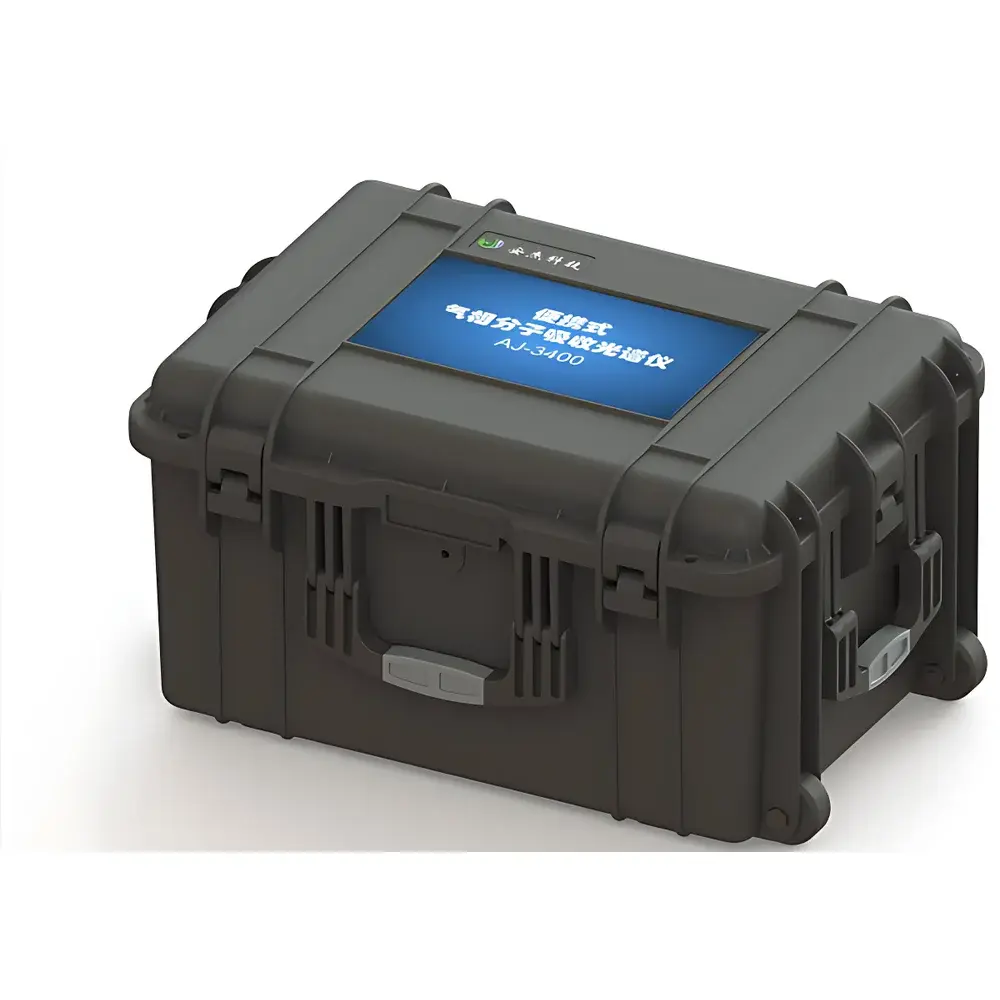
AJ-3400 Series Portable Gas Phase Molecular Absorption Spectrometer
| Brand | ANJIE |
|---|---|
| Origin | Shanghai, China |
| Model | AJ-3400 Series |
| Detector Type | Photomultiplier Tube (PMT) |
| Wavelength Accuracy | ±0.2 nm |
| Wavelength Repeatability | 0.1 nm |
Overview
The AJ-3400 Series Portable Gas Phase Molecular Absorption Spectrometer is an engineered field-deployable analytical instrument designed for quantitative determination of volatile molecular species—primarily sulfide (S²⁻), nitrite (NO₂⁻), ammonium (NH₄⁺), and total cyanide—in aqueous matrices. It operates on the principle of gas-phase molecular absorption spectroscopy (GPMAS): analytes are chemically converted in solution to gaseous molecular forms (e.g., H₂S from sulfide under acidic conditions), swept by a carrier gas into an optical absorption cell, and quantified via Beer–Lambert law-based absorbance measurement at characteristic UV–Vis wavelengths. Unlike conventional benchtop spectrometers, the AJ-3400 integrates all critical subsystems—including reagent delivery, gas generation, phase separation, optical path, and PMT detection—into a ruggedized, shock-absorbing chassis with IP54-rated enclosure, enabling reliable operation under ambient temperature fluctuations (5–40 °C), humidity up to 85% RH (non-condensing), and vibration conditions typical of vehicle-mounted or handheld field use.
Key Features
- Onboard electrochemical gas generator eliminates dependency on compressed gas cylinders—reducing logistical burden and safety hazards during transport and deployment.
- Modular DC power architecture supports direct integration with portable lithium-ion power stations (12–24 V input), enabling >8 hours of continuous operation without grid connection.
- Stabilized single-source optical design minimizes thermal drift and alignment sensitivity; optical path length is fixed at 100 mm with fused-silica flow-through absorption cell.
- Wavelength selection includes primary and secondary absorption bands (e.g., 202.6 nm and 204.4 nm for H₂S), allowing optimization of dynamic range and interference mitigation without hardware modification.
- Programmable purge-stirring module enables active homogenization of heterogeneous or settling-prone samples (e.g., wastewater slurry, sediment pore water) immediately prior to gas evolution—improving sampling representativeness and reproducibility.
- Embedded microcontroller with real-time diagnostics monitors gas flow rate (±2% FS), lamp intensity stability (<0.5% RSD over 1 h), and detector dark current—flagging deviations beyond ISO/IEC 17025-defined control limits.
Sample Compatibility & Compliance
The AJ-3400 accepts liquid samples ranging from 0.5 to 20 mL volume, including raw surface water, treated effluent, groundwater, and digested sludge extracts. It complies with ASTM D4129–22 (Standard Test Method for Sulfide in Water by Gas-Phase Molecular Absorption Spectrometry) and aligns with EPA Method 376.1 (Determination of Total Cyanide by Gas-Phase Molecular Absorption Spectrometry). All wetted components contact only PTFE, FEP, or quartz—ensuring chemical inertness against strong acids (HCl, H₃PO₄), oxidants (KMnO₄), and chelating agents (EDTA). Instrument firmware supports audit-trail logging per FDA 21 CFR Part 11 requirements when paired with compliant data acquisition software, and calibration records adhere to GLP documentation standards for environmental monitoring laboratories.
Software & Data Management
The system interfaces via USB-C or Bluetooth 5.0 to the proprietary ANJIE GPMAS Control Suite (v3.2+), a Windows-based application supporting method setup, sequence programming, real-time spectral visualization, and QC charting (Levey-Jennings, moving range). Raw absorbance data (16-bit ADC resolution), timestamped with GPS coordinates (when external GNSS module is connected), are stored in vendor-neutral CSV and XML formats. The software enforces calibration verification at user-defined intervals (e.g., every 10 samples or 60 min), automatically rejecting results outside ±5% of initial calibration slope unless manually overridden with electronic signature and justification. Data export modules include direct integration with LIMS platforms via HL7 v2.5 or ASTM E1384-compliant structured output.
Applications
- Rapid on-site screening of hydrogen sulfide in municipal wastewater influent during odor complaint investigations.
- Emergency response monitoring of cyanide contamination following industrial spill events in riverine systems.
- Mobile laboratory analysis of ammonium nitrogen in agricultural runoff across watershed-scale field campaigns.
- Regulatory compliance testing for nitrite in drinking water distribution networks—performed directly at valve pits or hydrant outlets.
- Research-grade speciation studies requiring spatially resolved sulfur redox profiling in constructed wetlands or sediment cores.
FAQ
Does the AJ-3400 require external calibration gases or certified reference standards for daily operation?
No—calibration is performed using aqueous standard solutions traceable to NIST SRM 3133 (sulfide) and SRM 2681b (cyanide); no certified gas mixtures are required.
Can the instrument quantify multiple analytes sequentially within a single sample injection?
Yes—method sequences can be programmed to perform sulfide → nitrite → ammonium analysis on one 10-mL aliquot with automated reagent switching and wavelength reconfiguration.
What maintenance intervals are recommended for field deployments exceeding 100 hours/month?
Optical window cleaning every 200 analyses; PMT high-voltage supply recalibration every 6 months; gas generator electrolyte replacement every 12 months or 500 operating hours, whichever occurs first.
Is remote firmware update supported over cellular networks?
Yes—via optional LTE-enabled gateway module (ANJIE-GW-LTE), with SHA-256 signed update packages and rollback capability.
How is carryover addressed for high-concentration samples (e.g., >5 mg/L sulfide)?
The system implements a three-stage rinse protocol: post-analysis acid flush, carrier gas purge (30 s), and blank water aspiration—validated to reduce carryover to <0.8% of previous high standard.






