
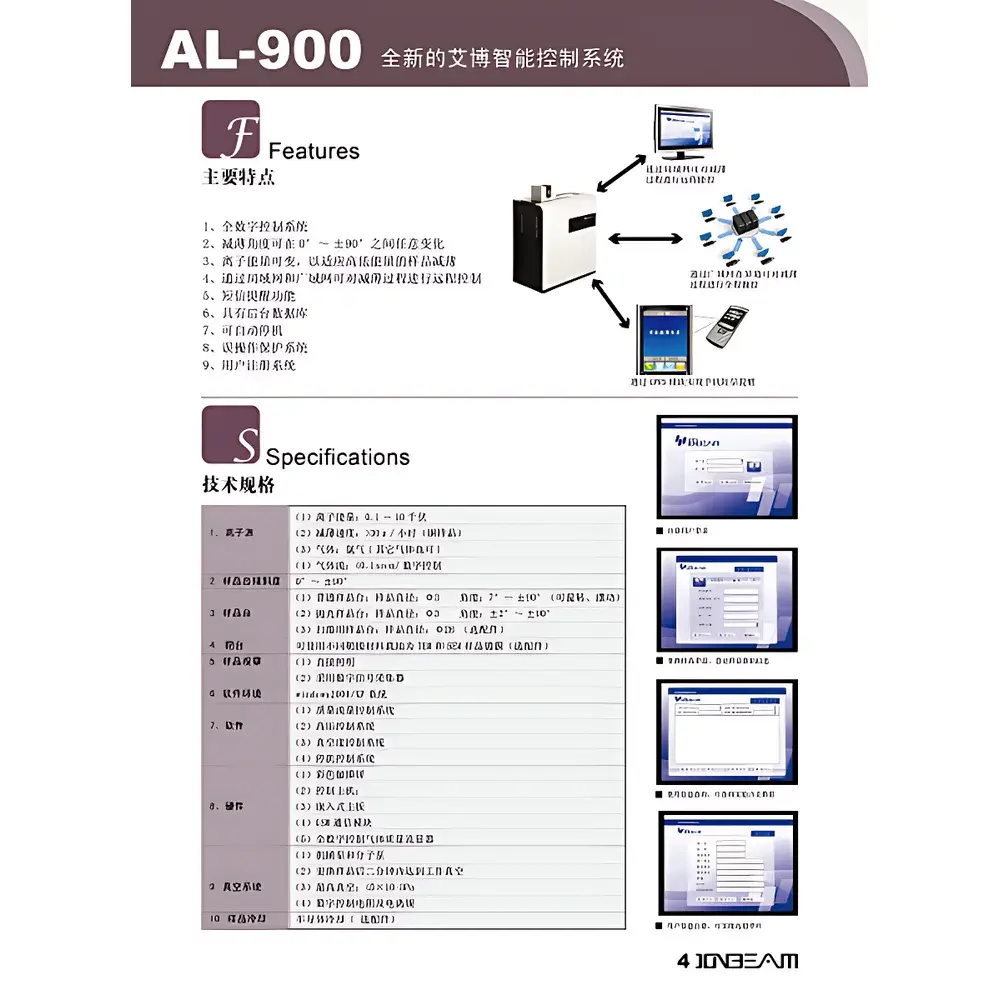
AL-900 Ion Beam Milling System by Aibo
| Brand | Aibo |
|---|---|
| Origin | Beijing, China |
| Manufacturer Type | Direct Manufacturer |
| Country of Origin | China |
| Model | AL-900 |
| Pricing | Available Upon Request |
Overview
The AL-900 Ion Beam Milling System is a high-precision, dual-beam argon ion milling instrument engineered for the preparation of electron-transparent thin sections from bulk solid samples. Designed specifically for transmission electron microscopy (TEM) and scanning transmission electron microscopy (STEM), the AL-900 employs broad-beam, low-energy argon ion sputtering to achieve artifact-free, uniform thinning with minimal surface damage or amorphization. Unlike focused ion beam (FIB) systems that rely on gallium ions and induce implantation and redeposition, the AL-900 utilizes neutralized, collimated Ar⁺ beams operating in the 1–8 keV range, enabling controlled material removal via physical sputtering while preserving crystallographic integrity. Its vacuum architecture integrates a turbo-molecular pumping system achieving base pressures <5×10⁻⁶ Pa, ensuring stable beam conditions and preventing hydrocarbon contamination during extended milling cycles.
Key Features
- Dual independent ion guns with adjustable incident angles (±10° to ±45°), enabling symmetric or asymmetric thinning for optimal electron transparency and reduced curtaining effects.
- Integrated liquid nitrogen-cooled specimen stage (−120 °C to +60 °C) to suppress beam-induced diffusion and thermal damage in temperature-sensitive materials including polymers, biological composites, and battery electrode layers.
- Real-time monitoring via integrated high-resolution CCD camera and optical alignment viewport, supporting precise positioning of regions-of-interest prior to and during milling.
- Automated beam current and voltage regulation with closed-loop feedback control, maintaining consistent sputter rates across heterogeneous samples such as metal-ceramic multilayers or geological inclusions.
- Modular chamber design compliant with ISO 14644-1 Class 5 cleanroom integration requirements; optional load-lock configuration available for high-throughput laboratories.
Sample Compatibility & Compliance
The AL-900 accommodates standard 3 mm TEM grids, cross-sectioned wafer pieces up to 15 mm × 15 mm, and bulk specimens up to 10 mm in height. It supports conductive, semi-conductive, and insulating materials—including oxides, nitrides, carbides, metallic alloys, geological minerals, and soft organic phases—without requiring conductive coating. All operational parameters are logged with timestamped metadata, supporting audit-ready documentation per GLP and ISO/IEC 17025 laboratory accreditation requirements. The system meets CE safety directives (2014/30/EU EMC, 2014/35/EU LVD) and incorporates interlocked vacuum door mechanisms and radiation shielding per IEC 61000-6-3 emission standards.
Software & Data Management
Controlled via Aibo’s proprietary IonBeam Control Suite v3.2, the AL-900 provides intuitive graphical interface navigation, recipe-based protocol storage, and multi-user access management with role-based permissions. All milling logs—including beam energy, current, angle, duration, vacuum status, and stage temperature—are exported in CSV and XML formats compatible with LIMS integration. Audit trail functionality records operator ID, parameter modifications, and system events in accordance with FDA 21 CFR Part 11 requirements for electronic records and signatures. Remote diagnostics and firmware updates are supported over secure TLS 1.2 encrypted connections.
Applications
- Preparation of site-specific TEM lamellae from semiconductor devices, MEMS structures, and advanced packaging interconnects.
- Thin-sectioning of brittle ceramics and refractory metals where mechanical polishing induces microcracking or phase transformation.
- Interface analysis in solid-state battery cathodes/anodes, revealing SEI layer morphology and intergranular degradation without electrochemical bias artifacts.
- Geological thin sectioning for high-resolution EDS mapping of trace element partitioning in zircon and monazite inclusions.
- Biomineralized tissue studies, including bone-implant interfaces and calcified cartilage, where cryo-milling preserves native hydration states.
FAQ
What vacuum level does the AL-900 achieve, and how is it maintained?
The system achieves a base pressure of ≤5×10⁻⁶ Pa using a two-stage vacuum architecture: a dry scroll pump for roughing and a 1200 L/s turbo-molecular pump backed by a diaphragm forepump.
Can the AL-900 be used for FIB-SEM correlative workflows?
Yes—the sample holder is compatible with standard SEM stubs and features fiducial markers for coordinate registration between ion milling and subsequent SEM/FIB imaging.
Is cryo-milling capability standard or optional?
Liquid nitrogen cooling is standard equipment; the stage includes integrated temperature sensors and PID-controlled thermal regulation.
Does the system support automated endpoint detection?
While real-time TEM visibility is not built-in, the AL-900 supports optical endpoint estimation via transmitted light intensity monitoring, with optional integration of in-situ electron diffraction detectors (add-on module).
What maintenance intervals are recommended for ion gun components?
Ion source filaments and extraction electrodes are rated for ≥1,500 hours of operation; preventive maintenance is scheduled every 500 hours or per vacuum integrity verification per ISO 13320 guidelines.



