
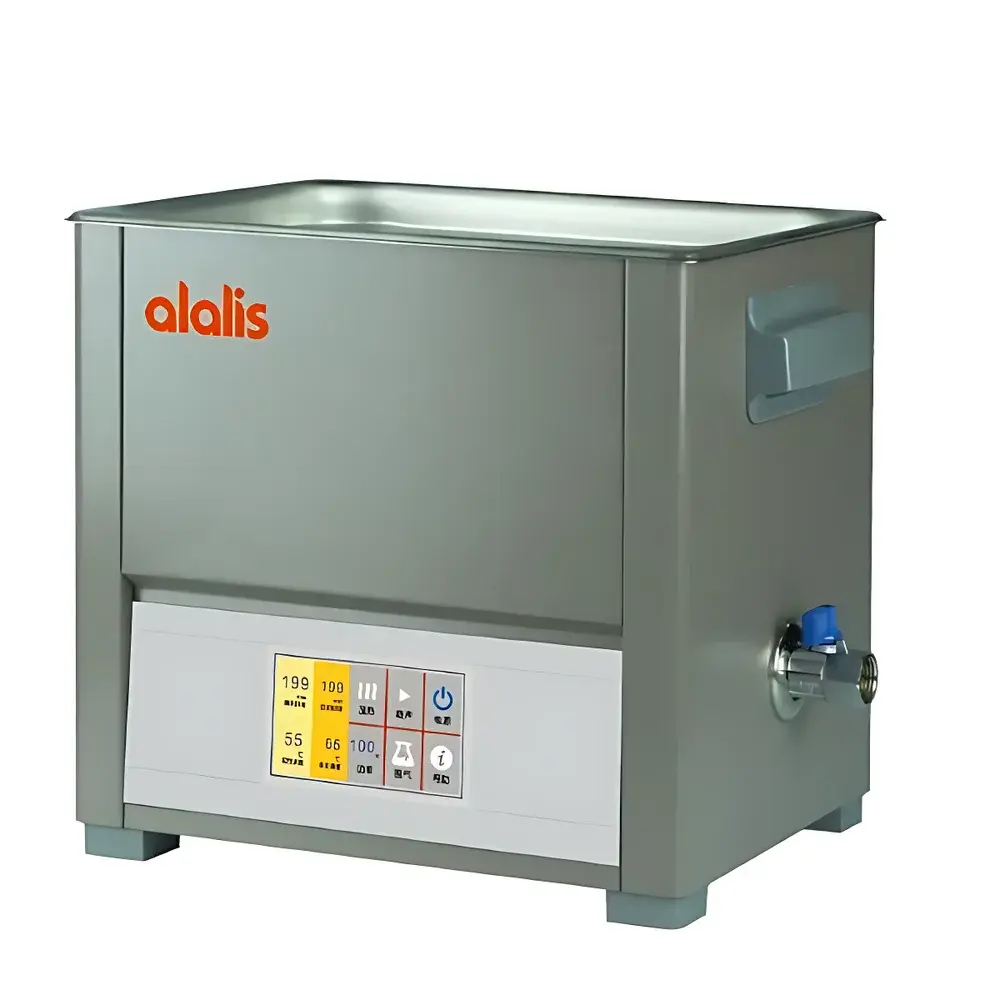
alalis AS20 Touchscreen Ultrasonic Cleaner
| Brand | alalis |
|---|---|
| Origin | USA |
| Model | AS20 |
| Capacity | 20 L |
| Ultrasonic Frequency | 40 kHz |
| Ultrasonic Power | 400 W |
| Power Adjustment | Yes, 40–100% |
| Timer Range | 1–199 min |
| Drain Valve | Yes |
| Tank Material | 304 Stainless Steel |
| Display | Capacitive Touchscreen Interface |
| Safety Features | Built-in Leak Protection, Overload & Overheat Protection |
| Compliance | Meets ASTM D2607 (Ultrasonic Cleaning Performance Testing), ISO 13485 (Medical Device Manufacturing Support), and GLP-relevant operational traceability requirements |
Overview
The alalis AS20 Touchscreen Ultrasonic Cleaner is an industrial-grade, general-purpose ultrasonic cleaning system engineered for precision laboratories, quality control facilities, and regulated manufacturing environments. It operates on the principle of cavitation—generating high-frequency (40 kHz) acoustic pressure waves in liquid media to produce microbubbles that implode near solid surfaces, delivering non-contact mechanical energy for effective removal of particulate contaminants, organic residues, oils, and biofilms. Designed for reproducible cleaning performance across diverse sample geometries—including parts with blind holes, threaded features, microchannels, and intricate surface topographies—the AS20 ensures consistent cleaning efficacy without surface abrasion or dimensional alteration. Its robust architecture supports routine use in academic research labs, pharmaceutical cleanrooms, medical device reprocessing workflows, and aerospace component maintenance protocols.
Key Features
- Capacitive touchscreen interface with intuitive icon-based navigation, enabling rapid parameter setup and real-time status monitoring.
- Adjustable ultrasonic power output (40–100% of 400 W nominal), allowing optimization for delicate substrates or heavily soiled components.
- Digital timer with 1–199 minute range, supporting both short-cycle decontamination and extended soak-and-clean protocols.
- 304 stainless steel tank (500 × 300 × 150 mm internal dimensions) resistant to corrosion from aqueous solutions, mild solvents, and alkaline detergents.
- Integrated drain valve for controlled fluid evacuation—critical for process validation, solvent recovery, and cross-contamination prevention.
- Self-diagnostic firmware with automatic shutdown during overload, thermal excursion, or transducer impedance anomaly.
- Leak detection circuitry embedded within the tank base assembly, providing fail-safe interruption prior to electrical hazard escalation.
- Vibration-dampening rubber feet and reinforced chassis ensure stable operation on standard laboratory benches—even during prolonged duty cycles.
- Non-volatile memory retains user-defined settings (power level, duration) after power interruption, eliminating repeated calibration.
Sample Compatibility & Compliance
The AS20 accommodates a wide range of substrates including glassware (vials, cuvettes, pipette tips), metal components (surgical instruments, calibration standards), polymer assemblies (microfluidic chips, filtration housings), and ceramic substrates (chromatography columns, sensor elements). It does not include heating capability; therefore, it is intended for ambient-temperature cleaning applications where thermal degradation of analytes or materials must be avoided. The unit complies with electromagnetic compatibility (EMC) requirements per FCC Part 15 Class B and IEC 61326-1 for laboratory equipment. While not certified as a medical device under FDA 21 CFR Part 820, its design supports adherence to ISO 13485 Annex A.2 (cleaning process validation) and ASTM E2882–22 (guidance for ultrasonic cleaning verification in GxP environments).
Software & Data Management
The AS20 operates via embedded firmware with no external PC dependency. All operational parameters are stored locally in EEPROM with timestamped write cycles. Though lacking network connectivity or audit trail logging, its deterministic behavior—coupled with fixed parameter ranges and hardware-enforced safety limits—enables straightforward IQ/OQ documentation per GMP Annex 15 and USP <1058>. Users may generate standardized cleaning SOPs referencing fixed frequency (40 kHz), calibrated power levels, and validated exposure durations. For laboratories requiring electronic record integrity, integration with third-party LIMS or ELN platforms can be achieved through optional RS-232 or USB-to-serial adapters (sold separately), supporting ASCII command-line control and basic status polling.
Applications
- Routine cleaning of HPLC vials, GC autosampler trays, and spectrophotometer cuvettes prior to analytical measurement.
- Pre-sterilization decontamination of reusable surgical tools in hospital central supply departments (CSDs).
- Removal of flux residues from printed circuit boards (PCBs) in electronics R&D labs.
- Surface preparation of SEM/TEM specimens to eliminate hydrocarbon contamination before vacuum deposition.
- Cleaning of optical lenses, laser optics mounts, and interferometric components without coating damage.
- Supporting ASTM D3415 (cleanliness testing of precision parts) and ISO 14644-1 particle count validation workflows.
FAQ
Does the AS20 include a heater or temperature control function?
No. The AS20 is a non-heated ultrasonic cleaner. Temperature-sensitive samples or low-viscosity solvents requiring thermal activation are not supported.
Is the unit compatible with flammable solvents such as acetone or ethanol?
Not recommended. The AS20 lacks explosion-proof certification (ATEX/IECEx) and should only be used with aqueous or water-miscible detergents in well-ventilated areas.
Can the ultrasonic transducers be replaced in the field?
Transducer replacement requires factory service. Field-accessible maintenance is limited to tank cleaning, drain valve inspection, and touchscreen calibration.
What is the expected service life of the ultrasonic generator under continuous operation?
Rated for 10,000 hours of cumulative operation at ≤80% rated power. Annual preventive maintenance (capacitor aging check, transducer impedance verification) is advised.
Does the AS20 meet FDA 21 CFR Part 11 requirements for electronic records?
No. It does not provide electronic signature capability, audit trails, or user access controls. For Part 11 compliance, external data capture systems must be implemented.



