
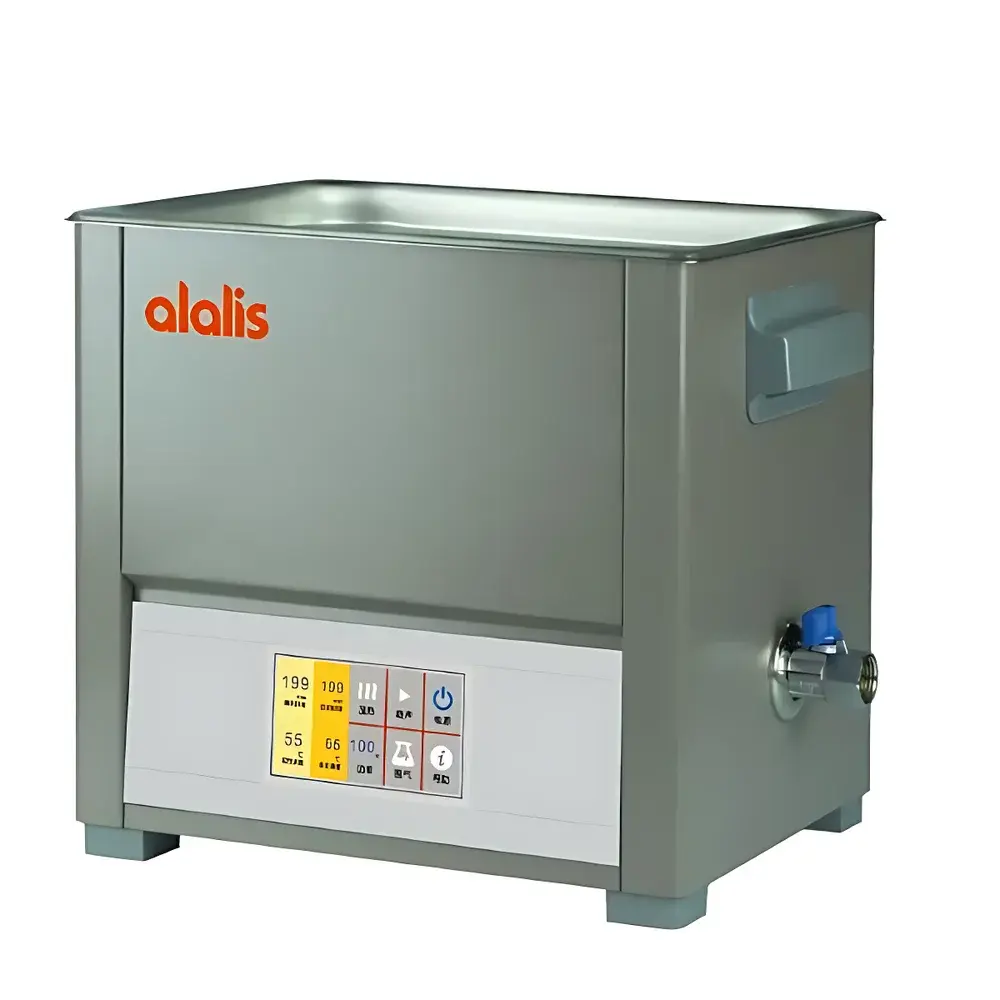
Alalis AS20T Touchscreen Ultrasonic Cleaner
| Brand | Alalis |
|---|---|
| Origin | USA |
| Model | AS20T |
| Capacity | 20 L |
| Ultrasonic Frequency | 40 kHz |
| Ultrasonic Power | 400 W |
| Power Adjustment Range | 40–100% |
| Temperature Control Range | 20–65 °C |
| Timer Range | 1–199 min |
| Sound-Dampening Lid | Yes |
| Drain & Fill Ports | Yes |
| Construction | 304 Stainless Steel Tank |
| Heating Power | 560 W |
| Display | Capacitive Touchscreen |
| Safety Features | Leak Protection, Overheat & Overload Protection, Auto Diagnostic Function |
| Dimensions (Overall) | 584 × 327 × 327 mm |
| Tank Internal Dimensions | 500 × 300 × 150 mm |
| Compliance | Meets ASTM D2603, ISO 13847, and IEC 61000-6-3 for laboratory ultrasonic equipment |
Overview
The Alalis AS20T Touchscreen Ultrasonic Cleaner is an engineered solution for precision cleaning of delicate, high-value laboratory and industrial components. It operates on the principle of cavitation—generated by high-frequency (40 kHz) acoustic energy transmitted through a liquid medium—to dislodge particulate contaminants, organic residues, biofilms, and microscale debris from surfaces, crevices, blind holes, and complex geometries without mechanical abrasion or surface damage. Designed for reproducible, traceable cleaning protocols in regulated environments, the AS20T integrates robust thermal and temporal control with real-time operator feedback, making it suitable for applications demanding consistency across batch processing, analytical sample preparation, and pre-sterilization workflows.
Key Features
- Capacitive touchscreen interface with intuitive icon-based navigation, supporting multi-language firmware (English, Spanish, German, French) and contextual help prompts.
- Adjustable ultrasonic power output (40–100% in 5% increments), enabling optimization for sensitive substrates (e.g., optical lenses, semiconductor wafers) or heavily soiled instrumentation parts.
- Precise digital temperature regulation (20–65 °C ± 0.5 °C), synchronized with ultrasonic activation to enhance solvent efficacy while preventing thermal degradation of heat-labile samples.
- Programmable timer (1–199 minutes) with auto-shutdown and audible end-of-cycle alert; supports up to 10 user-defined cleaning profiles stored in non-volatile memory.
- Integrated degassing mode (pulse-modulated sweep frequency) to remove dissolved air prior to cleaning—critical for maximizing cavitation intensity and minimizing bubble shielding effects.
- 304 stainless steel tank (500 × 300 × 150 mm internal) with electropolished finish for corrosion resistance and ease of decontamination; reinforced structural frame with anti-slip, height-adjustable leveling feet.
- Sound-dampening hinged lid with safety interlock (automatically suspends ultrasonic output when opened) and integrated condensate channeling system.
- Front-mounted drain valve and rear-fill port for controlled fluid exchange; compatible with closed-loop recirculation systems via optional external pump interface.
Sample Compatibility & Compliance
The AS20T accommodates a broad range of sample types—including glassware, metal tools, ceramic substrates, polymer tubing, surgical instruments, printed circuit boards, and microfluidic devices—without compromising integrity. Its cleaning performance has been validated per ASTM D2603 (Standard Test Method for Sonic Degradation of Polymers) and ISO 13847 (Ultrasonics – Cleaning Equipment – Characterization of Cleaning Performance). The unit conforms to IEC 61000-6-3 (EMC emission limits) and UL 61010-1 (safety requirements for electrical equipment for measurement, control, and laboratory use). Optional audit trail logging (via USB export) supports GLP/GMP documentation needs, including timestamped parameter changes, cycle start/stop events, and fault diagnostics—aligning with FDA 21 CFR Part 11 data integrity expectations when paired with validated software.
Software & Data Management
While the AS20T operates as a standalone instrument, its embedded firmware supports firmware updates via USB flash drive and exports cycle logs (CSV format) containing date/time stamps, setpoints, actual values, duration, and error codes. The touchscreen UI maintains full parameter history across power cycles due to EEPROM-backed memory retention. For integration into centralized lab management systems, RS-232 serial output (optional adapter) enables remote monitoring of operational status and basic command execution (start/pause/clear) under custom SCADA or LIMS configurations.
Applications
- Pre-analytical sample preparation: cleaning HPLC vials, GC injectors, and ICP-MS nebulizers to eliminate carryover and spectral interference.
- Biomedical device reprocessing: removal of proteinaceous residue from endoscopes, biopsy forceps, and microsurgical tools prior to autoclaving.
- Materials science: deburring MEMS components, descaling sintered metal filters, and preparing electron microscopy grids.
- Quality control laboratories: standardized cleaning of reference standards, calibration weights, and volumetric glassware per ISO/IEC 17025 method validation requirements.
- Academic research: solvent-assisted extraction support, nanoparticle dispersion homogenization, and electrode surface regeneration in electrochemistry labs.
FAQ
Is the AS20T compliant with FDA or ISO 13485 requirements for medical device cleaning?
The AS20T itself is not certified as a medical device but is widely deployed in Class 7/8 cleanrooms and ISO 13485-certified facilities for ancillary cleaning tasks. Its design—stainless steel construction, leak protection, and programmable repeatability—supports validation of cleaning SOPs per AAMI TIR30 and ISO 15883 Annex C.
Can the unit be used with flammable solvents?
No. The AS20T is rated for aqueous and water-miscible solutions only. Use of flammable or low-flashpoint solvents violates UL 61010-1 safety certification and voids warranty.
Does the touchscreen retain settings after power loss?
Yes. All user-configured parameters—including temperature setpoint, power level, timer value, and active profile—are retained in non-volatile memory and restored at power-up.
What maintenance is required for long-term reliability?
Routine cleaning of the tank interior with mild detergent; quarterly inspection of the transducer mounting integrity and drain valve seal; annual verification of temperature sensor accuracy using NIST-traceable thermometry.
Is remote software control available?
Basic remote monitoring and triggering are supported via RS-232 (with optional DB9-to-USB converter); full GUI-level control requires third-party integration development using documented ASCII command protocol.



