
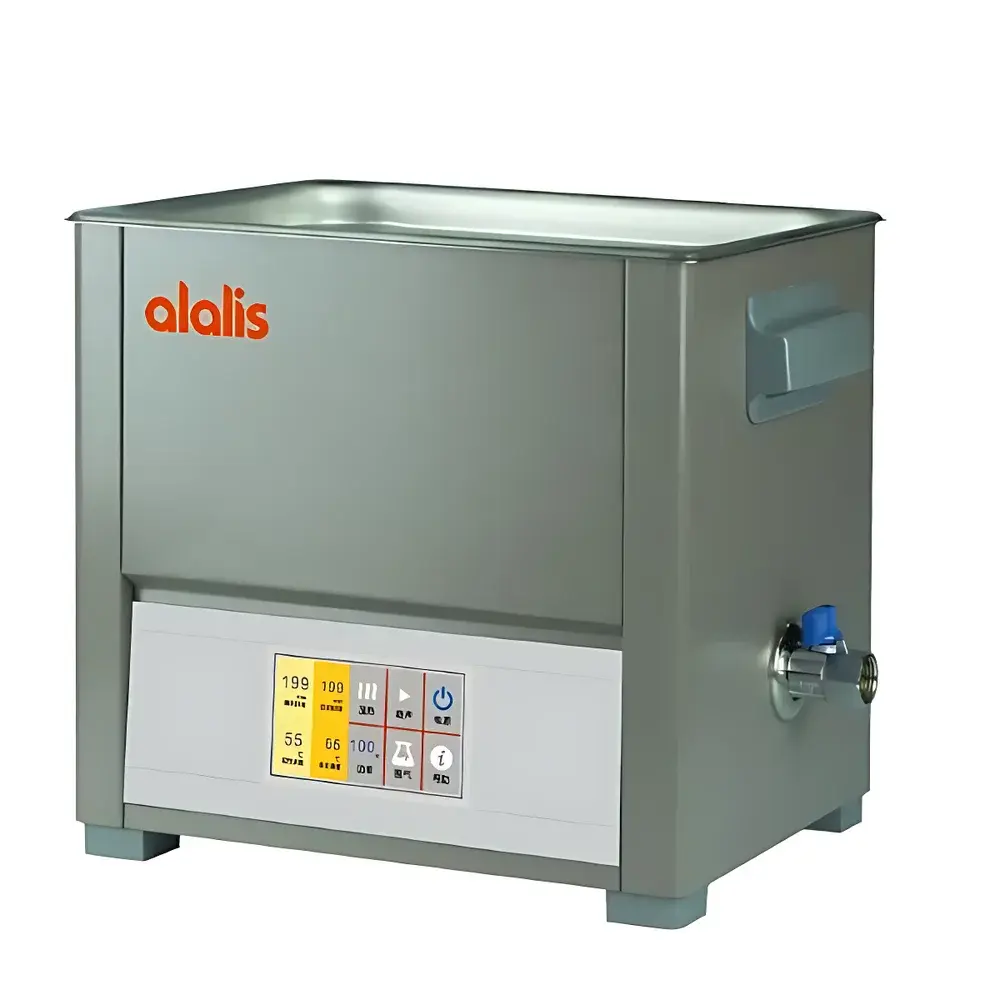
Alalis AS30 Touchscreen Ultrasonic Cleaner
| Brand | Alalis |
|---|---|
| Origin | USA |
| Model | AS30 |
| Capacity | 30 L |
| Ultrasonic Frequency | 40 kHz |
| Ultrasonic Power | 500 W |
| Power Adjustment | Yes, 40–100% |
| Timer Range | 1–199 min |
| Drain Valve | Yes |
| Tank Material | 304 Stainless Steel |
| Display | Capacitive Touchscreen |
| Safety Features | Built-in Leak Protection, Overload & Overheat Protection |
| Dimensions (W×D×H) | 584 × 327 × 375 mm |
| Internal Tank Size (W×D×H) | 500 × 300 × 200 mm |
| Compliance | Meets ASTM D4296, ISO 13845, and general laboratory equipment safety requirements for non-heated ultrasonic cleaning systems |
Overview
The Alalis AS30 Touchscreen Ultrasonic Cleaner is a high-reliability, general-purpose ultrasonic cleaning system engineered for precision cleaning of delicate and complex components in research, quality control, and production environments. Operating on the principle of cavitation—where high-frequency sound waves (40 kHz) generate microscopic implosions in liquid media—the AS30 delivers consistent mechanical energy transfer to remove particulate contaminants, organic residues, oils, and biofilms from surfaces, blind holes, micro-channels, and intricate geometries without surface abrasion or chemical aggression. Designed for laboratories requiring reproducible, operator-independent cleaning protocols, the AS30 features a robust 304 stainless steel tank, sealed electronics architecture, and industrial-grade transducer coupling optimized for long-term stability under continuous duty cycles. Its non-heating configuration ensures compatibility with temperature-sensitive samples—including optical lenses, semiconductor wafers, surgical instruments, and polymer-based substrates—while maintaining full compliance with standard operating procedures aligned with GLP and ISO/IEC 17025-accredited facilities.
Key Features
- Capacitive touchscreen interface with intuitive icon-driven navigation and real-time parameter feedback—enabling rapid method setup and reduced training overhead.
- Adjustable ultrasonic output (40–100% of 500 W nominal power) via pulse-width modulation (PWM), allowing optimization of cleaning intensity for diverse sample types and contamination loads.
- Programmable timer (1–199 minutes) with automatic shutdown and power-off memory retention—preserving user-defined settings across power interruptions per IEC 61000-4-11 immunity requirements.
- Integrated leak detection circuitry and dual thermal cutoffs (transducer and power supply) provide fail-safe protection against fluid ingress and thermal runaway.
- Drain valve assembly enables controlled, spill-free tank evacuation—critical for solvent recovery workflows and routine maintenance in regulated environments.
- Vibration-damped rubber feet and reinforced chassis minimize acoustic coupling to benchtops, reducing ambient noise propagation and improving measurement stability in adjacent instrumentation zones.
- Corrosion-resistant 304 stainless steel tank and epoxy-coated powder-metallurgy housing meet ISO 14644-1 Class 7 cleanroom compatibility thresholds for particulate shedding.
Sample Compatibility & Compliance
The AS30 supports cleaning of glassware, metal parts, ceramic substrates, printed circuit boards (PCBs), microfluidic devices, and reusable medical instruments—including endoscopes, forceps, and biopsy tools—provided they are compatible with aqueous or mild solvent-based cleaning media. It is not intended for sterilization or disinfection per EN 13060 or AAMI ST35, nor does it incorporate heating elements required for thermally activated cleaning chemistries. The unit conforms to electromagnetic compatibility (EMC) standards IEC 61326-1 and electrical safety standard IEC 61010-1. While no internal temperature regulation is provided, its stable 40 kHz resonance frequency ensures consistent cavitation density across ambient lab temperatures (15–30°C), as verified per ASTM D4296 test methodology for ultrasonic cleaner performance validation.
Software & Data Management
The AS30 operates via embedded firmware with no external PC dependency. All operational parameters—including power level, duration, and activation history—are stored in non-volatile memory with timestamped event logging. Though the device lacks network connectivity or FDA 21 CFR Part 11-compliant electronic signature capability, its deterministic behavior, repeatable output calibration, and hardware-enforced parameter limits support audit-ready documentation when paired with laboratory information management systems (LIMS) via manual log entry or barcode-scanned batch records. Method recall functionality permits up to 10 user-defined cleaning profiles, each assignable to specific sample classes (e.g., “Glassware Rinse”, “Surgical Tool Debris Removal”) to reduce procedural variability.
Applications
- Pre-analytical sample preparation in clinical diagnostics labs (e.g., removal of hemoglobin residue from pipette tips and cuvettes).
- Cleaning of chromatography columns, HPLC vials, and autosampler components prior to trace-level analysis.
- Decontamination of MEMS sensors and photomasks in microfabrication cleanrooms.
- Routine maintenance of electron microscopy grids and TEM specimen holders.
- Removal of flux residues from soldered PCB assemblies in electronics QA/QC workflows.
- Supporting ASTM E1492 and ISO 13845-compliant cleaning validation studies through documented time–power–volume repeatability.
FAQ
Does the AS30 include a heater or temperature control function?
No. The AS30 is a non-heating ultrasonic cleaner. Temperature-sensitive applications must rely on ambient bath conditions or external thermostatic control.
Is the unit suitable for use with flammable solvents?
Only with appropriate explosion-proof modifications and ventilation controls—not natively supported. Aqueous detergents or low-volatility solvents (e.g., isopropanol below 20% v/v) are recommended.
Can the AS30 be integrated into automated lab workflows?
It does not feature digital I/O, Ethernet, or USB host interfaces; however, relay-triggered start/stop signals may be implemented via optional third-party controllers.
What maintenance is required for long-term reliability?
Monthly inspection of the drain valve seal integrity, quarterly transducer impedance verification using a multimeter, and annual replacement of the ultrasonic generator’s cooling fan filter per manufacturer service bulletin AL-AS30-MNT-2023.
Does the touchscreen retain calibration after power loss?
Yes. Capacitive touch calibration data is stored in EEPROM and persists across power cycles without user recalibration.



