
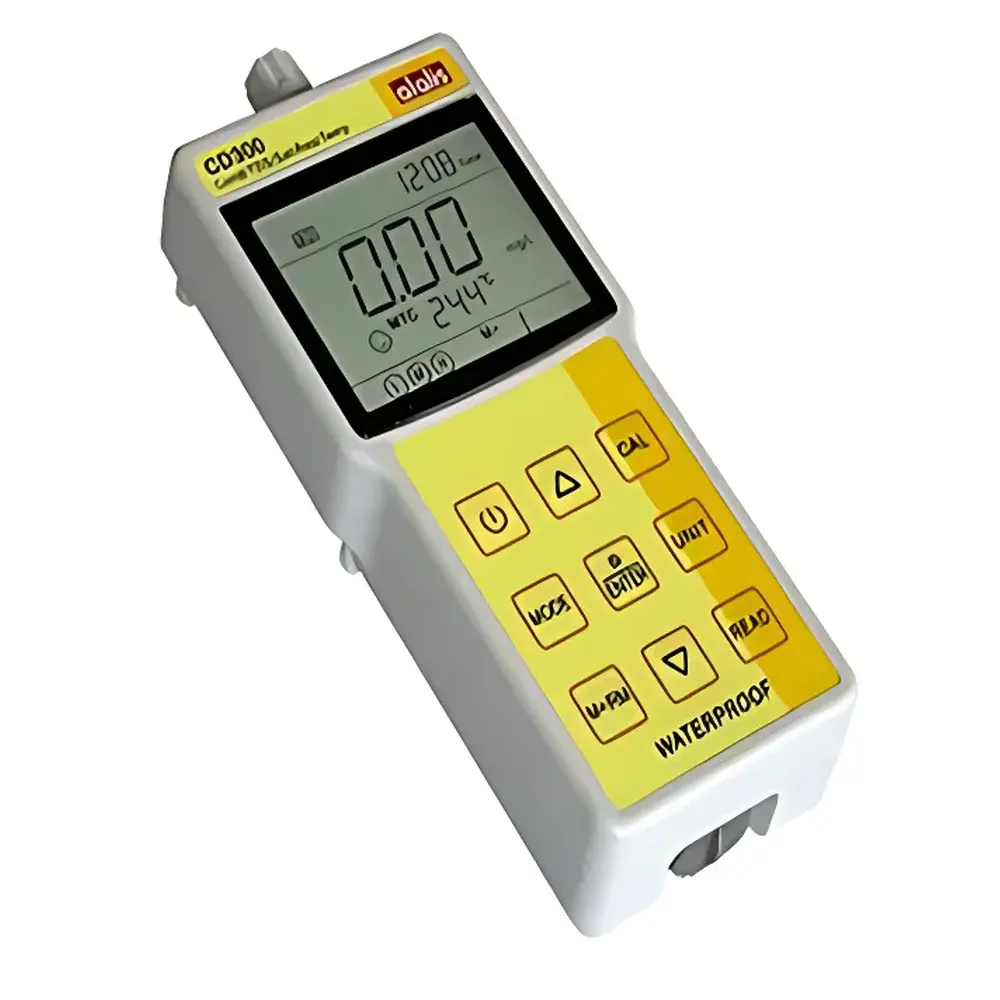
Alalis CD300 Portable Professional Conductivity Meter
| Brand | Alalis |
|---|---|
| Origin | Shanghai, China |
| Model | CD300 Professional |
| Portability | Portable |
| Conductivity Range | 0.00 μS/cm to 200.0 mS/cm (5-range auto-scaling) |
| TDS Range | 0–100 g/L |
| Resistivity Range | 0–100 MΩ·cm |
| Salinity Range | 0–100 ppt |
| Temperature Range | −10 °C to 110 °C |
| Accuracy | ±1.0% FS (conductivity), ±0.5 °C (temperature) |
| Resolution | 0.01 μS/cm (min), 0.1 °C (temperature) |
| IP Rating | IP57 |
| Data Storage | 500 sets (manual & auto) |
| Calibration | 1–4 point, with built-in calibration guidance and validation |
| Temp Compensation | Automatic/manual (0–50.0 °C), nonlinear mode for ultrapure water (<10 μS/cm) |
| Standards Support | 8 preloaded conductivity standards (GB, ASTM D1125, ISO 7888, USP <645>) |
| Interface | USB, GLP-compliant data export |
| Power | Rechargeable battery with low-voltage indicator and auto-off |
Overview
The Alalis CD300 Portable Professional Conductivity Meter is an engineered solution for high-integrity conductivity, TDS, resistivity, and salinity measurements across demanding industrial and regulated laboratory environments. Designed around a four-electrode (ATC) conductivity sensor with selectable cell constant (K = 1.0 cm⁻¹ standard), the instrument operates on the principle of AC conductometric measurement—applying a low-frequency alternating current to minimize polarization effects and electrode fouling. Its extended temperature range (−10 °C to 110 °C) enables direct in-line or grab-sample analysis of hot process streams—including boiler feedwater, condensate, multi-effect distillation (MED) effluent, heat exchanger coolants, and high-temperature cleaning solutions—without requiring external cooling or dilution. Unlike benchtop meters constrained by ambient thermal limits, the CD300 maintains metrological stability under transient thermal loads, supporting continuous verification of water purity in pharmaceutical steam generation systems and thermal power plant cycle chemistry control.
Key Features
- Five-segment auto-ranging conductivity measurement (0.00–20.00 μS/cm, 20.0–200.0 μS/cm, 200–2000 μS/cm, 2.00–20.00 mS/cm, 20.0–200.0 mS/cm) with dynamic resolution switching (0.01/0.1/1 μS/cm; 0.01/0.1 mS/cm)
- Nonlinear temperature compensation algorithm optimized for ultrapure water (<10 μS/cm), compliant with USP Annex 1 requirements for purified water and water for injection (WFI) monitoring
- GLP-compliant data management: 500-stored measurement records with timestamp, temperature, unit, calibration status, and operator ID (via optional software configuration)
- Eight factory-loaded calibration standards—including Chinese GB/T 6682, ASTM D1125-22, ISO 7888:2012, and USP , enabling traceable field verification per ISO/IEC 17025
- IP57-rated enclosure with 8-pin waterproof electrode connector, ruggedized rubberized housing, and 68 × 53 mm backlit LCD supporting dual temperature units (°C/°F) and real-time clock display
- Integrated ATC (Automatic Temperature Compensation) Pt1000 sensor in K = 1.0 conductivity probe; configurable β coefficient (0.0–10.0 %/°C) and reference temperature selection (15 °C, 20 °C, or 25 °C)
- USB interface with dedicated PC software for audit-trail-enabled data export, compatible with FDA 21 CFR Part 11 requirements when deployed with user authentication and electronic signature modules
Sample Compatibility & Compliance
The CD300 supports direct measurement of aqueous matrices with suspended solids up to 5% w/w and viscosity ≤ 50 cP, including boiler blowdown, geothermal brines, industrial cleaning baths, and pharmaceutical process water. Its wide resistivity range (0–100 MΩ·cm) accommodates both low-conductivity purified water and high-salinity seawater analogs. All measurement modes—conductivity, TDS (calculated via NaCl or 442™ conversion), salinity (ppt), and resistivity—are traceably linked through NIST-traceable calibration hierarchies. The instrument conforms to IEC 61000-6-2 (immunity) and IEC 61000-6-3 (emission) for industrial electromagnetic environments. For regulated applications, it supports full GLP documentation workflows, including calibration due-date alerts, electrode performance logging, and firmware revision tracking—essential for GMP-compliant water system qualification (e.g., WHO TRS 970, EU GMP Annex 1).
Software & Data Management
Bundled Windows-compatible software enables secure data retrieval, report generation (PDF/CSV), and long-term trend analysis. Each stored record includes measurement value, temperature, date/time stamp, selected unit, calibration ID, and sensor status flag. Audit trail functionality logs all user-initiated actions—including calibration events, parameter changes, and data deletion—with immutable timestamps and operator identifiers. When integrated into validated IT infrastructure, the CD300 meets FDA 21 CFR Part 11 requirements for electronic records and signatures, provided system-level controls (e.g., role-based access, password policies, and backup protocols) are implemented per organizational SOPs.
Applications
- Pharmaceutical: Monitoring conductivity of purified water (PW) and water for injection (WFI) in multi-effect stills and distribution loops per USP and EP 2.2.38
- Power Generation: Real-time assessment of condensate polishers, feedwater purity, and steam cycle chemistry in fossil and nuclear plants (ASTM D4582, D511)
- Food & Beverage: Verification of CIP rinse water quality and brine concentration control in thermal processing lines
- Environmental Fieldwork: On-site profiling of surface water, groundwater, and wastewater effluents across seasonal temperature gradients
- Academic Research: Teaching electrochemical fundamentals and validating membrane filtration efficiency in desalination studies
FAQ
Does the CD300 support automatic temperature compensation for high-purity water below 10 μS/cm?
Yes. It applies a non-linear temperature compensation curve aligned with USP Annex 1, specifically designed for low-conductivity water where linear β correction introduces significant error.
Can the instrument be calibrated using non-standard solutions?
Yes. Users may define custom calibration standards with known conductivity values and temperature coefficients via the setup menu.
Is the USB interface compatible with modern operating systems?
The included software supports Windows 10/11 (64-bit) and requires .NET Framework 4.8; driver-free CDC ACM mode enables basic serial communication on Linux/macOS for custom scripting.
What maintenance is required for the K = 1.0 ATC electrode?
Rinse with deionized water after each use; store immersed in 3 M KCl or electrode storage solution. Annual verification against certified reference materials is recommended for GxP applications.
How is data integrity ensured during battery replacement?
All stored measurements and calibration settings reside in non-volatile memory; no data loss occurs during power interruption or battery swap.






